
The Fender FCT-2 is the best ukulele tuner because its dual-hinge clip and broad tuning range offer the most reliable performance for any player. It works for everyone from beginners needing simple visual cues to professionals playing in loud venues. The main difference between these tuners is how they handle power and display information, which dictates how they fit into your practice routine.
Quick Picks
- Best Overall: Fender FCT-2 — Reliable multi-instrument tuning with a clear, intuitive color display.
- Most Compact: D’Addario Micro Rechargeable — Discretely hides behind the headstock with a low-profile design.
- Best Rechargeable: LEKATO Rechargeable Tuner — Offers long-lasting battery life with a helpful note key function.
- Most Reliable Grip: Snark SN6X — Features a specialized “Stay Put” clip for secure headstock attachment.
- Best Multi-Function: AROMA Digital Metronome — Combines a tuner, metronome, and tone generator in one unit.
- Best Display Visibility: New Bee Color Tuner — High-resolution screen ensures clarity in any lighting condition.
- Simplest to Use: Donner DT-2 — Features a single-button design for quick, no-fuss operation.
- Best for Noisy Environments: Ranch Clip-On Tuner — Piezo sensor ignores background noise for consistent, accurate readings.

- Vibration sensing for accurate tuning
- Color LCD needle display
- Guitar, Bass, Ukulele, Violin, Chromatic modes
- Dual-hinge clip for headstock mounting

- USB-C rechargeable battery, 22 hours
- Piezo transducer, 410-480Hz range
- Full color screen with auto-off
- 360-degree swivel with padded clamp

- Micro processor and piezo sensor
- Rechargeable battery, 10 hours use
- 360º rotational clip with LCD display
- Supports alternate and flat tunings

- Secure stay put clip
- Fast and accurate tuning
- 360 degree rotating display
- Full color display

- Metronome, tuner, tone generator combo
- 30–260 BPM tempo range
- A0–C8 range, 410–450Hz pitch
- Built-in tone generator

- High-res color screen
- Guitar, bass, ukulele, violin, cello modes
- 360° rotatable screen with padded clamp
- USB-C rechargeable, 10 hours

- Strong and resistant design
- Simple one button control
- Rotational clip design
- High precise vibration detection
- Piezo sensor for string instruments
- Vibration-based tuning for noisy environments
- 360° rotating green backlit LCD
- Spring-loaded clip with silicone padding
1. Fender FCT-2 Professional Multi-Instrument Clip-On Tuner
Best for: Players who want a consistent, professional-grade tuning experience.
This tuner stands out by balancing a clear color display with a flexible dual-hinge clip that fits almost any headstock. The needle display moves naturally toward the center, making it easy to identify your pitch at a quick glance during a song. It adapts to various instruments, so you won’t need to swap devices if you also play guitar or violin.
Anyone who prefers to keep their gear simple will appreciate the included battery and straightforward setup. It relies on vibration sensing, which helps maintain accuracy even when you’re practicing in a noisy room. The Fender FCT-2 features a dual-hinge clip for flexible viewing angles.
This model isn’t built for anyone who wants a rechargeable battery, as it requires a CR2032 cell.
Pros
- Dedicated modes for ukulele and other instruments
- Color LCD needle display for intuitive feedback
- Dual-hinge clip for flexible viewing angles
- Wide B0 to B7 tuning range
Cons
- Requires a CR2032 battery, so you must keep spares on hand.
2. D’Addario Micro Rechargeable Headstock Tuner
Best for: Musicians who want a tuner that stays out of sight.
This is the most compact option on our list, designed to hide behind your headstock so it doesn’t distract from your instrument’s appearance. It uses a USB-C connection, meaning you can top off the battery without hunting for small replacements. The 360-degree swivel mechanism ensures that even when tucked away, you can rotate the screen to a comfortable viewing angle.
The piezo transducer is highly accurate, picking up vibrations directly from the wood rather than through the air. You get a wide calibration range of 410-480Hz, which is helpful if you play with other musicians who use non-standard pitch. It feels more streamlined than the LEKATO Rechargeable Tuner, which is larger and more visible on the front of the headstock.
Anyone who finds tiny screens difficult to read might struggle with this model, as its primary design goal is to remain discreet.
Pros
- Rechargeable via USB-C with 22 hours of life
- Extremely compact, low-profile design
- Wide calibration range for precise performance
- Swivel mechanism for flexible positioning
Cons
- Small screen size may be hard to see for some users.
3. LEKATO Guitar Tuner Rechargeable
Best for: Frequent players who need long battery life between charges.
This tuner is a powerhouse for those who practice daily, offering over 10 hours of continuous use on a single charge. It includes a specific note key function that allows you to switch between alternate tunings and flat settings, making it much more versatile than basic chromatic models. The large, high-contrast screen makes it very easy to read even in dim stage lighting.
Its 360-degree rotational clip allows you to place the screen exactly where you want it. It’s slightly larger than the D’Addario Micro Rechargeable, but that extra size translates to a much larger display. If you’re a beginner, the clear visual feedback helps you learn to recognize pitch quickly without needing to guess.
This tuner isn’t meant for players who need a device that completely disappears, as its larger display and chassis are quite noticeable on the instrument.
Pros
- Rechargeable lithium battery with auto-off
- Large, high-contrast color display
- Includes alternate tuning and flat key functions
- Rotational clip for custom positioning
Cons
- Larger footprint compared to the D’Addario Micro Rechargeable.
4. Snark SN6X Clip-On Ukulele Tuner
Best for: Ukulele players who need a secure, reliable grip.
The primary feature of this tuner is its “Stay Put” clip, which is engineered to grab onto the headstock and not move during your performance. It’s a no-nonsense device that prioritizes a solid connection to the instrument. The full-color display is bright and rotates 360 degrees, making it perfectly usable for both left-handed and right-handed players.
Because it focuses specifically on the ukulele, it’s very fast and accurate for that instrument’s unique frequency range. It’s less complex than the AROMA Digital Metronome, which offers extra features like a metronome and tone generator that you might not need if you only want to tune. You won’t find any extra buttons to confuse you here.
Anyone looking for a multi-function device will find this too limited, as it performs only one job.
Pros
- Specialized “Stay Put” clip design
- Full-color display for clear visibility
- Fully adjustable rotation to suit any player’s viewing angle.
- Fast and accurate response
Cons
- Lacks the extra features like metronomes found on the AROMA Digital Metronome.
5. Aroma Digital Metronome Tuner Rechargeable
Best for: Students who need to work on rhythm and pitch simultaneously.
This is a complete practice station that combines a tuner, a metronome, and a tone generator. It’s perfect if you want to improve your timing while also ensuring your ukulele is perfectly in tune. The large HD color screen is easy to read, and the device even includes voice prompts to help guide your practice sessions.
The frequency range is very wide, spanning A0 to C8, which makes it compatible with almost any instrument you might pick up. It features a sturdy stand, so you can set it on a music stand or table rather than clipping it to your instrument. Compared to the Donner DT-2, which is a simple clip-on, this is a much more advanced tool for serious practice.
Players who only want a simple clip-on tuner for stage use might find this device too bulky for their needs.
Pros
- All-in-one tuner, metronome, and tone generator
- Wide frequency range for many instruments
- Large HD color screen with adaptive backlight
- Built-in stand for tabletop use
Cons
- Significantly bulkier than the compact Donner DT-2.
6. New Bee Guitar Tuner Clip-On Rechargeable with Color Screen 360°
Best for: Performers who need high visibility in various lighting conditions.
The high-resolution color screen is the standout feature here, designed to be visible whether you’re in a dark studio or on a bright stage. It handles a variety of instruments and includes an auto-open tuning detection feature for guitar. The silicone-padded clamp is designed to protect your instrument’s finish from scratches or marks.
It’s rechargeable via USB-C, providing 10 hours of use per charge. This makes it a convenient choice if you prefer not to deal with disposable batteries. It’s similar to the LEKATO Rechargeable Tuner in its use of a rechargeable battery, but it focuses more on screen resolution and color clarity than on alternate tuning functions.
Anyone who needs specific alternate tuning modes for their ukulele will find this model less capable than the LEKATO Rechargeable Tuner.
Pros
- Vivid, high-resolution color display
- Silicone-padded clamp protects instrument
- Rechargeable via USB-C
- A screen that rotates to face any direction.
Cons
- Lacks the specialized alternate tuning modes found on the LEKATO Rechargeable Tuner.
7. Donner Guitar Tuner Clip on-Accurate Chromatic
Best for: Beginners who want the easiest possible tuning process.
If you find technology overwhelming, this tuner is designed for you. It uses a single button to control everything, so you just clip it on, turn it on, and start playing. Despite its simplicity, it’s quite accurate and uses a sensitive vibration clip to detect your notes quickly.
The display is bright and rotates, ensuring you can always see your tuning status clearly. It’s built to be durable, making it a good choice for someone who is just starting out and might be moving their instrument around a lot. It’s much simpler to use than the feature-heavy AROMA Digital Metronome, which requires navigating multiple menus.
This model isn’t for advanced users who need complex features like tone generation or metronome settings, as it’s strictly for tuning.
Pros
- Simple one-button interface
- Durable design for frequent travel
- Bright, rotating display
- Sensitive vibration detection
Cons
- No advanced features compared to the AROMA Digital Metronome.
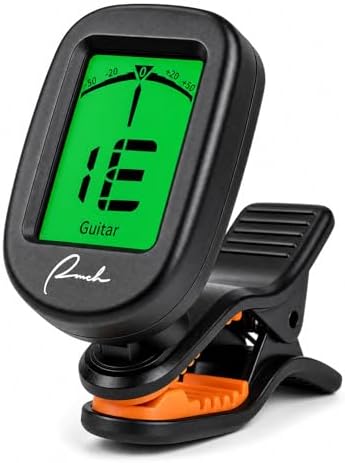
8. Ranch Clip-On Tuner
Best for: Musicians who perform in loud, chaotic environments.
This tuner uses a vibration-based sensor to ignore all the background noise that usually makes tuning difficult in a crowd. It locks onto the pitch in under a second and shows a green light when you’re perfectly in tune. The clip is spring-loaded and includes orange silicone padding to keep your ukulele safe from scratches.
It’s very compact, yet the screen is bright enough to read easily in low light. It covers all the standard modes you would expect, including ukulele and chromatic. Compared to the Fender FCT-2, this model is designed specifically to emphasize noise rejection in busy practice rooms.
Players who need a rechargeable device will find this less convenient, as it relies on a replaceable CR2032 battery.
Pros
- Excellent vibration-based noise rejection
- Fast locking speed that registers almost instantly.
- Protective silicone padding on the clip
- Clear, green-backlit LCD screen
Cons
- Requires CR2032 batteries, unlike the rechargeable Fender FCT-2.
Also Worth Considering
The D’Addario Eclipse Rechargeable Headstock Clip-On Guitar Tuner is a convenient, rechargeable version of their standard clip-on model.
The D’Addario Eclipse Headstock Clip-On Guitar Tuner is the basic battery-powered version of the Eclipse line. It’s less convenient than the Fender FCT-2, which offers more versatile instrument modes, but it’s a reliable option for players who don’t mind using disposable batteries.
The Fender FT-1 Guitar Tuner is a straightforward, chromatic tuner with dual-rotating hinges. It’s less specialized for ukulele than the Snark SN6X, which offers a more secure grip for that specific instrument’s headstock, but it’s a dependable, no-frills choice.
How We Chose
Each product had to feature a vibration-based sensor to ensure reliability in various environments. Tuners that lacked clear specifications for their tuning modes or display types were excluded to prioritize ease of use. The final list was selected based on how well each device balances its physical design with the needs of a ukulele player. Picks were chosen for specific advantages, such as rechargeable power, screen visibility, or grip security, to ensure every type of musician is served.
How to Choose the Best Ukulele Tuner
Power Source and Battery Life
Decide whether you prefer the convenience of a rechargeable battery or the reliability of a replaceable one. Rechargeable models like the LEKATO Rechargeable Tuner eliminate the need for battery replacements, while battery-powered options like the Fender FCT-2 allow you to simply swap in a fresh cell if you run out of power mid-gig.
Display Visibility and Size
Consider where you’ll be playing most often. If you perform in dark venues, a high-resolution color display like the one on the New Bee Color Tuner is essential. For those who prefer a clean look, compact models like the D’Addario Micro Rechargeable stay out of sight while still providing the necessary feedback.
Ease of Use and Extra Features
Think about whether you need a simple, streamlined device or a multi-function tool. The Donner DT-2 is perfect for beginners who want to tune and go, whereas the AROMA Digital Metronome is better for students who need to practice rhythm and pitch training alongside their tuning.
Frequently Asked Questions
Is it safe to leave a clip-on tuner on my headstock?
Yes, it’s generally safe as long as the tuner has protective padding. Models like the Ranch Clip-On Tuner include silicone padding specifically to prevent scratches on your instrument’s finish. Always remove the tuner if you’re storing your ukulele in a tight case to prevent any accidental pressure or damage.
How do I know if my tuner is accurate?
Most clip-on tuners use a piezo transducer to detect vibrations directly from the wood. The American National Standards Institute provides guidelines on measurement and calibration that help ensure these devices function correctly. A tuner that shows a clear, steady needle or color change is usually the most reliable way to confirm your pitch.
Can I use a guitar tuner for my ukulele?
Yes, you can use a guitar tuner as long as it has a chromatic mode. Chromatic tuners detect all twelve notes, allowing you to tune to any frequency. Many modern tuners, such as the Fender FCT-2, include a dedicated ukulele mode to make the process even faster by limiting the notes to those used on a ukulele.
How often should I calibrate my tuner?
Most tuners are factory-set to A440, which is the standard pitch for most music. Unless you’re playing with an older piano or a specific ensemble that uses a different reference pitch, you rarely need to change this setting. If your tuner allows for calibration, like the D’Addario Micro Rechargeable, only adjust it if you have a specific musical reason.
Why does my tuner jump around when I play?
Vibration-based tuners like the Ranch Clip-On Tuner work best when you play a clear, sustained note. These devices are designed to filter out ambient noise, but they can struggle if there is too much background interference or if you pluck the string too hard. Pluck the string gently to help the tuner lock onto the pitch.
What does the “Chromatic” mode actually do?
Chromatic mode allows the tuner to detect any of the twelve notes in the musical scale, rather than being limited to the four strings of a ukulele. This is useful if you want to experiment with alternate tunings or if you play other instruments like a mandolin or banjo. The Fender FCT-2 and Ranch Clip-On Tuner both include this mode for maximum flexibility.
Does the thickness of the headstock affect the tuner’s grip?
Yes, the thickness can impact how securely a tuner clips on. Models with a wide-opening, spring-loaded clip, such as the Snark SN6X, are designed to accommodate various headstock shapes and thicknesses. If you have an instrument with a particularly thin or thick headstock, look for a tuner with an adjustable or padded clamp to ensure it stays in place without slipping.
Can I use my tuner while the instrument is in a gig bag?
It isn’t recommended to leave any clip-on tuner attached while your instrument is inside a gig bag or hard case. The pressure from the bag’s fabric against the tuner can snap the hinge or damage the headstock finish. Always remove the tuner and store it in a dedicated pocket before putting your ukulele away.
Will a tuner with a built-in metronome affect my tuning accuracy?
No, the metronome and tuner functions work independently within devices like the AROMA Digital Metronome. The metronome simply provides a rhythmic pulse, while the piezo sensor focuses on the vibration of the strings to determine pitch. Using both at the same time can help you practice playing in time while staying perfectly in tune, without one feature interfering with the other.
Why is my tuner showing a different note than what I expect?
This often happens if the tuner is set to the wrong mode or if the string is significantly out of tune. Ensure your tuner is set to “Ukulele” or “Chromatic” mode. If you’re playing a C string but the tuner shows an A, your string may be tuned too low, and you should slowly tighten it while watching the screen until the correct note appears.
Are there any specific maintenance tips for rechargeable tuners?
To keep the battery healthy in models like the LEKATO Rechargeable Tuner or New Bee Color Tuner, avoid letting the battery drain completely to zero on a regular basis. Charge the device when you notice the battery indicator getting low. Additionally, keep the USB-C port free of dust and debris to ensure a solid connection every time you plug in the charging cable.
Final Thoughts

Choosing the right tool makes your daily practice much more enjoyable. Once you’ve picked your favorite, try keeping it clipped to your headstock so you’re always ready to play. You’ll find that staying in tune helps your ears develop faster, and you won’t have to worry about your sound drifting anymore.
As an Amazon Associate, Cleanestor earns from qualifying purchases at no additional cost to you.