
The Yamaha P225 is the best digital piano here because its listing includes 24 instrument voices, a weighted keyboard, and a sustain foot switch right in the box. It’s the one most buyers should start with. This guide helps anyone shopping for a digital piano who needs clear facts instead of marketing noise. What separates these picks is what comes in the box and how many sounds each one lists.
- Best Overall: Yamaha P225 — 24 voices, weighted keys, and a sustain pedal included.
- Best Upright Design: Yamaha Arius Series — Traditional cabinet with bench and three pedals.
- Most Portable: Yamaha P71 — Streamlined controls and ten voices for easy transport.
- Best Furniture Style: Donner DDP-80 — Wood finish with dual 25-watt speakers.
- Simplest to Use: Eastar EUP-100 — Beginner bundle with headphones and key stickers.
- Best for Beginners: Alesis Recital Play — Complete kit with stand, case, and lessons.
- Best Triple Pedal: UISCOM Home Digital Piano — Sustain, sostenuto, and soft pedals included.
- Weighted keys heavier in low, lighter in high
- Yamaha CFX Full Concert Grand Voice included
- 24 instrument Voices including pianos and organs
- Connects with Smart Pianist and Rec’n’Share apps

- Acoustic piano sound plus 9 other Voices
- Graded Hammer Standard keyboard with Touch Response
- Traditional upright design with wood grain finish
- Dual headphone jacks for solo or duet play

- Touch-sensitive weighted keys replicate acoustic feel
- 10 Voices including Yamaha grand piano sound
- Simple one-button operation for streamlined control
- Dual Mode blends two Voices together

- 88 key heavy hammer action keyboard simulates acoustic
- French DREAM sound source with 128 max polyphony
- 2x 25W speakers with stereo surround effect
- DDP-80 has wood finish, quick assembly required

- Eastar EUP-100 has 88-key weighted hammer action
- Dual Voice, Auto Chord, Transpose, Built-in Metronome
- Includes triple pedal, headphone and piano stickers
- Wood finish design also functions as a desk

- Portable lightweight keyboard with built-in speakers
- 88 full-size touch-sensitive piano-style keys
- 480 sounds, 160 rhythms, 140 built-in demo songs
- Split, Lesson and Record Modes with built-in metronome

- French Dream5704 sound chip with 8 distinct tones
- Dual-tone mode, recording and playback functionality
- MIDI capabilities to control external devices
- Integrated MP3 player via USB with volume knob
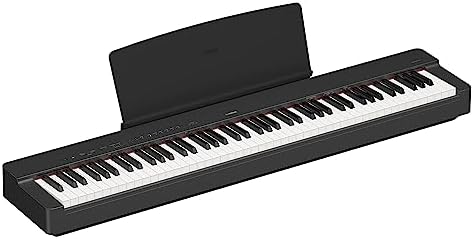
1. Yamaha P225 88-Key Digital Piano with Weighted Keys
Best for: Players wanting a complete portable piano setup.
The Yamaha P225 leads this list because it packs a full concert grand voice into a lightweight body. Its graded action means the low keys feel heavier than the high ones, matching what an acoustic piano does under your fingers. You don’t have to adjust your technique when switching between instruments. That matters if you’re practicing scales at home and then carrying it to a rehearsal space later the same day.
It ships with a music rest, a power adapter, and a sustain foot switch, so you can play right out of the box without hunting for missing parts. The 24 instrument voices cover pianos, organs, strings, and bass. Connecting to apps like Smart Pianist lets you change settings from a phone screen instead of memorizing button combinations on the panel itself.
Comparing the specs, the P225 offers 24 instrument voices against the 10 listed on the Yamaha P71, giving you far more tonal variety for different songs. If you want to record yourself playing, the Rec’n’Share app handles that too. It’s a setup built for someone who plays often and moves around.
Anyone needing a permanent living room centerpiece should look elsewhere, as this model’s portable design lacks the upright wooden cabinet found on other picks.
Pros
- Weighted keys are heavier in the low register and lighter in the high register.
- Includes the Yamaha CFX Full Concert Grand Voice.
- Ships with a music rest, sustain foot switch, and power adapter.
- Connects to Smart Pianist and Rec’n’Share apps.
- Lightweight build makes it easy to carry.
Cons
- the box lists keyboard, music rest, sustain foot switch, and power adapter, and not a stand, so that is a second purchase
2. Yamaha Arius Series 88-Key Weighted Action Upright Digital Piano
Best for: Homes needing a traditional upright piano look.
If you want something that stays in one place and looks like real furniture, the Yamaha Arius Series fits the job. Its traditional upright design features a wood grain finish that blends into a living room or study without standing out as electronic equipment. The three-pedal setup is built right into the base, so there’s nothing extra to wire up or position on the floor before you start playing.
The Graded Hammer Standard keyboard uses touch response to change the volume based on how hard you strike the keys. Ten voices are available, including a grand piano sound driven by a built-in stereo amplifier and speaker system. Dual headphone jacks let two people listen at once, which is useful for lessons or duets where both players need to hear the output clearly.
A bench comes in the box, saving you the trouble of finding one that matches the height of the keys. Alongside the hardware, you get a demo song for every built-in instrument sound and an equal number of piano preset songs to explore the tones immediately. The Yamaha Arius Series includes a matching bench, whereas the Yamaha P225 requires you to provide your own seating.
Pros
- Traditional upright design with a wood grain finish.
- Built-in three-pedal unit.
- Dual headphone jacks for solo or duo practice.
- Includes a matching bench.
- Graded Hammer Standard keyboard with Touch Response.
Cons
- The listing specifies 10 instrument voices against the 24 on the Yamaha P225, limiting tonal variety for players who want organs or strings.
3. YAMAHA P71 88-Key Weighted Action Digital Piano with Sustain Pedal
Best for: Musicians prioritizing simple controls and easy transport.
The Yamaha P71 strips away complex menus to focus entirely on playing, offering a single onboard instrument list rather than multiple pages of options. Its one-button operation means you turn it on and start making music without scrolling through screens or reading a manual first. A focused selection of unique voices is available, anchored by a Yamaha grand piano tone that delivers deep bass and dynamic sound across the full range of the keyboard.
The weighted action gives all 88 keys an acoustic feel, responding to how hard you press them. Dual Mode lets you layer two voices together, like blending piano and strings for a thicker sound during a performance. An included sustain pedal adds expression to your phrasing without requiring a separate purchase right away.
Because it’s designed for straightforward use, there aren’t extra buttons cluttering the top panel. It serves as a reliable practice tool that won’t distract you with features you might never touch. The Yamaha P71 relies on a smaller set of built-in instruments compared to the wider selection listed on the Eastar EUP-100.
Players who rely on app connectivity for lessons will find this model lacking, as the listing does not include wireless MIDI or smart device integration among its features.
Pros
- Simple one-button operation keeps the interface clean.
- Dual Mode allows blending two voices simultaneously.
- Weighted action across all 88 keys.
- Includes a sustain pedal.
- Touch-sensitive keys respond to playing dynamics.
Cons
- choose from 10 unique Voices, so anyone needing more sounds has to plan around this limit
4. Donner DDP-80 Digital Piano 88 Key Weighted Keyboard
Best for: Learners wanting a furniture-style piano with strong speakers.
The Donner DDP-80 looks like a piece of classic furniture thanks to its retro wood color finish. The environmentally friendly process leaves no odor, so you can set it up in a bedroom or office immediately. Assembly is quick, and once it’s together, it sits solidly in place without wobbling while you play heavy chords.
Under the hood, it uses an Advanced French DREAM sound source paired with 128 max polyphony. That number means you can hold down the sustain pedal through complex passages without earlier notes cutting off abruptly. Two stereo surround speakers deliver 2x 25W of maximum power, filling a room with sound without needing external amplification.
The 88-key heavy hammer action keyboard simulates the resistance of an acoustic grand piano. A triple pedal is included for nuanced control over sustain and softness. You can also connect it to teaching apps on a tablet or link it to music editing software on a PC via USB-MIDI.
Pros
- Retro wood finish acts as functional room furniture.
- Advanced French DREAM sound source with 128 max polyphony.
- Dual 25W speakers create a stereo surround effect.
- Triple pedal included for expressive playing.
- USB-MIDI connection supports apps and recording software.
Cons
- Input AC:100V-240V, and outside it this is the wrong buy
5. Eastar EUP-100 Digital Piano 88 Key Weighted Keyboard Full Size
Best for: New students needing every accessory in one box.
The Eastar EUP-100 arrives as a comprehensive bundle aimed directly at beginners. Inside the package, you’ll find a protective cover, headphones for quiet practice, piano stickers to help learn note positions, and a triple pedal system. Having all these items ready means you don’t spend your first week waiting for deliveries to complete your setup.
Its 88-key fully weighted hammer action keyboard mimics the responsive touch of a grand piano. Beyond basic playing, it includes features like Auto Chord, Transpose, and a built-in metronome to structure your practice sessions. Recording capability lets you capture your progress, while wireless MIDI connects to educational apps without cables tangling on your desk.
Thirteen immersive voices and 128 rhythms give you plenty of sonic variety to explore different genres. The practical desk design features a wood finish that doubles as a sophisticated centerpiece or even a functional desk when you aren’t playing. The manufacturer suggests two people work together to assemble it due to its substantial weight. The Eastar EUP-100 provides 13 voices, sitting between the 10 on the Yamaha P71 and the 24 on the Yamaha P225.
Experienced players looking for a minimalist interface might find the extensive rhythm and accompaniment features unnecessary for their daily routine.
Pros
- Bundle includes a cover, headphones, piano stickers, and a triple pedal.
- Wireless MIDI connects to educational apps easily.
- 13 voices, 128 rhythms, and 31 built-in songs.
- Functions as a practical desk when not in use.
- Features Auto Chord, Transpose, and recording capability.
Cons
- The manufacturer suggests two people work together to assemble it due to its substantial weight.
6. Alesis Recital Play 88-Key Piano Keyboard Bundle
Best for: Students starting lessons with a complete portable kit.
The Alesis Recital Play is built specifically for learning. It ships as a complete accessory bundle containing a keyboard stand with adjustable height, a sheet music and tablet stand, a sustain pedal, headphones, a carry case, and a power supply. You literally unpack it and start your first lesson without buying anything else to support the instrument.
Eighty-eight full-size, touch-sensitive keys help build finger strength and dexterity across all ages. The massive sound library holds 480 realistic sounds, adjustable reverb effects, and 160 rhythms for creating songs in various genres. Educational tools include Split, Lesson, and Record Modes, allowing a student and teacher to play side-by-side on the same keyboard.
A USB-MIDI connection plugs directly into a Mac or PC to run recording software or premium lessons from Skoove and Melodics. When you need to leave the house, you can power it via the included adapter or switch to 6 AA cell batteries for total portability. The Alesis Recital Play lists 480 sounds, vastly exceeding the 13 voices provided by the Eastar EUP-100.
Classical pianists requiring weighted hammer action will notice the difference immediately, as this model uses touch-sensitive piano-style keys instead of fully weighted ones.
Pros
- Bundle includes a stand, carry case, headphones, and sustain pedal.
- 480 sounds and 160 rhythms offer huge variety.
- Split, Lesson, and Record Modes aid structured learning.
- Runs on the included adapter or 6 AA batteries.
- USB-MIDI connects to computers and educational software.
Cons
- Battery operation requires 6 AA cells that aren’t included in the box, meaning you must buy them separately before playing away from an outlet.
7. UISCOM 88 Key Weighted Home Digital Piano
Best for: Players wanting dedicated sustain, sostenuto, and soft pedals.
The UISCOM Home Digital Piano centers its appeal around its custom-designed triple pedals. Unlike a single sustain switch, this setup offers distinct sustain, sostenuto, and soft pedal functionality. That level of control lets you articulate complex classical pieces exactly as written, adding layers of expression that simpler boards can’t achieve.
Sound generation relies on the French Dream5704 sound chip, driving 8 distinct tones and a library of 40 demo songs. You can customize your output using built-in reverb, chorus, and tempo settings. Dual-tone mode lets you blend sounds together, while the record and playback functions help you review your performances to spot areas for improvement.
Connectivity is handled through MIDI capabilities that adjust key sensitivity and control external devices like computers. For casual listening or backing tracks, the integrated MP3 player reads directly from a USB device, letting you pause and adjust volume with physical knobs. Dual headphone jacks allow private practice sessions without disturbing others in the room. The UISCOM Home Digital Piano offers 8 distinct tones, which is fewer than the complete set listed on the Yamaha Arius Series.
Musicians who need dozens of instrument variations for live gigs will find the selection of eight tones too narrow for professional stage work.
Pros
- Custom triple pedals provide sustain, sostenuto, and soft functions.
- Powered by the French Dream5704 sound chip.
- Integrated MP3 player reads directly from a USB device.
- Dual headphone jacks support private practice.
- Reverb, chorus, and tempo settings allow sound customization.
Cons
- The sound library contains 8 distinct tones against the 480 sounds on the Alesis Recital Play, severely limiting options for experimenting with different instruments.
Also Worth Considering
The YAMAHA P-143 Digital Piano is an 88-key weighted musical keyboard sold as a bundle that includes a stand, bench, music rest, and sustain foot switch. The Yamaha P225 beats it on sheer versatility, offering 24 instrument voices where the P-143’s title mentions none beyond being a weighted keyboard. Still, buyers who want a bench and stand delivered in the same shipment without searching for compatible accessories might prefer this bundled approach for a quick home setup.
How We Chose
Every selected product had to feature 88 keys to ensure a full playing range suitable for standard repertoire. Listings lacking clear details about what shipped in the box were passed over, as hidden requirements lead to frustrating second purchases. The final seven models were separated by their physical designs, ranging from portable slabs to wooden upright cabinets, and by their specific accessory bundles. Products targeting identical use cases with overlapping feature sets were narrowed down to the one offering the clearest specifications. This ensures each recommendation serves a distinct buyer profile, whether they need a travel-friendly keyboard or a permanent fixture for a living room.
How to Choose the Right Digital Piano
Where the piano will live
Decide if the instrument needs to move or stay put. Portable designs like the Yamaha P225 and Yamaha P71 slide into bags for rehearsals. Fixed wooden cabinets, such as the Donner DDP-80 and Eastar EUP-100, act as permanent furniture. Matching the physical footprint to your available space prevents clutter in smaller rooms.
What comes inside the box
Check the included accessories before buying. The Alesis Recital Play ships with a stand, bench, headphones, and a carry case. The Yamaha P225 includes a music rest and sustain switch. Knowing what’s missing saves you from discovering you need a separate stool after delivery arrives.
How many sounds you actually need
Voice counts vary wildly across these models. The Alesis Recital Play lists 480 sounds for broad experimentation. The UISCOM Home Digital Piano provides 8 distinct tones focused purely on core piano playing. More voices matter if you plan to compose across genres; fewer suit strict classical practice routines.
Pedal configuration for your repertoire
A single sustain switch works for pop songs and basic exercises. Classical training demands more nuance. The UISCOM Home Digital Piano and Donner DDP-80 include triple pedals offering sustain, sostenuto, and soft control. Your sheet music dictates which configuration you’ll eventually require to play accurately.
Frequently Asked Questions
Can I connect these pianos to a computer?
Yes, several models support direct computer connections. The Donner DDP-80 uses USB-MIDI to link with music editing software on a PC. The Alesis Recital Play also features a USB-MIDI connection for Mac or PC recording programs. The UISCOM Home Digital Piano includes MIDI capabilities to control external devices and computers.
Do any of these work without a wall outlet?
Battery power is rare among full-sized 88-key instruments. The Alesis Recital Play is the exception here, running on 6 AA cell batteries for outdoor or remote practice. The remaining models, including the Yamaha P225 and Donner DDP-80, rely exclusively on their included power adapters plugged into standard wall outlets.
Is a weighted keyboard necessary for beginners?
Weighted keys build proper finger strength early on. The Eastar EUP-100 and Donner DDP-80 both feature fully weighted hammer action keyboards designed to simulate acoustic grand pianos. The Alesis Recital Play uses touch-sensitive piano-style keys instead. Starting with weighted action prevents bad habits if you plan to transition to an acoustic instrument later.
How do I practice quietly at night?
Headphone jacks mute the internal speakers completely. The Yamaha Arius Series features dual headphone jacks for silent duets or teacher-student sessions. The Donner DDP-80 also includes a dedicated headphone mode. The Alesis Recital Play and Eastar EUP-100 ship with headphones directly in their respective bundles for immediate quiet practice.
Are the benches always included?
Not every listing provides seating. The Yamaha Arius Series includes a matching bench alongside its upright cabinet. The Alesis Recital Play bundle contains an adjustable keyboard stand but no dedicated seat. For slab-style models like the Yamaha P71, you’ll need to source your own bench or chair separately.
What does polyphony mean on a spec sheet?
Polyphony refers to how many notes the sound engine can produce simultaneously. The Donner DDP-80 lists 128 max polyphony, ensuring sustained chords don’t cut off earlier notes. The Eastar EUP-100 also features 128 polyphony. Higher numbers matter when playing complex classical pieces with the sustain pedal held down continuously.
Conclusion

For most people, the Yamaha P225 remains the strongest choice because its 24 voices, graded weighted keys, and included sustain switch cover nearly every need. If you just want everything delivered in one shipment without thinking about compatibility, the Alesis Recital Play hands you a stand, case, and lessons right out of the box. Pick the one that matches your space, and start playing today.
As an Amazon Associate, Cleanestor earns from qualifying purchases at no additional cost to you.