
The M-AUDIO Keystation 49 MK3 is the best midi piano here because its 49 full-size velocity-sensitive keys give you an extended playing surface. This guide helps anyone shopping for a controller to make music with a computer or tablet. The one thing that separates these picks is how many keys they have and what kind of extras come in the box, from drum pads to built-in batteries.
- Best Overall: M-AUDIO Keystation 49 MK3 — 49 full-size keys cover an extended range.
- Most Expressive Controls: Akai MPK Mini IV — Full-color screen plus eight push-and-turn knobs.
- Best Built-In Sounds: Kartier Piano MIDI Keyboard — Over 1,000 presets included right out of the box.
- Best Smart Features: PartyKeys 36-Key Smart Piano — Browser games and modular linking without software installs.
- Best Extended Range: Akai MPK Mini Plus — 37 keys and CV/Gate outputs for hardware synths.
- Best Compact: M-AUDIO Keystation Mini 32 — 32 mini keys fit easily inside a laptop bag.
- Best for Beginners: Donner DMK 25 Pro — 40 teaching courses and 16 smart scales included.
- Simplest to Use: Akai LPK25 — One USB cable powers everything with zero extra setup.

- 49 full-size velocity-sensitive keys
- Volume fader, transport buttons, pitch and modulation wheels
- Plug-and-play USB connection for Mac or PC
- Compact design fits desk, studio or stage

- USB-powered with 25 mini velocity-sensitive keys
- 8 assignable 360° knobs and full-color screen
- 8 velocity- and pressure-sensitive MPC pads
- Includes virtual suite with 1000+ sounds

- Learn and play 1,000+ melodies with exact presets
- Includes over 1,000 sounds and presets
- Desktop software and iOS/Android app included
- Fully customizable per-key LED lighting

- Works as an open MIDI instrument
- 36 keys with individually addressable RGB lighting
- Integrates with Anything Piano for interactive practice
- Supports up to three units as a 108-key layout

- 37-Key MPK Mini keybed for 3 full octaves
- Connect via CV/Gate and MIDI I/O
- Native Kontrol Standard (NKS) integration
- Select one of three Komplete 15 Select bundles
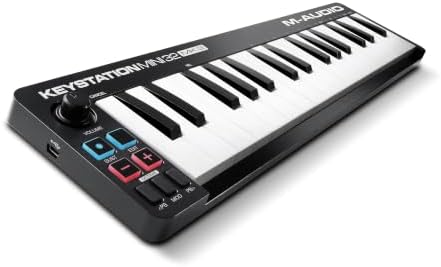
- Portable USB MIDI controller with 32 miniature keys
- Mini keys with selectable velocity curves
- Plug-and-play connection to Mac or PC
- Octave up and down buttons, volume knob

- Requires connection to DAW software for sound
- Smart dynamic scale mode with 16-scale tones
- Built-in arpeggio, note repeat, and chord functions
- Includes USB-C adapter for PC and mobile devices

- 25-key MIDI controller keyboard
- Dedicated octave up and down buttons
- Built-in arpeggiator and clock powered by USB
- 8 programmable preset slots for custom mappings
1. M-AUDIO Keystation 49 MK3 USB MIDI Controller
Best for: players needing a wide keyboard for two-handed parts.
Forty-nine full-size velocity-sensitive keys make this the roomiest controller on the list. That span lets you play bass lines with your left hand while reaching chords with your right, something the smaller models can’t handle comfortably. A volume fader, transport buttons, and pitch and modulation wheels sit above the keys so you don’t have to grab your mouse every time you want to tweak a sound.
Plug-and-play connection means it works with Mac and PC computers without installing drivers. The Kartier Piano listing states it connects to dedicated desktop software and iOS/Android apps for full access to interactive features. The included software bundle covers a lot of ground: MPC Beats, Ableton Live Lite, Velvet, XPand2, Mini Grand, and Touch Loops give you instruments and a recording environment right away. Free online lessons from Skoove and over 60 app-based lessons from Melodics help newer players get started.
Anyone who needs to toss their keyboard into a small backpack should skip this one, since 49 full-size keys take up real desk space. You’ll find 49 keys here against 37 on the Akai MPK Mini Plus, which offers more reach than a 25-key board but less footprint than this one.
Pros
- 49 full-size velocity-sensitive keys
- Volume fader, transport, and directional buttons included
- Pitch and modulation wheels built in
- Sustain pedal input available
- Software suite includes Ableton Live Lite and virtual instruments
Cons
- Requires an Apple to USB Camera Adapter (sold separately) for iOS connection, adding a second purchase for mobile users
- 49 keys demand more desk space than any other pick here
2. Akai Professional MPK Mini IV 25-Key USB-C MIDI Keyboard Controller
Best for: producers wanting hands-on control without touching a mouse.
A vibrant full-color screen and eight assignable 360° knobs put your software settings right under your fingers. Instead of clicking through menus, you turn a knob or push the encoder to change presets, adjust DAW functions, and navigate your session. Eight velocity- and pressure-sensitive MPC pads light up with RGB feedback so you can see your hits land in real time.
Twenty-five mini velocity-sensitive keys handle melodies and synth leads. The advanced performance tools include an arpeggiator with Pattern, Freeze, and Mutate functions, plus Chord and Scale modes to build ideas fast. Pre-mapped DAW integration covers Ableton Live Lite 12, Logic Pro, and FL Studio so you’re producing in under 15 minutes. USB-C connectivity over a USB 3.0 port and a full-size MIDI Out keep connections modern.
The included studio instrument collection packs over 1,000 sounds from AIR, Akai Pro, and Moog. A 30-day Melodics trial and two months of Splice samples round out the package. Beat makers who rely on long melodic runs will run out of room quickly with only 25 keys to work across. The Akai MPK Mini Plus offers 37 keys against the 25 listed here, giving those players three more octaves to stretch out on.
Pros
- 8 assignable 360° knobs with push/turn encoder
- Full-color display screen
- 8 RGB-lit MPC pads
- USB-C and full-size MIDI Out ports
- Arpeggiator with Pattern, Freeze, and Mutate functions
Cons
- The compact key count restricts two-handed playing styles
- Melodics access is a 30-day trial rather than a permanent license
3. Kartier Piano MIDI Keyboard
Best for: creators wanting instant sounds without loading external software.
Over 1,000 famous sounds and presets are included with this keyboard. You can play melodies and drums using the exact tones from popular songs right out of the box, remixing tracks or building original music without hunting through third-party sample libraries first. Dedicated desktop software and iOS/Android apps unlock interactive piano lessons, lighting customization, and freeplay modes.
Fully customizable per-key LED lighting shows you exactly which notes to press during lessons in real time. You can also change the colors to match your personal setup. Bluetooth and wired connections let you link to phones, tablets, or computers depending on where you’re working. The listing calls this a special limited release model designed by DJ Kartier, targeting collectors and serious producers alike.
Songwriters who prefer traditional unlit keys might find the illuminated layout distracting during late-night sessions. This model provides over 1,000 onboard presets, whereas the M-AUDIO Keystation 49 MK3 relies entirely on its included software bundle for sounds, making the Kartier the clear choice if you hate loading plugins.
Pros
- 1,000+ built-in sounds and presets
- Per-key LED lighting with lesson guidance
- Bluetooth and wired connection options
- Desktop and mobile apps included without subscriptions
- Customizable lighting effects
Cons
- Listed for iOS, Android and Desktop, so anyone on another platform has the wrong buy.
4. PartyKeys 36-Key Smart Piano
Best for: players wanting browser-based games and expandable key counts.
Thirty-six individually addressable RGB keys light up for chord guides, scale tools, and browser-based music games. You don’t need to install software or create a login to use the Game Center; just open a compatible browser and start playing. The open MIDI design means you aren’t locked into fixed onboard tones—you choose your own DAW or PartyStudio as your sound engine.
Measuring 16.6 x 5.5 x 1.3 inches, this 3-octave board fits tight desks and travel bags. A 2200mAh battery delivers up to 6 hours of use, letting you practice away from outlets. Bluetooth MIDI and USB-C connections cover both wireless and wired setups. Published MIDI and SysEx documentation supports custom lighting and visualizers, with code examples provided for JavaScript, Python, Node.js, and Swift.
The modular system aligns multiple units together through PartyStudio to build a 108-key layout, though the listing states additional keyboards and the software are sold separately. Anyone needing more than six hours of continuous play will have to stop and recharge before finishing longer sessions. You get 36 keys here against 49 on the M-AUDIO Keystation 49 MK3, so pianists used to a full-sized board will feel the shorter reach immediately.
Pros
- 36 individually addressable RGB keys
- 2200mAh battery rated for up to 6 hours
- Browser-based games require no installation or login
- Modular linking supports up to 108 keys
- Open MIDI and SysEx documentation with code examples
Cons
- Battery tops out at 6 hours, requiring a recharge for longer gigs
- Additional modules and PartyStudio software are sold separately to reach the 108-key maximum
5. Akai Professional MPK Mini Plus 37-Key USB MIDI Keyboard Controller
Best for: hardware synth owners needing CV/Gate and 37 keys.
Thirty-seven keys give you three full octaves of melodic range, sitting between the compact 25-key boards and the 49-key models. That extra width makes chord voicings and bass lines much easier to play without constantly hitting the octave shift buttons. A built-in 64-step sequencer holds one track for drums and another for melodies or chords, supporting polyphonic layers so you can compose without a computer running.
Advanced connectivity sets this apart: CV/Gate and MIDI I/O ports let you drive modular gear, sound modules, and hardware synthesizers directly. Native Kontrol Standard (NKS) integration means you can browse and control Native Instruments presets straight from the board, choosing from three curated Komplete 15 Select bundles covering Beats, Band, or Electronic sounds. Premium RGB MPC pads and assignable rotary knobs handle finger drumming and mixer automation.
Producers working strictly inside a laptop with no external gear won’t use the CV/Gate outputs at all. This model lists 37 keys against the 25 on the Akai MPK Mini IV, offering noticeably more room for two-handed playing while keeping the same pad and knob layout for beat production.
Pros
- 37-key bed spanning 3 full octaves
- CV/Gate and MIDI I/O for hardware gear
- Built-in 64-step sequencer
- NKS integration with Komplete 15 Select bundles
- RGB MPC pads and rotary knobs for hands-on control
Cons
- CV/Gate outputs go unused if you produce solely inside a computer
- 37 keys still fall short of the 49 offered by the M-AUDIO Keystation 49 MK3 for classical pieces
6. M-AUDIO Keystation Mini 32 MK3 USB MIDI Controller
Best for: travelers needing a lightweight controller for laptop production.
Thirty-two miniature piano-style velocity-sensitive keys pack into a highly portable frame designed specifically for Windows and Mac laptops. You can slide this into a bag alongside your computer without taking up much room. Selectable velocity curves let you match the response to traditional piano playing, synthesizer work, or key-based beat making, while pitch bend and modulation buttons add expression without bulky wheels.
Setup is immediate thanks to plug-and-play USB operation that requires no drivers or external power supply. Octave up and down buttons extend your range beyond the physical 32 keys when you need higher or lower notes. A volume knob handles level adjustments, and a sustain button adds phrasing capability without plugging in a pedal. Included software features MPC Beats for production, plus 60 interactive lessons from Melodics to build your skills.
Pianists accustomed to standard-width keys will need time to adjust their finger spacing to the miniature layout. This unit provides 32 mini keys against the smaller layout on the Akai LPK25, giving you nearly an extra octave of reach in a similarly compact footprint.
Pros
- 32 miniature velocity-sensitive keys
- Selectable velocity curves for different playing styles
- Plug-and-play USB with no drivers needed
- Pitch bend and modulation buttons included
- MPC Beats software and 60 Melodics lessons included
Cons
- Miniature keys require adjustment for players used to full-size layouts
- Lacks the dedicated drum pads found on the Akai MPK Mini IV for beat tapping
7. Donner USB-C MIDI Keyboard Controller
Best for: new producers learning arrangement basics step by step.
Forty beginner-to-advanced keyboard teaching courses are included to walk you through music arrangement essentials. Sixteen smart dynamic scale modes let you switch between genres instantly, making it easy to play bass lines, melodies, and leads without knowing complex music theory first. Real-time multi-mode controls feature arpeggio, note repeat, and chord functions so you can craft clips anywhere.
Four innovative wheels provide visual control with a light scale, letting you map them to the specific parameters you need for your session. Six transport controllers improve arrangement efficiency by handling playback and recording commands directly. The personalized touch bar handles pitch and modulation duties while glowing to simulate a stage feel. An OLED display keeps your settings visible at a glance.
The listing explicitly states this controller doesn’t produce sound on its own and must connect to a phone or computer’s DAW software to function. Four types of DAW software are provided, and it’s compatible with Cubase LE, Live, Logic Pro, ProTools, and Studio One. A USB-C adapter comes in the box, though the listing notes that users with Micro USB or Lightning interfaces need to purchase adapters separately. Shoppers expecting standalone piano tones will be disappointed, as this requires software to make any noise at all. The Donner model lists 40 teaching courses against the 60 app-based lessons bundled with the M-AUDIO Keystation Mini 32, so the M-AUDIO edges ahead purely on guided learning volume.
Pros
- 40 included keyboard-teaching courses
- 16 smart dynamic scale modes
- 4 innovative wheels with light scale mapping
- OLED display for settings visibility
- Arpeggio, note repeat, and chord functions
Cons
- Produces no sound independently, requiring a connected device and DAW software to function
- Users with Micro USB or Lightning ports must buy separate adapters despite the included USB-C one
8. Akai Professional LPK25 25-Key USB MIDI Keyboard Controller
Best for: songwriters wanting the simplest possible setup process.
Twenty-five responsive mini keys deliver dynamics and feel for composing melodies, bass lines, and jamming out ideas. A built-in arpeggiator and clock give you creative control over software instruments and USB-enabled modular gear using just one USB cable. Dedicated octave up and down buttons transpose your entire range instantly, while a sustain button adds expression without plugging in extra hardware.
Eight programmable preset slots let you save and recall custom mappings for your favorite DAWs and virtual instruments. You create, edit, and manage these presets from your computer so your workflow stays consistent across sessions. Plug-and-play compatibility covers Mac and PC systems with USB power, meaning there’s nothing to configure before you start writing. Universal application support includes GarageBand, Logic, Studio One, Cubase, Ableton Live, ProTools, FL Studio, Digital Performer, and Adobe Audition.
The sleek design fits neatly alongside existing studio equipment without crowding your workspace. Players who need drum pads for finger-tapping beats won’t find any on this streamlined board. This model features programmable preset slots against the zero mentioned in the M-AUDIO Keystation Mini 32’s listing, giving you faster recall for mapped software instruments.
Pros
- Responsive mini keys for portable play
- Built-in arpeggiator and clock
- Programmable preset slots for quick recall
- Single USB cable for power and data
- Works universally with major DAW applications
Cons
- The smaller keyboard restricts wide chord voicings compared to the 37 on the Akai MPK Mini Plus
Also Worth Considering
Akai Professional Compact Keyboard Controller This is the MPK Mini MK3, a portable USB MIDI controller from Akai Professional. The Akai MPK Mini IV on our main list beats it by adding a full-color screen, USB-C connectivity, and an expanded studio instrument collection. Buyers who already own older Akai software or simply prefer the previous generation’s layout might still seek this specific MK3 version out.
Donner N-25 Mini MIDI Keyboard The Donner N-25 is a 25-key mini MIDI controller aimed at beginners, featuring velocity-sensitive keys, a light-up rocker, music production software, and 40 teaching courses. The Donner DMK 25 Pro earns the spot on our main list instead because it adds an OLED display, four innovative wheels, and 16 smart scale modes. Those who only need the basic 25-key layout and the light-up rocker feature may still prefer this simpler N-25 model.
How We Chose
The final picks are separated by distinct physical attributes: an extended keybed, the most assignable knobs, built-in sounds, battery-powered modularity, hardware CV outputs, and dedicated teaching courses. Every selected listing clearly defines what comes in the box and what the buyer still needs to add, ensuring the differences between models are obvious from the seller’s own descriptions.
How to Choose the Right MIDI Piano
Key count and physical size
Decide how much desk space you have and how far your hands need to reach. Forty-nine full-size keys, like those on the M-AUDIO Keystation 49 MK3, suit two-handed playing. Twenty-five mini keys, seen on the Akai LPK25, fit inside a backpack. Thirty-seven keys on the Akai MPK Mini Plus split the difference for traveling producers.
Pads, knobs, and screens
If you program drums or tweak synthesizer parameters, look for dedicated hardware controls. The Akai MPK Mini IV lists 360° knobs and RGB pads alongside a full-color screen. The Donner DMK 25 Pro uses four wheels instead. Models without these, like the M-AUDIO Keystation Mini 32, rely entirely on your computer mouse.
What comes in the box
Check whether the listing includes the software you actually need. The M-AUDIO Keystation 49 MK3 bundles Ableton Live Lite and several virtual instruments. The Kartier Piano MIDI Keyboard provides over 1,000 built-in sounds and apps without a subscription. Others require you to load your own digital audio workstation before making any noise.
Power and connection types
Determine if you’ll play at a desk or away from outlets. USB power is standard across the Akai LPK25 and M-AUDIO boards. The PartyKeys 36-Key Smart Piano lists a 2200mAh battery for up to 6 hours of untethered use. If you own hardware synthesizers, the Akai MPK Mini Plus provides CV/Gate and standard MIDI ports.
Frequently Asked Questions
Can I use these keyboards without a computer?
Most controllers here require a computer or mobile device running software to produce sound. The Donner DMK 25 Pro listing explicitly states it makes no sound on its own. The Kartier Piano MIDI Keyboard is the exception, packing over 1,000 built-in presets. The Akai MPK Mini Plus can sequence external hardware via CV/Gate without a laptop.
Do I need to install drivers for these to work?
No, most of these use plug-and-play USB connections. The M-AUDIO Keystation 49 MK3 and M-AUDIO Keystation Mini 32 both state that no drivers are required for Mac or PC. The Akai LPK25 confirms effortless setup via USB power alone.
Are mini keys hard to play for beginners?
Mini keys require tighter finger placement than full-size ones. The M-AUDIO Keystation 49 MK3 uses full-size keys for a natural feel. Boards like the Akai LPK25 and Donner DMK 25 Pro use mini keys to stay portable. Beginners focusing on beat production often adapt quickly, while those studying classical technique usually prefer full-size layouts.
What software do I need to record music?
You need a digital audio workstation (DAW). Several picks include one: the M-AUDIO Keystation 49 MK3 bundles Ableton Live Lite, and the Donner DMK 25 Pro provides four DAW options including Cubase LE. The Akai MPK Mini IV lists pre-mapped integration for Ableton Live Lite 12, Logic Pro, and FL Studio.
How do I connect these to an iPad or iPhone?
Connection methods vary by model. The M-AUDIO Keystation 49 MK3 works with iOS devices but requires an Apple to USB Camera Adapter, which the listing notes is sold separately. The PartyKeys 36-Key Smart Piano supports Bluetooth MIDI for wireless tablet pairing. The Donner DMK 25 Pro includes a USB-C adapter for mobile devices.
Is a sustain pedal included with these controllers?
None of the listings mention a sustain pedal inside the box. The M-AUDIO Keystation 49 MK3 features a sustain pedal input so you can plug one in later, while the Akai LPK25 and M-AUDIO Keystation Mini 32 offer a sustain button on the board itself to mimic that effect without extra hardware.
Conclusion

Picking the right controller changes how you feel when you sit down to make music. Don’t overthink it—just plug your new gear in, open your favorite software, and start playing. You’ll figure out what works for you once your fingers hit the keys.
As an Amazon Associate, Cleanestor earns from qualifying purchases at no additional cost to you.