
The Thomastik-Infeld Dominant set is the best choice of violin strings for most players because of its balanced, reliable synthetic core that has become a reference standard for musicians worldwide.
Quick Picks
- Best Overall: Thomastik-Infeld Dominant — The industry standard for a balanced, clear, and reliable tone.
- Most Responsive: Pirastro Evah Pirazzi — Engineered for immediate, precise bow response across all dynamics.
- Best for Advanced Players: Thomastik-Infeld Dominant Pro — A powerful, modern synthetic set designed for soloists and chamber musicians.
- Widest Tonal Range: Thomastik-Infeld Peter Infeld — Features a unique platinum E-string for exceptional projection and complexity.
- Best for Electric Violins: D’Addario Helicore — Multi-stranded steel core provides the stability needed for amplified instruments.
- Best for Developing Students: D’Addario Ascente — Synthetic core construction helps students achieve a more sophisticated sound quickly.
- Best for Beginners: D’Addario Prelude — Solid steel core offers maximum durability and consistent tuning for new learners.
- Most Consistent Projection: Thomastik-Infeld Rondo Gold — Professional set offering intense, warm sound with two E-string options.
- Best Hybrid Set: Vio JSI Special — Combines professional-grade E and A strings with standard synthetic D and G.
- Clear and balanced tone
- Available in 4/4 to 1/16 sizes
- Flexible multi-strand synthetic core
- Tuning stability and long lifespan

- Powerful and easy to play
- Designed for DP100 set
- Immediate bow response
- Flexible multi-strand synthetic core
- Wide tonal range
- Synthetic core for tuning stability
- Quick and precise bow response
- Includes PI01PT platinum-plated E-string

- Versatile stranded-steel core strings
- Multi-stranded steel core construction
- Fits 4/4 scale 13 inches (328mm) violin
- Sealed pouches protect against corrosion

- Consistent performance
- Synthetic core for tonal range
- Tuning stability

- Quick bow response
- Solid steel core construction
- Sealed pouches prevent corrosion
- Warm tone for students
- High tonal intensity and range
- Easy playability for professionals
- Includes tin-plated and gold-plated E strings
- Warm and shiny sound
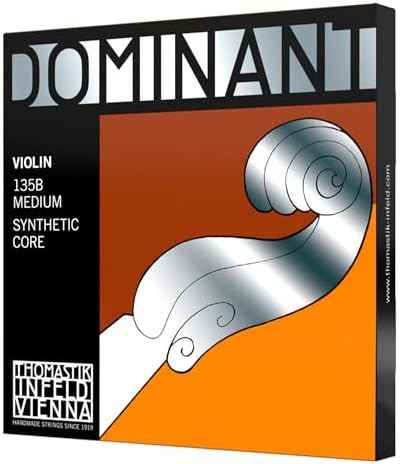
1. Thomastik-Infeld Dominant Violin String Set
Recommended Violin Buying Guides:
Best for: Musicians wanting a versatile, balanced, and proven sound.
These strings are the standard for a reason, offering a synthetic core that mimics the warmth of gut strings while maintaining better tuning stability. They respond quickly to the bow, which makes them comfortable for both beginners and seasoned professionals. If you need a reliable, clear tone that works well in almost any musical setting, these are a safe and effective choice.
The Dominant series is available in 4/4 full size down to 1/16 size. This makes them the go-to for students as they grow into larger violins. The listing doesn’t mention the specific tonal character of the Dominant strings beyond a clear, rich, well-balanced tone.
Pros
- Synthetic multi-strand core design.
- Excellent tuning stability and longevity.
- Available in many fractional sizes.
- Warm, gut-like tonal quality.
Cons
- 4/4 to 1/16 size range is specific, so players needing custom lengths for non-standard violins must look elsewhere.
2. Pirastro Evah Pirazzi 4/4 Violin String Set

Best for: Soloists who need intense, immediate bow response.
This set is built for players who demand high performance and responsiveness from their instrument. They’re known for reacting instantly to the bow, allowing you to shape phrasing and dynamics with great ease. The inclusion of a gold-plated E-string adds a layer of brilliance that helps a violin project in large concert halls.
Pros
- Gold-plated E-string included.
- Highly responsive to bow pressure.
- Designed for professional-level projection.
Cons
- Professional-focused responsiveness can be challenging for those still learning basic bow technique.
3. Thomastik-Infeld Dominant Pro Violin Strings DP100
Best for: Chamber and orchestral musicians needing modern power.
These strings represent a modern evolution of the classic Dominant brand. They’re designed to offer a broader range of sound colors and a more powerful, room-filling projection. Because they react effortlessly to the bow, they’re well-suited for advanced players who need to switch quickly between soft, nuanced passages and loud, brilliant fortissimo sections.
When you look at the DP100 set against the standard Thomastik-Infeld Dominant, the Pro version offers a more focused core sound with extra brilliance. It’s a sophisticated set for those who have already mastered their technique and want to expand their tonal palette. Anyone who prefers a darker, simpler sound might find these too complex or bright for their specific violin’s natural voice.
Pros
- Powerful, room-filling sound projection.
- Excellent for dynamic phrasing.
- Stable even in changing humidity.
- Modern multi-strand synthetic construction.
Cons
- Sophisticated tonal palette may be unnecessary for those who prefer the simpler, traditional sound of the original Dominant.
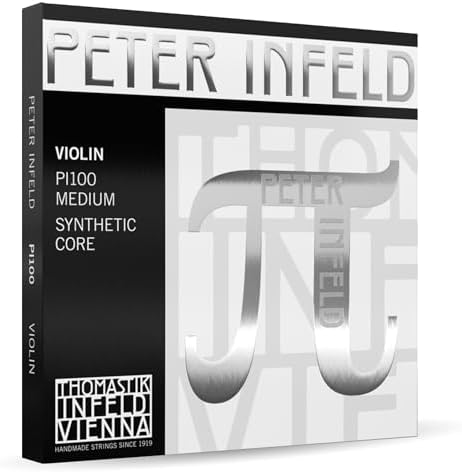
4. Thomastik-Infeld Peter Infeld Violin String Set
Best for: Experienced violinists seeking elegance and tonal complexity.
The Peter Infeld set is crafted to provide a mix of power and elegance. Its standout feature is the platinum-plated E-string, which adds a distinct brilliance and projection that helps the entire set sound more complex. These strings are built for performance, offering a fast break-in time and high stability during long sessions.
These strings provide a wider array of sound colors compared to the D’Addario Prelude, which prioritizes durability and warmth over tonal complexity. The PI100 set is designed for players who want to express every nuance of their performance. If your violin is already naturally very bright or aggressive in its tone, the added brilliance of the platinum E-string might be too much for your setup.
Pros
- Unique platinum-plated E-string.
- Fast break-in period.
- Exceptional tuning stability.
- Wide range of sound colors.
Cons
- Platinum E-string adds a level of brightness that may not suit already sharp-sounding instruments.
5. D’Addario Helicore Violin Strings Set H310 4/4M
Best for: Players using electric violins or those needing steel-core stability.
Helicore strings use a multi-stranded steel core that makes them incredibly versatile. They’re a top choice for electric violins because the steel core handles amplification well, providing a clear and warm tone without the unwanted feedback that can sometimes occur with other materials. The listing doesn’t mention X.
At 13 inches (328mm), these are specifically scaled for 4/4 violins. This makes them a perfect fit for that size, but they aren’t meant for players with fractional instruments who need a different playing length. If you’re looking for the natural, gut-like warmth found in the Thomastik-Infeld Dominant, you should know that the steel construction of the Helicore provides a different, more focused feel under the fingers.
Pros
- Multi-stranded steel core construction.
- Excellent for electric and amplified playing.
- Sealed packaging prevents corrosion.
- Quick bow response.
Cons
- Steel core feel is distinct from synthetic strings, which may not suit players used to a gut-like texture.
6. D’Addario Ascente Violin Strings
Best for: Developing students ready for a more sophisticated sound.
The Ascente set is designed to bridge the gap between beginner strings and professional sets. They use a synthetic core to provide a wider tonal palette than solid steel, which helps students learn to hear and produce more nuanced sounds. Ascente strings offer excellent pitch stability.
Compared to the D’Addario Prelude, which is a solid steel string, the Ascente provides a more complex sound that elevates a student’s practice. It’s a great step up for someone who has outgrown their first set of strings but isn’t yet ready for a top-tier professional set. Anyone who needs the maximum durability of a solid steel core might find the synthetic construction of these strings slightly more delicate.
Pros
- Synthetic core for better tone.
- Superior tuning stability.
- Designed to help students advance.
- Elegant sound palette.
Cons
- Synthetic core is inherently less durable than the solid steel found in the D’Addario Prelude.
7. D’Addario Prelude Violin String Set
Best for: New students who need a durable, reliable set.
These strings are the educator’s choice because they’re built to last and are very forgiving. The solid steel core makes them almost immune to changes in temperature and humidity, which is vital for students who might leave their instruments in varying environments. They offer a warm sound that’s consistent and easy to produce, helping beginners build confidence.
While the Prelude is the warmest solid steel option available, it lacks the tonal complexity of the Thomastik-Infeld Dominant. It’s a workhorse string that favors consistency over the nuanced sound colors required by soloists. Anyone who is looking for the sensitive, gut-like response of a professional synthetic string will find the solid steel construction here to be quite different.
Pros
- Solid steel core for durability.
- Unaffected by humidity and temperature.
- Ideal for beginners and students.
- Consistent and warm sound.
Cons
- Solid steel construction rules out the complex, shifting tonal colors found in synthetic sets like the Dominant.
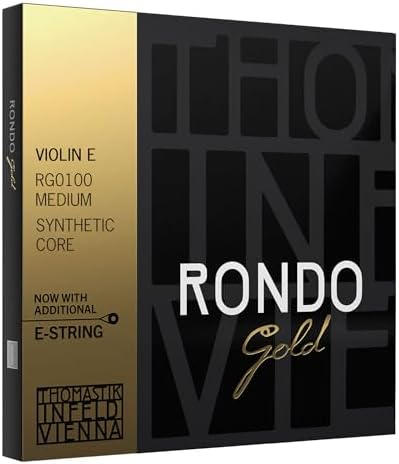
8. Thomastik-Infeld Rondo Gold Violin Set with 2 E Strings RG100
Best for: Professionals who want intense sound and consistent projection.
The Rondo Gold set is a high-performance option that offers a unique intensity of sound. It comes with two different E-string options—one tin-plated and one gold-plated—giving the player a choice in how their instrument projects. This set offers a warm and shiny sound and focussed response.
This set offers a more intense dynamic range compared to the D’Addario Ascente, which is meant for developing students. The Rondo Gold is built for musicians who have already refined their bowing technique and need a string that can handle demanding professional performance. This one isn’t meant for beginners, as the high level of tonal intensity can be difficult to manage without advanced bow control.
Pros
- Includes two different E-string types.
- Warm and shiny sound character.
- Focused bow response.
- High-intensity dynamic range.
Cons
- Having multiple choices for the highest-pitched string is a luxury for professionals, but it may represent an unnecessary complexity for students.
9. JSI Special 4/4 Violin String Set

Best for: Players who want a professional E-string on a standard set.
The JSI Special is a hybrid set that mixes a high-quality gold label E-string with the reliable Dominant A, D, and G strings. This is a common strategy for players who want the brilliance of a professional E-string without replacing their entire setup with a full professional-grade set.
This set pairs a professional E-string with the Dominant A, D, and G strings, which are the same as those found in the Thomastik-Infeld Dominant. It’s a specialized, pre-packaged hybrid that saves you the trouble of buying strings individually. Anyone who needs a perfectly matched professional-level set across all four strings might find this mix less balanced than a dedicated professional set like the Peter Infeld.
Pros
- Includes a professional-grade gold label E-string.
- Uses reliable Dominant synthetic core strings for A, D, and G.
- Convenient pre-packaged hybrid set.
Cons
- Hybrid nature means the E-string’s character may not perfectly match the tension or tonal profile of the other three strings.
Also Worth Considering
You might consider this if you only need a quick, temporary fix for a secondary violin.
The jiaoguo Steel Size Violin Strings are a bulk pack of stainless steel strings. They’re significantly less sophisticated in their construction than the D’Addario Helicore, which also uses steel but features advanced winding technology for better playability. These are best for someone who needs to keep multiple student instruments strung with basic, functional steel strings.
How We Chose
Thirty Amazon listings were compared on material, intended skill level, and core construction, and near-duplicates were left out. Each string set had to state its core material—whether synthetic, solid steel, or multi-stranded steel—to be included in this selection.
How to Choose the Right Violin Strings
Core material and sound
The core material dictates the basic personality of the string. Solid steel, like that in the D’Addario Prelude, is durable and bright. Synthetic cores, such as those in the Thomastik-Infeld Dominant, offer a warmer, more complex sound that mimics gut strings. Multi-stranded steel, found in the D’Addario Helicore, provides a balance of warmth and stability for amplified playing.
Skill level and playability
Beginners benefit from strings that are forgiving and stay in tune, such as the D’Addario Prelude or Ascente. Advanced players often choose strings like the Thomastik-Infeld Peter Infeld or Rondo Gold, which offer nuanced sound colors but require more precise bowing technique to control. Always match the string’s intended performance level to your current playing ability.
Size and instrument type
Strings must be sized to fit your violin. While most professional sets are designed for full-sized instruments, sets like the Thomastik-Infeld Dominant are available in fractional sizes for younger students. If you play an electric violin, prioritize steel-core strings like the Helicore to ensure the best performance with your pickup system. Musicians should consult the American String Teachers Association for professional guidance on string maintenance and instrument care.
Related guides
Frequently Asked Questions
How often should I change my violin strings?
If you notice the tone has become dull, or if the winding begins to unravel, it’s time for a new set. Professional musicians often change them more frequently to maintain optimal performance.
Can I mix and match different brands of strings?
Yes, many players mix and match to customize the sound of their violin. For example, using a brighter E-string from one set with a warmer A, D, or G string from another is common. The Vio JSI Special is a pre-packaged example of this type of hybrid approach.
Do synthetic strings break in quickly?
Synthetic strings, such as the Thomastik-Infeld Peter Infeld, generally require a short break-in period to reach their full tonal potential and tuning stability. This usually takes a few days of regular playing. Solid steel strings, like the D’Addario Prelude, are generally stable almost immediately after installation.
What is the difference between ball-end and loop-end strings?
Ball-end strings have a small metal ball at the end that secures the string to the fine tuner or tailpiece. Loop-end strings have a small loop that attaches to a hook on the fine tuner. The Pirastro Evah Pirazzi set includes a ball-end gold-plated E string.
Are more expensive strings always better?
Professional sets like the Thomastik-Infeld Rondo Gold use premium materials like gold or platinum plating, which provide specific tonal benefits. Choose the string that best complements your violin’s natural voice and your own playing style.
Final Thoughts

The Thomastik-Infeld Dominant remains the most reliable choice for the vast majority of violinists due to its balanced synthetic core. If you’re a student or a beginner, the D’Addario Prelude is a simpler, more durable alternative that will keep you playing without worry.
As an Amazon Associate, Cleanestor earns from qualifying purchases at no additional cost to you.