
Finding the best violin for beginners means choosing an instrument that encourages practice through comfort and reliable tuning. The Kmise 4/4 Acoustic Violin features a spruce top, maple back, and a starter accessory kit.
This guide helps you navigate the options based on your specific learning needs.
Quick Picks
- Best Overall: Kmise 4/4 Acoustic Violin — Delivers a balanced, clear tone with a complete starter accessory kit.
- Best for Learning Finger Placement: Eastar 3/4 Student Violin — Features inlaid fingerboard points to help players find notes quickly.
- Best Ready-to-Play Kit: PHOENIX 4/4 Violin Kit — Comes with a pre-installed bridge and pre-rosined bow for immediate use.
- Best Traditional Craftsmanship: SYLVATA 4/4 Starter Violin — Focuses on precise hand-carved details and professional-grade varnish aesthetics.
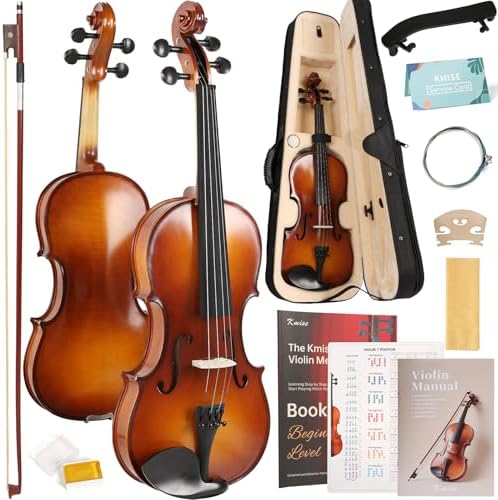
- 4/4 full size violin
- Smooth ebony fingerboard
- Ebony pegs and 4 fine tuners
- Designed for teens and adults

- Inlaid Muscovite fingerboard points
- Spruce top and maple back
- Handmade with embedded black line
- Wood tuning knobs

- 4/4 full-size spruce and maple
- Pre-installed bridge and rosined bow
- Responsive strings for beginners
- Includes case and starter accessories

- Spruce and maple body
- Hand-fitted ebony parts
- Pre-adjusted bridge and strings
- Optimized bridge height and string distance
1. Kmise Violin 4/4 Full Size Starter Kit
Best for: Beginners and adult students seeking a well-rounded starter set.
This violin focuses on sound and tuning stability. The combination of a solid spruce top and maple back and sides is a classic pairing meant to produce a balanced tone, which is vital for a student to hear their notes clearly while learning.
Compared to the PHOENIX full-size violin kit, this model provides a broader range of maintenance accessories, including a cleaning cloth, whereas the PHOENIX focuses more on pre-installation of components like the bridge.
Pros
- Solid spruce top for balanced sound
- Four fine tuners for easier tuning
- Includes shoulder rest and fingering chart
- Ebony fingerboard for durability
Cons
- Requires manual bridge installation, so the initial setup takes more time than pre-fitted models.
2. Eastar 3/4 Student Violin
Best for: Younger players or those who specifically need visual help with finger positions.
The standout feature here is the use of Muscovite fingerboard points. These inlays act as a visual map, helping beginners train their ear and muscle memory.
At 3/4 size, this instrument is smaller than the adult-sized models like the SYLVATA Starter Violin, making it the right pick for anyone who finds a full-size violin too physically demanding to hold comfortably.
Pros
- Inlaid fingerboard points for note location
- Four integrated fine-tuning tuners
- Includes two bridges for backup
- Reliable customer support included
Cons
- The 3/4 size is smaller than standard adult instruments, which limits its use for players who have outgrown this specific scale.
3. PHOENIX Violin 4/4 Full Size Kit
Best for: Anyone who wants to open a case and start playing without complex assembly.
The inclusion of a clip-on tuner and a mute makes it a practical choice for home practice.
Pros
- Bridge is pre-installed for immediate use
- Includes a clip-on tuner for accuracy
- Comes with a mute for quiet practice
- Extra E string included
Cons
- The kit doesn’t include a dedicated fingering chart, which some beginners might miss during their first weeks of study.
4. SYLVATA Violin 4/4 Full Size Starter Kit
Best for: Students who appreciate a traditional aesthetic and precise, hand-crafted details.
This violin emphasizes structural quality. The attention to detail extends to the hand-fitted ebony parts and the precise carving of the F-holes, which are meant to provide a stable, beautiful resonance.
Pros
- Tiger-striped varnish for a classic look
- Ebony fingerboard, pegs, and tailpiece
- Bridge height optimized for easier string pressing
- Includes a setup demonstration video
Cons
- The bridge requires basic final adjustment upon arrival, which is a step some might find intimidating compared to a fully pre-installed bridge.
How We Chose
9 Amazon listings were compared on material quality, accessory completeness, and ease of initial setup, and near-duplicates were left out. To earn a place, an instrument had to feature a spruce top, which is a standard material for producing resonant sound in student-level instruments.
How to Choose the Right Violin
Material and Construction
Look for a solid spruce top, as this wood is known for its ability to vibrate well and create a clear tone. Maple is used for the back and sides for stability. Ebony fingerboards are durable and resist wear.
What Comes in the Box
A complete starter kit should include a bow, rosin, a sturdy case, and a shoulder rest. Check if the bridge is pre-installed.
Size and Fit
Violins come in different sizes, and choosing the right one is crucial for your comfort and posture. A 4/4 size is standard for adults, while students may need smaller sizes.
Frequently Asked Questions
How do I know if the violin is the right size?
Measure from the base of your neck to the center of your palm with your arm fully extended. You can verify the sizing requirements for your specific arm length through the American String Teachers Association guidelines, which help ensure the instrument fits your reach.
Is it hard to install the bridge myself?
It requires care. The bridge is held in place by the tension of the strings. Most kits include setup instructions or video links. Ensure the bridge is centered so strings align with the fingerboard.
How often should I apply rosin to the bow?
Apply rosin whenever the bow stops gripping the strings. New bows require rubbing the rosin block until a fine powder appears. A few swipes before practice are usually sufficient.
Do I really need a shoulder rest?
A shoulder rest helps maintain proper violin height and angle without neck strain. Most kits include one to get you started.
How do I keep the violin from going out of tune?
Temperature and humidity changes cause the wood to expand or contract. Fine tuners make small pitch adjustments easy.
The Kmise 4/4 Acoustic Violin is a complete set that covers every need from day one. Start by measuring your reach to confirm the size, then choose your kit.
Why does the violin sound scratchy when I play?
The scratchy sound is common for beginners and is usually caused by the bow hair not having enough rosin or by applying too much pressure on the strings. If the hair is too smooth, it will slide over the string without gripping it. Ensure you have applied enough rosin to the bow, as noted for the PHOENIX 4/4 Violin Kit, and try using a consistent bow stroke.
Can I replace the strings myself?
Yes, you can replace the strings, but it’s best to change them one at a time to keep the bridge and soundpost in place.
What is the purpose of the mute?
A mute is a small device, often made of rubber or wood, that attaches to the bridge to dampen the vibrations of the strings. It reduces the overall volume of the instrument, making it ideal for late-night practice sessions when you want to avoid disturbing others.
How should I store my violin to keep it safe?
Always store your violin in its hard case when you aren’t playing it. Keep the case away from direct sunlight, heaters, or air conditioning vents.
Does the wood type affect the sound quality?
Yes, the wood type is a major factor in the instrument’s resonance. Maple back and sides provide a denser structure that reflects the sound, creating the balanced tone required for student practice.
Is a 4/4 violin the same as a full-size violin?
Yes, 4/4 is the technical term for a full-size violin. Any student who is tall enough to reach the scroll comfortably without straining their arm should use a 4/4 model. If you’re unsure about your size, you can measure your arm length; if it’s shorter than the requirement for a 4/4, you might need a 3/4 size like the Eastar 3/4 Student Violin.
How often should I clean the instrument?
You should wipe the body of the violin and the strings with a soft, clean cloth after every practice session to remove rosin dust and skin oils. Rosin dust can accumulate on the top of the instrument and potentially damage the varnish.
What should I do if a peg keeps slipping?
If a peg slips, it means there isn’t enough friction between the peg and the peg box. First, try pushing the peg firmly into the hole while turning it to lock it in place. If it continues to slip, you may need a small amount of peg compound, which is a specialized wax, to increase the friction. Don’t use standard candle wax or oil, as these can make the problem worse.
Can I play this violin in an orchestra?
Yes, all the models listed are suitable for school or community orchestra use. They’re designed to produce a clear, balanced tone that fits in with a group setting.
Is the shoulder rest mandatory for all players?
While not strictly mandatory, the shoulder rest is essential for developing proper posture. It prevents the violin from sliding off your shoulder and allows you to hold the instrument at the correct angle without using your left hand to support it. This freedom is necessary for moving your hand up and down the neck to play different notes accurately.
How do I know when the bow hair needs replacing?
Bow hair loses its ability to hold rosin and grip the strings. If you notice that you need to apply excessive amounts of rosin and the sound remains thin or “airy,” it’s likely time to have the bow re-haired. This is a standard maintenance task for any string player that can be performed by a professional luthier.
Are the fingerboard stickers permanent?
No, the fingerboard stickers included with kits like the PHOENIX 4/4 Violin Kit and the SYLVATA 4/4 Starter Violin are designed to be temporary. They’re meant to help you learn the note positions during your first few months of study. Once you have developed the muscle memory to find the notes without them, you can easily peel them off without leaving a residue on the ebony fingerboard.
What is the function of the fine tuners?
Fine tuners are small metal screws located on the tailpiece that allow for very precise adjustments to the pitch of each string. They’re much easier for beginners to use than the wooden pegs, which require a delicate touch to avoid over-tightening. All the models featured here, including the Eastar 3/4 Student Violin, include four integrated fine tuners.
Can I use the same rosin for all types of bows?
Yes, the rosin included in these kits is generally universal for violin bows. It’s designed to provide the right amount of friction for the horsehair. If you find that your bow isn’t producing a sound, ensure you have applied enough rosin to the entire length of the hair, from the frog to the tip.
Should I loosen the bow hair after playing?
Yes, you should always loosen the bow hair by turning the screw at the end of the frog after you finish playing. Leaving the bow under tension for long periods can stretch the hair, making it less effective for future practice sessions. Ensure you tighten it just enough before your next session so that the hair is at the correct distance from the stick.
Why is the bridge curved?
The bridge is curved to allow you to play individual strings with the bow. If the bridge were flat, you would accidentally hit multiple strings at once every time you moved the bow. The curve ensures that each string is at a different height, giving you the clearance needed to play distinct, clear notes on each string independently.
How long does it take for a new violin to “settle in”?
A new violin may require frequent tuning for the first few weeks as the strings stretch and the wood adjusts to the pull of the strings. This is a normal part of the process for any new instrument. Keep checking the pitch with a digital tuner like the one included with the PHOENIX full-size violin kit until the strings stabilize.
Is the chin rest adjustable?
Most standard chin rests are fixed in place, but they’re designed to be ergonomic for the average player. If you find it uncomfortable, there are various styles of chin rests available that can be swapped out. However, for a beginner, the provided chin rest on models like the Kmise 4/4 Acoustic Violin is usually sufficient for developing proper contact and comfort.
What is the “soundpost” and why does it matter?
The soundpost is a small wooden dowel inside the violin body that connects the top and back plates. It’s crucial for the structural integrity of the instrument and for transmitting vibrations to create sound. It’s held in place only by pressure; if it falls over, you must take the instrument to a professional luthier to have it reset, as this isn’t a user-serviceable part.
Can I paint or decorate my violin?
It isn’t recommended to paint or decorate the body of your violin, as this can deaden the sound and damage the varnish. The finish is carefully applied to allow the wood to breathe and vibrate. If you want to personalize your setup, use stickers or accessories that don’t interfere with the body or the fingerboard, such as a colored case or a different shoulder rest.
How do I store the bridge if I need to move the violin?
If you must transport the violin for a long distance, it’s often safer to loosen the strings slightly and lay the bridge down inside the case. However, for daily use, the bridge should remain standing under the force exerted by the strings.
Why do some violins have a “tiger-striped” finish?
The tiger-striped finish, as seen on the SYLVATA 4/4 Starter Violin, is a result of the natural grain pattern in the maple wood used for the back and sides. This figure, often called “flamed” maple, is highly prized for its visual beauty. While it doesn’t change the sound, it’s a hallmark of traditional craftsmanship and is often found on higher-quality instruments.
Is it necessary to play every day?
Regular practice is the most effective way to improve, even if it’s only for short periods. Consistency helps build the muscle memory required for fingering and bowing. Setting up your space with the accessories provided in your kit, such as the shoulder rest and tuner, makes it easier to start your practice session without delay.
What makes the “warm” sound in a violin?
The warm, balanced sound is produced by the combination of a spruce top and maple back and sides. The spruce top is lightweight and flexible, allowing it to vibrate at a wide range of frequencies, while the maple adds depth and resonance.
How do I handle the violin when I am not playing?
Always hold the violin by the neck or the body, but avoid touching the strings or the bridge unnecessarily. Oils from your hands can affect the strings and the varnish. When putting the violin away, ensure the bow is loosened and the violin is securely placed in its case with the latches closed to prevent it from falling out.
Why is the fingerboard usually black?
The fingerboard is traditionally made of ebony, which is naturally dark or black. Ebony is used because it’s an extremely dense, hard wood that can withstand the constant friction of steel strings and the pressure of your fingers without wearing down. Some student models use other woods dyed black to mimic the look of ebony, but the result is the same: a durable surface for playing.
What should I do if the bridge starts to lean?
If the bridge starts to lean forward toward the fingerboard, you should gently pull it back to a vertical position. Use both hands to grip the bridge and carefully adjust it while the strings are pulled tight. If you let it lean too far, it can snap. Keeping the bridge vertical is essential for proper string height and playability.
Are there different types of violin strings?
Yes, there are many types of strings, including steel core, synthetic core, and gut core. Steel core strings are very common for beginners because they’re durable, stable, and hold their pitch well. Most of the kits listed here come with standard steel strings, which are an excellent choice for learning the basics of the instrument.
Can I use a guitar tuner for my violin?
Yes, a chromatic digital tuner can be used for both guitar and violin. The clip-on tuner included with the PHOENIX 4/4 Violin Kit is designed to pick up the vibrations of the instrument, making it easy to tune even in a noisy room. Ensure the tuner is set to “chromatic” or “violin” mode to get the correct pitch readings for the G, D, A, and E strings.
How should I hold the bow?
Holding the bow is one of the first things you’ll learn in your lessons. You should hold it with a relaxed grip, using your fingers to control the tightness and the angle of the bow hair against the strings. The weight of the bow should do most of the work, rather than your arm muscle. Practice this movement carefully to avoid cramping in your hand.
Is the shoulder rest size-dependent?
Yes, a shoulder rest must match the size of the violin. A 4/4 shoulder rest won’t fit a 3/4 size violin, and vice-versa. When purchasing accessories, always ensure they’re compatible with the size of your instrument.
Why is the bow hair made of horsehair?
Horsehair has tiny barbs that grab the string when rosin is applied, creating the vibration that makes the sound. Synthetic alternatives exist, but natural horsehair is still considered the standard for providing the best grip and tone.
How do I know if I have applied too much rosin?
If you see a lot of white dust on the top of the violin after you play, you have applied too much rosin. Simply wipe the excess away with a soft cloth. Too much rosin can make the sound scratchy and harsh. A few swipes of the rosin block across the bow hair should be enough for a standard practice session.
Can I use the violin for folk music?
Yes, the violin is a versatile instrument used in many genres, including classical, folk, and jazz. The acoustic construction of the Kmise 4/4 Acoustic Violin and other models makes them well-suited for any style of music. The “fiddle” style of playing often emphasizes a more rhythmic, energetic approach, which these instruments can handle perfectly.
Why is the E string the most likely to snap?
The E string is the thinnest string on the violin and is pulled the tightest. Because of its small diameter, it’s more susceptible to breaking, especially if the bridge notch is sharp or if the tuner is turned too quickly. The PHOENIX full-size violin kit includes an extra E string precisely because it’s the most common point of failure for beginners.
How do I care for the bow stick?
The bow stick is usually made of wood or carbon fiber and should be kept clean and free of rosin dust. Wipe it down with a soft cloth after playing. Avoid touching the stick with your fingers, as the oils can build up. If the stick feels sticky, you can wipe it with a very slightly damp cloth, but be careful not to get any moisture on the hair.
Is it normal for the fingerboard to have a slight curve?
Yes, the fingerboard is slightly curved (radiused) to match the curve of the bridge. This allows you to play one string at a time with the bow. If the fingerboard were flat, it would be much harder to play individual notes cleanly. This design is standard on all the violins listed here to ensure proper technique and ease of play.
How do I transport the violin safely?
Always use the provided hard case to protect the violin from physical impact and environmental changes. Make sure the violin is properly secured with the internal straps if provided. Never leave the case in a hot car or in a place where it could be knocked over. The cases included with these kits are designed to be sturdy and protective for daily use.
Why does the violin need a “bridge”?
The bridge serves as the support for the strings and transfers their vibrations to the top plate of the violin, which acts as a resonator. Without the bridge, the strings wouldn’t be held at the correct height, and the sound wouldn’t be projected. It’s a critical component that must be positioned correctly for the instrument to function.
Can I use the chin rest if I have a long neck?
Yes, if the standard chin rest feels too low, you can buy a higher chin rest to provide a better fit for your neck length. Comfort is key to playing without physical strain, so don’t hesitate to adjust your setup. However, start with the included chin rest on models like the Kmise acoustic violin, as it’s designed for the average beginner’s needs.
What is the difference between a “starter kit” and a “professional violin”?
A starter kit, like the SYLVATA 4/4 Starter Violin, is designed to be durable and easy to set up for someone learning the instrument. Professional violins are often hand-made with aged woods, specific varnishes, and custom setups that provide a much greater range of tonal color and expressiveness. For a beginner, the starter kit provides the perfect foundation to learn the necessary skills.
How do I keep the strings from rusting?
Wipe your strings with a soft, clean cloth after every practice session to remove sweat and skin oils. This simple habit will significantly extend the life of your strings. If you live in a humid climate, consider using a small humidifier in your violin case to keep the environment stable, as excess moisture can accelerate corrosion.
Can I play the violin while sitting down?
Yes, you can play the violin while sitting or standing. When sitting, choose a chair that allows you to sit with your feet flat on the floor and your back straight. This helps maintain good posture and prevents unnecessary strain on your back and neck. Ensure your chair doesn’t have arms that interfere with your bow arm.
Why is the scroll shaped like a spiral?
The scroll is a traditional design element that has been a hallmark of the violin for centuries. While it doesn’t serve a functional purpose for the sound, it’s a sign of the craftsmanship that goes into the instrument. Many makers use the scroll to display their personal style, making it a unique part of the violin’s visual identity.
How do I know if the bow hair is too loose?
If the bow hair sags and touches the wood of the bow stick when you press it against a string, it’s too loose. Tighten the frog screw until there’s a small gap between the hair and the stick, typically about the width of a pencil. Don’t over-tighten, as this can cause the stick to warp or the hair to snap.
What is the “frog” of the bow?
The frog is the part of the bow that you hold in your hand. It contains the screw mechanism that adjusts how tight the hair is. It’s usually made of ebony or another hard material and is an important part of the bow’s balance. Learning to hold the bow correctly at the frog is the first step in developing proper bowing technique.
Why do some violins have “fine tuners” on all four strings?
Fine tuners on all four strings make it much easier for a beginner to keep the violin in tune. Pegs are difficult to adjust precisely, and beginners often struggle to turn them by the tiny amount required to reach the correct pitch.
Is it normal for the violin to smell like varnish?
Yes, new violins often have a distinct smell of varnish or wood, especially if they have been recently manufactured. This smell will dissipate over time as the varnish cures and the instrument is exposed to air. It isn’t an indication of any problem with the instrument and won’t affect the sound quality.
How do I find a local teacher?
You can search for local music schools, community colleges, or private instructors in your area. Many teachers are happy to help you select an instrument and guide you through the initial setup. If you aren’t sure where to start, check with local community centers or music stores, as they often have lists of qualified teachers.
Can I learn to play violin online?
Yes, there are many online platforms and resources that offer beginner violin lessons. Videos, such as the setup guide provided by SYLVATA, can be very helpful for learning the basics. However, a private teacher can provide personalized feedback on your posture and technique, which is invaluable for a beginner.
Why does the sound change when I move the bow closer to the bridge?
Moving the bow closer to the bridge creates a brighter, more intense sound with more volume. Moving it closer to the fingerboard produces a softer, warmer, and more mellow tone. Experimenting with your bow placement is a great way to learn how to express different emotions and musical colors on your instrument.
Is the case waterproof?
Most violin cases are designed to be water-resistant to protect the instrument from light rain or moisture. However, they aren’t completely waterproof and shouldn’t be submerged or left out in heavy rain.
How do I adjust the shoulder rest?
Most shoulder rests are adjustable in width and height. You can slide the feet to fit the width of your violin and adjust the height to match your shoulder and neck. Experiment with the settings until you find a position that’s comfortable and allows you to hold the violin securely without straining your neck.
What should I do if the soundpost falls?
If the soundpost falls, you must stop playing immediately and take the instrument to a luthier. The soundpost is held firmly in place and is the only thing preventing the top plate from collapsing under the pressure of the strings. It’s a delicate procedure that requires special tools and experience to set correctly; never attempt to fix it yourself.
Why is the fingerboard higher than the body?
The fingerboard is elevated to allow you to press the strings down without them touching the body of the violin. This height is carefully calculated to give you the right amount of clearance for clear sound production. All the violins here, including the PHOENIX 4/4 Violin Kit, follow these traditional dimensions to ensure proper playability.
Is it normal for the strings to feel “sharp” on my fingers?
Yes, especially when you’re just starting, the steel strings can feel sharp and may cause temporary soreness on your fingertips. This is a normal part of building calluses. As you practice more, your skin will thicken, and the discomfort will decrease. Take breaks if you feel pain, and ensure your technique is relaxed.
Can I use the same case for a different violin?
It’s best to use the case that comes with your violin, as it’s designed to fit the instrument’s specific size and shape. If you need a new case, ensure it’s the correct size for your violin (e.g., 4/4 or 3/4). A case that’s too loose can allow the violin to move and sustain damage during transport.
What is the purpose of the “f-holes”?
The f-holes are the openings in the top plate that allow the violin to project sound. They’re shaped like the letter “f” and are a defining feature of the violin’s acoustic design. The size and placement of the f-holes are critical for the resonance and volume of the instrument. Precision in carving, as seen on the SYLVATA 4/4 Starter Violin, is a sign of quality.
Should I keep the violin in the case when not in use?
Yes, the case is the safest place for your violin. It protects the instrument from dust, light, and accidental damage. Establishing a routine of putting the violin back in its case after every practice session is a simple but effective way to ensure it stays in good condition for years to come.
Why are there two bridges in some kits?
Some kits, like the Eastar 3/4 Student Violin, include two bridges so that you have a spare if the original is damaged or if you need to experiment with a different fit.
How do I know if the bridge is positioned correctly?
The bridge should be centered between the f-holes and should be perfectly vertical when viewed from the side. The feet of the bridge should be in full contact with the top of the violin. If it’s leaning or off-center, it can affect the intonation and the playability of the strings. Use the f-holes as a guide for proper alignment.
Why is the neck made of maple?
Maple is a dense, hard wood that provides the necessary strength for the neck to withstand the constant tension of the strings. It’s also resistant to warping, which is crucial for maintaining the correct string height and playability over time.
Can I play the violin with my fingers (pizzicato)?
Yes, pizzicato is a technique where you pluck the strings with your fingers instead of using the bow. It’s a common technique in both classical and folk music. It’s a great way to practice note positions and develop your ear without the complexity of bowing. Try it occasionally to add variety to your practice routine.
Why are the pegs made of ebony?
Ebony is a very hard, dense wood that’s ideal for pegs because it resists wear and holds its position well under tension. When properly fitted, ebony pegs are smooth and easy to turn, making it easier to keep the violin in tune.
How do I keep the rosin from cracking?
Rosin can be brittle and may crack if it’s dropped or exposed to extreme temperature changes. Keep it in its protective container or cloth when not in use. If it does crack, you can still use the pieces, but be careful not to let them fall onto the violin’s varnish, as they can cause scratches.
Why is the tailpiece important?
The tailpiece is the part of the violin where the strings are anchored. It’s usually made of ebony or a durable composite and is connected to the endpin by a tailgut. It must be strong enough to withstand the tension of all four strings.
What should I do if the violin sounds “dead”?
A “dead” sound can be caused by old strings, an incorrectly positioned bridge, or even the wood being too cold. First, try changing the strings if they’re old. Then, check the bridge position and ensure the violin is at room temperature. If the sound remains dull, take the instrument to a luthier, as there may be an issue with the soundpost or the instrument’s setup.
How do I learn to hold the bow correctly?
A firm but relaxed bow grip allows you to control the bow with your fingers rather than your whole arm. Start by watching instructional videos and following the guidance of a teacher. Consistency is key, so practice your bow hold even when you aren’t playing the strings.
Why is the violin varnish so important?
The varnish protects the wood from moisture, dirt, and wear while also influencing the instrument’s resonance. A thin, well-applied varnish allows the wood to vibrate freely, while a thick or poor-quality varnish can deaden the sound.
Can I use the same shoulder rest for different violins?
Yes, most shoulder rests are designed to be adjustable and can be used on any violin of the same size. If you have multiple violins, you can move the shoulder rest from one to the other. Just ensure that the rest is securely attached and properly positioned for each instrument before you start playing.
Why is the E string usually the one with the fine tuner?
Modern student violins include fine tuners for all four strings to make tuning easier for beginners. This is a significant advantage for anyone managing string tension.
How do I maintain the ebony parts?
Ebony is a naturally hard and durable wood, so it doesn’t require much maintenance. Keep it clean by wiping it with a soft cloth after playing. Avoid using oils or polishes on the fingerboard, as these can make it slippery and affect the sound. If the fingerboard becomes very dirty, a professional luthier can clean it safely.
Why is the violin sound so expressive?
The violin is known for its ability to mimic the human voice, with a wide range of tonal colors and nuances. This is due to the way the bow interacts with the strings and the resonance of the wood body. By varying your bow speed, pressure, and placement, you can create a vast array of sounds, from soft and sweet to loud and intense.
Should I get a tuner or an app?
Both are excellent options. A clip-on tuner, like the one included with the PHOENIX 4/4 Violin Kit, is very convenient because it picks up the vibrations directly from the instrument. An app on your phone can also be very accurate and is always with you. Choose the one that you find easiest to use during your practice sessions.
Why is the violin scroll carved by hand?
Hand-carving the scroll is a traditional technique that allows the maker to add a personal touch to the instrument. While it doesn’t affect the sound, it’s a sign of the craftsmanship and attention to detail that goes into a high-quality violin.
How do I know if the strings are too old?
If the strings sound dull, are difficult to keep in tune, or show signs of fraying or rust, it’s time to replace them. Strings lose their tonal clarity over time as they’re stretched and played. Replacing them with a fresh set, like the extra set included with these starter kits, will make a noticeable difference in the sound and playability of your violin.
Why is it important to have an extra bridge?
A bridge can be easily damaged if the violin is dropped or if the bridge isn’t handled correctly during setup. Having an extra bridge, as included with the Eastar 3/4 Student Violin and others, ensures that you can continue playing without having to wait for a replacement. It’s a small but very useful item to have in your accessory kit.
Can I use the violin for classical music?
Yes, the violin is the primary instrument of the classical orchestra and is used in almost every genre of classical music. The balanced, clear tone of the instruments featured here makes them perfect for learning classical pieces. They provide the right foundation for developing the technique and ear required for orchestral and solo performance.
Why do some violins have “inlaid” fingerboard points?
Inlaid fingerboard points, like those on the Eastar 3/4 Student Violin, are designed to help beginners find the correct note positions quickly. They act as a visual map on the fingerboard, which is very helpful for training your ear and muscle memory. Once you’re comfortable finding the notes, you’ll rely less on the markers, but they’re a great tool for starting out.
How do I keep the pegs from slipping?
If your pegs are slipping, ensure they’re pushed in firmly as you turn them. If they still won’t stay in place, you can use a small amount of peg compound to increase the friction. Avoid using oil or grease, as these will make the problem worse. If the problem persists, it may be time to have the pegs checked by a luthier.
Why is the violin bridge NOT glued?
The bridge is held in place by the tension of the strings and isn’t glued to the top of the violin. This allows it to vibrate freely and transfer the sound to the body. It also makes it easy to replace or adjust if necessary. Always ensure the bridge is in the correct position and vertical, as it’s the only thing keeping the strings at the right height.
Is the violin bow usually made of wood?
Yes, the bow stick is traditionally made of wood, such as Brazilwood or Pernambuco, which provides the right balance of strength and flexibility. Some modern bows are made of carbon fiber, which is also very durable and consistent. The bows included in these kits are selected for their balance and playability, providing the right experience for a beginner.
Why are there four strings?
The four strings of the violin—G, D, A, and E—are tuned in fifths, which gives the instrument its unique range and tonal character. This tuning is standard for the violin and allows you to play a wide variety of scales and melodies. Learning to tune these four strings accurately is the first step in mastering the instrument.
Should I use a different shoulder rest for different sizes of violins?
Yes, a shoulder rest must be sized to match the violin. A shoulder rest designed for a 4/4 violin won’t fit a 3/4 size violin. Always ensure your accessories are compatible
Why does the violin bridge sometimes “snap” forward?
The bridge can lean or snap forward if the tension of the strings is adjusted too quickly or if the strings aren’t properly lubricated in their notches. Friction between the string and the bridge notch can pull the bridge toward the fingerboard during tuning. To prevent this, apply a small amount of graphite from a pencil lead to the string notches to help the strings slide smoothly.
Can I play the violin if I have small hands?
Yes, the violin is a versatile instrument, and players with all hand sizes learn to play successfully. If you find a 4/4 size challenging to reach, you might benefit from a 3/4 size model, such as the Eastar 3/4 Student Violin, which has a slightly smaller scale length. Proper technique, such as keeping your wrist straight and your thumb relaxed, is more important than hand size for achieving clear intonation.
Why is the E string sometimes “whistling”?
An E string “whistle” is a common issue for beginners, often caused by an uneven bow stroke or improper contact with the string. It can also happen if the string is slightly defective or if the bridge notch isn’t properly shaped. Try adjusting your bow pressure and speed; if the sound persists, ensure your bow hair is evenly rosined and not catching on the string.
How do I store the rosin to keep it fresh?
Keep your rosin in its original container or wrapped in a soft cloth to protect it from dust and dirt. Store it in your violin case at room temperature, away from direct sunlight or extreme heat, which can cause it to melt or become sticky. If the rosin becomes too hard, you can lightly roughen the surface with a small piece of sandpaper to help it grip the bow hair.
Why is the chin rest sometimes uncomfortable?
A chin rest can feel uncomfortable if it isn’t the right shape or height for your jaw. If you experience pain or irritation, you may need a different model that better fits your anatomy. Many players experiment with different chin rest designs to find the one that provides the most comfort and stability while playing. Always ensure the chin rest is securely fastened to the violin body.
Can I use a metronome to improve my playing?

Yes, a metronome is an essential tool for developing a steady sense of rhythm and timing. It helps you practice playing at a consistent speed, which is crucial for musical development. Many digital tuners, like the one included with the PHOENIX 4/4 Violin Kit, have a built-in metronome function, or you can use a smartphone app to help you stay in time during your daily practice.
Why does the sound change when the humidity changes?
Wood is a hygroscopic material, meaning it absorbs and releases moisture from the air. High humidity can cause the wood to expand, which may make the violin sound dull or “stuffy,” while low humidity can cause it to shrink, potentially leading to cracks or making the instrument sound bright and harsh. Using a case humidifier can help maintain a stable environment and protect your violin’s sound quality.
Final Thoughts
Once you have your instrument, don’t worry if it sounds a bit scratchy at first. Every great player started exactly where you are today. You’ll find that consistent practice makes a huge difference, so try to play for just ten minutes each day. You’re going to love the music you create.
As an Amazon Associate, Instrument Insight earns from qualifying purchases at no additional cost to you.