
The Rode NT1 Signature Series package includes the microphone, an SM6 shock mount with a pop filter, an XLR cable, and a dust cover, requiring only an audio interface to begin recording. Finding the best microphones for home studio setups usually means balancing vocal clarity against room noise, and the right model depends on how you plan to hook it up.
This guide helps creators, voice actors, and musicians build a clean recording path without second-guessing their gear. The main divide across these options sits between dedicated XLR models that demand external audio hardware and plug-and-play USB units that route directly into your computer port.
Quick Picks
- Best Overall: Rode NT1 Signature Series — complete vocal setup with shock mount, pop filter, and cable.
- Most Versatile Studio Standard: Audio-Technica AT2020 — wide dynamic range with custom low-mass diaphragm design.
- Superior Noise Rejection: Shure SM4 — dual-diaphragm capsule, woven mesh Faraday cage, and interference shielding.
- Simplest USB Setup: FIFINE T669 — direct plug-and-play desktop kit with suspension arm and dual pop filter.
- Best On-Mic Controls: ROCCAT Torch — mixer-style volume sliders with three onboard pickup patterns.
- Best Large-Diaphragm Entry: Mackie EM-91C — large-diaphragm condenser build supplied with shock mount and XLR cable.

- Includes shock mount, pop filter, XLR cable
- Large-diaphragm condenser voicing
- Low self-noise microphone
- Tight cardioid pattern

- Side address studio condenser microphone
- For project and home studios
- High SPL handling and wide dynamic range
- Low mass diaphragm for extended frequency response

- 1-inch dual-diaphragm capsule
- Uniform cardioid polar pattern
- Reduces proximity effect
- Interference shielding blocks RF noise
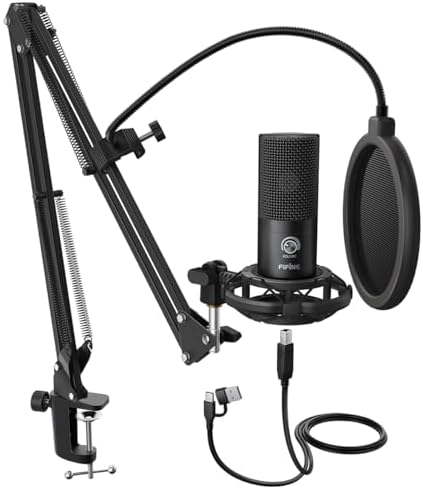
- USB plug-and-play connection
- Wide frequency response and high SPL handling
- Adjustable broadcast suspension boom arm
- Includes C-clamp and desktop mount

- 24-Bit audio at 48kHz sampling
- Mixer-style volume and gain controls
- Cardioid, Stereo and Whisper pickup patterns
- Gesture activated contactless quick-mute

- Professional-quality condenser microphone
- For large and home studios
- Rugged, reliable construction
- Cardioid polar pattern
1. RØDE NT1 Signature Series Studio Condenser Microphone
Best for: vocalists wanting a complete, quiet studio recording bundle
Rode’s NT1 Signature Series centers on a large-diaphragm condenser capsule tuned specifically for voice capture. The manufacturer describes the underlying architecture as having among the lowest self-noise ratings ever produced, which keeps faint circuit hiss out of quiet vocal passages. Its tight cardioid polar pattern focuses pickup directly on the performer directly in front while attenuating the acoustic reflections bouncing off untreated room walls.
The physical package includes an SM6 shock mount paired with a detachable pop filter, a standard XLR cable, and a protective dust cover to shield the capsule between tracking sessions. That complete accessory grouping removes the hassle of finding separate hardware that fits the outer casing correctly. You get a voice-tuned setup ready for an interface right out of the box, whereas the Audio-Technica AT2020 listing includes no external shock mount or cable.
Anyone who records without a dedicated audio interface or mixer can’t use this unit, as its 3-pin connection relies entirely on external phantom power. You will need to provide an audio interface with balanced hardware inputs to capture audio.
- Pros:
- Complete vocal setup includes shock mount, pop filter, XLR cable, and dust cover
- Large-diaphragm condenser capsule voiced specifically for vocal recording
- Whisper-quiet circuit profile delivers exceptionally low self-noise
- Tight cardioid pattern rejects room ambiance
- Cons:
- Requires an external audio interface supplying phantom power, as it provides only an XLR connection
2. Audio-Technica AT2020 Cardioid Condenser Studio XLR Microphone
Best for: multi-instrument home recording needing a balanced studio workhorse
The Audio-Technica AT2020 serves as an enduring reference point for home tracking due to its high sound pressure level handling and broad dynamic range. The heart of the unit is a custom-engineered, low-mass diaphragm tailored to capture fast audio transients cleanly without smearing sharp attacks. It uses a side-address orientation, allowing you to position the capsule against acoustic guitar bodies, percussion, or vocals in compact project rooms.
Its cardioid polar pattern narrows the pickup zone to diminish sound entering from the rear and sides, preserving clear separation between your source and ambient room flutter. The rugged exterior houses an integral 3-pin XLRM-type output connector that couples firmly to standard microphone cables. The AT2020 specifies high SPL handling for loud instrument sources, matching the workhorse demands of tracking dynamic instruments, while the Rode NT1 Signature Series listing focuses primarily on low-noise vocal capture.
Podcasters will need to acquire a shock mount and cable separately, as these are not included with the microphone. It expects a dedicated studio setup with existing mounting hardware and an external recording interface.
- Pros:
- Custom-engineered low-mass diaphragm delivers superior transient response
- Wide dynamic range handles both delicate instruments and louder sources
- High SPL handling manages high-volume audio without early capsule breakup
- Side-address cardioid pattern isolates sound from background spill
- Cons:
- The package lists only the bare microphone, leaving you to buy an XLR cable and shock mount separately
3. Shure SM4 XLR Studio Condenser Microphone Kit
Best for: tracking loud instruments near wireless routers and electronics
Shure built the SM4 around a 1-inch brass dual-diaphragm capsule aimed at delivering clean low-end audio alongside smooth, mix-ready highs. The internal construction includes patent-pending interference shielding designed specifically to block radio frequency noise generated by nearby cell phones, laptops, and Wi-Fi routers. This shielding makes it uniquely suited to home studios crammed into regular bedrooms where computer screens and mobile devices sit inches from the microphone stand.
The microphone utilizes an integrated pop filter combined with a woven mesh Faraday cage to suppress plosive bursts and air turbulence before they strike the diaphragm. It handles extreme volume up to 140dB SPL, so you can point it at drum kits, brass sections, or loud guitar amplifiers without distorting the audio waveform. The SM4 is capable of capturing sounds up to 140dB.
Producers who prefer switching between omnidirectional or stereo polar patterns will find the SM4 limited, as its brass capsule features a fixed cardioid pickup design. It stays locked on single-source capture straight in front of the grille.
- Pros:
- Patent-pending interference shielding blocks RF noise from mobile devices and routers
- Integrated dual-layer pop filter and woven mesh Faraday cage reduce plosive bursts
- Brass 1-inch dual-diaphragm capsule provides smooth highs and controlled low frequencies
- Handles high sound levels up to 140dB without capsule distortion
- Cons:
- Cardioid pickup pattern is fixed, ruling out wide omnidirectional room capture
4. FIFINE T669 Studio Condenser USB Microphone
Best for: quick plug-and-play voiceovers without buying extra studio hardware
The FIFINE T669 condenser microphone bypasses external audio interfaces entirely by providing a direct USB connection to your PC or laptop. It functions right out of the box without special drivers, making it an efficient pick for voiceover artists, video calls, or casual game commentary. The condenser capsule features a cardioid pattern that emphasizes audio directly in front of the desktop stand while dampening sound reflections behind the desk.
FIFINE provides a complete hardware mounting bundle inside the retail package. You get an all-steel suspension scissor arm stand offering 180 degrees of vertical rotation and 135 degrees of extension, along with a 30-inch total horizontal reach secured by a C-clamp desktop mount. An 8.2-foot USB-B to USB-A/C cable, an elastic shock mount, and a double-layer pop filter ship in the carton. The T669 includes an adjustable 30-inch reach desk arm, whereas the Mackie EM-91C includes a shock mount and XLR cable.
Console streamers who rely on an Xbox can’t use this system, as the manufacturer listing explicitly states it’s incompatible with Xbox hardware. It’s built strictly around desktop computers, laptops, and compatible PC software.
- Pros:
- Direct USB output offers driver-free plug-and-play connectivity for PC and Mac
- Includes an all-steel adjustable suspension scissor arm with up to 30 inches of reach
- Double-layer pop filter dissipates vocal air blasts to minimize plosives
- Ships with an 8.2-foot USB cable and dedicated shock mount
- Cons:
- Explicitly incompatible with Xbox consoles according to the manufacturer listing
5. ROCCAT Torch USB Microphone
Best for: creators needing instant physical gain adjustments and pickup switching
ROCCAT designed the Torch to combine studio-style 24-bit audio resolution at up to 48kHz sampling with physical, mixer-style desk controls. The desktop base incorporates smooth slider controls to dial in gain levels or alter headphone volume on the fly without clicking through digital menus. It also incorporates a versatile range of pickup options—Cardioid, Stereo, and an exclusive Whisper pattern designed to capture quiet late-night vocal delivery.
A contactless, gesture-activated quick-mute sensor sits on top of the chassis, letting you cut your live signal by waving your hand over the grille without making mechanical clicks. The base includes three separate RGB lighting zones that glow to confirm the active pickup pattern, communicate mute status, and visually represent incoming gain levels. You can detach the main capsule assembly from the control base to mount it on a standard boom arm while keeping the mixer controls within reach. The Torch offers a variety of switchable pickup patterns, contrasting with the fixed cardioid pickup design listed on the Shure SM4.
The internal digital converter supports up to 48kHz sampling. It’s engineered primarily for computer streaming and voice tasks rather than ultra-high-resolution musical oversampling.
- Pros:
- Onboard mixer-style sliders provide tactile control over gain and volume adjustments
- Offers a selection of pickup patterns: Cardioid, Stereo, and Whisper
- Contactless gesture-activated mute cuts the audio feed without mechanical clicks
- Detachable capsule mounts onto standard boom arms while retaining base controls
- Cons:
- Digital converter caps audio sampling at a maximum of 48kHz
6. Mackie EM-91C
Best for: musicians seeking an uncomplicated, durable large-diaphragm XLR condenser
Mackie’s EM-91C is a large-diaphragm condenser microphone with a rugged, reliable metal construction. The condenser element captures a broad frequency range suited for tracking both clean vocal lines and dynamic acoustic instruments like brass, acoustic guitars, and string sections. Its cardioid polar pattern isolates the main performance while cutting out incidental room noise leaking in from behind the housing.
The packaging includes the microphone itself, a custom-fitted studio shock mount, and an XLR audio cable. You plug the balanced XLR cable directly into your studio mixer or interface to feed clean analog audio into your DAW. The EM-91C includes an XLR connection cable alongside its shock mount, unlike the Audio-Technica AT2020 which lists neither item inside the standard carton.
Buyers who lack a stand or boom arm will need an extra purchase, because the package lists only a shock mount and XLR cable without an included tabletop or floor mount. You must secure a compatible desk arm or tripod before positioning the unit to record.
- Pros:
- Large-diaphragm condenser capsule suited for both project and home tracking
- Rugged, all-metal construction provides dependable physical protection
- Cardioid pickup pattern minimizes spill from room reflections
- Includes a tailored shock mount and standard XLR microphone cable
- Cons:
- Supplied with a shock mount and cable but lacks any desktop stand or mounting arm
How We Chose
18 Amazon listings were compared on connection type, capsule configuration, and included mounting hardware, and near-duplicates — another colour, another size of one already here — were left out. Condenser microphones earned priority because their responsive diaphragms capture subtle acoustic details and vocal transients that standard dynamic elements often smooth over.
Candidate models had to state clear polar pattern specifications and detail their physical connection types, whether analog 3-pin XLR or digital USB. Products were dropped if their listings failed to describe capsule sizing, mounting compatibility, or basic hardware inclusions. The final selection reflects clear differences in daily workflow: fully outfitted studio vocal kits, multi-pattern streaming setups with on-chassis controls, and high-SPL instrument workhorses designed to reject home studio electrical interference.
How to Choose the Right Microphones for Home Studio
XLR Hardware Versus Direct USB Connections
Your audio path determines whether you need external equipment before capturing your first take. USB models like the FIFINE T669 and ROCCAT Torch connect directly to desktop computers, drawing power and sending digital data across a single cable. Analog XLR options like the Rode NT1 Signature Series or Audio-Technica AT2020 require an interface providing 48V phantom power. The Audio Engineering Society outlines how balanced analog wiring prevents external electromagnetic hum over longer studio cable runs, which is why traditional XLR connections remain the studio standard.
Polar Patterns and Room Acoustic Isolation
Cardioid capsules pick up sound directly in front of the grille while rejecting noise coming from the sides and rear. This pattern is essential for untreated bedrooms where air conditioning or wall echoes ruin clean takes. The Shure SM4, Mackie EM-91C, and Audio-Technica AT2020 use cardioid patterns to focus on the singer. If you record paired vocalists or room ambience, multi-pattern units like the ROCCAT Torch switch from cardioid to true stereo capture.
Hardware Bundles and Necessary Mounting Accessories
Microphones can’t perform properly if desk bumps and mechanical vibrations travel up the stand into the capsule. The Rode NT1 Signature Series includes its SM6 shock mount and pop filter, while the FIFINE T669 ships with an articulating scissor arm, desktop clamp, and dual pop screen. The Audio-Technica AT2020 and Mackie EM-91C do not include stands or filter screens.
Capsule Durability and High Volume Ceilings
Tracking brass instruments, loud drum kits, or amplified guitar cabinets can overload delicate microphone diaphragms. The Shure SM4 is explicitly rated to handle sound pressure levels up to 140dB without introducing capsule distortion. The Audio-Technica AT2020 similarly lists high SPL handling combined with a low-mass diaphragm, ensuring fast acoustic transients come through cleanly during high-volume tracking sessions.
Frequently Asked Questions
Do XLR condenser microphones require an external power supply to work?
Yes, all standard XLR condenser microphones need external phantom power to charge their internal diaphragms. The Rode NT1 Signature Series, Shure SM4, Audio-Technica AT2020, and Mackie EM-91C can’t plug directly into a computer sound card. You must connect them to an audio interface or dedicated mixer that supplies 48V phantom power.
Can USB microphones run through an external audio interface?
No, USB microphones can’t interface with analog studio hardware. Units like the FIFINE T669 and ROCCAT Torch contain their own internal analog-to-digital converters and send digital signals straight to a computer. They can’t accept standard 3-pin XLR cables, so they never plug into hardware mixers, preamps, or analog studio gear.
How does the ROCCAT Torch mute function operate without physical noise?
The ROCCAT Torch features a contactless, gesture-activated sensor mounted on the top of the microphone grille. Waving your hand over the sensor mutes or unmutes the audio signal electronically. Because there’s no mechanical button or rocker switch to depress, zero physical handling noise travels through the stand into your track.
Does the Shure SM4 block Wi-Fi and mobile phone interference?
Yes, the Shure SM4 listing highlights patent-pending interference shielding designed specifically to deflect radio frequency noise. Its internal structure features a woven mesh Faraday cage that shields the capsule from cell phone signals and Wi-Fi routers. This keeps electrical buzzing and wireless interference out of your finished recordings.
Which model offers the longest physical reach for desk mounting?
The FIFINE T669 bundle includes an all-steel suspension scissor arm stand that offers a stated 30-inch horizontal reach. The arm rotates 180 degrees up and down with 135 degrees of forward and backward extension. It clamps directly to your desk edge, allowing you to position the microphone without buying a separate boom arm.

For most creators setting up a vocal booth, the Rode NT1 Signature Series provides the cleanest path forward thanks to its bundled shock mount, pop filter, and ultra-quiet capsule design. If you want a simpler desktop setup that skips external audio interfaces entirely, grab the FIFINE T669 to start recording directly over USB.
As an Amazon Associate, Cleanestor earns from qualifying purchases at no additional cost to you.