
The PreSonus Eris 3.5 is the top pick among the best budget studio monitors, earning that spot with 50 watts of amplification and a frequency range reaching down to 80 Hz in a complete stereo pair. This guide helps anyone setting up a small desk or bedroom studio who needs honest sound without hunting for extra parts. The real difference between these speakers comes down to driver size, listed power, and what’s actually inside the box when it arrives.
- Best Overall: PreSonus Eris 3.5 — 50 watts, 80 Hz low end, and TRS, RCA, and aux inputs.
- Best Waveguide Design: PreSonus Eris Studio 5 — 120° x 60° waveguide for a wider sweet spot.
- Best Mid-Size Entry: PreSonus Eris E4.5 — 4.5-inch woofers and a front headphone jack.
- Simplest Controls: Mackie CR3.5 — single tone knob plus isolation pads included.
- Best Wired Latency: M-Audio BX3 — wired design built specifically for zero-latency monitoring.
- Best Bluetooth Connectivity: Ortizan C7 — Bluetooth 5.3 pairing in two seconds.
- Most Powerful Output: Rockville APM6W V2 — 400 watts peak power and 105 dB max SPL.
- Best Brand Heritage: Yamaha HS4 — XLR/TRS combo inputs and room control switches.
- Best Hi-Res Certified: Edifier MR3 — certified flat response from 52 Hz to 40 kHz.
- Best Compact Reference: Yamaha HS5 — 70 watts bi-amplified power with a 5-inch cone woofer.
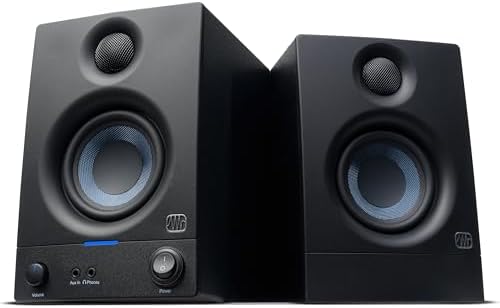
- TRUSTED STUDIO-QUALITY SOUND: True studio sound for music production, gaming, movies, streaming, and everyday audio. Sold as a complete stereo pair.
- POWERFUL, DISTORTION-FREE SOUND: 50 watts of built-in amplification drives clear, dynamic sound at any volume — powerful enough to fill the room,…
- ACCURATE, POWERFUL SOUND: 3.5” woven-composite woofers deliver deeper, tighter bass while 1” silk-dome tweeters smooth out harshness for clear,…
- DIAL IN PERFECT SOUND IN ANY ROOM: Built-in high- and low-frequency acoustic tuning controls let you tailor the sound to your space — no treatment or…

- Professional studio monitors for music and other audio production.
- Superior high-frequency reproduction: 1-inch (25 mm), ultra-low-mass, silk-dome, high-frequency transducer for crystal-clear, natural high end.
- Custom-tuned 120˚(H) x 60˚(V) EBM waveguide provides a wide sweet spot for superior stereo imaging.
- 5.25-inch, woven-composite, low-frequency drivers produce a powerful, accurate, and smooth bass response with extended low end.

- HONEST. Eris 4.5 near field studio monitors deliver studio-quality, accurate sound perfect for music production, hi-fi audio listening, or multimedia…
- EXPRESSIVE. Clear, accurate audio with a big low end — Eris 4.5’s woven-composite woofers’ weave and nature result in tight bass that you can feel,…
- POWERFUL. Compact speakers that pack a punch — 50 Watts of Class AB dual amplification (25W per side) provide all the volume and loudness you want…
- ULTRA-WIDE LISTENING SWEET SPOT. The natural high-frequency response of the 1-inch low-mass, silk-dome transducers (tweeters) provide superior stereo…

- Sold as a pair, sized for desks and small studios
- Hear your mix or stream the way it actually sounds, not flattered
- Tone Knob: dial voicing from your desk without menus
- Location Switch: corrects bass whether they sit against a wall or free

- Latency Free Wired Connection – Engineered for zero-latency audio monitoring, these wired desktop speakers provide a pure, uninterrupted signal…
- Studio-Grade Sound – Upgrade your built-in computer speakers with crystal-clear, bi-amplified power that delivers professional studio monitor quality…
- 3.5-inch Kevlar Woofers – Designed for ultimate acoustic performance, the Black Kevlar low-frequency drivers provide a smooth, punchy bass response…
- Natural Silk Dome Tweeters – Experience the full spectrum of frequencies with natural silk dome tweeters that provide precise stereo imaging and…
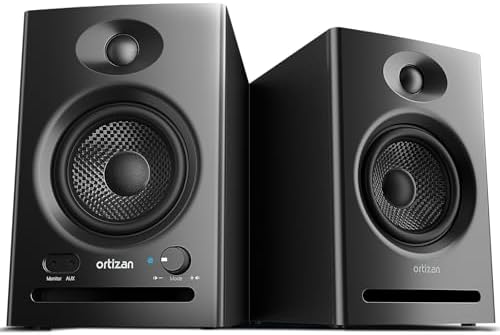
- 【Multiple INPUTS】The stereo speakers home audio is built with RCA which ensure a lossless connection surround sound system for TV; With the addition…
- 【HIFI BOOKSHELF SPEAKERS】The built-in 24-bit DAC captures digital audio directly via USB, minimizing signal loss during conversion and maximizing…
- 【3.5 INCH CARBON FIBER SPEAKER AND 0.75inch SILK DOME TWEETER】The 0.75-inch tweeter and 3.5-inch mid-bass golden acoustic combination, with a…
- 【PROFESSIONAL TUNING】Through extensive laboratory adjustments and meticulous comparisons, the speaker units have been finely tuned to achieve a flat…

- High-Output Bi-Amped Performance: Professional Bi-Amped Class D architecture delivering 400W Peak / 100W RMS total power; features independent…
- Pro-Grade Audio Specifications: Engineered for high-fidelity monitoring with a 105dB Max SPL and a 96dB Signal-to-Noise Ratio (SNR); ultra-low…
- Studio Accuracy & Range: Delivers a flat frequency response of 43Hz – 22kHz (-3dB); features a 6.5 inch polypropylene woofer for punchy lows and a 1…
- Integrated USB & Bluetooth 5.3: Features a built-in USB Soundcard for high-quality direct digital playback from your computer; latest Bluetooth 5.3…
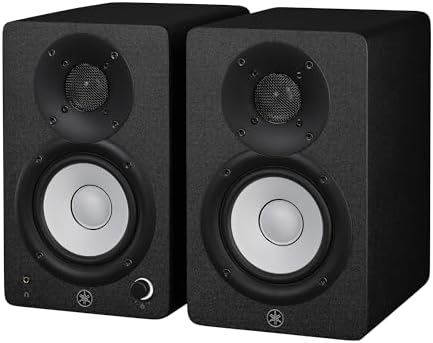
- Packaging: Pair
- 2-way bass-refiex powered speaker with 4.5" cone woofer and 1" dome tweeter
- 60 Hz – 22 kHz frequency response (-10 dB)
- 26 W and above 26 W output power
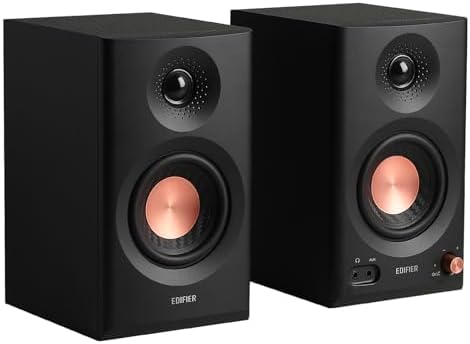
- Hi-Res Audio Certified – Experience superior sound with Hi-Res Audio certification, delivering a flat response across 52Hz to 40kHz for precise and…
- Rich Connectivity – Balanced TRS, RCA, and AUX inputs, headphone output, with Bluetooth supporting multi-point connection. RCA and AUX inputs enable…
- Powerful Sound Output – Enjoy 18W*2 RMS output with a peak SPL of 92.5dB, enhanced by 3.5" mid-low drivers and 1" tweeters for rich, full-range sound.
- Customizable Sound Experience – Easily switch between Music, Monitor, and Custom modes to suit your needs. Fine-tune your sound precisely through the…

- Includes (2) Yamaha HS5 studio monitors
- 2 Way bass reflex bi amplified near field studio monitor with 5 inch Cone woofer and 1 inch dome tweeter
- Has monitors emphasize sonic purity without any coloring or alternation of the original sound
- 54 hertz to 30 kilohertz frequency response; 45W LF plus 25W HF bi amp system for high-performance 70 watts power amplification
1. PreSonus Eris 3.5 Powered Studio Monitors
Best for: beginners needing a complete stereo pair fast.
This pair gives you 50 watts of built-in amplification driving 3.5-inch woven-composite woofers and 1-inch silk-dome tweeters. The frequency response runs from 80 Hz to 20 kHz, which covers most mixing tasks on a desktop. You don’t need extra gear to get started because the box holds everything required to hear sound immediately.
Built-in high- and low-frequency tuning controls let you adjust the output to your room. That matters when your desk sits against a wall, where bass tends to build up. The connections include balanced TRS, RCA, and a front-panel aux input, plus a headphone jack for late-night sessions. It’s a straightforward setup for music production, gaming, or streaming.
Anyone working with deep sub-bass genres will find the 80 Hz floor too high for accurate translation without adding a separate subwoofer later.
Pros
- 50 watts of built-in amplification
- 3.5-inch woven-composite woofers and 1-inch silk-dome tweeters
- High- and low-frequency acoustic tuning controls
- Balanced TRS, RCA, and front-panel aux inputs
- Front headphone jack included
Cons
- Frequency response starts at 80 Hz, so deep bass tracking requires an added subwoofer
- Box includes TRS, RCA, and aux cables but no dedicated subwoofer output for expansion
2. PreSonus Eris Studio 5 5.25-inch 2-Way Active Studio Monitors
Best for: producers needing precise stereo imaging across a wide desk.
A custom-tuned 120° horizontal by 60° vertical EBM waveguide shapes the high frequencies here. That specific geometry creates a wider sweet spot, meaning you can shift in your chair without losing the center image. The 1-inch ultra-low-mass silk-dome transducer handles the highs, while a 5.25-inch woven-composite driver covers the lows down to 48 Hz.
Power comes from an 80-watt Class AB biamplification system capable of 102 dB peak SPL at one meter. Internal bracing suppresses resonance, and the front-firing port extends the bass response. You’ll find balanced XLR, balanced quarter-inch TRS, and unbalanced RCA inputs on the back panel. This layout suits a permanent studio desk where accuracy matters more than quick moves.
Mixing in a very tight space means the 5.25-inch driver might excite room modes you can’t easily treat without acoustic panels.
Pros
- Custom-tuned 120° x 60° EBM waveguide
- 5.25-inch woven-composite low-frequency drivers
- 80W Class AB biamplification delivering up to 102 dB SPL
- 48 Hz to 20 kHz frequency response
- Balanced XLR, TRS, and unbalanced RCA inputs
Cons
- 5.25-inch drivers require more physical desk depth than the most compact near-field alternatives
- 102 dB peak SPL ceiling means extremely loud mastering sessions might push the limit
3. PreSonus Eris E4.5-2-Way 4.5″ Near Field Studio Monitor (Pair)
Best for: creators wanting front-panel headphone switching and room tuning.
These near-field monitors use 4.5-inch woven-composite woofers paired with standard-sized silk-dome tweeters. The weave of the woofer material aims for tight bass you can feel alongside cleaner overall sound. Fifty watts of Class AB dual amplification splits the power evenly at 25 watts per side, keeping tonal balance intact as volume rises.
High- and low-frequency tuning controls sit on the back for room correction. Up front, an eighth-inch TRS stereo aux input and a headphone output with a built-in amplifier make switching between speakers and cans instant. Quarter-inch TRS balanced and RCA unbalanced inputs handle professional interfaces and consumer electronics alike. It’s a flexible middle ground for desks that host both mixing and casual listening.
Pros
- 4.5-inch woven-composite woofers
- 50 watts of Class AB dual amplification (25W per side)
- 1-inch low-mass silk-dome tweeters
- High- and low-frequency tuning controls
- Front-panel aux input and headphone output with built-in amplifier
Cons
- 50 watts total power limits maximum volume compared to higher-wattage models like the Rockville APM6W V2
- Companion Eris Sub 8BT subwoofer is listed as an option for extended lows
4. Mackie CR3.5 Studio Monitors (Pair)
Best for: users who want simple controls and included isolation pads.
Simplicity defines this pair. Instead of separate bass and treble knobs, a single tone knob dials the voicing in right from your desk. A location switch corrects the bass response depending on whether the speakers sit flush against a wall or stand free in the room. These compact woofers are sized specifically for small studios and desktop setups.
What really sets it apart is the box contents. Both monitors arrive with isolation pads and all the cables needed to start playing audio immediately. You won’t have to hunt for speaker wire or figure out which pad fits the footprint.
Engineers needing independent high and low adjustments will find a single tone knob too broad for precise room correction work.
Pros
- Single tone knob for easy voicing adjustments
- Location switch for wall or free-standing placement
- 3.5-inch woofers sized for desks
- Isolation pads included in the box
- All necessary cables included to start immediately
Cons
- Single tone knob replaces separate high/low controls, limiting precise room tuning
- Compact woofers restrict low-end extension compared to larger drivers like those on the Yamaha HS5
5. M-AUDIO BX3 3.5″ Wired Studio Monitors Pair
Best for: live performers needing zero-latency wired monitoring.
This pair focuses entirely on a latency-free wired connection. There’s no wireless radio inside; the signal path stays purely analog and digital via cables to ensure uninterrupted monitoring for live streaming, gaming, and studio tracking. The compact Black Kevlar low-frequency drivers aim for smooth, punchy bass response tailored to recording.
Natural silk dome tweeters handle the high frequencies for precise stereo imaging. The cabinets use acoustically-inert MDF wood construction paired with an advanced bass reflex design to stop unwanted vibration. Rear inputs cover quarter-inch, eighth-inch, and RCA connections, fitting DJ gear and instruments directly. A front panel eighth-inch AUX input lets you plug headphones in quickly for silent mixing.
Pros
- Engineered for zero-latency wired audio monitoring
- 3.5-inch Black Kevlar low-frequency drivers
- Natural silk dome tweeters for precise stereo imaging
- Acoustically-inert MDF cabinet with bass reflex design
- Rear quarter-inch, eighth-inch, and RCA inputs plus front panel AUX
Cons
- 3.5-inch drivers limit low-frequency reach compared to the 6.5-inch woofers on the Rockville APM6W V2
6. Ortizan C7 Powered Studio Monitors Pair with Bluetooth 5.3
Best for: streamers wanting instant Bluetooth 5.3 wireless pairing.
Wireless freedom meets studio utility here. Bluetooth 5.3 technology pairs with a smartphone or tablet in about two seconds, cutting out messy wires for casual playback. When accuracy matters, the built-in 24-bit DAC captures digital audio directly via USB to minimize signal loss during conversion. RCA and 3.5mm AUX inputs round out the connection options.
The acoustic design uses a 3.5-inch carbon fiber mid-bass driver and a 0.75-inch silk dome tweeter with a suspended sound structure. An electronic 2-way crossover separates the frequencies for layered performance. On the back, a 6.35mm TRS balanced input connects professional gear like mixing consoles. The front panel adds two AUX unbalanced inputs and a headphone output for quick switching.
Pros
- Bluetooth 5.3 pairing in approximately two seconds
- Built-in 24-bit DAC for direct USB digital audio capture
- 3.5-inch carbon fiber mid-bass driver and 0.75-inch silk dome tweeter
- 6.35mm TRS balanced input for professional mixing consoles
- Front panel headphone output and two AUX unbalanced inputs
Cons
- 0.75-inch tweeter is smaller than the high-frequency drivers on most other picks here
- 3.5-inch carbon fiber driver limits maximum bass depth compared to the 5-inch cone on the Yamaha HS5
7. Rockville APM6W V2 6.5″ White Powered Studio Monitor Speakers Pair
Best for: large rooms requiring high-volume playback and deep bass.
Raw output defines this white cabinet pair. The bi-amped Class D architecture delivers 400 watts peak and 100 watts RMS total power, with independent amplification for each woofer and tweeter. A 6.5-inch polypropylene woofer pushes the low end down to 43 Hz, while a standard-sized soft dome tweeter handles crisp highs up to 22 kHz. Maximum SPL hits 105 dB.
Connectivity covers almost every modern source. A built-in USB soundcard allows direct digital playback from a computer, and Bluetooth 5.3 streams wirelessly up to 50 feet. Analog inputs include a balanced XLR/TRS combo, RCA, and 3.5mm Aux. An RCA line output lets you expand the system with a subwoofer later. The half-inch MDF enclosure features a beveled baffle to minimize acoustic diffraction.
Pros
- 400W Peak / 100W RMS total bi-amped Class D power
- 6.5-inch polypropylene woofer and 1-inch soft dome tweeter
- 43 Hz to 22 kHz frequency response (-3dB)
- Built-in USB soundcard and Bluetooth 5.3 up to 50 feet
- RCA line output for subwoofer expansion
Cons
- 6.5-inch woofers demand significant desk space unsuitable for compact setups
8. Yamaha HS4 Powered Studio Monitor in Black
Best for: producers trusting established studio heritage and room controls.
Yamaha builds this 2-way bass-reflex powered speaker pair around a 4.5-inch cone woofer and a standard-sized dome tweeter. The frequency response spans 60 Hz to 22 kHz (-10 dB), driven by 26 watts and above of output power. Room control and high trim response switches on the back let you cut bass buildup or tame harsh highs based on your specific space.
Input flexibility is strong for a compact monitor. An XLR/TRS Phone combo jack accepts professional balanced signals, while RCA and Stereo Mini inputs handle consumer devices. The packaging includes a Stereo mini-to-RCA cable, a speaker cable, and an anti-slip pad.
Pros
- 4.5-inch cone woofer and 1-inch dome tweeter
- 60 Hz to 22 kHz frequency response (-10 dB)
- Room control and high trim response switches
- XLR/TRS combo, RCA, and Stereo Mini inputs
- Includes Stereo mini-RCA cable, speaker cable, and anti-slip pad
Cons
- 26 W output power limits maximum volume compared to the 80W system in the PreSonus Eris Studio 5
9. Edifier MR3 Powered Studio Monitor
Best for: listeners wanting app-based EQ and multi-point Bluetooth.
Hi-Res Audio certification backs this active speaker pair, promising a flat response across 52 Hz to 40 kHz. That upper limit reaches well into ultrasonic territory for precise monitoring. Output comes from the built-in amplification per channel, with a peak SPL of 92.5 dB. The drivers consist of 3.5-inch mid-low units and 1-inch tweeters housed in an MDF cabinet.
Connectivity blends old and new standards. Balanced TRS, RCA, and AUX inputs sit alongside Bluetooth with multi-point connection support, letting you pair two devices simultaneously. You can switch between Music, Monitor, and Custom modes, then fine-tune the sound precisely through the EDIFIER ConneX app for personalized EQ control.
Pros
- Hi-Res Audio Certified with 52 Hz to 40 kHz flat response
- 18W x 2 RMS output with 92.5 dB peak SPL
- 3.5-inch mid-low drivers and 1-inch tweeters
- Bluetooth multi-point connection support
- EDIFIER ConneX app for personalized EQ control and mode switching
Cons
- 92.5 dB peak SPL limits maximum loudness for high-volume mixing environments
- The total built-in amplification trails the 100 watts RMS offered by the Rockville APM6W V2
10. YAMAHA HS5 Powered Studio Monitor
Best for: serious mixers prioritizing sonic purity and bi-amplified power.
This pair emphasizes sonic purity without coloring the original sound. It achieves that through a 2-way bass reflex bi-amplified near-field design featuring a 5-inch cone woofer and a 1-inch dome tweeter. The frequency response stretches from 54 Hz to 30 kHz, capturing deep lows and airy highs accurately.
A 45-watt low-frequency amp and a 25-watt high-frequency amp combine for 70 watts total. This bi-amp system ensures each driver gets dedicated headroom for high-performance monitoring. Inputs are strictly professional, with XLR and TRS phone jacks accepting both balanced and unbalanced signals. It’s a no-nonsense tool for critical listening.
Pros
- 5-inch cone woofer and 1-inch dome tweeter
- 54 Hz to 30 kHz frequency response
- 45W LF plus 25W HF bi-amp system for 70 watts total
- Emphasizes sonic purity without coloring the original sound
- XLR and TRS phone jack inputs for balanced or unbalanced signals
Cons
- Only XLR and TRS inputs listed, requiring adapters for consumer RCA or 3.5mm cables
- 70 watts total power falls short of the 100 watts RMS listed for the Rockville APM6W V2
Also Worth Considering
The PreSonus 2-Way Field Studio Monitor is a 5.25-inch near-field model. The PreSonus Eris Studio 5 explicitly lists the 120° x 60° EBM waveguide for stereo imaging, making the Studio 5 a choice for wide desks.
The Rockville APM5B Studio Monitor Speakers come as a black 5.25-inch powered pair. The Rockville APM6W V2 surpasses it with 6.5-inch woofers and a stated 105 dB Max SPL, offering significantly more output for larger rooms.
The PreSonus 2-Way Active Studio Monitor features a 4.5-inch driver and the EBM waveguide. The PreSonus Eris E4.5 matches that 4.5-inch size but adds a front-panel headphone output and dedicated tuning controls, giving it more daily utility.
How We Chose
A listing had to state its frequency response or power output clearly to earn a place. Products missing basic specifications like woofer diameter or input types were excluded immediately. The remaining picks handle the core trade-offs of small-room audio: physical footprint versus bass extension, and wired simplicity versus wireless convenience. Each selected monitor states its exact driver dimensions and connection methods, allowing direct arithmetic comparisons. The final ten represent distinct configurations covering 3.5-inch desktop pairs up to 6.5-inch high-output cabinets.
How to Choose the Right Studio Monitors
Driver size and desk space
Driver diameter dictates both bass extension and physical footprint. The Rockville APM6W V2 uses 6.5-inch woofers for deep 43 Hz lows, demanding substantial desk depth. If your workspace is narrow, the 3.5-inch drivers on the Mackie CR3.5 or M-Audio BX3 fit tighter spots while sacrificing some low-end reach. Measure your available surface before picking a size.
Power output and room volume
Amplification determines how loud the speakers play cleanly. The Rockville APM6W V2 lists 100 watts RMS for large spaces, while the Edifier MR3 provides its built-in amplification for quiet desktop work. Match the wattage to your room size. A bedroom doesn’t need 400 watts peak, but an open living area might benefit from the extra headroom.
Included accessories and cables
Check what arrives in the box. The Mackie CR3.5 includes isolation pads and all necessary cables, removing extra shopping trips. The Yamaha HS4 bundles a stereo mini-RCA cable and anti-slip pad. Other models list only the monitors themselves. If you lack specific cables or desk pads, factor those additions into your setup plan.
Wireless versus wired connections
Decide if Bluetooth matters for your workflow. The Ortizan C7 and Edifier MR3 feature wireless pairing for streaming from phones. The M-Audio BX3 relies entirely on wired connections for zero-latency performance. If you track live instruments, wired is safer. For casual listening between mixing sessions, wireless adds convenience.
Frequently Asked Questions
Do I need an audio interface to run these?
Not always. Models like the PreSonus Eris 3.5 list RCA and front-panel aux inputs that connect directly to a computer’s headphone jack or a phone. However, balanced TRS or XLR inputs on the Yamaha HS5 perform best when fed a clean signal from a dedicated interface. Check the specific inputs listed for your chosen pair.
Can I add a subwoofer to these systems later?
Some models support it directly. The Rockville APM6W V2 lists an RCA line output specifically for subwoofer expansion. The PreSonus Eris E4.5 mentions compatibility with a companion Eris Sub 8BT, though it’s a separate purchase. Others, like the Yamaha HS4, list no dedicated sub-out, meaning you’d need an external crossover to integrate one.
What does room control or acoustic tuning actually do?
These switches adjust the speaker’s output to match your physical space. The Yamaha HS4 lists room control and high trim switches to cut bass buildup near walls or tame bright highs. The PreSonus Eris 3.5 offers similar high- and low-frequency tuning controls. They compensate for basic room acoustics without requiring foam panels.
Are Bluetooth monitors okay for mixing music?
They introduce potential latency. The Ortizan C7 lists Bluetooth 5.3 for fast pairing, which works well for referencing tracks or casual listening. For critical mixing where timing matters, switch to the listed USB or TRS wired inputs on that same model. Wired connections, like those emphasized on the M-Audio BX3, eliminate wireless delay entirely.
Why do some monitors list bi-amplification?

Bi-amplification means separate amplifiers drive the woofer and tweeter independently. The Yamaha HS5 lists a 45W low-frequency amp and a 25W high-frequency amp. The Rockville APM6W V2 uses a similar Class D bi-amped architecture. This prevents one driver from stealing power from the other during loud passages, resulting in clearer sound at higher volumes.
Does the cabinet material change the sound?
Listings point to it reducing unwanted noise. The M-Audio BX3 highlights an acoustically-inert MDF cabinet designed to stop vibration, while the Edifier MR3 similarly notes its MDF construction reduces distortion. The Rockville APM6W V2 specifies half-inch MDF with a beveled baffle to minimize acoustic diffraction. Dense wood generally keeps the enclosure from resonating alongside the drivers.
Conclusion
The PreSonus Eris 3.5 remains a starting point for most desks, offering 50 watts and full connectivity in one box. If you prefer simpler controls and included pads, the Mackie CR3.5 does the job with less fuss. Pick the one that fits your physical space, connect your audio source, and start listening critically today.
As an Amazon Associate, Instrument Insight earns from qualifying purchases at no additional cost to you.