
The PreSonus Eris 3.5 is a cheap studio monitor that earns the top spot by including acoustic tuning controls and three input types in one package. These speakers provide accurate sound for new producers and desktop users who need to avoid complex cable setups or room correction issues. The real difference between these picks is whether their specific features solve your space and connection needs right out of the box.
Quick Picks:
- Best Overall: PreSonus Eris 3.5 — Tuning controls and three inputs fit any desk setup
- Best for Mixing: Yamaha HS5 Pair — Flat response prioritizes sonic purity over enhancement
- Most Compact: IK Multimedia iLoud Micro — DSP compensation fits tight spaces and travel bags
- Best Wireless Connectivity: Edifier MR3 — Bluetooth multi-point connects two devices simultaneously
- Best Midrange Clarity: KRK Kreate 3 — Glass aramid woofer targets clear vocal reproduction
- Best Desktop Size: Mackie CR4.5 — Larger woofer fills mid-sized desks without subwoofers
- Simplest Setup: M-Audio BX3 — Wired-only design eliminates latency for live performance
- Most Powerful: PreSonus Eris E7 XT — Waveguide and large driver suit untreated rooms
- Best Reference Accuracy: Yamaha HS5 White Bundle — Industry-standard flat response for critical mixing
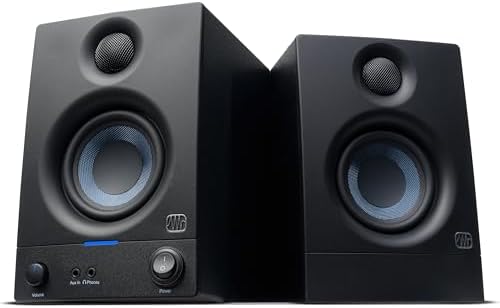
- Sold as a complete stereo pair
- 50 watts of built-in amplification
- 3.5” woven-composite woofers and 1” silk-dome tweeters
- Frequency response from 80 Hz to 20 kHz

- Includes (2) Yamaha HS5 studio monitors
- 5 inch Cone woofer and 1 inch dome tweeter
- 54 hertz to 30 kilohertz frequency response
- 45W LF plus 25W HF bi amp, 70 watts total

- Internal DSP for linear frequency response
- Class D amplifiers deliver 50W RMS total
- Low-end response down to 55Hz (-3dB)
- Portable and lightweight design
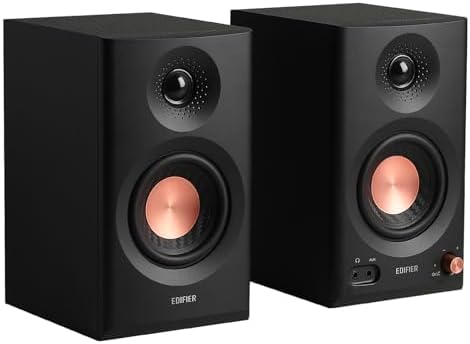
- Flat response across 52Hz to 40kHz
- Balanced TRS, RCA, AUX inputs and Bluetooth
- 18W*2 RMS output with 92.5dB peak SPL
- 3.5" mid-low drivers and 1" tweeters

- Textile dome tweeter for highs
- Woven glass fiber composite woofer
- 3.5” Glass Aramid Woofer with 1" Textile Dome Tweeter
- Bluetooth input for wireless audio streaming

- Sold as a pair
- Fuller low end than 3.5-inch monitors
- Front-panel voicing control knob
- Wall or free-standing bass correction switch

- Zero-latency wired connection for monitoring
- Bi-amplified power for desktop use
- 3.5-inch Kevlar Woofers for bass response
- Natural silk dome tweeters for stereo imaging

- 6.55-inch woven composite low-frequency transducer
- 1.25-inch (32 mm) silk-dome high-frequency transducer
- Includes Studio One Prime and Studio Magic plug-in suite
- 100˚(H) x 60˚(V) EBM waveguide

- Bundle Includes: 2 x YAMAHA HS5 W 5-Inch Powered Studio Monitor (White)
- Delivers: HS Series nearfield reference monitors are the embodiment of this philosophy, delivering a concise sound image, high resolution, and flat…
- Accuracy: When selecting studio reference monitors for mixing and music production, one consideration takes precedence above all others – accuracy
- Designed to Achieve: Yamaha studio monitors are designed to achieve the best possible mix by ensuring that the sound from your speakers is true to…
1. PreSonus Eris 3.5 Powered Studio Monitors
Best for: Beginners needing versatile connections and room correction
This monitor pair stands out because it includes high and low-frequency acoustic tuning controls directly on the rear panel, letting you adjust the sound to match your room’s acoustics without external software or hardware. Most entry-level speakers lack this feature entirely, forcing buyers to accept whatever frequency response the factory set regardless of their desk placement or wall proximity. Having physical knobs means you can dial in a balanced sound immediately after unpacking, which matters when you’re learning to trust what you hear.
Connectivity is equally practical for mixed-use setups, with balanced TRS inputs for audio interfaces, RCA for consumer gear, and a front-panel aux jack for quick phone or tablet playback. You don’t need adapters or extra cables to switch between producing music and watching videos, and the front headphone jack lets you monitor privately without reaching behind the speakers. It’s a complete system that removes friction for someone setting up their first home studio.
Anyone working in larger rooms or requiring deep sub-bass extension will find the stated 80 Hz low-end limit insufficient for bass-heavy genres. Comparing its 3.5-inch woven composite woofer against the 5-inch cone on the Yamaha HS5 Pair shows exactly where this model fits: it’s a near-field tool for smaller desks, not a full-range mixing solution.
Pros
- Rear-panel acoustic tuning controls for highs and lows
- Three input types: balanced TRS, RCA, and front aux
- Front-panel headphone jack for private monitoring
- Sold as a matched stereo pair with amplification included
- Frequency response listed at 80 Hz–20 kHz
Cons
- Low-frequency response starts at 80 Hz, ruling out sub-bass work
- 50 watts total amplification may struggle in larger untreated spaces
- No wireless connectivity options listed for streaming from mobile devices
2. YAMAHA HS5 Powered Studio Monitor
Best for: Mix engineers prioritizing uncolored accuracy over bass extension
Yamaha’s HS series has built its reputation on sonic purity, and this listing explicitly states the monitors emphasize accuracy without coloring or altering the original sound. That philosophy means what you hear is what’s actually in the recording, not a flattering version of it, which is exactly what mixing demands. If your mix sounds good on these, it’ll translate to other systems; if it doesn’t, the problem is in the track, not the speakers.
The bi-amped design delivers 45W to the low-frequency driver and 25W to the tweeter separately, ensuring each range gets dedicated power without crossover distortion. Combined with the 5-inch cone woofer and 1-inch dome tweeter, this creates a controlled response from 54 Hz to 30 kHz that’s flatter than most competitors in this range. XLR and TRS inputs accept both balanced and unbalanced signals, making integration with professional interfaces straightforward.
Producers seeking deep bass for hip-hop or EDM production will hit a wall at 54 Hz, which cuts off before many modern kick drums fully develop. Against the PreSonus Eris E7 XT’s 6.55-inch transducer, this 5-inch driver simply moves less air, trading low-end reach for midrange precision that serves mixing better than genre-specific enjoyment.
Pros
- Bi-amplified 70W system with separate LF and HF power
- Frequency response extends to 30 kHz for detailed highs
- Balanced XLR and TRS inputs for professional signal chains
- Bass reflex design optimized for sonic purity
- Sold as a matched pair for stereo imaging
Cons
- Low-end rolls off at 54 Hz, limiting bass-heavy production work
- Lacks consumer-friendly inputs like RCA or Bluetooth
3. IK Multimedia iLoud Micro Monitor 50 watt Portable Wireless Bluetooth
Best for: Traveling producers and extremely small workspaces
These are marketed as the smallest active studio reference monitoring system available, and the listing backs that claim with internal DSP that compensates for desktop placement versus free-field positioning. That means you can switch EQ profiles with a button press instead of accepting compromised sound when your speakers sit against a wall or crowd into a corner. For someone producing in hotel rooms, dorms, or shared apartments, that flexibility turns unusable spaces into functional ones.
Despite the compact size, the class-D amplifiers deliver 50W RMS and push bass response down to 55 Hz, which rivals some larger passive designs. Bluetooth connectivity adds wireless streaming from phones and tablets, while stereo RCA and 1/8″ aux inputs handle wired sources. The optional travel bag mention confirms portability is a core design goal, not an afterthought.
Engineers needing extended high-frequency detail for mastering will note the 3/4″ silk dome tweeter is smaller than the 1″ domes on most other picks here. Compared to the Edifier MR3’s Hi-Res Audio certification extending to 40 kHz, this model’s frequency range prioritizes midrange accuracy and bass control over ultra-high sparkle, which suits tracking and editing more than final polish.
Pros
- Internal DSP with position compensation EQ settings
- 50W RMS output with bass extension to 55 Hz
- Bluetooth wireless plus RCA and 1/8″ wired inputs
- Compact enough for travel with optional matching bag
Cons
- 3/4″ tweeter is smaller than competing 1″ domes, limiting high-frequency extension
- No balanced TRS or XLR inputs for professional interfaces
4. Edifier MR3 Powered Studio Monitor
Best for: Multi-device users needing seamless wireless switching
Hi-Res Audio certification here means a verified flat response from 52 Hz to 40 kHz, covering more audible spectrum than any other pick on this list. That extended range matters for producers working with high-sample-rate recordings or wanting confidence that nothing above 20 kHz is being artificially rolled off. The MDF cabinet construction further supports accuracy by reducing resonance that plastic enclosures often introduce at higher volumes.
Bluetooth multi-point connection lets you pair two devices simultaneously and switch between them without disconnecting, which is rare in studio monitors at this tier. Combined with balanced TRS, RCA, and AUX inputs plus a headphone output, you can keep your interface, phone, and turntable all connected at once. The EDIFIER ConneX app adds customizable EQ beyond the preset Music, Monitor, and Custom modes, giving deeper control than physical knobs alone.
Users in very small rooms may find the 3.5″ mid-low drivers produce too much energy for near-field listening distances under three feet. Against the IK Multimedia iLoud Micro’s DSP position compensation, this model relies on manual EQ adjustment rather than automated correction, meaning you’ll need to dial in settings yourself if your desk sits against a wall.
Pros
- Hi-Res Audio certified with 52 Hz–40 kHz response
- Bluetooth multi-point connects two devices at once
- App-based EQ customization via EDIFIER ConneX
- MDF cabinet reduces unwanted resonance
- Multiple simultaneous inputs including balanced TRS
Cons
- 3.5″ drivers may overwhelm very small near-field setups
- No automated room correction like DSP-equipped competitors
5. KRK Kreate 3 Powered Studio Monitors Pair
Best for: Vocal-focused producers needing clear midrange articulation
The glass aramid composite woofer listed here is specifically engineered for midrange clarity and tight bass, targeting the frequency range where vocals and lead instruments live. Textile dome tweeters complement this by delivering smooth highs without the harshness that metal domes sometimes introduce during long sessions. Together, they create a voicing that makes vocal presence and intelligibility easier to judge during tracking and mixing.
Bluetooth input adds wireless streaming capability, while multiple audio inputs ensure compatibility across studio environments. The combination suggests a hybrid use case: serious vocal work during production hours, casual listening afterward without reconfiguring cables. For singer-songwriters or podcasters who prioritize voice over instrumental depth, this tuning makes sense.
Bass-heavy electronic producers will find the 3.5″ woofer size limits low-end impact compared to larger drivers. Against the Mackie CR4.5’s explicit “fuller low end than 3.5-inch monitors” claim, this model trades sub-bass authority for midrange focus, which serves vocals well but leaves beatmakers wanting more.
Pros
- Glass aramid woofer optimized for midrange clarity
- Textile dome tweeter for smooth high-frequency response
- Bluetooth input for wireless audio streaming
- Multiple input options for universal connectivity
- Compact 3.5″ form factor fits crowded desks
Cons
- 3.5″ woofer limits bass extension for electronic genres
- Frequency response range not specified in listing
6. Mackie CR4.5 Studio Monitors (Pair)
Best for: Mid-sized desks needing fuller bass without a subwoofer
The 4.5″ woofers here occupy a sweet spot between compact 3.5″ models and larger 5″ monitors, delivering what the listing describes as fuller low end without requiring a separate subwoofer. That makes this pair ideal for desks with enough surface area to accommodate slightly larger cabinets but not enough for full-size nearfields. You get meaningful bass extension while keeping the footprint manageable.
Front-panel tone knob and location switch provide immediate voicing adjustments without reaching behind the speakers or opening software. The location switch specifically corrects bass buildup when placed against walls, addressing one of the most common home studio problems. Included isolation pads and all necessary cables mean you can set up properly without additional purchases.
Producers in very small spaces under 10 square feet will find even 4.5″ drivers too large for proper near-field placement. Compared to the M-Audio BX3’s identical 3.5″ Kevlar woofers, this model sacrifices some desk real estate for bass response, so measure your workspace before choosing size over portability.
Pros
- 4.5″ woofers deliver fuller bass than 3.5″ alternatives
- Front-panel tone knob and location switch for quick adjustments
- Isolation pads and cables included in the box
- Sold as a complete stereo pair
- Wall-placement bass correction built in
Cons
- Larger cabinet size rules out very small desks
- No Bluetooth or wireless connectivity listed
- Frequency response specifications not provided
7. M-AUDIO BX3 3.5″ Wired Studio Monitors Pair
Best for: Live performers and streamers requiring zero-latency monitoring
This wired-only design is engineered specifically for latency-free audio monitoring, eliminating the delay that Bluetooth introduces during live performance, streaming, or real-time tracking. When timing matters down to milliseconds, wireless convenience becomes a liability, and this model commits fully to the wired path. That makes it the right choice for anyone whose primary use case involves playing along with backing tracks or monitoring their own voice instrumentally.
Black Kevlar low-frequency drivers and natural silk dome tweeters provide studio-grade sound quality despite the simplified connectivity. The acoustically-inert MDF cabinet with enhanced bass reflex design stops unwanted vibration, producing richer sound than plastic multimedia speakers. Front-panel 1/8″ AUX input allows silent late-night monitoring via headphones without disturbing others.
Users wanting wireless streaming from phones or tablets will find no Bluetooth option here whatsoever. Against the Edifier MR3’s multi-point Bluetooth and app-based EQ, this model offers pure wired reliability without modern convenience features, so decide whether latency or flexibility matters more for your workflow.
Pros
- Zero-latency wired connection for live monitoring
- Black Kevlar woofers for smooth bass response
- Natural silk dome tweeters for precise stereo imaging
- Front-panel headphone input for silent sessions
- MDF cabinet with bass reflex design reduces vibration
Cons
- No wireless connectivity options available
- Only 3.5″ drivers limit bass extension
- No acoustic tuning controls listed
8. PreSonus Eris E7 XT 2-Way Active Studio Monitor with EBM
Best for: Untreated rooms needing wide dispersion and deep bass
The innovative EBM waveguide listed here creates a 100° horizontal by 60° vertical sweet spot, which is significantly wider than typical studio monitor dispersion patterns. In untreated rooms where you can’t sit perfectly centered or move around during mixing, that wider imaging means consistent tonal balance across more listening positions. Combined with the 6.55-inch woven composite transducer, this monitor handles larger spaces and deeper frequencies than anything else on this list.
Acoustic tuning controls include Level, HPF, LF Trim, HF Trim, and Acoustic Space settings, providing comprehensive room adaptation without external processors. The included Studio One Prime and Studio Magic plug-in suite add substantial software value for new producers building their DAW ecosystem. Ultra-low-mass silk-dome tweeter ensures smooth highs that won’t fatigue during extended sessions.
Small-desk users will find the 6.55″ driver and corresponding cabinet too large for proper near-field placement under three feet. Against the Yamaha HS5 Pair’s 5-inch driver and 70W bi-amp system, this model’s increased size and power serve bigger rooms better but overwhelm cramped spaces where near-field accuracy depends on proximity.
Pros
- EBM waveguide provides 100° x 60° wide sweet spot
- 6.55″ transducer delivers deepest bass on this list
- Five acoustic tuning controls for room adaptation
- Includes Studio One Prime and plug-in suite
- Ultra-low-mass tweeter reduces listening fatigue
Cons
- Large cabinet size unsuitable for small near-field setups
9. YAMAHA HS5 W 5-Inch Powered Studio Monitor
Best for: Critical mixing requiring industry-standard reference accuracy
This white variant bundle maintains the same accuracy-first philosophy as the standard HS5, with the listing emphasizing concise sound image, high resolution, and flat response above all else. Yamaha’s nearfield monitors have become genuine industry standards precisely because they reveal flaws rather than hiding them, ensuring mixes translate reliably across playback systems. If flat frequency response is your primary requirement, this lineage carries decades of validation.
The bundle format includes two matched white monitors, which matters for stereo imaging consistency and aesthetic coordination in visible studio spaces. Like its black counterpart, it prioritizes true-to-original sound reproduction over flattering coloration, making it suitable for professional mixing and mastering decisions. The philosophy here is that better-sounding mixes come from honest monitoring, not enhanced speakers.
Producers wanting modern connectivity like Bluetooth or app-based EQ will find none listed here. Compared to the Edifier MR3’s Hi-Res certification and wireless multi-point, this model focuses exclusively on analog accuracy, so choose based on whether traditional reference performance outweighs contemporary convenience features.
Pros
- Industry-standard flat response for critical mixing
- Matched white pair for consistent stereo imaging
- High-resolution sound with concise imaging
- Built on legendary HS series accuracy legacy
- Designed specifically for true-to-original reproduction
Cons
- No wireless or digital connectivity options
- White finish may show dust and wear more visibly
Also Worth Considering
Mackie CR3.5 Studio Monitors offer the same tone knob and location switch as the CR4.5 but with 3.5″ woofers, making them suitable for tighter desks where the larger model won’t fit. However, the PreSonus Eris 3.5 beats them on connectivity with a wider selection of inputs versus limited options here, so only consider this if Mackie’s voicing specifically suits your ears.
PreSonus Eris E4.5-2-Way Field Studio Monitor sits between the Eris 3.5 and E7 XT in size, offering 4.5″ drivers for those needing more bass than the 3.5 but less bulk than the 6.55″. The Mackie CR4.5 matches this driver size while including isolation pads and cables in the box, making it the more complete package unless PreSonus tuning controls matter more to you.
YAMAHA HS4 Powered Studio Monitor represents the newest entry in the HS line with updated styling, but the established HS5 Pair listed above carries decades of proven accuracy and a wider frequency response starting at 54 Hz. Choose the HS4 only if the newer aesthetic or potentially updated components outweigh the documented performance history of the HS5.
How to Choose Studio Monitors
Driver Size and Room Fit
Decide your available desk depth first, then match driver size to that constraint. Listings state woofer dimensions directly: 3.5″ models like the PreSonus Eris 3.5 suit desks under three feet deep, while 5″ options like the Yamaha HS5 Pair need more breathing room. Larger drivers like the PreSonus Eris E7 XT’s 6.55″ transducer require treated spaces and greater listening distance to avoid bass buildup. Measure before buying; a speaker too large for your room creates more problems than it solves.
Connection Types You Actually Need
List every device you’ll connect before choosing inputs. Balanced TRS and XLR serve audio interfaces, while RCA and AUX handle consumer gear and mobile devices. The Edifier MR3 lists Bluetooth multi-point for wireless switching between two sources, whereas the M-Audio BX3 commits to wired-only for zero latency. Don’t assume you’ll adapt later; mismatched connections mean adapter clutter or returned gear. Match the listing’s stated inputs to your actual signal chain.
Room Correction Features
Assess whether your space needs acoustic compensation before relying on flat-response monitors. The PreSonus Eris 3.5 and Eris E7 XT list rear-panel tuning controls for highs, lows, and acoustic space, letting you adjust for wall placement or room modes physically. The IK Multimedia iLoud Micro goes further with DSP position presets switched via button press. Models without these features, like the Yamaha HS5 Pair, assume either treated rooms or acceptance of uncorrected response. Know your room’s limitations before deciding whether correction belongs in the speaker or elsewhere.
Frequency Range Requirements
Identify the lowest frequency your work demands by checking the stated Hz range on each listing. A smaller monitor like the PreSonus Eris 3.5 rolls off at 80 Hz, sufficient for vocals and podcasts but inadequate for bass-heavy production. The Yamaha HS5 Pair extends to 54 Hz, while the PreSonus Eris E7 XT’s larger driver reaches deeper still. Audio Engineering Society guidelines recommend matching monitor bandwidth to your source material’s spectral content. Choosing insufficient range means missing problems in your mix; excess range in a small room creates new ones.
Related guides
- Is FL Studio Industry Standard
- How to Use FL Studio on Multiple Monitors
- Where to Find 808 Bass in FL Studio
Frequently Asked Questions
Can I use these monitors without an audio interface?
Yes, several models list direct consumer connections. The PreSonus Eris 3.5 includes RCA and front-panel aux inputs for computers, phones, and turntables without an interface. However, balanced TRS or XLR inputs on models like the Yamaha HS5 Pair require an interface or mixer for proper signal matching.
Do I need acoustic treatment before buying monitors?
Not necessarily, but monitors with built-in correction help in untreated spaces. The PreSonus Eris 3.5 lists acoustic tuning controls that compensate for wall placement physically. Models emphasizing flat response without correction, like the Yamaha HS5 Pair, perform best in treated environments. Correction features extend usability where treatment isn’t feasible.
Are Bluetooth monitors suitable for professional mixing?
They can be for reference checking, but wired connections remain standard for critical work. The Edifier MR3 and KRK Kreate 3 list Bluetooth for convenient streaming, yet both also include balanced TRS inputs for latency-free monitoring during mixing. Use Bluetooth for casual listening, but switch to wired connections when timing precision matters.
What’s the difference between bi-amped and single-amp designs?

Bi-amped systems like the Yamaha HS5 Pair dedicate separate amplifiers to low and high-frequency drivers, preventing crossover distortion. Single-amp designs split power through passive crossovers, which can introduce phase issues and reduce headroom. The listing’s stated wattage breakdown (45W LF plus 25W HF on the HS5) confirms true bi-amplification. This matters most at higher volumes or when demanding transient response.
How important is stated frequency response range?
It tells you what the manufacturer claims the monitor reproduces, but context matters. The Edifier MR3 lists 52 Hz–40 kHz with Hi-Res certification, suggesting verified performance across that span. The PreSonus Eris 3.5 covers a frequency span adequate for midrange-focused work but insufficient for sub-bass. Compare ranges against your source material’s needs; match the specification to your actual use case.
Conclusion
The PreSonus Eris 3.5 remains a reliable starting point for most buyers thanks to its tuning controls and flexible connectivity in a complete pair. Those needing stricter accuracy for professional mixing should look to the Yamaha HS5 Pair instead. Measure your desk, list your connections, and choose based on stated specs rather than assumptions.
As an Amazon Associate, Instrument Insight earns from qualifying purchases at no additional cost to you.