
The JBL 305P MkII is the best studio monitors under 1000 because its patented Image Control Waveguide provides a wide sweet spot that helps producers make more accurate mix decisions. The main factor that separates these speakers is how they handle the frequency spectrum and room acoustics.
- Best Overall: JBL 305P MkII — Offers a wide sweet spot with precise imaging for critical mixing.
- Most Powerful: Yamaha HS8 Pair — Features a high-performance 120W bi-amp system for larger studio spaces.
- Industry Standard Mid-Range: Yamaha HS5 Pair — Delivers uncolored, pure sound for professional monitoring environments.
- Best Compact Yamaha: Yamaha HS4 Pair — Provides essential studio performance in a space-saving, 4.5-inch woofer design.
- Best Wireless Connectivity: Edifier MR3 — Includes Bluetooth multi-point support alongside balanced TRS and RCA inputs.
- Best Small Active: PreSonus Eris 3.5 — Packs 50 watts of amplification into a compact, feature-rich stereo pair.
- Simplest Tone Control: Mackie CR3.5 — Uses a dedicated physical knob for quick voicing adjustments at your desk.
- Best Entry-Level Wired: M-Audio BX3 — Delivers zero-latency performance with Kevlar woofers for clear, punchy bass.

- Includes two 305P MkII 5 2-way powered monitors
- Patented image control waveguide for wide sweet spot
- Dual 41-Watt Class-D amplifiers with 5-inch woofer
- Boundary EQ and HF Trim adjust room frequencies

- 38Hz – 30kHz frequency response
- 75W LF plus 45W HF bi-amp system, 120W total
- 8-inch cone woofer, 1-inch dome tweeter
- Large magnets in advanced magnetic circuit design

- Includes two Yamaha HS5 studio monitors
- 2 way bass reflex with 5 inch cone woofer
- Emphasizes sonic purity without coloring sound
- 54 hertz to 30 kilohertz, 70 watts total power
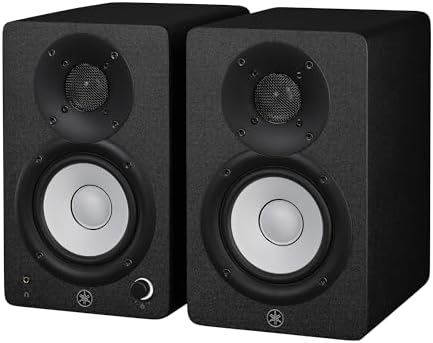
- Sold as a pair of speakers
- 2-way bass-reflex with 4.5" woofer, 1" tweeter
- 60 Hz – 22 kHz frequency response (-10 dB)
- 26 W and above 26 W output power
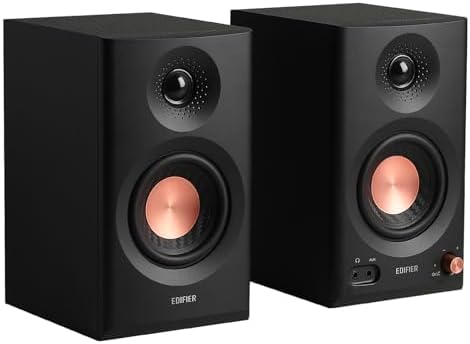
- Hi-Res Audio Certified – Experience superior sound with Hi-Res Audio certification, delivering a flat response across 52Hz to 40kHz for precise and…
- Rich Connectivity – Balanced TRS, RCA, and AUX inputs, headphone output, with Bluetooth supporting multi-point connection. RCA and AUX inputs enable…
- Powerful Sound Output – Enjoy 18W*2 RMS output with a peak SPL of 92.5dB, enhanced by 3.5" mid-low drivers and 1" tweeters for rich, full-range sound.
- Customizable Sound Experience – Easily switch between Music, Monitor, and Custom modes to suit your needs. Fine-tune your sound precisely through the…
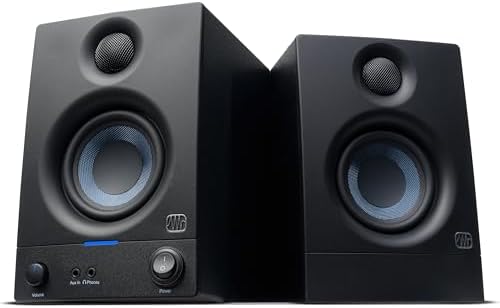
- TRUSTED STUDIO-QUALITY SOUND: True studio sound for music production, gaming, movies, streaming, and everyday audio. Sold as a complete stereo pair.
- POWERFUL, DISTORTION-FREE SOUND: 50 watts of built-in amplification drives clear, dynamic sound at any volume — powerful enough to fill the room,…
- ACCURATE, POWERFUL SOUND: 3.5” woven-composite woofers deliver deeper, tighter bass while 1” silk-dome tweeters smooth out harshness for clear,…
- DIAL IN PERFECT SOUND IN ANY ROOM: Built-in high- and low-frequency acoustic tuning controls let you tailor the sound to your space — no treatment or…

- Sold as a pair, sized for desks and small studios
- Hear your mix or stream the way it actually sounds, not flattered
- Tone Knob: dial voicing from your desk without menus
- Location Switch: corrects bass whether they sit against a wall or free

- Latency Free Wired Connection – Engineered for zero-latency audio monitoring, these wired desktop speakers provide a pure, uninterrupted signal…
- Studio-Grade Sound – Upgrade your built-in computer speakers with crystal-clear, bi-amplified power that delivers professional studio monitor quality…
- 3.5-inch Kevlar Woofers – Designed for ultimate acoustic performance, the Black Kevlar low-frequency drivers provide a smooth, punchy bass response…
- Natural Silk Dome Tweeters – Experience the full spectrum of frequencies with natural silk dome tweeters that provide precise stereo imaging and…
1. (2) JBL 305P MkII 5″ 2-Way Active Powered Studio Reference
Best for: Producers who need a wide sweet spot for accurate mixing.
This monitor stands out for its Image Control Waveguide, which is designed to create a consistent sound field. In a daily studio workflow, this means you don’t have to sit perfectly still to hear the correct balance of your mix. The dual 41-watt amplifiers provide enough dynamic range for cinematic design, while the rear-facing Boundary EQ allows you to adjust the output if you place the speakers near a wall.
Compared to the Yamaha HS5 Pair, the JBL 305P MkII features a specialized waveguide that focuses on imaging, whereas the HS5 emphasizes a completely uncolored, neutral frequency response. If you’re working in a room with limited acoustic treatment, the EQ settings on these speakers help you compensate for room-induced bass buildup.
Pros
- Patented Image Control Waveguide for precise sound
- Boundary EQ and HF Trim for room adjustment
- Dual 41-watt Class-D amplifiers
- Includes two studio reference monitors
Cons
- Requires physical cables for every input, so it won’t work with wireless devices.
2. Yamaha HS8 8-Inch Powered Studio Monitor Pair
Best for: Professionals working in larger rooms who need high power.
With an 8-inch cone woofer and a bi-amp system totaling 120 watts, these are the most powerful monitors on this list. The large magnets and advanced magnetic circuit are built to handle high-performance audio without distortion. They provide a frequency response starting at 38Hz, which is deeper than any other pick here, making them suitable for full-range monitoring.
The Yamaha HS8 Pair offers more low-end reach than the Yamaha HS4 Pair, which hits 60Hz. Because of their size, they’re best suited for larger desks or dedicated speaker stands where you have the physical space to let the 8-inch drivers perform.
Pros
- Powerful 120W bi-amp system
- 8-inch cone woofer for deep bass
- Wide 38Hz – 30kHz frequency response
- Sold as a matched pair
Cons
- A woofer this large requires significant desk or stand space.
3. YAMAHA HS5 Powered Studio Monitor
Best for: Engineers who prioritize a neutral, uncolored sound profile.
These monitors are designed to show you exactly what is in your recording without adding artificial warmth or excitement. With a frequency response of 54Hz to 30kHz, they provide a clear view of the mid-range and high frequencies. They’re a popular choice for those who need to hear flaws in a mix so they can fix them before finalizing a track.
The Yamaha HS5 Pair provides 70 watts of total power, which is less than the 120 watts found on the Yamaha HS8 Pair. They’re small enough for most desks while still maintaining the professional-grade components that define the Yamaha HS series. They support both balanced XLR and TRS inputs for reliable connectivity.
Pros
- Neutral sound with no artificial coloring
- 5-inch cone woofer for balanced mid-range
- 70 watts total power
- XLR and TRS inputs for professional gear
Cons
- The 54Hz lower frequency limit means you might miss frequencies below that range.
4. Yamaha HS4 Powered Studio Monitor in Black
Best for: Users who want the Yamaha sound in a compact size.
These are the smallest monitors in the Yamaha HS lineup, featuring a 4.5-inch woofer. They include a comprehensive set of inputs, including XLR/TRS combo jacks, RCA, and a stereo mini jack. This makes them very flexible if you need to connect a computer, an audio interface, and a secondary device like a phone or media player simultaneously.
The Yamaha HS4 Pair offers a 60Hz to 22kHz frequency response, which is a tighter range than the 54Hz to 30kHz found on the Yamaha HS5 Pair. They include room control and high trim switches on the back, allowing you to tune the response based on where they sit on your desk. The package even includes the cables and anti-slip pads you need to get started.
Pros
- Compact 4.5-inch woofer design
- Versatile input options including RCA and Stereo Mini
- Room control and high trim switches
- Includes cables and anti-slip pads
Cons
- The 60Hz frequency limit is the highest floor on this list.
5. Edifier MR3 Powered Studio Monitor
Best for: Creators who need both wired quality and wireless flexibility.
These speakers are unique because they include Bluetooth multi-point connectivity. You can keep your computer connected via balanced TRS cables while also pairing your phone or tablet wirelessly. They’re Hi-Res Audio certified and offer a 52Hz to 40kHz response, which is a very wide range for a 3.5-inch driver system.
Compared to the M-Audio BX3, the Edifier MR3 offers the convenience of the EDIFIER ConneX app for EQ adjustments. This app lets you switch between different listening modes or customize the sound profile to your liking. They’re built with an MDF cabinet to keep the sound clean and reduce unwanted vibrations during playback.
Pros
- Bluetooth support with multi-point connection
- Hi-Res Audio certification
- Customizable sound modes via app
- Balanced TRS and RCA inputs
Cons
- Requires the use of an app for in-depth EQ adjustments.
6. PreSonus Eris 3.5 Powered Studio Monitors
Best for: Beginners who want a balanced sound in a small space.
These monitors are designed to be an all-in-one solution for music production, streaming, and movies. They feature a 3.5-inch woven-composite woofer that provides a tight bass response, paired with a 1-inch silk-dome tweeter for clear highs. With 50 watts of power, they’re designed to fill a small room without distorting the audio.
The PreSonus Eris 3.5 includes front-panel controls, such as a headphone jack and an aux input, which is more accessible than the rear-only inputs on the M-Audio BX3. They also include high and low-frequency tuning knobs on the back, allowing you to tailor the output to the acoustics of your specific room.
Pros
- Front-panel aux input and headphone jack
- 50 watts of built-in power
- High and low-frequency acoustic tuning
- Woven-composite woofers for tight bass
Cons
- This woofer is smaller than the 5-inch models listed.
7. Mackie CR3.5 Studio Monitors (Pair)
Best for: Users who want to adjust tone without digging into software.
These monitors are built for simplicity. The most notable feature is the physical tone knob on the front, which lets you change the voicing of the speakers instantly. There’s also a location switch on the back that helps you correct the bass response depending on whether the speakers are pushed against a wall or sitting in an open space.
The Mackie CR3.5 comes with isolation pads and all necessary cables, providing a complete package. Compared to the Edifier MR3, which relies on an app for EQ, the Mackie uses simple, tactile controls that work immediately. They are designed to provide an accurate representation of your mix.
Pros
- Physical tone knob for quick voicing
- Location switch for bass correction
- Includes isolation pads and all cables
- Compact size for small studios
Cons
- The tone knob provides less granular control than the app-based EQ on the Edifier MR3.
8. M-AUDIO BX3 3.5″ Wired Studio Monitors Pair
Best for: Users who want a reliable, zero-latency wired connection.
These monitors use Kevlar low-frequency drivers, which are known for being rigid and durable. The sound is designed to be punchy and clear, making them a good choice for beat-making or gaming. They feature an acoustically-inert MDF cabinet, which helps prevent the speaker housing from adding its own resonance to your music.
The M-Audio BX3 offers a variety of rear inputs, including 1/4-inch, 1/8-inch, and RCA connections. Compared to the PreSonus Eris 3.5, which has a front-panel aux input, the M-Audio keeps the front panel cleaner, housing only the headphone jack. They’re designed to provide a professional-grade upgrade over standard computer speakers.
Pros
- Compact Kevlar woofers for punchy bass
- Acoustically-inert MDF cabinet construction
- Rear-panel hook-up flexibility
- Front headphone jack for private listening
Cons
- Lacks the wireless Bluetooth convenience found on the Edifier MR3.
Also Worth Considering
The Ortizan C7 Powered Studio Monitors include Bluetooth 5.3 connectivity. They offer a wireless alternative to the wired M-Audio BX3, though they lack the specific Kevlar driver construction found on that model.
How We Chose
18 Amazon listings were compared on frequency response range, connectivity options, and total power output, and near-duplicates were left out. Products that didn’t specify their input types were excluded, as the ability to connect to professional audio interfaces is a requirement for this category. The selection focuses on the balance between physical size and sonic accuracy to ensure suitability for different room setups.
How to Choose the Best Studio Monitors Under 1000
Size and where it has to fit
The physical dimensions of the monitor and its woofer determine how well it fits your desk. Larger speakers like the Yamaha HS8 Pair require more space, while compact options like the Yamaha HS4 Pair or PreSonus Eris 3.5 are better for smaller workstations.
Connectivity and how you listen
Consider whether you need to connect only to an audio interface or if you also need Bluetooth for casual listening. Monitors like the Edifier MR3 offer wireless options, while the JBL 305P MkII is designed purely for professional wired setups.
Sound profile and tuning
Some monitors, like the Yamaha HS5 Pair, are designed to be completely neutral. Others, like the Mackie CR3.5, provide physical tone knobs to help you shape the sound to your preference.
Related guides
- How to Hear the Beat Through Headphones in FL Studio
- Do Beats Studio 3 Have a Headphone Jack
- How to Turn off Direct Monitoring FL Studio
Frequently Asked Questions
Do I need an audio interface to use these monitors?
Most monitors here, such as the JBL 305P MkII and Yamaha HS5 Pair, use balanced XLR or TRS inputs. While you can connect them to a computer with adapters, an audio interface provides a cleaner signal and better volume control, which is the standard for professional audio production.
Can I place these speakers directly against a wall?
Many speakers, like the Mackie CR3.5, include a location switch to compensate for wall placement. If your monitors have rear-facing ports, they generally need a few inches of clearance to prevent bass buildup, or you can use the Boundary EQ found on models like the JBL 305P MkII to adjust the low-end response.
Is the wattage the most important spec for sound quality?
Wattage indicates the power of the amplifier, but it doesn’t equate to sound quality. A lower-wattage monitor with high-quality drivers, such as the Yamaha HS5 Pair, can provide more accurate and cleaner sound than a high-wattage speaker with poor construction. Focus on the frequency response range for better context.
What is the difference between active and passive monitors?
All the monitors on this list are active, meaning they have built-in amplifiers. You don’t need to buy a separate amplifier to power them. This is the most efficient choice for home studios because the manufacturer has matched the amplifier specifically to the drivers used in the cabinet.
How do I connect a subwoofer to these monitors?
Ensure your monitors have a balanced output or your interface has a dedicated sub-out before adding a subwoofer. Most models, including the Yamaha HS8 Pair, operate as a stereo pair, so verify your interface can route signals to both the monitors and the sub simultaneously.
Why is one speaker louder than the other on my desk?
A volume mismatch usually traces back to how the signal reaches each cabinet. On models like the Yamaha HS4 Pair, one monitor sends audio to the second via an included speaker cable rather than both receiving independent feeds. Before assuming a driver is faulty, firmly reseat every cable linking the units.
What causes a constant hum or buzz from studio monitors?
A persistent low-frequency hum almost always points to a ground loop or an unbalanced cable run. When using RCA inputs—available on the Edifier MR3 and PreSonus Eris 3.5—the signal lacks balanced noise cancellation. Moving audio cables away from power cords often eliminates the noise immediately.
How far apart should I place my monitors for mixing?
The distance between your speakers dictates how accurately you hear the stereo field. Form an equilateral triangle: the distance between the two speakers should equal the distance from each speaker to your head. For compact models like the Mackie CR3.5, about three feet of spacing usually works well.
Can I lay these monitors on their sides instead of standing them up?
Turning a studio monitor sideways changes how sound waves interact with your desk and ears. Most speakers here, including the JBL 305P MkII and Yamaha HS5 Pair, are engineered as vertical 2-way designs. Laying them flat causes certain frequencies to cancel out as you move your head.
Do I really need the isolation pads included with some monitors?
When a speaker plays bass, the cabinet vibrates, turning a hollow wooden desk into a resonator that muddies the sound. Isolation pads break this physical connection. The Mackie CR3.5 includes isolation pads in the box to decouple the speakers from your furniture right out of the packaging.
Which input type gives the cleanest audio signal?
Balanced connections are the standard for professional studios because they reject outside noise. Both the JBL 305P MkII and Yamaha HS5 Pair feature XLR and TRS inputs for this purpose. An XLR cable uses three pins so any electrical noise picked up along the cable cancels out entirely.
How does room correction EQ actually change the sound?
Every room alters the sound a speaker produces. Hard walls reflect high frequencies, and corners trap bass, creating peaks and dips that have nothing to do with your actual mix. Room correction switches let you compensate for these physical realities. The JBL 305P MkII features Boundary EQ, which is specifically designed to reduce the artificial bass boost that happens when you push a speaker close to a wall or into a corner. It also has an HF Trim switch to adjust the high frequencies if your room is overly reflective or heavily carpeted.
Other models handle this differently based on their size and target use. The Yamaha HS4 Pair includes room control and high trim response controls on the back panel, allowing you to tune the smaller 4.5-inch drivers to your specific desktop environment. The PreSonus Eris 3.5 takes a similar approach with built-in high- and low-frequency acoustic tuning controls, letting you tailor the output from its small drivers without needing external hardware. The Mackie CR3.5 simplifies the process with a location switch that corrects the bass depending on whether the monitors sit against a wall or stand free in the room.
What does the frequency response range actually tell me?
The numbers listed for frequency response indicate the span of pitches a speaker can reproduce, measured in Hertz (Hz) for low sounds and kilohertz (kHz) for high sounds. Human hearing generally spans from 20Hz to 20kHz.
Smaller drivers naturally struggle to produce the lowest frequencies. The PreSonus Eris 3.5 lists a range of 80Hz to 20kHz, which tells you that deep sub-bass notes—like the fundamental thump of an 808 kick drum—will roll off before you hear them. The Yamaha HS4 Pair hits 60Hz, while the Edifier MR3 claims a remarkably wide 52Hz to 40kHz range despite its compact mid-low drivers. If you’re working with electronic music or cinematic sound design where sub-frequencies matter, a monitor that stops at 80Hz forces you to rely on headphones or add a dedicated subwoofer to your setup.
Are bi-amplified speakers better than single-amplifier designs?
Every monitor on this list utilizes a bi-amplified architecture, meaning it contains two separate amplifiers inside the cabinet—one dedicated solely to the woofer and another solely to the tweeter. The Yamaha HS8 Pair specifies a 75W LF plus 45W HF bi-amp system, totaling 120 watts. By splitting the power this way, the heavy lifting required to move the 8-inch cone doesn’t steal current from the delicate 1-inch dome tweeter.
This separation improves clarity, especially at higher volumes. The Yamaha HS5 Pair uses a 45W LF plus 25W HF system for 70 watts total, scaling the power down to match its smaller 5-inch driver while maintaining the same architectural advantage. Even the compact M-Audio BX3 highlights bi-amplified power as a core feature to deliver studio-grade sound from its small Kevlar woofers and silk dome tweeters.
Does Bluetooth connectivity introduce latency for recording?

Wireless convenience comes with a physical trade-off: processing time. The Edifier MR3 stands out on this list by offering Bluetooth multi-point connection alongside its wired inputs, allowing you to stream audio from a phone while keeping a computer plugged in. However, Bluetooth transmission inherently introduces a delay between the moment you play a note and the moment you hear it through the speaker. For casual listening, podcast playback, or referencing a mix on a phone, this delay is imperceptible and harmless.
For live tracking—such as singing into a microphone or playing a MIDI keyboard—that delay becomes unusable. Hearing your own voice echo back a fraction of a second late disrupts timing and performance. This is exactly why the M-Audio BX3 emphasizes its engineered zero-latency wired connection for live streaming, gaming, and studio work. If you plan to record instruments or vocals, you must bypass the wireless features and plug your audio interface directly into the balanced TRS or RCA inputs. The Edifier MR3 accommodates this easily by providing those wired connections alongside its Bluetooth module, but during a recording session, the wireless function should be treated as a playback convenience, not a monitoring tool.
Conclusion
Finding the right speakers is just the start. Once they’re on your desk, spend a few days listening to music you love before mixing anything new. You’ll learn how they translate sound in your room, and your ears won’t trick you later.
As an Amazon Associate, Instrument Insight earns from qualifying purchases at no additional cost to you.