
The Yamaha P225 features a flagship CFX concert grand voice and graded hammer action. Choosing a piano depends on key feel, voice count, and form factor. This guide helps you pick the right instrument.
Different models serve different musical paths.
- Best Overall: Yamaha P225 – Authentic CFX concert grand voice paired with natural graded hammer key action.
- Most Authentic Feel: Yamaha P71 – Acoustic-style weighted touch with a simple one-button interface for focused practice.
- Best Upright Design: AKLOT Weighted Upright – Sturdy wood-grain cabinet with sliding lid, ambient light, and triple pedals.
- Best Furniture Style: Donner DDP-80 – Minimalist retro wood build with French DREAM sound engine and triple pedals.
- Most Versatile Tones: Donner DEP-20 – Wide selection of 238 instrument voices and 128-note maximum polyphony.
- Best Progressive Action: MOSEN Progressive Hammer – Progressive hammer action keys paired with dual Bluetooth and starter kit accessories.
- Best Visual Interface: Donner DDP-95 – Large 4.3-inch blue backlit screen displaying staff notation and active key positions.
- Best Compact Build: VEVOR Weighted Digital – Streamlined minimalist cabinet featuring 238 built-in tones and dual-keyboard teaching mode.
- Simplest to Use: Glarry 88-Key – Straightforward hammer action console featuring dual Bluetooth and integrated 10W stereo speakers.
- Best for Beginners: Alesis Recital – Lightweight semi-weighted practice board with battery power option and included interactive lesson subscriptions.
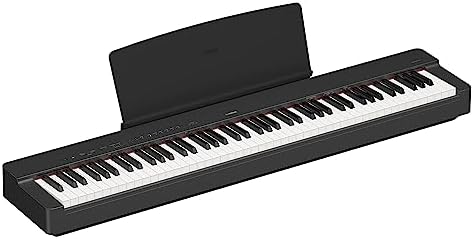
- Weighted keyboard action
- Yamaha CFX Grand Piano sound
- 24 instrument voices
- App connectivity

- Touch-sensitive weighted keys
- 10 instrument voices
- Simple one-button operation
- Dual mode for layered sound

- 88-key graduated hammer action
- Dual 25W speakers
- Wood grain furniture finish
- Headphone mode for practice

- 88-key full-weighted hammer action
- French DREAM sound source
- 2x 25W stereo speakers
- Wood finish furniture design

- 88 full-sized hammer action keys
- 238 tones and 128 polyphony
- Dual-tone mode
- LCD screen and 25W amplifiers

- 88 weighted progressive action keys
- 128-note polyphony and 128 tones
- Bluetooth and MIDI connectivity
- Triple pedal system

- 88-key fully-weighted keyboard
- 4.3" blue light LCD display
- 610 tones and 600 rhythms
- 3 teaching modes
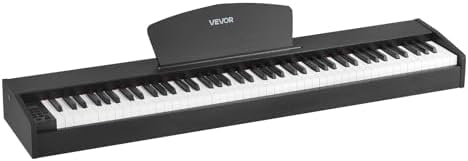
- 88-key fully weighted hammer action
- Dual speaker system
- 238 rhythms and 238 tones
- Dual keyboard mode
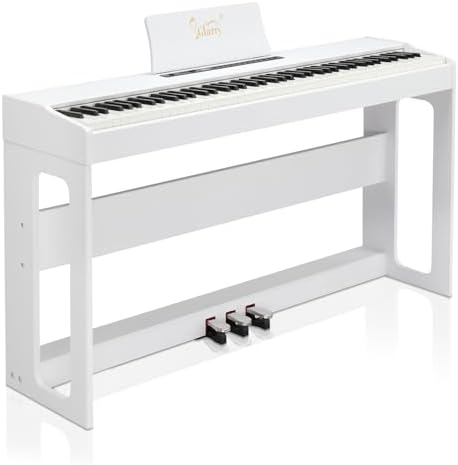
- Full weighted hammer action keys
- Record and play feature
- Metronome and transpose control
- USB and MIDI input/output

- 88 full-sized semi weighted keys
- 5 voices and 20W speakers
- Headphone and RCA outputs
- Battery or adapter power
1. Yamaha P225 88-Key Digital Piano with Weighted Keys
Best for: Serious students wanting authentic concert grand sound.
Yamaha built the P225 around its premium CFX Full Concert Grand voice, capturing mechanical resonance and rich tone depth. The keyboard action provides graded acoustic resistance, giving lower notes a heavier pull while letting higher notes feel noticeably lighter under your fingers. It connects directly with Yamaha apps like Smart Pianist and Rec’n’Share, so you can adjust settings through your phone screen or record clean performance videos without extra equipment.
You get 24 distinct instrument voices, spanning realistic organs, electric pianos, and acoustic basses, giving you plenty of variety for daily drills. It includes a sustain foot switch, music rest, and power adapter.
- Pros:
- Yamaha flagship CFX Full Concert Grand sampling
- Graded keyboard action matches acoustic piano weighting
- Seamless pairing with Smart Pianist and Rec’n’Share apps
- Includes music rest, power adapter, and foot switch
- Cons:
- The box lists a basic sustain foot switch and not a three-pedal unit, so nuanced pedal work requires buying an upgrade
2. YAMAHA P71 88-Key Weighted Action Digital Piano with Sustain Pedal
Best for: Minimalist players who want pure piano focus.
The Yamaha P71 keeps things direct and uncluttered with its single-button operation. Instead of wrestling with screens, complex dials, or deep configuration menus, you hold down the main button and press a key to switch between its 10 acoustic and electric voices. The weighted action simulates the resistance of a traditional acoustic keyboard, giving your fingers proper training for dynamics and touch control.
You can engage Dual Mode to blend two sounds simultaneously, such as laying warm acoustic strings behind a concert grand tone. It ships with a power supply and a basic sustain pedal, so you can plug it straight in and begin working through your repertoire immediately. The clean, lightweight top panel keeps your focus on your sheet music.
- Pros:
- Full 88-key weighted action replicates acoustic touch
- Simple one-button interface eliminates practice distractions
- Dual Mode combines two voices for layered practice
- Includes sustain pedal and standard power supply
- Cons:
- Listed with 10 total voices, which limits sound exploration for players who like arranging modern synthesizer or brass parts
3. AKLOT Weighted Upright Digital Piano
Best for: Living rooms needing fine upright furniture aesthetics.
The AKLOT Weighted Upright brings full furniture styling into your home, featuring an enclosed wooden base, sturdy vertical legs, and an integrated sliding keyboard lid to keep out dust. Its graduated hammer action mechanism delivers firm initial resistance followed by sensitive rebound, helping players develop proper finger velocity across fast runs. The cabinet houses dual 25-watt speakers in a sealed chamber for punchy bass and transparent highs.
Under the hood, a French Dream chip and dedicated DSP processor drive four expressive piano tones: Classical, Pop, Jazz, and Bar. A brightness dial tweaks the acoustic profile, while a soft 12V light strip illuminates the keybed for late-night practice. A classic metal-core triple pedal setup provides authentic damper, soft, and sostenuto control.
- Pros:
- Graduated hammer action with high-precision velocity sensing
- Dual 25W ear-height stereo speakers inside a sealed chamber
- Integrated sliding lid, ambient lighting strip, and triple pedals
- French Dream sound chip with four tailored acoustic voices
- Cons:
- Offers only 4 selectable tones, ruling it out for players wanting organs, synthesizers, or orchestral strings
4. Donner DDP-80 Digital Piano 88 Key Weighted Keyboard
Best for: Modern homes seeking sleek wooden furniture styling.
The Donner DDP-80 blends clean mid-century furniture styling with traditional keyboard mechanics. Finished in a retro wood grain, it sits atop four angled legs that look right at home in modern living spaces. The heavy hammer action keys mimic an acoustic grand, registering finger dynamics accurately for both loud and quiet passages.
A French DREAM sound source delivers realistic acoustic piano samples, driven through a dual 25-watt stereo sound system that produces convincing room-filling volume. It comes equipped with a matched three-pedal unit mounted to a lower crossbar, offering traditional soft, sostenuto, and sustain controls. A USB-MIDI port lets you connect an iPad or computer for direct learning apps and DAW composition.
- Pros:
- Striking retro wood furniture profile with four sturdy legs
- Full-weighted 88-key heavy hammer action keybed
- Dual 25W stereo speakers provide substantial room projection
- Includes metal triple-pedal unit and matching sheet rest
- Cons:
- Listed with a single acoustic piano sound, so anyone wanting organs, electric pianos, or strings must connect external software
5. Donner DEP-20 Beginner Digital Piano 88 Key Full Size Weighted
Best for: Versatile musicians needing extensive onboard sounds.
The Donner DEP-20 serves as a flexible creative workstation, combining a full-weighted 88-key hammer action keyboard with an expansive sound bank. It includes 238 instrument voices ranging from grand pianos to synths. A backlit LCD screen displays active chord names, rhythms, and voice numbers.
Its dual-tone function allows you to blend two instruments together, while split mode divides the keyboard into two equal zones for side-by-side student and teacher duets. Dual 25-watt internal amplifiers project deep, distinct tones across all frequencies, backed by a generous 128-note polyphony ceiling that prevents dropped notes during complex sustain-heavy passages.
- Pros:
- Full-sized hammer action with adjustable touch response
- 238 diverse instrument voices and 128-note max polyphony
- Backlit LCD screen clearly shows notation, chords, and tones
- Twin 25W stereo amplifiers deliver robust audio output
- Cons:
- The package includes a portable sustain pedal and not a three-pedal unit, requiring an optional accessory for soft and sostenuto play
6. MOSEN 88 Key Progressive Hammer Action Weighted Digital Piano
Best for: Students wanting full accessories in one package.
The MOSEN Progressive Hammer features progressive weighted action that mimics the variable touch of a grand piano, helping beginners develop correct finger mechanics from their first lesson. Its French DREAM audio engine pairs with 128-note polyphony to ensure sustained arpeggios ring out smoothly without cutting off prematurely. Dual stereo speakers spread sound evenly across your practice room, while an onboard LCD screen provides quick feedback on settings.
This bundle includes a wooden stand, pedal assembly, music rest, and key stickers for early learners. Wireless dual Bluetooth connectivity lets you stream background tracks from your smartphone through the piano’s speakers or pair directly with interactive MIDI learning applications on a tablet.
- Pros:
- Progressive hammer action mimics natural resistance
- French DREAM sound source with 128 voices and 128 rhythms
- Dual Bluetooth for wireless audio playback and MIDI lesson apps
- Complete starter kit includes wooden console and triple pedals
- Cons:
- At 128 built-in voices, it offers a noticeably smaller tone library than the 610 tones found on the Donner DDP-95
7. Donner DDP-95 Digital Piano with 88 Key Weighted Keyboard
Best for: Visual learners who read musical notation on screen.
The Donner DDP-95 stands out thanks to its large 4.3-inch blue backlit display, which presents standard musical staff notation, indicates active key positions, and gives real-time visual prompts during practice. Its 88-key fully weighted keyboard offers 16 adjustable levels of touch sensitivity, allowing you to fine-tune key responsiveness to match your exact finger strength.
With 610 tones, 600 rhythms, and 100 demo songs, this console functions like an arranger workstation. Three dedicated teaching modes let you isolate your left or right hand while practicing tricky classical pieces, allowing you to build muscle memory gradually. An integrated 5,000-byte recording memory lets you capture your rehearsals to analyze phrasing mistakes.
- Pros:
- Spacious 4.3-inch LCD clearly displays musical staff notation
- Massive sound library featuring 610 tones and 600 rhythm tracks
- 16-level touch sensitivity adjustment for personalized key action
- Three interactive teaching modes support isolated hand practice
- Cons:
- The internal recording memory caps out at 5,000 bytes, which limits how many multi-track performances you can store locally
8. VEVOR Weighted Digital Piano
Best for: Small apartments needing a slim, space-saving slab.
The VEVOR Weighted Digital piano packs full-size hammer action into a sleek, minimalist slab that fits neatly onto small desks or lightweight folding stands. Its fully weighted keys feature selectable levels of touch sensitivity, letting you match the keyboard’s response curve to your playing style. A dual internal speaker system pumps out balanced stereo audio, cleanly capturing the delicate nuances of its acoustic grand piano samples.
The instrument includes 238 voices, 238 rhythms, and 100 demo pieces for casual songwriting or daily exercises. Its dual-keyboard mode splits the entire range into two identical pitch sections, allowing a teacher and student to sit side by side on one bench to demonstrate and mimic fingering drills. It also supports wireless connection to phone apps for guided tutorials.
- Pros:
- Full-size hammer action with multiple touch-sensitivity levels
- Dual-keyboard mode splits keybed into identical pitch zones
- Broad library of 238 tones, 238 rhythms, and 100 demo songs
- Wireless connectivity supports easy pairing with practice apps
- Cons:
- The listing specifies this model ships without a stand, so setting it up at proper playing height requires a separate stand purchase
9. Glarry 88-Key Digital Piano
Best for: Households wanting a complete white upright console.
The Glarry console features triple-pedal mechanics and fully weighted hammer action. The keys emulate the physical hammer throw of an acoustic instrument, reacting reliably to gentle or aggressive finger strikes. It features an integrated French DREAM sound source that reproduces full acoustic samples through built-in 10-watt stereo speakers.
The attached pedal board houses soft, sostenuto, and sustain pedals to control tone intensity, dampening, and resonance. It also provides dual Bluetooth channels, letting you stream backing tracks wirelessly via Bluetooth Audio while sending performance data over Bluetooth MIDI into software recording suites on your computer or phone.
Regarding amplifier power, the Glarry is equipped with twin 10W speakers, which compares to the dual 25W speakers built into the AKLOT Weighted Upright. This model focuses on fundamental piano patches rather than a large sound palette.
- Pros:
- Full weighted hammer heavy action keys capture dynamic changes
- Dual Bluetooth connections for simultaneous audio streaming and MIDI
- Complete three-pedal unit with soft, sostenuto, and sustain controls
- Built-in recording and playback feature captures practice runs
- Cons:
- Dual 10W speakers offer less acoustic output compared to models housing 25W sound systems, limiting volume in large living rooms
10. Alesis Recital Digital Piano 88-Key Semi-Weighted
Best for: Beginners looking for a lightweight, battery-powered board.
The Alesis Recital is designed specifically for students taking their first steps in music education, featuring 88 full-sized semi-weighted keys with adjustable touch resistance. While semi-weighted keys don’t have the heavy physical hammer throw of an acoustic piano, they give beginners light, springy resistance that’s gentle on unconditioned fingers. It runs on the included power supply or six D-cell batteries for portable practice anywhere.
Audio fires through two built-in 20-watt speakers that produce surprisingly loud, clean stereo sound. You get five primary voices: Acoustic Piano, Electric Piano, Organ, Synth, and Bass, along with built-in Chorus and Reverb effects to expand your tone. Educational features include a handy lesson mode that divides the keybed into two zones with the exact same pitch, plus included subscriptions to Skoove and Melodics interactive training software.
- Pros:
- Lightweight semi-weighted keys with adjustable touch response
- Can run on 6 D-cell batteries for true wireless portability
- Two 20W stereo speakers deliver clear, room-filling sound
- Includes 3 months of Skoove and 30 days of Melodics online lessons
- Cons:
- The product box excludes a sustain pedal, so buyers must purchase a 1/4-inch foot pedal separately to sustain notes
Also Worth Considering
The NOVATAGE Key Full-Weighted Digital Piano is an 88-key weighted piano that bundles an adjustable stool and U-shaped stand. It loses out to the MOSEN Progressive Hammer, which provides dual Bluetooth connectivity and progressive hammer action, but it remains a sensible pick for buyers who need a matching bench included right in the shipping box.
The Donner DEP-16A is an 88-key weighted keyboard that includes a three-pedal unit for classical foot control. The Donner DEP-20 beats it out thanks to its rich backlit LCD screen and comprehensive 238-tone sound library, yet the DEP-16A remains attractive for someone who wants Donner’s weighted action paired directly with a triple-pedal unit out of the box.
The UISCOM is an 88-key semi-weighted keyboard that arrives with a stand, sustain pedal, sheet stand, and headphones. The Alesis Recital holds the edge over it with its robust 20-watt speaker array and battery-powered portable design, but the UISCOM is worth looking at if you want bundled headphones and a frame stand packaged together in a single order.
How We Chose
29 Amazon listings were compared on key weighting type, speaker amplifier wattage, and included pedal equipment, and near-duplicates — another colour, another size of one already here — were left out. To earn a spot, a listing had to state a full 88-key layout, clearly identify its keybed action type, and disclose its sound engine or voice library. Instruments with incomplete key counts or ambiguous keyboard specifications were eliminated. Separation between the picks came down to cabinet style, polyphony limits, onboard screen interfaces, and whether essential practice gear came standard or had to be purchased separately.
How to Choose the Right Weighted Digital Piano
Key action and hammer resistance
Keybed construction dictates how closely a digital keyboard copies the mechanical feel of an acoustic instrument. Graded hammer action, featured on the Yamaha P225 and AKLOT Weighted Upright, provides heavier resistance in the lower bass registers and lighter touch at the treble end. Semi-weighted designs, like the Alesis Recital, use lighter spring tension that works well for younger beginners or portable gigging musicians.
Furniture console versus portable slab
Console pianos come with permanent wooden legs, structural crossbars, and modesty panels that resemble traditional home uprights. The Donner DDP-80 and AKLOT Upright serve as decorative furniture with solid stability. Portable slab models like the Yamaha P71 and VEVOR Weighted Digital fit into gig bags or scissor stands, making them easy to pack away.
Speaker amplification and sound projection
Speaker wattage determines dynamic clarity, low-end bass resonance, and maximum volume output before digital clipping occurs. Compact systems like the Glarry 88-Key utilize dual 10-watt drivers suitable for small study bedrooms. Larger living rooms benefit from the dual 25-watt systems on the Donner DEP-20 and AKLOT Upright, which push rich volume without external amplifiers.
Pedals and practice accessories
A complete acoustic piano setup relies on three distinct foot pedals: sustain (damper), soft (una corda), and sostenuto. Traditional upright bundles like the MOSEN Progressive Hammer include built-in triple-pedal units fixed to the lower frame. Slab keyboards like the Yamaha P225 ship with basic single foot switches, meaning players working on advanced classical pieces must purchase three-pedal expansions separately.
Frequently Asked Questions
Can an 88-key weighted keyboard run on standard batteries?
Most fully weighted digital pianos require a continuous 12-volt DC wall adapter to power their heavy key sensors and high-wattage speaker amplifiers. The Alesis Recital stands out as an exception on this list, offering battery operation using six D-cell batteries, though its lighter semi-weighted key mechanism uses less power than mechanical hammer action designs.
What is the practical difference between fully weighted and semi-weighted keys?
Fully weighted keys use physical mechanical weights or simulated hammers to recreate the resistance of striking strings, as seen on the Yamaha P71 and Donner DDP-80. Semi-weighted keys, such as those on the Alesis Recital, combine light mechanical weights with spring resistance, making the board much lighter to carry but less authentic for classical finger training.
How does polyphony affect complex piano practice?
Polyphony represents the maximum number of individual sound notes a digital piano can render at the same instant without dropping trailing notes. Advanced models like the Donner DEP-20 and Donner DDP-80 feature 128-note polyphony, ensuring rapid, pedal-sustained arpeggios ring out smoothly without notes cutting off.
Are digital piano triple pedals necessary for beginner lessons?
Beginners spend their first year using only the sustain pedal to hold chords and smooth transitions. A three-pedal unit, included standard on the AKLOT Weighted Upright and Glarry 88-Key, becomes important once you tackle intermediate classical repertoire that specifically marks soft pedal and sostenuto pedal techniques.
Does a weighted digital piano require regular mechanical tuning?
Digital pianos use digital acoustic audio samples stored on internal memory chips, such as the French DREAM engine inside the MOSEN Progressive Hammer.

The Yamaha P225 is a choice for players who want graded hammer resistance and the sound of Yamaha’s flagship CFX concert grand. If you want a simpler board that runs on batteries and offers light keys for early technique drills, pick up the Alesis Recital and start practicing your scales today.
As an Amazon Associate, Cleanestor earns from qualifying purchases at no additional cost to you.