
The Yamaha HS5 is the top pick among these best studio monitors because it ships as a matched pair with 70 watts of bi-amplified power and a stated goal of sonic purity. This guide helps anyone setting up a home recording space, podcasting desk, or editing room who needs honest sound from their speakers. What actually separates these picks isn’t just size — it’s how each one handles your specific room, what connections you need, and whether the box gives you everything to start working right away.
- Best Overall: Yamaha HS5 — two monitors, 70W bi-amped power, and a focus on pure, uncolored sound.
- Best Imaging: JBL 305P MkII — patented waveguide delivers a wide sweet spot for precise stereo placement.
- Best Mid-Range Accuracy: PreSonus Eris E5 — 80W Class AB amplification provides serious headroom for nearfield mixing.
- Best Compact Studio Monitor: PreSonus Eris E4.5 — small footprint with front-panel headphone output and aux input.
- Best Tone Control: Mackie CR4.5 — single front-panel knob adjusts voicing instantly without reaching behind the speaker.
- Best Wireless Connectivity: Edifier MR3 — Bluetooth multi-point connection lets you switch devices without replugging cables.
- Best Wired Desktop Pair: M-Audio BX4 — zero-latency wired design built specifically for computer-based streaming and production.

- Includes two Yamaha HS5 studio monitors
- 2-way bi-amplified monitor with 5 inch woofer
- 54 hertz to 30 kilohertz frequency response
- 45W LF plus 25W HF for 70 watts total

- Includes two 305P MkII 5 inch powered monitors
- Dual 41-Watt Class-D amplifiers with 5-inch woofer
- Boundary EQ and HF Trim adjust room frequencies

- 6.55-inch woven composite low-frequency transducer
- 1.25-inch (32 mm) silk-dome high-frequency transducer
- Includes Studio One Prime and Studio Magic plug-in suite
- 100˚(H) x 60˚(V) EBM waveguide design
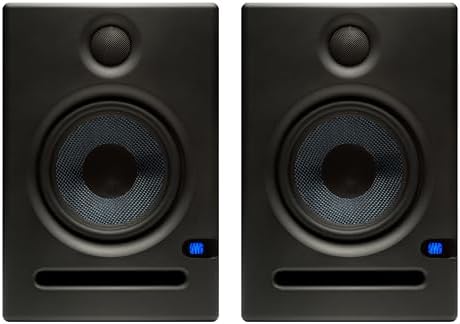
- 5.25-inch woven composite woofer
- 1-inch ultra-low-mass silk-dome tweeter
- 80 watt, Class AB bi-amplification

- HONEST. Eris 4.5 near field studio monitors deliver studio-quality, accurate sound perfect for music production, hi-fi audio listening, or multimedia…
- EXPRESSIVE. Clear, accurate audio with a big low end — Eris 4.5’s woven-composite woofers’ weave and nature result in tight bass that you can feel,…
- POWERFUL. Compact speakers that pack a punch — 50 Watts of Class AB dual amplification (25W per side) provide all the volume and loudness you want…
- ULTRA-WIDE LISTENING SWEET SPOT. The natural high-frequency response of the 1-inch low-mass, silk-dome transducers (tweeters) provide superior stereo…

- Sold as a pair, the step-up size for desks with more room
- Fuller low end than 3.5-inch monitors without needing a sub
- Tone Knob: front-panel voicing control
- Location Switch: wall or free-standing bass correction
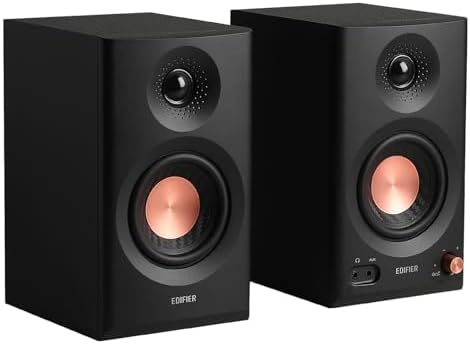
- Hi-Res Audio Certified – Experience superior sound with Hi-Res Audio certification, delivering a flat response across 52Hz to 40kHz for precise and…
- Rich Connectivity – Balanced TRS, RCA, and AUX inputs, headphone output, with Bluetooth supporting multi-point connection. RCA and AUX inputs enable…
- Powerful Sound Output – Enjoy 18W*2 RMS output with a peak SPL of 92.5dB, enhanced by 3.5" mid-low drivers and 1" tweeters for rich, full-range sound.
- Customizable Sound Experience – Easily switch between Music, Monitor, and Custom modes to suit your needs. Fine-tune your sound precisely through the…

- Latency Free Wired Connection – Engineered for zero-latency audio monitoring, these wired desktop speakers provide a pure, uninterrupted signal…
- Studio-Grade Sound – Upgrade your built-in computer speakers with crystal-clear, bi-amplified power that delivers professional studio monitor quality…
- 4.5-inch Kevlar Woofers – Designed for ultimate acoustic performance, the Black Kevlar low-frequency drivers provide a smooth, punchy bass response…
- Natural Silk Dome Tweeters – Experience the full spectrum of frequencies with natural silk dome tweeters that provide precise stereo imaging and…
1. YAMAHA Hs5 Powered Studio Monitor
Best for: producers wanting uncolored reference sound in pairs.
Yamaha built the HS5 around one clear idea: sonic purity without coloring or altering the original sound. That matters when you’re mixing music or editing dialogue, because what you hear is exactly what you recorded. The box includes two monitors, so you get a complete stereo setup immediately without hunting for a second speaker later. Each cabinet houses a 5-inch cone woofer and a 1-inch dome tweeter driven by a dedicated amplifier.
The bi-amp system splits the workload, sending 45 watts to the low frequencies and 25 watts to the highs for a total of 70 watts per speaker. That separation keeps the bass tight while the treble stays detailed. On the back panel, you’ll find both XLR and TRS phone jack inputs that accept balanced or unbalanced signals. This means they plug straight into professional audio interfaces and consumer mixers alike.
Comparing its frequency response to the rest of the list, the HS5 covers 54 hertz to 30 kilohertz, which sits between the 52-hertz floor of the Edifier MR3 and the deeper reach you’d expect from larger drivers. It doesn’t dig as deep as the PreSonus Eris E7 XT, but it doesn’t try to — it aims for accuracy in the midrange where most instruments live. You won’t need extra software to tune them, though you might want acoustic treatment if your room is very reflective.
Anyone tracking heavy bass music like hip-hop or EDM will notice the 54-hertz bottom end stops short of sub-bass territory.
Pros
- Sold as a pair of two monitors in one box
- 70 watts of total bi-amplified power per speaker
- 45W low-frequency and 25W high-frequency amplifiers
- XLR and TRS inputs handle balanced and unbalanced signals
- 5-inch cone woofer paired with a 1-inch dome tweeter
Cons
- Frequency response starts at 54 hertz, so deep sub-bass monitoring requires adding a separate subwoofer
2. (2) JBL 305P MkII 5″ 2-Way Active Powered Studio Reference
Best for: mixers needing a wide, forgiving listening position.
JBL designed the 305P MkII around its patented Image Control Waveguide, a piece of engineering meant to deliver crystal-clear imaging across a broad area. If you move your head while mixing, the stereo image shouldn’t collapse. That wide sweet spot makes this package especially useful for podcasting duos or producers who share a desk, since both people hear an accurate picture without sitting perfectly still in one chair.
Inside the MDF enclosure, dual 41-watt Class-D amplifiers drive a 5-inch woofer and a Slip Stream port. Together, they push dynamic range and deep bass that JBL says suits cinematic sound design. You also get Boundary EQ and HF Trim switches on the back. These let you adjust low and high frequencies to match your room, cutting boominess if you have to place the speakers close to a wall.
This listing states the package includes two monitors, matching the Yamaha HS5 in quantity, but it takes a different approach to power delivery with its dual Class-D amplification against the Yamaha’s 70 watts of Class AB-style bi-amplification. The inputs mirror the industry standard too, offering both XLR and TRS connections. JBL notes these went through a 100-hour reliability test, confirming they can handle long sessions.
Producers working in untreated rooms with lots of hard surfaces will find the boundary EQ helpful, but those who already treat their spaces heavily might not use it often.
Pros
- Package includes two 305P MkII monitors
- Patented Image Control Waveguide widens the sweet spot
- Dual 41-watt Class-D amplifiers power each speaker
- Boundary EQ and HF Trim adjust output to your room
- XLR and TRS inputs accept various signal types
Cons
- Boundary EQ settings are fixed adjustments rather than continuous dials, limiting fine-tuning options in highly irregular rooms
3. PreSonus Eris E7 XT 2-Way Active Studio Monitor with EBM
Best for: engineers needing extended low-end from a single monitor.
PreSonus lists the Eris E7 XT as a pack of one, which immediately changes how you plan your setup. You’ll need to buy two for stereo mixing, but the trade-off is a massive 6.55-inch woven composite low-frequency transducer. That’s the largest woofer in this entire guide, and it’s built to give deep lows without relying on a subwoofer for basic tracking.
The high frequencies come from a 1.25-inch ultra-low-mass silk-dome transducer, which is noticeably larger than the 1-inch tweeters found on most other picks here. PreSonus pairs these drivers with an innovative EBM waveguide measuring 100 degrees horizontally and 60 degrees vertically. That shape yields a wide sweet spot and solid imaging, keeping your stereo field stable even if you shift in your chair.
Acoustic tuning controls sit on the back, covering Level, HPF, LF Trim, HF Trim, and Acoustic Space settings. You can contour the monitor to your exact room dimensions. The listing also mentions included software: Studio One Prime and the Studio Magic plug-in suite. Compared to the Yamaha HS5’s 5-inch woofer, this 6.55-inch driver moves significantly more air, making it the obvious choice if your genre relies on heavy low-end information.
Buyers needing a matched stereo pair out of the box should note that this listing only contains a single monitor.
Pros
- 6.55-inch woven composite low-frequency transducer
- 1.25-inch ultra-low-mass silk-dome high-frequency transducer
- 100-degree by 60-degree EBM waveguide for wide dispersion
- Five acoustic tuning controls including a high-pass filter
- Includes Studio One Prime and Studio Magic plug-in suite
Cons
- Packaged as a single unit, so stereo mixing requires buying two separately
4. PreSonus Eris E5 Pair 2-Way 5.25” Near Field Studio Monitors
Best for: nearfield mixers requiring high headroom and protection.
The PreSonus Eris E5 comes as a pair, ready for stereo work right out of the box. Its main selling point is 80 watts of Class AB bi-amplification, which provides plenty of volume and headroom for nearfield monitoring. That power reserve means your mixes stay clean even when you push the levels during loud playback sessions, reducing the chance of distortion masking your decisions.
A 5.25-inch woven composite woofer delivers the low end with minimal bass distortion, while a 1-inch ultra-low-mass silk-dome tweeter eliminates harshness. PreSonus added a front-firing acoustic port to help with superior bass-frequency reproduction, especially useful if you place these near a wall. On the back, you’ll find balanced XLR and 1/4-inch inputs alongside unbalanced RCA inputs, covering almost every device you might own.
Protection circuits are listed in detail here: RF interference containment, output current limiting, over-temperature shutoff, transient protection, and subsonic filtering. Against the JBL 305P MkII’s dual 41-Watt Class-D setup, this Class AB system offers similar overall power but uses a different amplification topology favored by many traditional studio engineers.
Those with extremely small desks might find the 5.25-inch woofer cabinets take up more surface area than they can spare.
Pros
- Sold as a pair of two-way nearfield monitors
- 80 watts of Class AB bi-amplification for high headroom
- Front-firing acoustic port enhances bass reproduction
- Balanced XLR, 1/4-inch, and unbalanced RCA inputs included
- Built-in protection against RF, heat, transients, and subsonic frequencies
Cons
- 80 watts of Class AB amplification draws more continuous power than lower-wattage desktop alternatives
5. PreSonus Eris E4.5-2-Way 4.5″ Near Field Studio Monitor (Pair)
Best for: desktop creators needing compact size and quick access.
PreSonus engineered the Eris E4.5 for tight spaces where a full-sized studio monitor won’t fit. At 4.5 inches, the woven-composite woofers are smaller than the 5-inch drivers on the Yamaha HS5, yet they’re designed to deliver tight bass you can feel along with cleaner overall sound. The listing calls them compact speakers that pack a punch, aiming at music production, hi-fi listening, and multimedia reference.
Power comes from 50 watts of Class AB dual amplification, split as 25 watts per side. That’s enough to fill a small room without sacrificing tonal balance. The 1-inch low-mass silk-dome tweeters provide natural high-frequency response and superior stereo imaging from nearly any listening angle. You also get high- and low-frequency tuning controls on the back to customize the output for your room size and speaker orientation.
Connectivity is unusually generous for this size. The back panel holds 1/4-inch TRS balanced inputs and unbalanced RCA inputs, but the real convenience is the front-panel 1/8-inch TRS stereo aux input for plugging in a phone quickly. There’s also a front-panel headphone output with a built-in amplifier, letting you switch to silent monitoring instantly. PreSonus notes compatibility with their Eris Sub 8BT if you eventually want a 2.1 system.
Mixers working in large, acoustically treated control rooms will find the 50-watt output insufficient for filling that kind of space.
Pros
- Pair of 4.5-inch woven-composite woofers for tight bass
- 50 watts of Class AB dual amplification (25W per side)
- Front-panel 1/8-inch TRS aux input for mobile devices
- Front-panel headphone output with built-in amplifier
- High- and low-frequency tuning controls included
Cons
- 50 watts of total Class AB dual amplification (25W per side)
6. Mackie CR4.5 Studio Monitors (Pair)
Best for: casual users wanting simple, immediate sound adjustment.
Mackie sells the CR4.5 as a pair, positioning them as the step-up size for desks with more room. They feature 4.5-inch woofers that deliver a fuller low end than 3.5-inch monitors without needing a subwoofer. The standout feature here is simplicity: a single Tone Knob sits on the front panel for instant voicing control, meaning you don’t have to reach behind the speaker to tweak the sound.
Alongside the tone knob, a Location Switch corrects the bass response depending on whether you place the monitors free-standing on a desk or push them up against a wall. This kind of hardware toggle removes guesswork from room placement. Mackie also includes isolation pads and all necessary cables in the box. That’s a significant detail, because many other listings leave you hunting for speaker wire before you can make any noise.
While the PreSonus Eris E4.5 offers individual high- and low-frequency tuning controls on the rear, the Mackie opts for a single front-facing knob that changes the overall voicing at once. For someone who just wants to turn a dial until the music sounds good, that’s faster. However, it offers less surgical precision for critical mixing tasks where you need to adjust specific frequency bands independently.
Audio engineers requiring independent high and low frequency trim controls will find the single tone knob too blunt for precise room correction.
Pros
- Sold as a pair with 4.5-inch woofers
- Front-panel Tone Knob for immediate voicing adjustment
- Location Switch toggles between wall and free-standing bass correction
- Box includes both monitors, isolation pads, and all cables
- Fuller low end than smaller 3.5-inch desktop speakers
Cons
- Single Tone Knob replaces independent frequency trims, limiting precise acoustic tailoring for critical mixing
7. Edifier MR3 Powered Studio Monitor
Best for: producers switching between phones, computers, and instruments.
Edifier built the MR3 around versatility, starting with Hi-Res Audio certification and a flat frequency response spanning 52Hz to 40kHz. That upper limit reaches further than the Yamaha HS5’s 30kHz ceiling, capturing extreme harmonic overtones. The 3.5-inch mid-low drivers and 1-inch tweeters produce 18 watts RMS per channel, with a peak SPL of 92.5dB, housed in an MDF cabinet designed to reduce distortion.
Wireless connectivity sets this apart from every other pick. Bluetooth supports multi-point connection, letting you pair two devices simultaneously and switch between them without disconnecting. You also get balanced TRS, RCA, and AUX inputs that enable simultaneous wired connections. A headphone output is included for private listening. Through the EDIFIER ConneX app, you can switch between Music, Monitor, and Custom modes, applying personalized EQ control directly from your phone.
At modest power per side, the total RMS output is significantly lower than what competing nearfield monitors offer. That means the MR3 is strictly a nearfield or desktop solution, not something to fill a large room. Still, for video editing, guitar playing, and daily listening in a small space, the combination of Bluetooth, app control, and multiple wired inputs makes it highly adaptable.
Engineers needing high-volume playback for large studio spaces will hit the 92.5dB peak SPL ceiling quickly.
Pros
- Hi-Res Audio certified with 52Hz to 40kHz frequency response
- Bluetooth multi-point connection for wireless streaming
- Balanced TRS, RCA, and AUX inputs plus headphone output
- EDIFIER ConneX app offers Music, Monitor, and Custom EQ modes
- 18W per channel RMS output in an MDF cabinet
Cons
- Peak SPL is listed at 92.5dB, capping maximum loudness well below higher-powered monitors
8. M-AUDIO BX4 4.5″ Wired Studio Monitors Pair
Best for: streamers and gamers demanding zero-latency desktop audio.
M-Audio markets the BX4 specifically for latency-free wired connections, skipping wireless entirely to ensure a pure, uninterrupted signal. That makes them ideal for live streaming, gaming, podcasting, and studio work where even a millisecond of Bluetooth delay ruins the experience. They arrive as a compact pair of wired desktop speakers, upgrading standard computer audio with bi-amplified power.
The drivers consist of black Kevlar low-frequency woofers for smooth, punchy bass and natural silk dome tweeters for pristine highs. An acoustically-inert MDF cabinet with an advanced bass reflex design stops unwanted vibration. M-Audio emphasizes that this construction produces deep sound quality superior to standard plastic multimedia speakers. Rear inputs include 1/4-inch, 1/8-inch, and RCA connections, ensuring instant compatibility with DJ gear, instruments, and studio equipment.
For late-night sessions, a front panel 1/8-inch AUX input lets you connect headphones directly. Comparing the driver material here to the PreSonus Eris E4.5, the BX4 uses Kevlar for its woofers while the PreSonus relies on a woven-composite material; both aim for rigidity, but Kevlar is traditionally chosen for its high strength-to-weight ratio in acoustic cones. Neither offers the wireless flexibility of the Edifier MR3, but that’s intentional.
Pros
- Zero-latency wired connection for live streaming and gaming
- 4.5-inch Black Kevlar low-frequency woofers
- Natural silk dome tweeters for precise stereo imaging
- Bi-amplified power in an acoustically-inert MDF cabinet
- Rear 1/4-inch, 1/8-inch, and RCA inputs plus front headphone jack
Cons
- Strictly wired design means no Bluetooth or wireless connectivity options are available
Also Worth Considering
The PreSonus Eris Powered Studio Monitors listing describes a pair of 3.5-inch active nearfield monitors. They’re smaller than the 4.5-inch PreSonus Eris E4.5, which means less bass extension and lower overall output. Anyone with a severely restricted desk footprint might still prefer them, but the E4.5 offers more driver area and a front headphone jack.
The Edifier R1700BT Bluetooth Bookshelf Speaker listing names a 2.0 active near-field setup with a wooden enclosure and 66 watts RMS. That power figure beats the RMS output of the Edifier MR3, making it louder, but it’s styled as a bookshelf speaker rather than a dedicated studio reference monitor. Buyers wanting living-room volume with Bluetooth could consider it.
The Mackie CR4.5BT Powered Studio Monitors listing identifies a compact creative reference pair. It shares the same driver size as the wired Mackie CR4.5 but adds “BT” for Bluetooth. If you love the front-panel tone knob but absolutely need wireless streaming, this variant fits, though the wired version keeps the signal path simpler.
How to Choose the Right Studio Monitor
Driver size and bass extension
Decide how low your music needs to go before picking a speaker. Larger woofers move more air, producing deeper bass naturally. The PreSonus Eris E7 XT uses a 6.55-inch driver for extended lows, while the Edifier MR3 relies on a 3.5-inch driver that rolls off earlier. Match the woofer size to your genre and whether you plan to add a subwoofer later.
Amplification power and headroom
Check the wattage to know how loud the monitors play cleanly. Higher power reserves prevent distortion during loud mixing passages. The PreSonus Eris E5 lists 80 watts of Class AB power, whereas the PreSonus Eris E4.5 provides 50 watts. More headroom matters if you work in medium-sized rooms or frequently push playback levels while tracking.
Room correction and placement controls
Look at the back panel for switches that adapt the speaker to your walls. Rooms cause bass buildup, and built-in EQ helps fix it. The JBL 305P MkII offers Boundary EQ and HF Trim, while the Mackie CR4.5 uses a Location Switch for wall versus desk placement. Without these, you might need external acoustic treatment panels sooner.
Inputs and included accessories
Count the cables in the box before buying anything else. Some listings provide everything, while others assume you have gear. The Mackie CR4.5 includes isolation pads and all cables, but the PreSonus Eris E7 XT ships as a single unit. Ensure the inputs—XLR, TRS, or RCA—match your audio interface or computer outputs.
Frequently Asked Questions
Do I need an audio interface for these monitors?
Most powered monitors accept line-level signals directly from a computer’s headphone jack via RCA or 1/8-inch cables, like the inputs on the M-Audio BX4. However, balanced XLR or TRS connections—found on the Yamaha HS5—require an audio interface or mixer to send a proper balanced signal, reducing hum and interference over longer cable runs.
Can I add a subwoofer to these setups later?
Yes, if the monitors or your interface support routing low frequencies externally. The PreSonus Eris E4.5 listing specifically mentions compatibility with the Eris Sub 8BT to create a 2.1 system. Others, like the JBL 305P MkII, include boundary EQ that helps adjust low frequencies to suit your room when you decide to expand.
What does bi-amplified actually mean for my mixes?
Bi-amplification assigns separate power amplifiers to the woofer and the tweeter inside one cabinet. The Yamaha HS5 uses 45 watts for lows and 25 watts for highs. This prevents the bass driver from stealing power during heavy drops, keeping the high frequencies clear and detailed, which results in more accurate translation when you listen elsewhere.
Are Bluetooth monitors okay for professional mixing?
Bluetooth introduces slight latency, which can cause sync issues when tracking instruments or editing video frame-by-frame. The Edifier MR3 offers Bluetooth for convenient listening but also includes balanced TRS inputs for zero-delay wired monitoring. For critical mixing, professionals generally stick to wired connections like those emphasized by the M-Audio BX4 to ensure perfect timing.
Why do some listings sell one speaker instead of two?
Certain larger monitors are sold individually. The PreSonus Eris E7 XT is listed as a pack of one. Always check the “What’s Included” section carefully; otherwise, you might set up your desk and realize you only have half a stereo pair.
How important is the waveguide design on a monitor?
A waveguide shapes how sound leaves the tweeter, controlling high-frequency spread across your room. The JBL 305P MkII uses a patented Image Control Waveguide, and the PreSonus Eris E7 XT uses an EBM waveguide rated at 100 by 60 degrees. Both designs widen the sweet spot so your mix sounds consistent even if you shift slightly in your chair.
Conclusion

The Yamaha HS5 remains a reliable choice for most people because it arrives as a pair, delivers 70 watts of bi-amplified power, and focuses entirely on uncolored sound reproduction. If you need something simpler for a small desk, the Mackie CR4.5 offers a single tone knob and includes all your cables in the box. Pick the one that matches your room size, connect it to your interface, and start listening.
As an Amazon Associate, Cleanestor earns from qualifying purchases at no additional cost to you.