
Finding the best violin shoulder rest means balancing your physical comfort against the specific size of your instrument. The Kun Collapsible Shoulder Rest earns the top spot as the most reliable choice for 4/4 violins, offering the premium quality that most players expect from a standard accessory. This guide helps you navigate the various frames and padding types available to ensure your practice sessions remain pain-free and productive. The one factor that truly separates these picks is how they adjust to your unique neck length and shoulder shape.
- Most Ergonomic Support: Bonmusica Violin Shoulder Rest — Features a unique curved base for personalized, stable positioning.
- Best Wood Construction: Fiddlerman Wood Shoulder Rest — Combines a resonant wooden frame with a comprehensive warranty.
- Best Folding Design: Everest Folding Shoulder Rest — A compact solution for players who prioritize portability in their cases.
- Most Durable Build: SUEWIO Aluminum Shoulder Rest — Constructed with an aluminum alloy base designed to resist impact damage.
- Best for Beginners: Meidier Ergonomic Shoulder Rest — Includes essential accessories to help new students start their practice journey.
- Best Metal Frame: RAUYIVANY Metal Shoulder Rest — Utilizes a spring-loaded attachment system for secure, long-lasting performance.
- Most Adjustable Fit: Jasiyah Foldable Shoulder Rest — Offers a quick-adjust system that adapts to various player needs rapidly.

- Fits 4/4 violin
- Height and width adjustable
- Padded curved adjustable base

- Height adjustable and collapsible feet
- Fits 4/4 and 3/4 violins, 13" and 14" violas
- Solid wood body
- Premium foam padding

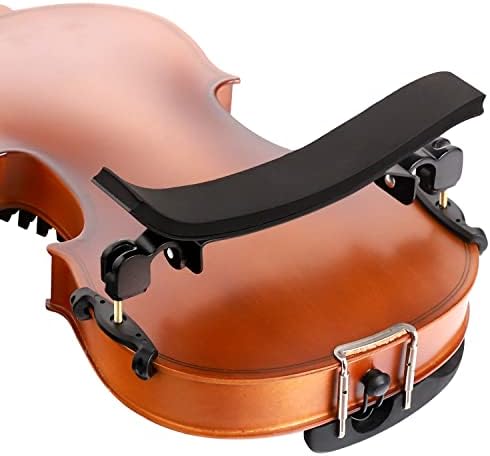
- Compatible with 4/4 violin
- 0.3 inch thick foam pad
- Adjustable length and height
- Aluminum alloy base, weight 109g

- Soft EVA foam padding
- Weighs 57g
- Adjustable for 4/4 and 3/4 violins
- Non-slip silicone feet

- Thicker padding for comfort
- Fits 4/4 and 3/4 violins
- Adjustable support
- Secure spring attachment design

- Adjustable height and width, foldable
- Reinforced polymer composite frame
- 0.55" thick memory foam cushion
- Non-slip rotatable rubber feet
1. Kun Collapsible Shoulder Rest

Best for: Players who want a proven, reliable 4/4 accessory.
This model is a staple in the music world, known for its ability to fold down into a compact shape that fits easily into most violin cases. It’s built to the standards of the Kun brand, which prioritizes a balance between firm support and a lightweight feel. Because it’s designed specifically for 4/4 violins, it provides a secure fit that doesn’t feel loose or distracting while you play.
The collapsible feet are the standout feature here, as they allow you to tuck the unit away without removing the adjustment settings. This means you can keep your height preference intact from one day to the next. When comparing its design to the Fiddlerman Wood Shoulder Rest, you’ll notice this model focuses on a sleek, minimalist profile rather than the warm resonance of a wooden frame.
Anyone who plays a fractional-sized violin should look elsewhere, as this unit is strictly listed for full-sized instruments.
Pros
- Collapsible design for easy storage
- Premium quality build standards
- Designed specifically for full-sized violins.
Cons
- Limited to full-sized violins.
2. Bonmusica 4/4 Violin Shoulder Rest
Best for: Musicians managing arthritis or past shoulder injuries.
If you struggle with discomfort, the curved base of this model provides a level of custom support that standard flat rests can’t match. You can adjust both the height and the width to create a cradle that fits your body precisely. Because the base is padded and shaped to follow the line of your shoulder, it helps keep the violin in a stable, ergonomic position.
The build quality emphasizes precision, as it’s manufactured in Germany. While other rests use simple tension to stay in place, this one focuses on a structural shape that distributes the weight of the instrument more evenly across your shoulder. Against the SUEWIO Aluminum Shoulder Rest, this model offers a much more customizable curvature at the expense of a heavier, more complex frame.
Players who prefer a simple, “set-it-and-forget-it” rest may find the level of customization on this model more involved than they need.
Pros
- Highly adjustable width and height
- Padded curved base for ergonomic fit
- Made in Germany
Cons
- Requires more time to dial in the perfect shape
3. Fiddlerman Wood Violin Shoulder Rest
Best for: Players who prefer the aesthetic and resonance of wood.
This rest is crafted from solid wood, which provides a distinct look and a firm feel that many find superior to plastic or metal alternatives. It includes collapsible feet, ensuring that the warm, resonant body doesn’t take up unnecessary space in your accessory compartment. The inclusion of a 12-month warranty from Fiddlershop adds a layer of security to your purchase.
The foam padding is designed to offer maximum support, which is helpful if you practice for long periods. It’s versatile enough to fit both 4/4 and 3/4 violins, and the listing notes it can even fit 13-inch and 14-inch violas. When you compare its material to the aluminum base of the SUEWIO Aluminum Shoulder Rest, you get a more traditional, classic appearance here.
Anyone needing a rest for a tiny fractional violin, such as a 1/2 or 1/4 size, will find this model too large for their instrument.
Pros
- Solid wood construction for resonance
- Fits 4/4 and 3/4 violins
- Includes a 12-month warranty
Cons
- Not compatible with smaller, fractional-sized violins.
4. Everest 4/4 Folding Shoulder Rest
Best for: Musicians who travel frequently with their gear.
This rest focuses on a folding mechanism that makes it exceptionally easy to stow away between practice sessions. It’s a straightforward, no-nonsense tool that serves its purpose without adding extra weight or bulky features to your setup. Its design is centered on utility and efficiency for the daily player.
While the listing is sparse, the fold-down nature is the primary benefit for those with limited space in their cases. Compared to the Jasiyah Foldable Shoulder Rest, which emphasizes a memory foam cushion, this model prioritizes a classic, slim profile that many students find familiar.
Players who require significant height adjustment or special ergonomic shaping for health reasons might find this model too basic for their specific needs.
Pros
- Folding design for portability
- Simple to attach and remove
- Compact footprint in a case
Cons
- Lacks the advanced ergonomic padding of other picks
5. SUEWIO Aluminum Shoulder Rest
Best for: Players who want a rest that won’t break.
The aluminum alloy base makes this one of the most rugged options on the list. It’s built to withstand drops and the daily wear of being tossed into a gig bag. Despite the metal construction, it weighs only 109g, so it shouldn’t cause extra fatigue during long rehearsals.
You can adjust the claw position by moving the screws to different holes, allowing you to fine-tune the length. The 0.3-inch thick foam padding ensures that the metal frame doesn’t press uncomfortably against your collarbone. This model feels much more rigid than the Meidier Ergonomic Shoulder Rest, which uses a lighter, more flexible design.
Teenagers and children should avoid this model, as the listing explicitly states it’s only for full-sized violins and isn’t suitable for younger students.
Pros
- Durable aluminum alloy base
- Thick foam padding for comfort
- Adjustable claw positions
Cons
- Not meant for students using smaller violins
6. Meidier Ergonomic Shoulder Rest
Best for: Students who are just starting out.
This rest is designed to be as user-friendly as possible, with a lightweight construction that weighs only 57g. Because it’s meant for beginners, it includes a few extras like a practice mute and a cleaning cloth. These additions help students keep their instruments in good shape while they learn the basics of proper posture.
The EVA foam padding is soft and gentle, which is ideal if you’re still getting used to the sensation of holding a violin under your chin. It fits both 4/4 and 3/4 violins, meaning it can grow with the student as they move up in instrument size. Compared to the RAUYIVANY Metal Shoulder Rest, this model is much lighter and focuses on student-centered convenience.
Professional players who need high-tensile strength or extreme durability for constant gigging might find the lightweight plastic-and-foam construction less substantial than they prefer.
Pros
- Includes practice mute and cloth
- Very lightweight at 57g
- Fits both 4/4 and 3/4 violins
Cons
- Less rigid than metal-frame models
7. RAUYIVANY Metal Shoulder Rest
Best for: Those who need a very secure connection to the instrument.
This model uses a spring-loaded attachment system to keep the rest firmly gripped to the violin. This is particularly useful if you tend to move around a lot while playing, as it prevents the rest from slipping or detaching unexpectedly. The frame is made from durable materials.
The padding is described as thickened, which helps reduce pressure on the shoulder during extended sessions. It’s compatible with both 4/4 and 3/4 violins, making it a flexible option for growing players. When you compare its spring-loaded grip to the silicone feet on the Meidier Ergonomic Shoulder Rest, this model offers a more mechanical, high-tension hold.
Players who find that metal frames feel too heavy on the collarbone may prefer the lighter, foam-heavy designs found elsewhere on this list.
Pros
- Spring-loaded design for security
- Durable construction
- Fits two common violin sizes
Cons
- Heavier than plastic or wood alternatives
8. Jasiyah Foldable Shoulder Rest
Best for: Players who need to adjust their setup in seconds.
The standout feature of this rest is how quickly it can be adjusted, with the manufacturer noting it takes about 30 seconds to set the width and height. This is a great choice if you share your rest with others or if you’re constantly tweaking your setup to find the perfect angle. The 0.55-inch thick memory foam provides a very plush surface that conforms to your body.
The frame is made of a reinforced polymer composite, which is designed to transfer vibration efficiently. It folds up compactly, making it easy to store in any standard violin case. Compared to the Everest Folding Shoulder Rest, this model offers significantly thicker padding for those who prioritize comfort over a slim profile.
Anyone who prefers a rigid, non-folding frame for maximum stability might find the foldable joints on this model to be an unnecessary point of movement.
Pros
- Very thick memory foam padding
- Fast adjustment system
- Folds compactly
Cons
- Foldable joints may feel less rigid than fixed frames
Also Worth Considering
The NANYI Violin Shoulder Rest is a collapsible and adjustable model designed for 3/4 to 4/4 violins. It’s less specialized than the Bonmusica Violin Shoulder Rest, which offers superior ergonomic curvature for injured players, but it serves as a functional, basic option for students.
The EVEREST EZ-4A Violin Shoulder Rest is a 4/4 size unit that can be adjusted to fit 3/4 violins. It’s a solid, standard choice that lacks the specific memory foam comfort of the Jasiyah Foldable Shoulder Rest, but it remains a reliable alternative for those who prefer the Everest design language.
The EVEREST ES4PU Adjustable Shoulder Rest is a purple-colored variant for 4/4 violins. It performs identically to other Everest models in this series, so it’s best for players who want a specific aesthetic compared to the more neutral tones of the Kun Collapsible Shoulder Rest.
How We Chose
Each product had to state its compatibility with specific violin sizes to be considered for inclusion. Products that didn’t provide clear information on height or width adjustment were removed to ensure only versatile models remained. The final selections were grouped by the specific benefit each provided, such as portability, ergonomic support, or material composition.
How to Choose the Right Violin Shoulder Rest
Size and Instrument Compatibility
The most important step is matching the rest to your violin size. Most models listed here fit 4/4 instruments, while some, like the Fiddlerman Wood Shoulder Rest and the Meidier Ergonomic Shoulder Rest, accommodate 3/4 violins as well. Always verify your violin size before selecting a model to ensure the feet will grip the edges correctly.
Adjustment and Ergonomics
Consider how much you need to change the height and angle of the rest. Models like the Bonmusica Violin Shoulder Rest provide extensive ergonomic options, which are helpful for players with specific physical needs. If you only need a standard fit, the Kun Collapsible Shoulder Rest provides a consistent, reliable height that suits most players without complex adjustments.
Portability and Storage
If your violin case has limited space, look for a folding or collapsible design. The Everest Folding Shoulder Rest and the Jasiyah Foldable Shoulder Rest are built to fold down, saving you from having to take the rest apart every time you pack up. Proper instrument care involves maintaining consistent posture to prevent long-term strain.
Related guides
Frequently Asked Questions
Does the material of the shoulder rest affect the sound?
Some players believe that wooden rests, like the Fiddlerman Wood Shoulder Rest, offer a warmer resonance compared to plastic or metal versions. However, the primary job of any rest is to provide a stable, comfortable bridge between your shoulder and the instrument so your technique remains consistent during performance.
Can I use a 4/4 shoulder rest on a 3/4 violin?
Generally, no. Most 4/4 rests, such as the SUEWIO Aluminum Shoulder Rest, are specifically designed for the wider body of a full-size violin. Attempting to force a 4/4 rest onto a smaller instrument can cause the feet to slip, potentially damaging the finish or causing the violin to fall during practice.
Is it necessary to have a foldable shoulder rest?
A foldable rest is primarily for convenience. If you travel daily or have a compact case, a folding model like the Everest Folding Shoulder Rest is a smart choice. However, if you have a large case with plenty of accessory room, a fixed-frame model is perfectly fine.
How do I stop the shoulder rest from sliding off the violin?
The most common cause of slipping is incorrect placement of the feet on the instrument’s edges. Ensure the rubber feet on your rest, such as those on the RAUYIVANY Metal Shoulder Rest, are clean and free of rosin dust, which can act as a lubricant. If the feet are dirty, wipe them with a slightly damp cloth to restore the silicone’s natural grip.
Can I adjust the shoulder rest to be higher?
Yes, most models allow for height adjustment by rotating the feet or using the provided adjustment holes. For example, the SUEWIO Aluminum Shoulder Rest allows you to increase the height by unscrewing the claws and repositioning them. If you have a particularly long neck and find even the highest setting too low, you may need to look for a model with longer adjustable legs or specialized tall feet.
Will the feet of the shoulder rest damage my violin varnish?
High-quality rests use soft silicone or rubber feet to protect the finish of your instrument. The Meidier Ergonomic Shoulder Rest and the Jasiyah Foldable Shoulder Rest both utilize non-slip, wear-resistant materials specifically designed to grip the violin firmly without scratching the wood. Always ensure the feet are securely attached to the edges of the instrument rather than resting on the delicate varnish of the back or belly.
What should I do if the shoulder rest feels unstable?
First, check that the width is set correctly so the feet seat firmly against the bouts of the violin. If the rest still feels wobbly, ensure all adjustment screws are tightened fully. On a model like the Bonmusica Violin Shoulder Rest, you may need to adjust the curvature of the base to better match the slope of your shoulder, which will significantly improve the overall stability of the instrument while you’re playing.
Are there specific shoulder rests for players with long necks?
Players with longer necks often benefit from rests that offer substantial height, such as the SUEWIO Aluminum Shoulder Rest. You should look for models that explicitly state they have height-adjustable feet. Some players also find that adding an additional layer of foam helps bridge the gap more comfortably.
Should I keep the shoulder rest on the violin when I put it in the case?
Most players remove the shoulder rest before storing the violin to avoid pressure on the instrument. If you have a collapsible model like the Kun or Everest, you can fold the feet down to fit the unit inside your accessory pocket. This keeps your violin safe during storage.
Does the weight of the shoulder rest matter for beginners?
Lighter rests, like the 57g Meidier Ergonomic Shoulder Rest, are often better for beginners because they don’t change the balance of the instrument significantly. A heavier rest can make the violin feel “bottom-heavy,” which might distract a student who is still learning to hold the instrument correctly. As you gain more experience, you may find that the extra weight of a metal-frame rest provides a more grounded and secure feeling.
How do I know if my shoulder rest is the right width?

The width is correct when the feet sit snugly on the edges of the violin without needing to be forced. If the rest is too wide, it will slide; if too narrow, it may put tension on the frame. Most adjustable rests allow you to slide the feet to fit.
Can I use a shoulder rest on a violin with a chinrest that’s off-center?
Yes, you can use a shoulder rest with most chinrest styles by adjusting the rest’s position on the instrument. If your chinrest is off-center, you might need to angle the shoulder rest for support. Models like the Bonmusica are well-suited for this because you can customize the angle and height.
Final Thoughts
Choosing the right support shouldn’t feel like a chore, so don’t hesitate to visit a local music shop to try a few options in person. Once you’ve found a fit that feels natural, you’ll finally be able to focus entirely on your music instead of adjusting your gear during every practice session.
As an Amazon Associate, Instrument Insight earns from qualifying purchases at no additional cost to you.