
The Yamaha HS5 is the #1 pick among the best high-end studio monitors because its bi-amplified design and 54Hz-30kHz frequency response provide the reliable, professional-grade performance that creators need. These picks differ mainly in frequency range and connectivity.
Quick Picks
- Best Overall: Yamaha HS5 — professional bi-amplified performance with a wide frequency range.
- Best for Deep Bass: PreSonus Eris E7 XT — features a large 6.55-inch woofer for low-end power.
- Best Compact Design: Yamaha HS4 — tiny footprint that includes all necessary cables for setup.
- Most Accurate Response: Edifier MR4 — tuned for a flat curve for precise music creation.
- Best for Mixing: PreSonus Eris E5 — includes acoustic tuning controls to suit any environment.
- Best for Pristine Highs: KRK Kreate 3 — utilizes a specialized textile dome tweeter for clear highs.
- Best Connectivity: Edifier MR3 — offers Bluetooth, balanced TRS, and simultaneous multi-device input.
- Best Wireless Integration: Fluid Audio C5BT — supports wireless streaming with Aptx and optical input.
- Best for Small Studios: Mackie CR4.5 — provides a fuller low end than smaller 3.5-inch models.
- Best Desktop Performance: M-AUDIO BX4 — engineered for zero-latency monitoring during live streaming.

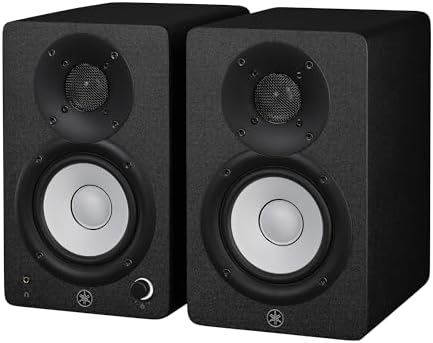
- 2-Way bass-reflex bi-amplified nearfield studio monitor with 5" cone woofer and 1" dome tweeter
- 54Hz-30kHz frequency response
- 45W LF plus 25W HF bi-amp system for high-performance 70W power amplification
- Room Control and High TRIM response controls

- 6.55-inch woven composite low-frequency transducer gives deep lows.
- 1.25-inch (32 mm), ultra-low-mass, silk-dome, high-frequency transducer provides smooth highs.
- Now comes included with Studio One Prime and Studio Magic plug-in suite, over $1000 USD worth of music production software.
- Innovative 100˚(H) x 60˚(V) EBM waveguide yields a wide sweet spot and solid imaging.
- Packaging: Pair
- 2-way bass-refiex powered speaker with 4.5" cone woofer and 1" dome tweeter
- 60 Hz – 22 kHz frequency response (-10 dB)
- 26 W and above 26 W output power

- TRUE STUDIO MONITOR – Based on the highly rated Edifier bookshelf speakers professionally tuned to a responsive almost flat curve for artists and…
- STUDIO QUALITY SOUND – The 1" silk dome tweeter and 4" composite woofer produce clear, smooth, and overall sound. MDF wood texture helps reduce…
- FLEXIBLE CONNECTORS – 1/4" balanced TRS input, an unbalanced RCA input, an unbalanced AUX input and a front headphone output are equipped for…
- Thoughtful Dual Mode Design – Freely switch between monitor mode, to listen to real audio for music production and music mode, to enjoy daily music…
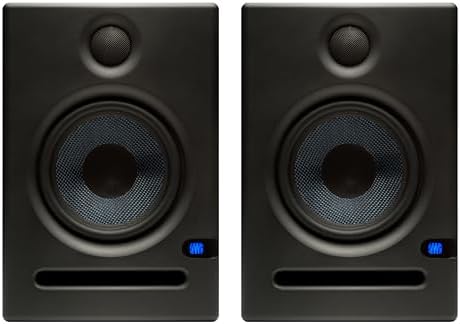
- An outstanding way to upgrade your monitoring so that your mixes translate.
- 5.25-inch woven composite woofer delivers solid low-end sound with minimal bass distortion.
- 1-inch ultra-low-mass silk-dome tweeter eliminates harshness and provides balanced high-frequency sound.
- 80 watt, Class AB bi-amplification provides plenty of volume and headroom for nearfield monitoring.

- Textile dome tweeter
- Woven glass fiber composite woofer
- 3.5” Glass Aramid Woofer with 1" Textile Dome Tweeter
- Bluetooth input for wireless audio streaming
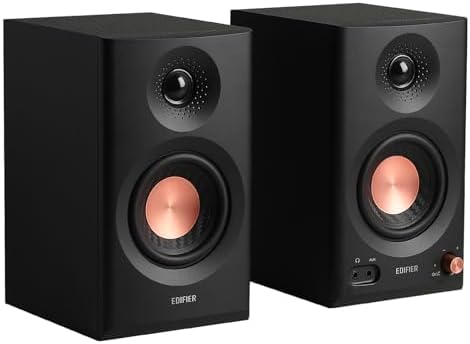
- Hi-Res Audio certified, 52Hz to 40kHz response
- Balanced TRS, RCA, AUX inputs and Bluetooth multi-point
- 18W*2 RMS output with peak SPL of 92.5dB
- Music, Monitor, Custom modes via EDIFIER ConneX app


- Sold as a pair
- Fuller low end than 3.5-inch monitors
- Tone Knob: front-panel voicing control
- Location Switch: wall or free-standing bass correction

- Zero-latency wired audio monitoring
- Bi-amplified desktop speakers
- 4.5-inch Kevlar Woofers
- Natural Silk Dome Tweeters
1. Yamaha HS5 Powered Studio Monitor
Best for: Professionals needing a reliable, bi-amplified nearfield monitor.
This monitor uses a 70W total power amplification system. The 5-inch cone woofer and 1-inch dome tweeter combination works well for those who need a balanced sound across a 54Hz to 30kHz frequency range. Room control and high trim settings let you tailor the sound to your space.
Pros
- Bi-amplified 70W system.
- Wide 54Hz-30kHz frequency response.
- Room and high trim controls.
- Balanced and unbalanced inputs.
Cons
- 5-inch woofer size is limited to nearfield use only.
2. PreSonus Eris E7 XT 2-Way Active Studio Monitor with EBM
Best for: Producers who prioritize deep low-end reproduction.
The 6.55-inch woven composite woofer is built to deliver low frequencies that smaller monitors often miss. It includes an EBM waveguide that creates a wide sweet spot, helping you hear an accurate stereo image while you mix. It also includes Studio One Prime software.
Pros
- Large 6.55-inch low-frequency transducer.
- 100-degree horizontal waveguide coverage.
- Includes music production software suite.
- Detailed acoustic tuning controls.
Cons
- Larger footprint limits placement on compact desks.
3. Yamaha HS4 Powered Studio Monitor in Black
Best for: Creators with limited desk space.
This pair of speakers is designed to fit where larger monitors simply cannot. Its 4.5-inch woofer covers a 60Hz to 22kHz frequency range. Inputs include XLR/TRS combo, RCA, and a stereo mini jack.
Pros
- Compact pair for tight spaces.
- Versatile input options including RCA.
- Includes all necessary cabling.
- Room and high trim adjustments.
Cons
- 26W output power is lower than the 70W Yamaha HS5.
4. Edifier MR4 Power Studio Monitor Speakers
Best for: Artists seeking a flat frequency response.
These speakers are tuned to provide a responsive, near-flat curve that helps you hear your music as it actually sounds. The MDF wood construction is helpful for reducing resonance, which keeps the sound clear. A front panel button switches between monitor and music modes.
Pros
- Tuned for a flat response curve.
- MDF cabinet minimizes sound resonance.
- Dual monitor and music modes.
- Front-panel headphone output.
Cons
- No wireless or Bluetooth input options.
5. PreSonus Eris E5 Pair 2-Way 5.25” Near Field Studio Monitors
Best for: Mixing engineers who need to refine their sound.
The Eris E5 uses an 80-watt Class AB bi-amplification system to provide plenty of headroom for critical listening. Its 5.25-inch woven composite woofer is paired with a front-firing acoustic port, which helps produce a solid low end. You also get extensive acoustic tuning controls to contour the output to your specific room.
Pros
- 80W Class AB bi-amplification.
- Front-firing acoustic port design.
- Comprehensive acoustic tuning controls.
- Multiple input types included.
Cons
- Lacks wireless streaming or Bluetooth connectivity.
6. KRK Kreate 3 Powered Studio Monitors Pair
Best for: Listeners who value clear, pristine high-frequency detail.
The textile dome tweeter is the standout feature here, designed specifically to deliver clear highs. A 3.5-inch glass aramid woofer keeps these monitors compact. Bluetooth streaming allows wireless audio playback.
Pros
- Specialized textile dome tweeter.
- Compact 3.5-inch glass aramid woofer.
- Bluetooth wireless audio streaming.
- Universal input connectivity.
Cons
- A woofer this small lacks the deep bass of larger models.
7. Edifier MR3 Powered Studio Monitor
Best for: Users who need multi-device connectivity.
This model is Hi-Res Audio certified and offers a wide frequency range from 52Hz to 40kHz. Its connectivity is a major benefit, featuring Bluetooth with multi-point support, balanced TRS, RCA, and AUX inputs. The Edifier ConneX app lets you adjust EQ settings.
Pros
- Hi-Res Audio certified performance.
- Bluetooth with multi-point connection.
- App-based EQ and sound modes.
- Simultaneous input capability.
Cons
- Requires app usage for in-depth sound tuning.
8. Fluid Audio C5BT Active Bluetooth Studio Monitor w/Aptx and Optical
Best for: Media creators who need optical and wireless inputs.
This monitor is built for flexibility with an optical input and Bluetooth support with Aptx. It simplifies connecting both professional gear and digital devices. The inclusion of a TRS input ensures you can still plug in your standard studio equipment.
Pros
- Optical input for digital sources.
- Bluetooth with Aptx support.
- Balanced TRS and RCA inputs.
- Compact active design.
Cons
- Lacks physical acoustic tuning knobs found on other picks.
9. Mackie CR4.5 Studio Monitors (Pair)
Best for: Small studios that need a bit more bass.
The CR4.5 is a step up from the smallest desktop monitors, providing a fuller low-end sound without requiring a separate subwoofer. It features a convenient tone knob on the front and a location switch that helps you correct the bass depending on whether the speakers are against a wall or free-standing. Everything you need to get started is in the box.
Pros
- Fuller low end than the smallest desktop speakers.
- Convenient front-panel tone knob.
- Includes isolation pads and cables.
- Wall or free-standing bass switch.
Cons
- 4.5-inch woofer is smaller than the 5.25-inch PreSonus Eris E5.
10. M-AUDIO BX4 4.5″ Wired Studio Monitors Pair
Best for: Desktop users wanting zero-latency monitoring.
These speakers are engineered for a pure, latency-free signal, which is perfect for gaming, streaming, or live recording. The 4.5-inch Kevlar woofers are designed to be punchy, and the silk dome tweeters help maintain clear highs. The MDF cabinet helps stop vibration, ensuring the sound remains tight and rich.
Pros
- Zero-latency wired performance.
- Durable Kevlar low-frequency drivers.
- Acoustically-inert MDF wood construction.
- Front-panel headphone AUX input.
Cons
- No wireless Bluetooth input options.
Also Worth Considering
The PreSonus E4.5-2-Way Field Studio Monitor is a 4.5-inch model that serves as a balanced option for home studios, though it’s outperformed in low-end depth by the PreSonus Eris E7 XT. The YAMAHA HS3 Powered Studio Monitor is a smaller alternative for those who like the HS series aesthetic but need a smaller footprint than the Yamaha HS5. Finally, the M-AUDIO 3.5″ Wired Studio Monitors offer a very compact footprint for tight desks, though they lack the fuller bass response provided by the Mackie CR4.5.
How We Chose
Thirty Amazon listings were compared on driver size, frequency response range, and input connectivity, and near-duplicates were left out. To earn a place in this guide, a monitor had to provide clear specifications regarding its amplification type and driver construction.
How to Choose the Best High-End Studio Monitors
Size and where it has to fit
The woofer size dictates how much space you need on your desk. Smaller models like the Yamaha HS4 or KRK Kreate 3 are better for cramped desks where space is limited.
Frequency response and accuracy
A wide frequency range allows you to hear more detail in your mix.
Connectivity needs
Decide if you need wired-only or wireless options. If you use professional audio interfaces, ensure the monitor has the balanced TRS or XLR inputs found on the PreSonus Eris E5.
Frequently Asked Questions
Do I need a separate subwoofer?
Most of the monitors on this list, such as the Mackie CR4.5 or PreSonus Eris E5, are designed to provide a full range of sound without a sub. If you work in a professional studio and need to monitor sub-bass frequencies, you might find a dedicated subwoofer necessary, but for standard production, these monitors are sufficient.
What is the advantage of balanced inputs?
Balanced inputs like XLR and TRS help reject electrical interference and noise, especially when using long cables. The Yamaha HS5 and Edifier MR3 feature these inputs to ensure a clean signal path. This is vital in studios with many cables and devices that could potentially cause hum or static in your audio.
How do I adjust these speakers to my room?
Many monitors, such as the PreSonus Eris E5 and Yamaha HS5, include acoustic tuning controls on the back. These allow you to adjust the high and low frequencies to compensate for room reflections or desk placement. Using these controls helps you achieve a more accurate sound in your specific environment.
Are these speakers safe for long-term use?
Studio monitors are designed for consistent operation during long mixing sessions. The PreSonus Eris E5 includes specific protection circuits against over-temperature and output current issues. According to guidelines from the International Electrotechnical Commission, electronic audio equipment should be used in well-ventilated areas to ensure safe and reliable performance over time.
Can I connect these to my computer directly?
Yes, most of these monitors have multiple input options. The M-AUDIO BX4 and Edifier MR4 allow direct connection via 1/4-inch or RCA cables. If your computer lacks these outputs, you may need an adapter or audio interface.
Why is there a humming noise coming from my monitors?
A constant hum usually points to a ground loop or an unbalanced cable picking up interference. The Yamaha HS5 and PreSonus Eris E5 list balanced XLR and TRS inputs specifically to reject this electrical noise. Switching to a balanced cable often solves it immediately.
What does bi-amplified actually mean for my daily mixing?
Bi-amplification means separate amplifiers drive the woofer and tweeter instead of sharing one power source. The Yamaha HS5 lists a 45W low-frequency amp paired with a 25W high-frequency amp, totaling 70W. This separation gives each driver dedicated headroom during dense mixes.
How far apart should I place these speakers on my desk?
The ideal distance depends on waveguide design and driver size. The PreSonus Eris E7 XT states a 100-degree horizontal by 60-degree vertical EBM waveguide engineered for a wide sweet spot. For nearfield models like the Yamaha HS5, place them roughly an arm’s length away.
Does Bluetooth latency ruin recording sessions?
It can, depending on the codec the monitor supports. The Fluid Audio C5BT lists Aptx support alongside its Bluetooth input, which reduces delay compared to standard wireless streaming. However, tracking live instruments requires the zero-latency wired connection that the M-AUDIO BX4 advertises.
Do I need acoustic treatment before buying better monitors?
Upgrading speakers won’t fix a room that reflects sound wildly. The Mackie CR4.5 includes a location switch for bass correction, and the Yamaha HS4 features room control dials to cut low-end buildup near boundaries. These tools help but can’t absorb physical reflections off hard surfaces.
Can I use just one monitor instead of buying a pair?
You can, but you’ll lose the stereo imaging that makes mixing decisions accurate. The PreSonus Eris E7 XT listing notes it ships as a pack of one, allowing professionals to buy units separately. Using only one channel forces you to pan everything to the center.
Which driver material handles heavy bass best?
Cone composition dictates how rigid the driver stays at high volumes. The PreSonus Eris E5 and E7 XT specify woven composite woofers designed to deliver solid low-end sound with minimal distortion. The M-AUDIO BX4 uses Black Kevlar drivers for a punchy response tailored to production.
Will leaving my monitors on all day damage them?
Continuous power generates heat in active designs where the amplifier sits inside the cabinet. The PreSonus Eris E5 lists protection circuits for over-temperature, output current limiting, and transient spikes. Models without stated thermal protection still benefit from being powered off when you step away.
Is a front-firing port better than a rear-firing one?
Where the bass reflex port vents determines how close you can push the cabinet against a wall. The PreSonus Eris E5 states it has a front-firing acoustic port for superior bass reproduction, letting you place it flush against a boundary if needed.
What software comes included with these speakers?
Hardware listings rarely bundle production tools, but the PreSonus Eris E7 XT is a notable exception. It states the inclusion of Studio One Prime and the Studio Magic plug-in suite. None of the other picks here list bundled recording software.
How do silk dome tweeters differ from textile ones?
Both materials aim to smooth out harsh high frequencies, but manufacturers tune them differently based on mass and rigidity. The PreSonus Eris E5 and M-AUDIO BX4 highlight ultra-low-mass or natural silk dome tweeters designed to eliminate harshness and provide precise stereo imaging.
Do isolation pads really change the sound?
Vibrations transfer directly from the speaker cabinet into whatever surface it rests on. The Mackie CR4.5 lists isolation pads right in the box contents, addressing this issue without requiring a secondary purchase. Without these barriers, woofer energy bleeds into your desk, smearing low-mid frequencies.
Can I connect a turntable directly to these monitors?
Most turntables output a phono-level signal that requires pre-amplification before an active monitor can process it cleanly. The Edifier MR4 and Yamaha HS4 both list RCA inputs, which physically accept the cables from a turntable’s output stage. However, unless your record player has a built-in phono preamp, the signal arriving at those RCA jacks will be far too quiet and lack proper equalization. Active monitors like the PreSonus Eris E5 expect line-level signals through their XLR, TRS, or RCA connections. You’ll need an external phono stage between the turntable and any of these speakers to bring the audio up to the correct operating level.
What happens if my room is untreated and highly reflective?
Hard floors, bare walls, and large windows bounce sound waves back at your listening position at slightly different times, creating comb filtering that masks the true tone of your mix. The Yamaha HS5 and PreSonus Eris E7 XT include high trim and LF trim controls specifically to compensate for some of these acoustic anomalies by adjusting the monitor’s output curve. But electronic room correction can only do so much against physical reflections. If you’re mixing in a glass-walled office, the flat-response tuning of the Edifier MR4 will still sound colored by the room itself. Treating early reflection points remains the most effective way to hear what these monitors are actually producing.
Are 4.5-inch woofers enough for electronic music production?
Sub-genres relying on deep sub-bass demand careful consideration of the lowest frequency a driver can physically move. The Yamaha HS4 lists a 60Hz bottom end, and the Mackie CR4.5 markets itself as delivering fuller low end than 3.5-inch monitors without needing a sub. For general arrangement and melodic work, these 4.5-inch drivers handle the task well. But if you’re producing heavy dubstep or trap where fundamental frequencies dip below 50Hz, you’ll hit a physical ceiling. The PreSonus Eris E7 XT pushes lower thanks to its 6.55-inch woofer, making it a safer standalone choice for bass-heavy genres unless you plan to integrate a dedicated subwoofer later.
Does the MDF cabinet material matter for desktop speakers?
Medium-density fiberboard is chosen for its density and uniform structure, which resists vibrating sympathetically with the drivers mounted inside it. The Edifier MR4, Edifier MR3, and M-AUDIO BX4 all explicitly state MDF wood construction or acoustically-inert MDF cabinets designed to reduce resonance and stop unwanted vibration. A plastic enclosure would flex and color the sound as the woofer pumps air, introducing distortion that masks fine details in your mix. When comparing monitors for close-range desktop use, the rigidity of the cabinet material ensures that the energy generated by the voice coil translates into acoustic output rather than rattling the box itself.
How do I know if my audio interface matches these inputs?
Matching outputs to inputs prevents signal degradation and unnecessary noise floors. Professional interfaces typically offer balanced 1/4-inch TRS or XLR outputs, which plug directly into the corresponding jacks on the Yamaha HS5, PreSonus Eris E5, and Edifier MR3. Consumer-grade laptop headphone jacks output an unbalanced stereo signal, which routes perfectly into the stereo mini or RCA inputs listed on the Yamaha HS4 and M-AUDIO BX4. The key is avoiding adapters whenever possible; running a balanced cable from a balanced output to a balanced input maintains the noise rejection engineered into the monitor’s circuitry.
Will firmware updates change how these speakers sound?
Digital features occasionally receive patches, but analog amplification and driver physics remain static once manufactured. The Edifier MR3 lists integration with the EDIFIER ConneX app for in-depth adjustments and personalized EQ control, meaning its digital processing layer could theoretically evolve if the manufacturer releases new app features. Traditional active monitors like the KRK Kreate 3 or Fluid Audio C5BT rely on fixed analog crossovers and hardware switches that don’t connect to software. When you buy a purely analog design, the tonal character you hear on the first day is exactly what you’ll get five years later, unaffected by operating system updates or app store changes.
Can I mount these studio monitors on wall brackets?

Hanging monitors frees up desk space and positions the tweeters closer to ear level, but not every cabinet is built for it. The Mackie CR4.5 features a location switch specifically labeled for wall or free-standing bass correction, acknowledging that users will mount them and providing a circuit adjustment to tame the boundary effect. Other models, like the Yamaha HS5 or PreSonus Eris E7 XT, don’t list integrated mounting hardware or threaded inserts in their specifications. You’d need third-party clamps or shelves to hang them, and doing so alters the bass response significantly since the rear or front ports interact differently with a solid wall than they do with open desk space.
Is optical audio better than Bluetooth for wireless setups?
Optical connections transmit digital audio via light pulses, completely immune to the electromagnetic interference that plagues copper cables in crowded studios. The Fluid Audio C5BT lists an optical input alongside its Bluetooth with Aptx support, giving you two distinct ways to receive a signal from a TV or computer. Bluetooth compresses audio to send it over radio waves, even with advanced codecs like Aptx reducing the loss. If your source device has a TOSLINK output, the optical path delivers a cleaner, uncompressed signal to the monitor’s internal DAC than any wireless protocol currently manages, making it the superior choice for critical listening tasks.
Conclusion
Finding the right speakers changes how your music feels. Once you’ve set them up in your room, spend a few days just listening to tracks you love. You’ll quickly hear details you’ve missed before, and that’s when your real work begins.
As an Amazon Associate, Instrument Insight earns from qualifying purchases at no additional cost to you.