
The Yamaha HS5 is the best home recording studio monitor here because its 54Hz–30kHz frequency response and bi-amplified 70W system cover more ground than any other single speaker on this list. This guide helps anyone setting up a desk or small room to mix audio, record podcasts, or produce music. The one thing that actually separates these picks is how much low-end detail each driver size can reproduce without extra gear. You’ll find five-inch woofers for full mixes alongside three-and-a-half-inch drivers built strictly for tight desktops.
- Most Powerful: Yamaha HS8 Pair — Highest output at 120W with an 8-inch woofer reaching 38Hz.
- Best Compact Pair: Yamaha HS3 — Smallest footprint with two monitors and bi-amplified power included.
- Best With Bluetooth: Ortizan C7 — Only pick adding BT 5.3 wireless streaming alongside balanced inputs.
- Best Mid-Size Desktop: Mackie CR4.5 — Includes isolation pads and cables with a front-panel tone knob.
- Best Reference Accuracy: Yamaha HS4 — Broadest input selection combining XLR/TRS combo, RCA, and stereo mini jacks.
- Best Entry-Level Active: PreSonus Eris 3.5 — Highest stated amplification for a 3.5-inch driver pair at 50 watts.
- Best Bi-Amplified Wired: M-Audio BX3 — Kevlar woofers and MDF cabinets in a dedicated wired design.

- 2-way bass-reflex bi-amplified nearfield studio monitor
- 54Hz-30kHz frequency response
- 45W LF plus 25W HF bi-amp, 70W total
- Room Control and High TRIM response controls

- 38Hz – 30kHz frequency response
- 75W LF plus 45W HF bi-amp, 120W total
- 8-inch cone woofer, 1-inch dome tweeter
- Large magnets in Advanced Magnetic Circuit design
- Packaging: Pair
- 2-way bass-refiex powered speaker with 3.5" woofer
- 70 Hz – 22 kHz frequency response (-10 dB)
- 26 W + 26 W output power
- RCA input and BT 5.3 wireless connectivity
- Built-in 24-bit DAC captures audio via USB
- 3.5 INCH CARBON FIBER and 0.75inch SILK DOME TWEETER
- Speaker units tuned to achieve a flat response curve

- Sold as a pair, step-up size for desks
- Fuller low end than 3.5-inch monitors without sub
- Tone Knob: front-panel voicing control
- Location Switch: wall or free-standing bass correction
- Packaging: Pair
- 2-way bass-refiex powered speaker with 4.5" woofer
- 60 Hz – 22 kHz frequency response (-10 dB)
- 26 W and above 26 W output power
- Sold as a complete stereo pair
- 50 watts of built-in amplification
- 3.5” woven-composite woofers and 1” silk-dome tweeters
- High- and low-frequency acoustic tuning controls

- Latency Free Wired Connection – Engineered for zero-latency audio monitoring, these wired desktop speakers provide a pure, uninterrupted signal…
- Studio-Grade Sound – Upgrade your built-in computer speakers with crystal-clear, bi-amplified power that delivers professional studio monitor quality…
- 3.5-inch Kevlar Woofers – Designed for ultimate acoustic performance, the Black Kevlar low-frequency drivers provide a smooth, punchy bass response…
- Natural Silk Dome Tweeters – Experience the full spectrum of frequencies with natural silk dome tweeters that provide precise stereo imaging and…
1. Yamaha HS5 Powered Studio Monitor
Best for: solo producers needing accurate nearfield monitoring
A 2-way bass-reflex bi-amplified design powers this nearfield studio monitor. It uses a 5″ cone woofer paired with a 1″ dome tweeter to handle the full signal. Room Control and High TRIM response controls sit on the back panel so you can shape the output to match your space.
The 45W LF plus 25W HF bi-amp system totals 70W of power amplification. XLR and TRS phone jack inputs accept both balanced and unbalanced signals.
Compared to the Yamaha HS8 Pair, the HS5 rolls off at 54Hz against 38Hz on the larger model, meaning deep sub-bass requires more careful translation work on this smaller driver.
Pros
- 54Hz-30kHz frequency response covers the widest range of any single monitor listed
- 45W LF plus 25W HF bi-amp system provides dedicated power to each driver
- Room Control and High TRIM response controls allow acoustic adjustment
- XLR and TRS phone jack inputs support balanced and unbalanced connections
- 5″ cone woofer and 1″ dome tweeter handle distinct frequency bands
Cons
- Frequency response stops at 54Hz, so mixing sub-heavy genres requires checking translations elsewhere
- Sold as a single powered monitor, so a stereo setup means buying two separately
2. Yamaha HS8 8-Inch Powered Studio Monitor Pair
Best for: mixers who need extended low-frequency reproduction
This listing bundles two monitors together, giving you a matched stereo pair right out of the box. Each cabinet houses an 8-inch cone woofer alongside a 1-inch dome tweeter. That larger driver pushes the frequency response down to 38Hz – 30kHz, reaching deeper into the bass register than anything else here. Large magnets in an Advanced Magnetic Circuit design drive the cones for tighter control over the movement.
Power comes from a 75W LF plus 45W HF bi-amp system for high-performance 120W power amplification.
You don’t have to guess if separate units came from the same production batch. Against the Yamaha HS5, this pair reaches 38Hz against 54Hz, letting you hear bass lines the smaller driver simply can’t reproduce.
Pros
- Bundles include a complete stereo set for immediate setup.
- 38Hz – 30kHz frequency response extends lowest among all picks
- 75W LF plus 45W HF bi-amp system delivers 120W power amplification per unit
- 8-inch cone woofer moves significantly more air than smaller alternatives
- Large magnets in an Advanced Magnetic Circuit design improve driver control
Cons
- 8-inch cone woofers require substantial desk or stand space compared to compact models
- 120W power amplification per unit can easily overwhelm untreated small rooms
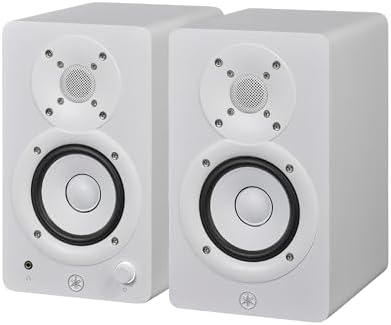
3. Yamaha HS3 Powered Studio Monitor in White
Best for: tight desks needing a matched white pair
Packaged as a set, these white speakers save you from matching separate purchases. They feature a 2-way bass-reflex powered speaker design with a 3.5″ cone woofer and 0.75″ dome tweeter. A 70 Hz – 22 kHz frequency response (-10 dB) covers the vocal and instrumental ranges most podcasters and casual producers focus on daily.
Output comes from a 26 W + 26 W configuration, splitting power evenly between the left and right channels. While modest next to larger studio monitors, it’s plenty for nearfield listening where the speakers sit within arm’s reach. Room control and high trim response controls let you adjust the sound to compensate for desk reflections or wall proximity.
Standing against the Yamaha HS4, the HS3 tops out at 22 kHz against 22 kHz but starts rolling off at 70 Hz against 60 Hz on the slightly larger sibling.
Pros
- Packaging includes a pair for immediate stereo use
- 3.5″ cone woofer and 0.75″ dome tweeter fit tight desk spaces
- 26 W + 26 W output power splits amplification evenly
- Room control and high trim response controls tailor sound to small rooms
- White finish suits bright or modern office aesthetics
Cons
- 70 Hz – 22 kHz frequency response (-10 dB) cuts off well above sub-bass territory
- 0.75″ dome tweeter is the smallest high-frequency driver in this article
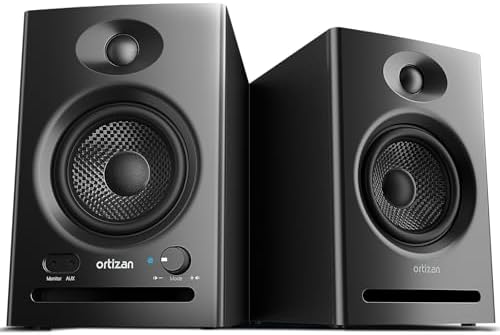
4. Ortizan C7 Powered Studio Monitors Pair with Bluetooth 5.3
Best for: creators switching between wired mixing and wireless playback
These stereo speakers blend professional inputs with consumer convenience. Built-in BT 5.3 technology lets you pair a smartphone or tablet in just 2 seconds for wireless music playback. When it’s time to work, the 6.35mm TRS balanced input connects directly to mixing consoles and interfaces. An RCA connection supports lossless surround sound systems for TV, while a 3.5mm AUX audio input adapts to any device with a headphone output.
Inside, a 3.5 inch carbon fiber speaker pairs with a 0.75inch silk dome tweeter. An electronic 2-way crossover manages the split between drivers. The built-in 24-bit DAC captures digital audio directly via USB, minimizing signal loss during conversion. Two AUX unbalanced inputs and a headphone output sit on the front panel for quick access.
Comparing connectivity, the Ortizan C7 offers USB, Bluetooth, RCA, TRS, and 3.5mm options against the three analog formats found on the PreSonus Eris 3.5.
Pros
- BT 5.3 technology enables fast wireless pairing with mobile devices
- Built-in 24-bit DAC captures digital audio directly via USB
- 6.35mm TRS balanced input connects to professional mixing consoles
- 3.5 inch carbon fiber speaker and 0.75inch silk dome tweeter provide layered sound
- Front panel headphone output allows quick switching to private monitoring
Cons
- The compact carbon fiber woofer limits low-end extension compared to larger alternatives.
- Combining Bluetooth, USB DAC, and analog inputs adds circuit complexity inside a small enclosure
5. Mackie CR4.5 Studio Monitors (Pair)
Best for: desktop users wanting included accessories and tone shaping
Sold as a pair, these monitors represent the step-up size for desks with more room. They use 4.5″ woofers designed to deliver a fuller low end than 3.5-inch monitors without needing a sub. A Tone Knob on the front panel gives you instant voicing control without digging through software menus.
The Location Switch handles wall or free-standing bass correction automatically. What really sets this listing apart is the box contents: both monitors, isolation pads, and all cables arrive together.
Measured against the Yamaha HS4, the Mackie CR4.5 ships with isolation pads and cables where the Yamaha lists an anti-slip pad and audio cables but no dedicated decoupling foam.
Pros
- 4.5″ woofers deliver fuller low end than smaller desktop alternatives.
- Tone Knob provides immediate front-panel voicing control
- Location Switch corrects bass response for wall or free-standing placement
- Box includes both monitors, isolation pads, and all cables
- Sold as a pair for straightforward stereo setup
Cons
- Tone Knob alters the factory voicing, making strict reference monitoring harder when engaged
- 4.5″ woofers still roll off earlier than the 5″ driver on the Yamaha HS5
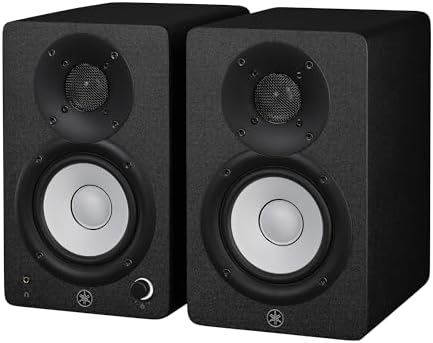
6. Yamaha HS4 Powered Studio Monitor in Black
Best for: small studios requiring versatile input connections
This black pair arrives ready for a stereo setup straight out of the packaging. Each 2-way bass-reflex powered speaker houses a 4.5″ cone woofer and a 1″ dome tweeter. The 60 Hz – 22 kHz frequency response (-10 dB) bridges the gap between ultra-compact desktop speakers and full-sized nearfields.
Power comes from a 26 W and above 26 W output configuration. Room control and high trim response controls let you dial in the acoustics based on where the speakers sit in your room. The standout feature here is the input array: XLR/TRS Phone (COMBO), RCA, and Stereo Mini inputs cover virtually every source you might own. The box also includes a stereo mini – RCA cable, speaker cable, and anti-slip pad.
Looking at high-frequency drivers, the Yamaha HS4 uses a 1″ dome tweeter against the 0.75″ dome tweeter on the Yamaha HS3.
Pros
- Packaging includes a pair for immediate stereo monitoring
- 4.5″ cone woofer and 1″ dome tweeter balance size and frequency coverage
- XLR/TRS Phone (COMBO), RCA, and Stereo Mini inputs accept almost any source
- Room control and high trim response controls adapt to room acoustics
- Stereo mini – RCA cable, speaker cable, and anti-slip pad included
Cons
- 60 Hz – 22 kHz frequency response (-10 dB) restricts deep bass evaluation
- 26 W output power per channel may struggle in larger living spaces
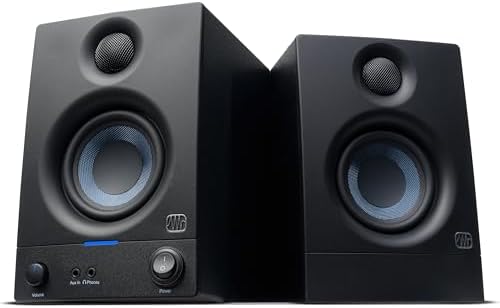
7. PreSonus Eris 3.5 Powered Studio Monitors
Best for: beginners needing high power in a small active pair
This complete stereo pair promises true studio sound for music production, gaming, movies, streaming, and everyday audio. The 3.5” woven-composite woofers aim to deliver deeper, tighter bass than their size suggests. Paired with 1” silk-dome tweeters, they smooth out harshness for clear, balanced highs across the full range. That range spans 80 Hz–20 kHz, covering the core frequencies where vocals and most instruments live.
Fifty watts of built-in amplification drives the system. That figure stands as the highest stated power for any 3.5-inch driver pair on this list. Built-in high- and low-frequency acoustic tuning controls let you tailor the sound to your space without extra gear. Connectivity is broad: balanced TRS, RCA, and a front-panel aux input plug straight into computers, interfaces, mixers, game consoles, phones, or turntables. A front headphone jack allows private listening without unplugging your main sources.
Comparing amplification, the PreSonus Eris 3.5 states 50 watts total against the 26 W + 26 W setup on the Yamaha HS3.
Pros
- 50 watts of built-in amplification leads the 3.5-inch category here
- 3.5” woven-composite woofers and 1” silk-dome tweeters cover the core spectrum
- High- and low-frequency acoustic tuning controls adjust for room placement
- Balanced TRS, RCA, and front-panel aux input connect to diverse sources
- Front headphone jack enables quick switching to private monitoring
Cons
- 80 Hz–20 kHz frequency response misses the lowest octave of a standard piano
- 3.5” woven-composite woofers physically limit maximum air displacement for loud playback
8. M-AUDIO BX3 3.5″ Wired Studio Monitors Pair
Best for: wired desktop setups prioritizing rigid cabinet construction
Engineered for zero-latency audio monitoring, these wired desktop speakers provide a pure, uninterrupted signal. The Black Kevlar low-frequency drivers deliver a smooth, punchy bass response tailored for music production.
The cabinet construction sets this pair apart. Premium MDF wood construction paired with an advanced bass reflex design stops unwanted vibration. This acoustically-inert MDF cabinet produces deep, rich sound quality superior to standard plastic multimedia speakers. An enhanced bass reflex port maximizes low-frequency immersion for beat-making and movie watching. Hook-up flexibility comes from rear 1/4-inch, 1/8-inch, and RCA inputs, ensuring instant compatibility with DJ gear, instruments, and studio equipment. A convenient front panel 1/8-inch AUX input lets you connect headphones directly for silent late night mixing sessions. Bi-amplified power upgrades built-in computer speakers with studio-grade clarity.
Placed next to the Ortizan C7, the M-Audio BX3 relies entirely on wired connections, omitting the Bluetooth 5.3 and USB DAC found on the Ortizan.
Producers who need to move audio wirelessly from a tablet or phone will find the strictly wired architecture too limiting for casual listening.
Pros
- Black Kevlar low-frequency drivers resist cone flex for punchy bass.
- Acoustically-inert MDF cabinet stops unwanted vibration from coloring the sound
- Rear 1/4-inch, 1/8-inch, and RCA inputs cover professional and consumer gear
- Front panel 1/8-inch AUX input allows direct headphone connection
- Bi-amplified power separates low and high frequency amplification stages
Cons
- Wired-only design excludes Bluetooth or USB digital connections for wireless streaming
- 3.5-inch Kevlar woofers can’t displace as much air as the 4.5″ drivers on the Mackie CR4.5
Also Worth Considering
The PreSonus Bundle Eris Studio Monitors is a full recording package listing an AudioBox 96 USB interface, Eris 3.5 monitors, condenser microphone, isolation shield, headphones, stands, cables, and software. The standalone PreSonus Eris 3.5 beats it for buyers who already own an interface, since the bundle forces you to accept components you might not need. Someone starting completely from scratch with zero gear might still prefer having everything arrive in one shipment.
The Focusrite Condenser Microphone Headphones Cables pairs a Focusrite Scarlett 2i2 4th Gen USB-C interface with PreSonus Eris 3.5 monitors, a recording shield, condenser microphone, headphones, and cables. Again, the dedicated PreSonus Eris 3.5 listing serves those who only want speakers, while this bundle targets absolute beginners needing a Focusrite interface specifically. If your computer lacks USB-A ports, the USB-C interface here solves that problem without an adapter.
How We Chose
Thirty-seven Amazon listings were compared on driver size, stated frequency response, and included connectivity, and near-duplicates — another colour, another size of one already here — were left out. A listing had to state its amplification type and input options to earn a place. Products missing basic specifications like woofer dimensions or frequency ranges were excluded immediately. The remaining picks separate themselves by intended room size and connection needs. Larger eight-inch drivers suit untreated rooms needing bass extension, while three-and-a-half-inch models target tight desktops. Bundled pairs were favored over single units where stereo imaging is the primary goal. Features like room correction switches, Bluetooth integration, and included isolation pads determined the final categories. Every selected product states its exact technical limits clearly in the seller’s copy.
How to Choose the Right Home Recording Studio Monitors
Driver size and low-end reach
Decide what you’re mixing first. A 5″ cone woofer like the one on the Yamaha HS5 reaches 54Hz, handling bass guitars and kick drums reasonably well. The Yamaha HS8 Pair pushes down to 38Hz with an 8-inch cone woofer for deeper extension. Smaller 3.5-inch drivers on the PreSonus Eris 3.5 stop at 80 Hz, making them strictly for vocals and podcasts.
What comes in the box
Check if you’re getting one speaker or two. The Yamaha HS5 is listed as a single powered monitor, so stereo mixing requires buying twice. The Mackie CR4.5 includes both monitors, isolation pads, and all cables. The Yamaha HS4 adds a stereo mini-RCA cable, speaker cable, and anti-slip pad to its pair, saving you extra trips to the store.
Inputs matching your current gear
Look at the back of your audio interface or computer before choosing. The Ortizan C7 covers USB, RCA, TRS, and 3.5mm AUX inputs alongside Bluetooth. The Yamaha HS4 offers an XLR/TRS combo jack, RCA, and stereo mini inputs. If you only have a headphone jack on your laptop, a monitor lacking a 3.5mm or RCA input like the Yamaha HS5 requires an adapter or interface.
Room size and power output
Match the wattage to your physical space. The Yamaha HS8 Pair delivers 120W power amplification per unit, easily filling larger rooms. The Yamaha HS3 outputs 26 W + 26 W, which is tailored for close-range desk listening. Putting massive speakers in a tiny bedroom causes bass buildup, while tiny speakers in a large living room distort when pushed too hard.
Related guides
- How to Connect Studio Monitors to Focusrite Solo
- How Do You Record Music on Your Phone
- Why is Audacity Only Recording the Left Channel
Frequently Asked Questions
Do I need an audio interface to run these?
Not always, but it depends on the inputs. The Yamaha HS5 has XLR and TRS phone jack inputs, which typically require an interface for a balanced signal. However, the Ortizan C7 includes a built-in 24-bit DAC that captures digital audio directly via USB from a computer. The PreSonus Eris 3.5 also accepts RCA and a front-panel aux input straight from consumer devices.
Will a 3.5-inch woofer ruin my mixes?
It won’t ruin them, but it limits your low-end perspective. The PreSonus Eris 3.5 states an 80 Hz–20 kHz range, meaning sub-bass frequencies are invisible to you. The Mackie CR4.5 claims a fuller low end than 3.5-inch monitors without needing a sub, thanks to its 4.5″ woofers. Always check your final mixes on headphones or a larger system if using small drivers.
What does a room control switch actually do?
It adjusts the bass response to account for speaker placement. The Yamaha HS4 features room control and high trim response controls to cut low frequencies when placed near walls. The Mackie CR4.5 uses a Location Switch specifically for wall or free-standing bass correction. Without these, placing a speaker flush against a wall artificially boosts muddy bass notes.
Are bi-amplified speakers better than single-amp designs?
They offer distinct advantages for accuracy. The Yamaha HS5 uses a 45W LF plus 25W HF bi-amp system, dedicating separate power to the woofer and tweeter. The M-Audio BX3 also highlights bi-amplified power for studio-grade sound. This prevents the low frequencies from starving the highs of power during complex passages, keeping the overall output cleaner.
Can I connect these to my television?

Yes, if the monitor has the right inputs. The Ortizan C7 lists an RCA connection ensuring a lossless connection for surround sound systems and TVs. The PreSonus Eris 3.5 includes RCA inputs that accept standard consumer audio cables. Models like the Yamaha HS5 only list XLR and TRS phone jack inputs, requiring a converter box for standard TV outputs.
Does Bluetooth add noticeable delay for recording?
Wireless connections introduce latency unsuitable for tracking live instruments. The M-Audio BX3 emphasizes a latency free wired connection engineered specifically for zero-latency audio monitoring. The Ortizan C7 includes BT 5.3 technology for wireless music playback, which is great for casual listening but risky when hitting record. Use the 6.35mm TRS balanced input on the Ortizan for actual production work.
Conclusion
For most people setting up a small room, the Yamaha HS5 remains the strongest choice because its 54Hz-30kHz response and bi-amplified design handle full mixes accurately. If you just need simple desktop playback without buying extra cables, the Mackie CR4.5 is the easier path since it includes pads and wiring. Pick the one that fits your desk, connect your interface, and start listening.
As an Amazon Associate, Instrument Insight earns from qualifying purchases at no additional cost to you.