
The Kali Audio LP-6 V2 is the best powered studio monitors pick here, earning that spot with 80 watts of bi-amped power and a stated 115dB max SPL. It’s built for anyone mixing music at home who needs flat, honest sound without extra noise.
This guide helps producers, podcasters, and casual listeners sort through ten different speakers. The one thing that separates them is how they handle your room — some use boundary EQ switches, others rely on acoustic tuning knobs or waveguides to keep the sound true where you sit.
- Best Overall: Kali Audio LP-6 V2 — 80W bi-amped power and 115dB max SPL lead this set.
- Industry Standard Reference: Yamaha HS5 Pair — Two monitors included with 70W total bi-amp power.
- Best for Mixing: KRK ROKIT 5 Gen 5 — Class D amplifiers and isolation pads come in the box.
- Best Wide Sweet Spot: JBL 305P MkII — Patented waveguide technology delivers neutral response off-axis.
- Best Compact Bluetooth: Edifier MR3 — Hi-Res certified with Bluetooth multi-point and app control.
- Best Desktop Wired: PreSonus Eris E4.5 — Front-panel aux input and headphone output for desk work.
- Best Creative Multimedia: Mackie CR4.5BT — Tone knob and location switch adapt to any listening setup.
- Most Powerful Single: PreSonus Eris E7 XT — 100-degree horizontal waveguide yields the widest single-speaker spread.
- Simplest Setup: M-Audio BX3 — Zero-latency wired connection with three rear inputs ready instantly.
- Best Large Woofer: Yamaha HS8 — 8-inch cone woofer reaches down to 38Hz for deep lows.

- 2nd gen LP-6 with robust DSP for flat response
- 12dB noise reduction and front port minimize turbulence
- Updated boundary EQ adapts to room placement
- 80 watts bi-amped, 47Hz-21kHz, max SPL 115dB

- Includes two Yamaha HS5 studio monitors
- 5 inch cone woofer and 1 inch dome tweeter
- Emphasizes sonic purity without coloring sound
- 54 hertz to 30 kilohertz, 70 watts total power

- Class D amplifiers reduce operating temperature
- 1” silk dome tweeter improves high frequency performance
- Low diffraction baffle lowers distortion
- Acoustic foam wedge pads minimize resonance

- JBL 305P MkII undergoes 100-hour full-power test
- Boundary EQ restores neutral low frequency response
- Balanced XLR and 1/4" TRS inputs included
- +4dBu / -10dBV input-sensitivity switch available
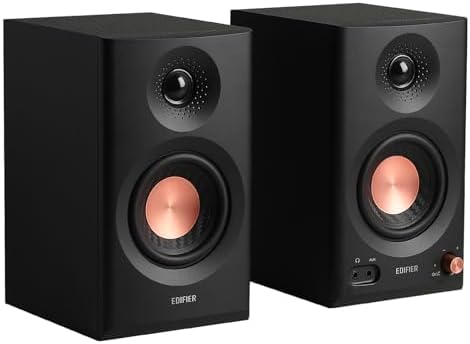
- Hi-Res Audio certified, 52Hz to 40kHz response
- TRS, RCA, AUX inputs and Bluetooth multi-point
- 18W*2 RMS output, peak SPL of 92.5dB
- Music, Monitor, Custom modes via EDIFIER ConneX app

- Eris 4.5 near field monitors deliver accurate sound
- Woven-composite woofers produce tight bass response
- 50 Watts Class AB dual amplification, 25W per side
- 1-inch silk-dome tweeters provide wide stereo imaging

- Mackie CR4.5BT monitors include tone control and Bluetooth
- TRS, RCA, 3.5 mm inputs and headphone output
- Tone knob boosts bass and adds high-end sparkle
- Location switch toggles desktop and bookshelf modes

- 6.55-inch woven composite low-frequency transducer
- 1.25-inch (32 mm) silk-dome high-frequency transducer
- Includes Studio One Prime and Studio Magic plug-in suite
- 100˚(H) x 60˚(V) EBM waveguide yields wide sweet spot

- Wired connection engineered for zero-latency monitoring
- Bi-amplified power delivers studio monitor quality
- 3.5-inch Black Kevlar low-frequency drivers included
- Natural silk dome tweeters provide precise stereo imaging

- 38Hz – 30kHz frequency response range
- 75W LF plus 45W HF for 120W total power
- 8-inch cone woofer and 1-inch dome tweeter
- Large magnets in Advanced Magnetic Circuit design
1. KALI AUDIO LP-6 V2 6.5″ Project Lone Pine Powered Studio
Best for: home producers needing loud, accurate monitoring
Noise reduction sits at 12dB, and the front port lets air exit at uniform velocity to cut turbulence. An updated boundary EQ lets you place it on a stand, against a wall, or right on your desk while keeping the audio output clear. It’s a single speaker, so you’ll need two for stereo mixing.
Comparing the specs, its 115dB max SPL stands well above the 92.5dB peak SPL listed on the Edifier MR3, giving you far more headroom before distortion sets in.
Pros
- 80 watts of bi-amped power split between a 1″ tweeter and 6.5″ driver
- 12dB noise reduction keeps the background quiet
- Updated boundary EQ adapts to desk, wall, or stand placement
- Frequency range covers 47Hz to 21kHz
- TRS, RCA, and XLR inputs handle any interface
Cons
- Sold as a single unit, so a stereo pair requires a second purchase
- 115dB max SPL is a ceiling; louder tracking sessions will hit it
- Frequency response bottoms out at 47Hz, ruling out deep sub-bass monitoring
2. YAMAHA Hs5 Powered Studio Monitor
Best for: engineers wanting a matched reference set
Getting two monitors in one box solves the immediate problem of setting up a stereo field. These are 2-way bass reflex speakers, each carrying a 5-inch cone woofer and a 1-inch dome tweeter.
The bi-amp system delivers 45W to the low frequencies and 25W to the highs, totaling 70 watts per speaker. XLR and TRS phone jack inputs accept both balanced and unbalanced signals, so they plug straight into professional interfaces and consumer gear alike. The 54Hz to 30kHz frequency response covers the entire range most musicians work in daily.
Pros
- Includes two monitors for instant stereo setup
- 70W total bi-amp power per speaker (45W LF plus 25W HF)
- 54Hz to 30kHz frequency response covers wide musical range
- XLR and TRS inputs accept balanced or unbalanced signals
- Bass reflex design emphasizes sonic purity without coloring
Cons
- 54Hz low-frequency limit means deep bass tracks require a separate subwoofer
- 70W total power per speaker is lower than the 80W on the Kali Audio LP-6 V2
- Sold only as a pair, taking up space if you only needed one replacement
3. KRK RP5G5 ROKIT 5 Generation Five 5″ Powered Studio Monitor
Best for: mixers needing built-in acoustic isolation
A low diffraction baffle design lowers distortion, helping you hear exactly where instruments sit in the mix. The box includes acoustic foam wedge isolation pads, so you don’t have to buy separate decouplers to minimize resonance from your desk. Connectivity comes through an XLR and 1/4-inch TRS combo analog input, fitting almost any audio device you own.
Pros
- Class D power amplifiers reduce heat during long sessions
- The silk dome tweeter improves high-frequency phase performance.
- Low diffraction baffle lowers distortion for better stereo imaging
- Acoustic foam wedge isolation pads included in the box
- XLR and 1/4-inch TRS combo input fits most interfaces
Cons
- Shipped as a pair, requiring enough desk space for two monitors plus foam pads
- The combo input limits you to a single connection type per speaker at a time.
- Foam pads add height, which matters under low shelves
4. JBL Professional 305PMkII 5-Inch 2-Way Powered
Best for: listeners moving around their workspace
This monitor undergoes a rigorous 100-hour full-power test to ensure dependable performance over years of use. It features technologies derived from JBL’s Master Reference Monitors, including updated transducers that optimize damping for superior transient response.
A new boundary EQ restores neutral low-frequency response when the speaker sits on a work surface or next to walls. The patented Slip Stream low-frequency port maintains bass performance even at lower playback levels. Dual integrated Class-D amplifiers provide 82 watts of power, and the design creates a broad sweet spot that stays neutral even when you listen off-axis.
Pros
- 82 watts of dual Class-D power for high dynamic range
- Boundary EQ corrects low frequencies near walls and desks
- Slip Stream port delivers consistent bass at all volumes
- Balanced XLR and 1/4″ TRS inputs with +4dBu/-10dBV sensitivity switch
- Broad sweet spot keeps frequency response neutral off-axis
Cons
- Sold individually, so stereo mixing requires buying a second unit separately
- 82W total power trails the 120W amplification found in the Yamaha HS8
- The compact woofer limits the lowest frequencies compared to larger drivers.
5. Edifier MR3 Powered Studio Monitor
Best for: creators wanting wireless streaming options
Connectivity is rich, featuring balanced TRS, RCA, and AUX inputs alongside a headphone output. Bluetooth supports multi-point connection, letting you switch between a laptop and a phone seamlessly. Output hits 18W per side RMS with a 92.5dB peak SPL.
The 92.5dB peak SPL is significantly lower than the 115dB max SPL listed on the Kali Audio LP-6 V2. Switching between Music, Monitor, and Custom modes via the EDIFIER ConneX app adds flexibility for different tasks throughout the day.
Pros
- Hi-Res Audio certified with 52Hz to 40kHz frequency response
- Bluetooth multi-point connection pairs two devices wirelessly
- TRS, RCA, and AUX inputs allow simultaneous wired connections
- MDF cabinet reduces unwanted resonance and distortion
- EDIFIER ConneX app provides personalized EQ control
Cons
- 92.5dB peak SPL limits maximum volume for loud mixing sessions
- 18W per side RMS is less power than the 50W total on the PreSonus Eris E4.5
- 3.5″ mid-low drivers can’t move as much air as 5″ or 6.5″ alternatives
6. PreSonus Eris E4.5-2-Way 4.5″ Near Field Studio Monitor (Pair)
Best for: desktop producers needing front-panel access
The 1-inch low-mass silk-dome tweeters provide natural high-frequency response and superior stereo imaging from nearly any angle. High- and low-frequency tuning controls on the back let you customize the output for your exact room size and speaker orientation. A convenient front-panel 1/8-inch TRS stereo aux input connects your phone instantly, while the front-panel headphone output includes a built-in amplifier for late-night reference checks.
Pros
- 50W Class AB dual amplification (25W per side) drives 4.5″ woven-composite woofers
- Front-panel 1/8-inch TRS aux input and headphone output for quick access
- High- and low-frequency tuning controls tailor sound to your room
- The silk-dome tweeters deliver wide stereo imaging.
- Ships as a matched pair for instant stereo setup
Cons
- Class AB amplification generates more heat than modern Class D designs.
- 4.5-inch woofers limit low-end extension compared to the 6.5-inch driver on the Kali Audio LP-6 V2
- No wireless connectivity, relying entirely on wired TRS, RCA, and aux cables
7. Mackie CR4.5BT 4.5″ Creative Reference Powered Studio Monitors
Best for: users switching between mixing and entertainment
Connection options cover just about anything. TRS and RCA connectors hook up audio interfaces, the 3.5mm input takes gaming consoles and PCs, and Bluetooth pairs smartphones wirelessly. A built-in headphone output sits ready for private listening. The location switch flips between desktop mode for close-up studio work and bookshelf mode for distance listening from a couch.
Pros
- Tone knob shapes sound from transparent studio response to boosted bass
- Bluetooth wireless pairing connects smartphones and tablets easily
- Location switch optimizes output for desktop or bookshelf placement
- TRS, RCA, and 3.5mm inputs cover professional and consumer gear
- Built-in headphone output allows silent monitoring
Cons
- Bluetooth connection can introduce latency unsuitable for live instrument tracking
- 4.5-inch woven woofer reaches less depth than the 6.55-inch driver on the PreSonus Eris E7 XT
- Tone knob alters the flat response required for strict mixing accuracy
8. PreSonus Eris E7 XT 2-Way Active Studio Monitor with EBM
Best for: solo engineers needing maximum single-speaker coverage
The 6.55-inch woven composite low-frequency transducer pushes deep lows that smaller drivers simply can’t reproduce. Paired with a 1.25-inch ultra-low-mass silk-dome high-frequency transducer, the top end remains smooth and detailed. This combination gives you a full-range picture of your mix from a single cabinet, which is ideal if you’re building your setup one piece at a time.
An innovative EBM waveguide spreads sound at 100 degrees horizontally and 60 degrees vertically. That yields a remarkably wide sweet spot and solid stereo imaging even when you shift in your chair. Acoustic tuning controls — including Level, HPF, LF Trim, HF Trim, and Acoustic Space — let you contour the monitor precisely to your room’s dimensions and surfaces.
Pros
- 6.55-inch woven composite driver delivers deep low frequencies
- 1.25-inch silk-dome tweeter handles smooth, detailed highs
- 100° x 60° EBM waveguide creates a very wide sweet spot
- Five acoustic tuning controls tailor the sound to any room
- Includes Studio One Prime and Studio Magic plug-in suite
Cons
- Since it is sold as a single unit, stereo mixing requires purchasing a second monitor.
- 6.55-inch driver demands more physical desk space than the 3.5-inch M-Audio BX3
- Waveguide dispersion is fixed at 100×60 degrees, offering no adjustable spread
9. M-AUDIO BX3 3.5″ Wired Studio Monitors Pair
Best for: beginners wanting instant zero-latency audio
Engineered specifically for zero-latency audio monitoring, these wired desktop speakers provide a pure, uninterrupted signal. That makes them perfect for live streaming, podcasting, gaming, and studio work where any delay ruins the performance. Bi-amplified power upgrades your built-in computer audio to professional studio monitor quality directly on your desktop without configuring complex software routing.
The 3.5-inch Black Kevlar low-frequency drivers deliver smooth, punchy bass tailored for music production. Natural silk dome tweeters cover the rest of the spectrum with precise stereo imaging and pristine highs. An acoustically-inert MDF cabinet paired with an advanced bass reflex design stops unwanted vibration, producing richer sound than standard plastic multimedia speakers ever could.
Pros
- Zero-latency wired connection ensures perfect sync for live tracking
- 3.5-inch Black Kevlar woofers provide punchy, smooth bass response
- Natural silk dome tweeters deliver precise stereo imaging
- Acoustically-inert MDF cabinet prevents unwanted resonance
- 1/4-inch, 1/8-inch, and RCA rear inputs fit any gear instantly
Cons
- 3.5-inch Kevlar woofers limit low-end reach compared to the standard driver size found in professional near-field monitors.
- Wired-only design lacks the Bluetooth flexibility found on the Edifier MR3
- Small driver size restricts maximum volume for large room filling
10. Yamaha HS8 8-Inch Powered Studio Monitor Pair
Best for: professionals needing deep bass without a subwoofer
An 8-inch cone woofer paired with a 1-inch dome tweeter defines the physical scale of this monitor. That large driver pushes the frequency response down to 38Hz, reaching deep into the sub-bass region without needing external help. Large magnets in an Advanced Magnetic Circuit design ensure the cone moves with precision and control at any volume.
Power comes from a bi-amp system delivering 75W to the low frequencies and 45W to the highs, totaling 120W of amplification per speaker. The bundle includes a pair of two monitors, so your left and right channels are covered immediately upon unboxing, saving you from matching separate purchases.
Pros
- 8-inch cone woofer extends frequency response down to 38Hz
- 120W total bi-amp power (75W LF plus 45W HF) drives large rooms
- Bundle includes a pair of two monitors for complete stereo
- Advanced Magnetic Circuit design uses large magnets for precise control
- 1-inch dome tweeter reproduces highs up to 30kHz
Cons
- 8-inch woofer requires substantial desk or stand space to fit properly
- 120W amplification may overpower very small, untreated bedroom studios
- 38Hz low end can excite room modes in spaces without acoustic treatment
Also Worth Considering
The JBL 2-Way MkII Powered is a 6-inch active monitor sold individually, stepping up the driver size from the 5-inch JBL 305P MkII on our main list. The 305P MkII earns its spot by stating a 100-hour full-power test and 82 watts of power, facts this alternative’s title doesn’t confirm. It suits buyers who want the JBL waveguide design but need slightly deeper bass reach from the larger cone.
The YAMAHA HS4 Powered Studio Monitor arrives as a pair in black, offering a smaller footprint than the Yamaha HS5 Pair. The HS5 secures its place with a stated 70W bi-amp system and 54Hz to 30kHz response, specifications the HS4 title leaves out. Creators with extremely tight desk space who still want Yamaha’s sonic purity might prefer these.
The Edifier R1700BT Bluetooth Bookshelf Speaker is an active 2.0 setup in a wooden enclosure boasting 66W RMS. The Edifier MR3 beats it onto our list by stating Hi-Res Audio certification and a 52Hz to 40kHz response. Listeners prioritizing raw power output and a traditional wooden bookshelf look over app-based EQ control will find this a solid alternative.
How We Chose
Thirty-one Amazon listings were compared on stated wattage, driver size, and included components, and near-duplicates were left out. To earn a place, a listing had to state its amplification class or total power, specify the woofer diameter, and clarify whether it shipped as a single unit or a pair. Products missing these basic specifications were removed from consideration. What separates the final picks is how they solve distinct problems: boundary EQ for difficult rooms, Bluetooth for wireless workflows, and large drivers for deep bass extension.
How to Choose the Right Powered Studio Monitors
Driver Size and Bass Extension
Decide how low your music needs to go before picking a speaker. The Yamaha HS8 lists a 38Hz bottom end thanks to its 8-inch woofer, while the M-Audio BX3 relies on a 3.5-inch driver that naturally rolls off sooner. Electronic producers need the larger cone; podcasters do fine with the smaller one.
Amplification Power and Headroom
Total wattage determines how loud a monitor plays before distorting. The Kali Audio LP-6 V2 states 80W and 115dB max SPL.
What Comes in the Box
Check if you’re getting one speaker or two. The Yamaha HS5 Pair and PreSonus Eris E4.5 ship as sets, covering stereo immediately. The JBL 305P MkII and PreSonus Eris E7 XT are sold individually, meaning you’ll need to plan for a second purchase to complete your left and right channels.
Room Correction Features
Your desk and walls change how speakers sound. The Kali Audio LP-6 V2 includes an updated boundary EQ, and the JBL 305P MkII offers a similar boundary EQ switch. The PreSonus Eris E4.5 uses manual high- and low-frequency tuning knobs instead.
Frequently Asked Questions
Do I need an audio interface to run these?
Not always, but it helps. Monitors like the Edifier MR3 list Bluetooth multi-point connection, letting you stream directly from a phone or laptop wirelessly. Others, such as the M-Audio BX3, focus on wired 1/4-inch, 1/8-inch, and RCA inputs. An interface provides balanced XLR or TRS outputs for the cleanest possible signal path.
Can I connect a subwoofer later?
Yes, several listings plan for this. The PreSonus Eris E4.5 explicitly mentions compatibility with the Eris Sub 8BT companion subwoofer. The Mackie CR4.5BT notes you can connect the CR8SBT subwoofer for enhanced bass. Check the manufacturer’s specifications for crossover settings before adding one to your setup.
Why do some speakers sell singly and others in pairs?
Professional studios often replace one damaged monitor or build custom surround setups, making singles like the Kali Audio LP-6 V2 practical. Desktop users typically need stereo immediately, which is why the Yamaha HS5 Pair and PreSonus Eris E4.5 include two units. Always verify the quantity stated in the listing before ordering.
Does Bluetooth cause delay when recording?
It can. The M-Audio BX3 highlights its “latency free wired connection” specifically for live tracking and streaming. While the Edifier MR3 and Mackie CR4.5BT offer Bluetooth for convenient playback, monitoring latency becomes a real issue when recording live vocals or guitar. Use the wired inputs for tracking, and save Bluetooth for casual listening.
Are larger woofers always better for mixing?

Larger drivers reach lower frequencies, as seen with the Yamaha HS8’s 8-inch woofer hitting 38Hz. However, placing a large speaker too close to your face blurs the stereo image. Near-field monitors with this driver size are engineered specifically for close listening distances on standard desks.
How important is the tweeter material?
It changes how high frequencies sound. The KRK ROKIT 5 Gen 5 uses a 1-inch silk dome tweeter designed for improved phase performance. The PreSonus Eris E4.5 also lists a silk-dome transducer for natural response. Stiffer materials sometimes sound brighter, while silk generally provides a smoother top end for long mixing sessions.
Conclusion
For most people, the Kali Audio LP-6 V2 remains the strongest choice, combining 80W of power, boundary EQ, and 115dB max SPL into a single accurate monitor. If you need something simpler for a small desk, the M-Audio BX3 offers instant wired connectivity without fuss. Pick the one that fits your space, and start mixing.
As an Amazon Associate, Instrument Insight earns from qualifying purchases at no additional cost to you.