
The Rode RØDE NT1 Signature is the best home studio microphone for vocals because it offers a complete, professional-grade setup that minimizes background noise. Choosing the right gear for your creative space can feel overwhelming, but the primary difference between these units is their connection type and the amount of extra hardware you need to get started. Whether you’re building a professional recording environment or a simple space for voiceovers, these options cover every common setup.
Quick Picks
- Best Overall: Rode RØDE NT1 Signature — Includes a full, professional-grade vocal recording kit.
- Best Classic Condenser: Audio-Technica AT2020 — Described as the price/performance standard in side address studio condenser microphone technology.
- Best for Untreated Rooms: Audio-Technica AT2035 — Features a high-pass filter to help manage low-end noise.
- Best Dynamic Option: MAONO HD300T — Offers both USB and XLR connectivity for flexible use.
- Best High SPL Handling: AKG P120 — Handles loud sound sources with high-pressure level support.
- Best All-in-One Kit: Dejasound Studio Condenser — Includes an isolation shield for immediate noise reduction.
- Simplest USB Setup: FIFINE T669 — Provides a complete, ready-to-use plug-and-play USB bundle.
- Best Dual Connectivity: MAONO A04 Gen2 — Features advanced software control for optimized vocal tones.
- Best Studio-Grade USB: ROCCAT Torch — Includes unique, mixer-style controls for on-the-fly adjustments.
- Best Large-Diaphragm Condenser: Mackie EM-91C — Offers a reliable, rugged build for home and studio use.

- Includes shock mount, pop filter and XLR cable
- Large-diaphragm condenser voicing trusted in studios
- Among the lowest self-noise microphones made
- Cardioid pattern focuses on voice, rejects room

- Side address studio condenser microphone technology
- Ideal for project and home studio applications
- High SPL handling and wide dynamic range
- Custom engineered low mass diaphragm for extended response

- Designed for home, project and professional studios
- Cardioid polar pattern reduces side and rear pickup
- Large diaphragm for smooth sound and low noise
- High SPL handling and wide dynamic range

- MAONO HD300T supports USB and XLR connections
- Cardioid dynamic capsule captures vocals clearly
- 3.5mm headphone jack with zero-latency monitoring
- Includes metal stand, shock mount, pop filter, cables

- Compatible with popular audio interfaces for easy setup
- Handles high sound pressure levels up to 150 dB
- Built with high-quality materials for long-lasting performance
- Includes 1 x P120 Microphone and 1 x Stand Adapter

- DJM5 USB condenser mic with plug-and-play connection
- Cardioid pattern, 16mm diaphragm, 192kHz/24Bit sampling rate
- Supports 5V voltage with echo control and volume adjustment
- Isolation shield has 5 high-density foldable panels
- USB plug-and-play connection to pc and laptop
- Wide frequency response handles high SPLs easily
- Boom arm rotates 180° and extends 135°
- Includes C-clamp, desktop mount and double pop filter

- A04 Gen2 offers dual XLR and USB connections
- 192kHz/24bit sampling rate, 30Hz-16kHz frequency response
- MAONO Link software adjusts gain and noise reduction
- Cardioid pattern with included pop filter and windscreen

- 24-Bit audio with up to 48kHz sampling rate
- Mixer-style controls adjust volume, gain and patterns
- Features Cardioid, Stereo and Whisper pick-up patterns
- Gesture activated mute with RGB lighting indicator

- Affordable professional-quality condenser microphone
- Suitable for large and home-based studios
- Rugged, reliable construction
- Cardioid polar pattern
1. RØDE NT1 Signature Series Studio Condenser Microphone
Best for: Vocalists who want a complete, high-quality studio package.
This microphone is designed for those who want a professional sound without the guesswork of picking individual parts. It includes a shock mount and pop filter in the box, which is essential for capturing clean vocal takes. By focusing on low self-noise, it ensures that your recordings stay clear and free of unwanted hiss.
The cardioid pickup pattern is tight, meaning it focuses on your voice while rejecting the sound of the room around you. This is a significant advantage if your recording space isn’t perfectly soundproofed.
Pros
- Includes shock mount and pop filter.
- Whisper-quiet self-noise levels.
- Tight cardioid pattern for isolation.
- Legendary studio-grade vocal voicing.
Cons
- Requires an external audio interface, which is an additional purchase.
2. Audio-Technica AT2020 Cardioid Condenser Studio XLR Microphone
Best for: Anyone needing a reliable, industry-standard studio condenser.
This microphone is widely recognized for its consistent performance across various studio applications. It features a low-mass diaphragm that provides an extended frequency response, making it a great choice for capturing the natural detail of a voice. Its ability to handle high sound pressure levels adds a layer of versatility if you plan to record instruments as well.
It’s a solid workhorse for anyone who prefers a no-frills, professional result.
Pros
- High sound pressure level handling.
- Excellent transient response.
- Wide dynamic range.
Cons
- Integral 3 pin XLRM type output, and anyone needing USB has to plan around that.
3. Audio-Technica AT2035 Cardioid Condenser Microphone
Best for: Creators working in rooms that have some unwanted low-end noise.
If you’re recording in a home studio, you often deal with rumble from air conditioners or traffic outside. This model helps solve that with a switchable 80 Hertz high-pass filter. The 10 dB pad is another useful feature that prevents distortion when you’re recording particularly loud vocal performances.
The large diaphragm provides a smooth, natural sound that works well for both singing and podcasting. It comes with a custom shock mount, which helps isolate the mic from vibrations on your desk. Against the AT2020, this model offers more control over the signal before it even reaches your recording software.
Pros
- Built-in high-pass filter.
- Includes a custom shock mount.
- Versatile 10 dB pad.
- Large diaphragm for natural sound.
Cons
- Features switchable 80 Hertz high pass filter, so anyone needing lower frequencies is ruled out.
4. MAONO HD300T USB XLR Dynamic Podcast Microphone
Best for: Creators who need the flexibility of USB and XLR connections.
This dynamic microphone is a great choice if you move between different recording environments. Because it supports both USB and XLR, you can plug it directly into a laptop for quick sessions or use a professional audio interface for higher-quality studio work. It captures a warm, natural vocal tone while the dynamic design helps keep background noise at bay.
The built-in headphone jack allows for zero-latency monitoring, which is vital when you need to hear yourself clearly without any delay. It’s a very practical setup for anyone who uses a mix of mobile and desktop gear.
Pros
- Dual USB and XLR modes.
- Zero-latency headphone monitoring.
- Includes desktop stand and pop filter.
- Dynamic capsule reduces room reflections.
Cons
- Requires an interface for professional XLR performance.
5. AKG Pro Audio P120
Best for: Those who record loud sources or high-energy vocalists.
The main strength of this microphone is its ability to handle sound pressure levels up to 150 dB. This makes it perfect if you’re a powerful singer or if you plan to record instruments alongside your vocals. The low-mass diaphragm ensures that you capture accurate sonic detail, which is important for clean voiceovers.
It also includes a bass-cut filter and a pre-attenuation pad to further manage your sound. When compared to the Rode RØDE NT1 Signature, this model offers a higher threshold for loud sources, though the Rode provides a more extensive accessory bundle in the box. It’s a reliable, durable piece of equipment for a project studio.
Pros
- High sound pressure handling.
- Bass-cut filter included.
- Accurate sonic detail.
- Durable build for long-term use.
Cons
- Includes a stand adapter.
6. Dejasound Upgraded Studio Recording Microphone with Isolation Shield & Pop
Best for: Beginners who want an all-in-one solution with acoustic treatment.
This kit is unique because it includes a foldable isolation shield. If you’re recording in a room with lots of echo, this shield helps absorb sound and provides a much cleaner vocal take. It’s a true all-in-one package that comes with headphones, cables, and adapters for smartphones and laptops.
The microphone itself features USB output, so you don’t need any additional audio hardware to start recording. While the MAONO A04 Gen2 offers more advanced software control, this kit focuses on physical sound management. It’s an ideal choice for someone who wants to set up a studio space in a regular bedroom without worrying about complex gear.
Pros
- Includes a five-panel isolation shield.
- Plug-and-play USB connection.
- Comes with headphones and adapters.
- Foldable design for portability.
Cons
- Soundproof shield measuring 27.55in x 10.23in, which anyone with a smaller desk has to plan around.
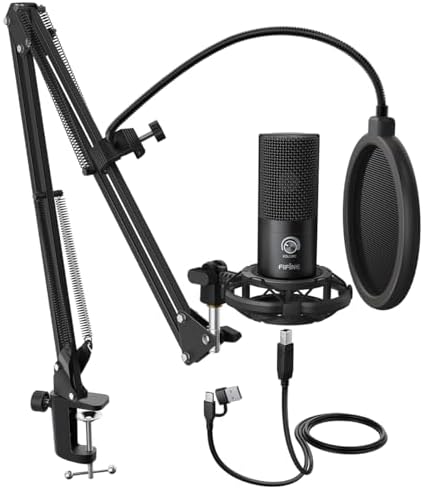
7. FIFINE T669 Studio Condenser USB Microphone
Best for: Someone who wants the simplest possible USB vocal setup.
This kit is built for speed and convenience, offering a plug-and-play experience that works immediately with any PC or laptop. It comes with a sturdy boom arm that allows you to position the microphone exactly where you need it, keeping your face clear during streaming or recording. The double-layer pop filter is a nice touch for minimizing plosives.
Because it’s a USB-based system, you don’t have to worry about phantom power or external interfaces. When you compare this to the Audio-Technica AT2020, you see that this model prioritizes an easy, all-inclusive workflow over the professional XLR signal chain. It’s perfect for those who want great-sounding results without technical hurdles.
Pros
- Complete boom arm bundle.
- Simple plug-and-play USB connection.
- Double-layer pop filter included.
- All-steel construction on the arm.
Cons
- Incompatible with Xbox.
8. MAONO A04 Gen2 XLR/USB Condenser Microphone Kit
Best for: Users who want to customize their vocal tone via software.
This microphone stands out because of the MAONO Link software, which lets you adjust gain, noise reduction, and EQ presets. These digital tools allow you to refine your sound before it even hits your recording software. It also offers the flexibility of both USB and XLR connectivity for different studio needs.
The 16mm capsule provides a warm, silky character that’s ideal for voiceovers and podcasting. Against the ROCCAT Torch, which uses mixer-style physical controls, this model relies on software to give you a clean, uncluttered desk. It’s a great pick if you like to tweak your audio signal to match your specific environment.
Pros
- Advanced software-based noise reduction.
- Dual XLR and USB connectivity.
- Customizable EQ and compression.
- Includes a full accessory kit.
Cons
- XLR cable isn’t included in the box.
9. ROCCAT Torch USB Microphone
Best for: Streamers who need quick, tactile control over their audio.
This unit is designed specifically with the creator in mind, featuring mixer-style controls for volume and gain. The contactless quick-mute functionality is a standout, allowing you to silence the mic instantly with a simple gesture. It also offers three pickup patterns, including a whisper mode for quiet recording sessions.
The RGB lighting acts as a visual indicator for your levels, which helps you stay in the “sweet spot” while broadcasting. Compared to the MAONO HD300T, this model offers more immediate physical control, though it’s primarily focused on USB-based streaming setups. It’s a highly interactive piece of gear for anyone who streams regularly.
Pros
- Gesture-activated mute function.
- Three distinct pickup patterns.
- Mixer-style physical controls.
- Visual gain indicators via RGB.
Cons
- Limited to USB connectivity.
10. Mackie EM-91C
Best for: Those who want a rugged, no-nonsense condenser microphone.
This microphone is built for reliability in both large and small home studios. It features a large-diaphragm design that captures a professional, clear vocal sound. The construction is notably sturdy, making it a good investment if you tend to move your gear around often.
It comes with a shock mount and an XLR cable, so you have the basics covered right out of the box. The Audio-Technica AT2035 features switchable filters and pads, while the Mackie EM-91C relies on its cardioid pattern and included shock mount for isolation. It’s a great choice for a straightforward, high-quality vocal recording setup.
Pros
- Rugged, reliable construction.
- Large-diaphragm for clear audio.
- Includes shock mount and cable.
- Professional sound quality.
Cons
- Includes shock mount and XLR cable and not an audio interface, so that is a second purchase.
Also Worth Considering
The Dejasound Isolation Shield Pop Filter is a specialized accessory that improves your recording quality by blocking room noise. If you already own a microphone but find your recordings sound “hollow” or “echoey,” this shield provides the acoustic isolation that a microphone alone can’t provide. It’s best suited for users who have a solid microphone but need to treat their environment.
How We Chose
Twenty-four Amazon listings were compared on connection type, included accessories, and vocal-focused features, and near-duplicates were left out. Each selection had to clearly state its polar pattern and intended use. Products were prioritized based on how much equipment they included in the box, as this helps a home studio buyer avoid additional purchases. Only microphones with clear technical specifications were included to ensure that each recommendation provides a stable, predictable performance for vocal recording.
How to Choose the Best Home Studio Microphone for Vocals
Connection type for your setup
Decide if you want a USB microphone for plug-and-play ease or an XLR model for professional flexibility. USB options like the FIFINE T669 are perfect for beginners who want to record directly to a computer. XLR microphones, such as the Rode RØDE NT1 Signature, require an interface but offer better sound quality for serious projects.
Room treatment and isolation
Consider your recording space before buying. If you record in a room with hard walls, you’ll get echoes. A microphone with a tight cardioid pattern like the Audio-Technica AT2035 helps reduce this. You can also add an isolation shield, like the one included with the Dejasound Studio Condenser, to further clean up your audio.
Essential accessories
Look at what comes in the box to save money and time. A shock mount, which you get with the Mackie EM-91C, stops desk vibrations from ruining your recording. A pop filter, included with the Rode RØDE NT1 Signature, is mandatory for stopping “popping” sounds on letters like P and B. Always check the box contents before ordering.
Frequently Asked Questions
Do I need a professional audio interface for these microphones?
If you choose a USB microphone like the ROCCAT Torch, you don’t need an interface. If you choose an XLR model like the Audio-Technica AT2020, you’ll need an interface to connect the microphone to your computer and provide phantom power. Always check your chosen model’s connection requirements.
How do I stop background noise in my vocal recordings?
You can reduce noise by choosing a microphone with a tight cardioid pattern, such as the Audio-Technica AT2035. You should also ensure your gain is set correctly so you aren’t capturing unnecessary room volume. The National Institute of Standards and Technology provides guidance on technical measurement standards that can help you understand how audio signals are processed in professional environments.
Are these microphones compatible with gaming consoles?
Most USB microphones, such as the FIFINE T669, are designed for PC or Mac and may not be compatible with Xbox or PlayStation. Always check the product listing for specific console compatibility notes. If you’re a console gamer, you should look for models that specifically mention gaming console support.
Is a shock mount really necessary for my home studio?
A shock mount is essential if your microphone sits on a desk. It prevents keyboard and mouse vibrations from reaching the capsule. Models like the Mackie EM-91C include one for cleaner recordings.
Why is my condenser microphone picking up a humming sound?
A steady hum usually means your XLR cable runs too close to a power cord or your interface isn’t grounded properly. The Rode RØDE NT1 Signature and Mackie EM-91C rely on XLR connections susceptible to electromagnetic interference. Moving the cable away from power sources often solves this immediately.
Can I use these microphones for recording acoustic guitar as well?
Yes, but results depend heavily on the capsule type you choose. Condenser microphones capture high-frequency detail better than dynamic ones, making them standard for acoustic instruments. The AKG P120 handles sound pressure levels up to 150 dB without distorting near a loudly strummed guitar’s sound hole.
What does the high-pass filter switch actually do during recording?
A high-pass filter removes low-frequency rumble before it reaches your recording software. On the Audio-Technica AT2035, flipping the switch engages an 80 Hertz high-pass filter. Human voices rarely produce fundamentals below 80 Hertz, so cutting below that point removes vibrations without thinning your vocal tone.
How close should I sit to the microphone when singing?
The ideal distance depends on the capsule size and pickup pattern printed on the spec sheet. The MAONO A04 Gen2 listing explicitly recommends 2 to 6 inches for optimal performance, typical for smaller electret condensers. Sitting closer causes proximity effect; sitting further introduces room echo.
Will a USB microphone sound worse than an XLR setup?
Not necessarily, but the limitation lies in the built-in analog-to-digital converter rather than the capsule itself. An XLR microphone like the Audio-Technica AT2035 sends a pure analog signal to an external interface, letting you upgrade independently. A USB microphone like the ROCCAT Torch processes audio internally using its own converter.
My voice sounds muffled even with a pop filter attached, how do I fix this?
A muffled vocal usually means the pop filter is positioned incorrectly or the gain is set too low. The FIFINE T669 uses a double-layer pop filter, but if it sits flush against the grille, it blocks high frequencies. You need at least a one-inch gap between the filter and capsule.
Do I need to install drivers for a USB microphone?
Most modern USB microphones operate as class-compliant devices, meaning your operating system recognizes them immediately without extra software. The FIFINE T669 listing specifies plug-and-play connection to PC and laptop without additional hardware or drivers. The MAONO HD300T works the same way for basic audio capture.
Can I mount a desktop microphone kit to a professional boom arm?
Yes, but you must check the threading and weight limits before buying an arm. The ROCCAT Torch listing explicitly states it’s boom arm compatible and separates from its base while retaining full use of its mixer-style controls. This makes transitioning from a desk stand to a suspended arm seamless.
What is the difference between a condenser and a dynamic capsule?
A condenser capsule requires electrical power, usually delivered as 48-volt phantom power through an XLR cable or via USB bus power. This powered design makes the diaphragm incredibly sensitive, which is why the Rode RØDE NT1 Signature captures whisper-quiet nuances. Condensers are standard for controlled studio environments.
How do I prevent clipping when recording loud vocals?
Clipping happens when your audio signal exceeds the maximum level your interface or software can process, resulting in distorted peaks. The first defense is engaging a pad switch if your microphone has one. The Audio-Technica AT2035 features a switchable 10 dB pad that lowers output before it leaves the microphone.
Is a 16mm diaphragm considered large for studio recording?
In strict professional terms, a 16mm capsule is technically a medium or small diaphragm, despite some marketing materials labeling it otherwise. True large-diaphragm condensers typically feature capsules measuring one inch or larger. The Mackie EM-91C is listed specifically as a large-diaphragm condenser microphone, placing it in that category.
Can I use these microphones for live stage performances?
Most condenser microphones on this list are engineered specifically for stationary studio use and are too fragile for live stages. The Audio-Technica AT2035 is the exception, as its listing explicitly states it’s designed for critical studio applications and live performance. Its rugged build handles stage vibrations better than studio-only models.
Why does my USB microphone disconnect randomly during recording?
Random dropouts almost always trace back to insufficient power delivery from your computer’s USB port rather than a defect in the microphone itself. USB condenser microphones like the ROCCAT Torch and the FIFINE T669 draw power continuously to run their internal converters, LED lighting, and headphone amplifiers. Plugging them into an unpowered USB hub or a front-panel computer port often starves the device. Connect the microphone directly to a rear motherboard USB port for a stable voltage supply.
The MAONO A04 Gen2 listing notes it supports connection to PCs, phones, and tablets, but mobile devices frequently limit USB power output to preserve battery life, causing the microphone to shut down mid-session. If you experience dropouts while using the Dejasound Studio Condenser with a smartphone via the included Lightning or Type-C adapters, ensure your phone’s battery isn’t in low-power mode, which restricts accessory power delivery.
Does the included software work on Mac and Windows equally?

Software compatibility varies significantly between brands, and the listing details dictate what you can expect. The MAONO A04 Gen2 relies on the MAONO Link software for its advanced noise reduction, compressor, and EQ presets, but the listing specifies these features only function in USB mode. Buyers should verify on the manufacturer’s download page whether the current version of MAONO Link supports macOS natively, as many companion utilities launch exclusively for Windows first.
The FIFINE T669 avoids this issue entirely by operating as a driver-free plug-and-play device, guaranteeing equal functionality on both operating systems since it relies on standard USB audio protocols. The ROCCAT Torch handles its pattern switching and RGB lighting via onboard physical controls, removing the dependency on platform-specific software for core audio functions. If you switch between a Mac laptop and a Windows desktop frequently, hardware-controlled microphones eliminate the friction of reinstalling or updating proprietary control panels every time you change machines.
Conclusion
Finding the right gear is just the beginning. Once you’ve set up your space, spend time learning how distance and angle change your sound. Don’t worry if your first takes aren’t perfect—you’ll get better with practice. Just hit record and trust your ears.
As an Amazon Associate, Instrument Insight earns from qualifying purchases at no additional cost to you.