
The Yamaha HS5 is the top pick for best monitors for studio mixing because its 70W bi-amp system and Room Control switches handle real rooms better than anything else here. This guide helps producers, beatmakers, and podcasters who need accurate sound without guessing what a mix will do on other speakers. The one thing that separates these picks is how they manage low frequencies in small spaces.
A big woofer needs room to breathe, while a tiny driver fits anywhere but drops the bass early. Knowing your desk size and your connection needs settles the choice fast.
- Best Overall: Yamaha HS5 — 70W bi-amped power with room-tuning controls built in.
- Best for Large Studios: PreSonus Eris Studio 8 — 140W amplification reaching down to 35 Hz.
- Best Compact Reference: IK Multimedia iLoud Micro — 50W class D amps with DSP position compensation.
- Best Mid-Range Nearfield: PreSonus Eris E5 — 80W class AB power with included production software.
- Best Small Desktop Pair: Yamaha HS3 — Sold as a matched pair with modest total output.
- Best Waveguide Technology: PreSonus Eris Studio 4 — Custom 120×60 degree waveguide for wide stereo imaging.
- Best Bi-Amplified Entry: M-Audio BX4 — Kevlar woofers with zero-latency wired connections.
- Best Ultra-Compact Wired: M-Audio BX3 — 3.5-inch drivers packed into an acoustically-inert MDF cabinet.
- Best Bluetooth Connectivity: Ortizan C7 — Bluetooth 5.3 pairing alongside a built-in 24-bit DAC.
- Best Entry-Level Nearfield: PreSonus Eris E4.5 — 50W dual amplification sold together as a pair.

- 2-way bass-reflex bi-amplified nearfield studio monitor
- 5" cone woofer and 1" dome tweeter
- 54Hz-30kHz frequency response
- 45W LF plus 25W HF bi-amp system, 70W total

- 1.25-inch (31.75 mm) silk-dome high-frequency transducer
- Custom-tuned 120˚(H) x 60˚(V) EBM waveguide
- 8-inch woven-composite low-frequency drivers

- Internal DSP for linear frequency response
- Class D power amplifiers push 50W RMS total
- Low-end response down to 55Hz (-3dB)
- Portable and lightweight design
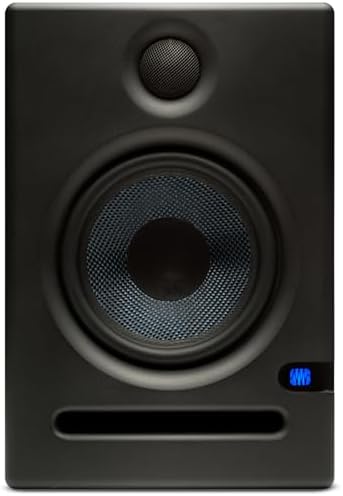
- Includes Studio One Prime and Studio Magic plug-in suite
- Over $1000 USD worth of music production software
- 5.25-inch woven composite woofer
- 1-inch ultra-low-mass silk-dome tweeter
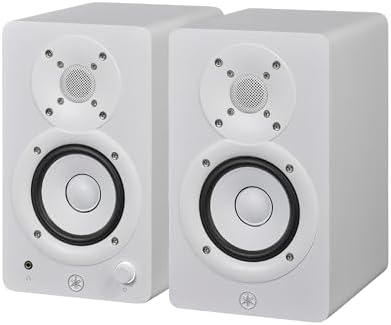
- Packaging: Pair
- 2-way bass-reflex powered speaker
- 3.5" cone woofer and 0.75" dome tweeter
- 70 Hz – 22 kHz frequency response (-10 dB)

- 1-inch (25 mm) silk-dome high-frequency transducer
- Custom-tuned 120˚(H) x 60˚(V) EBM waveguide
- 4.5-inch woven-composite low-frequency drivers

- Wired connection engineered for zero-latency audio monitoring
- Bi-amplified power delivers studio monitor quality
- 4.5-inch Kevlar woofers for smooth bass response
- Natural silk dome tweeters for precise stereo imaging

- Wired connection engineered for zero-latency audio monitoring
- Bi-amplified power delivers studio monitor quality
- 3.5-inch Kevlar woofers for smooth bass response
- Natural silk dome tweeters for precise stereo imaging

- Built-in RCA and BT 5.3 wireless connectivity
- Built-in 24-bit DAC captures digital audio via USB
- 3.5-inch carbon fiber speaker and 0.75inch silk dome tweeter
- Professionally tuned for flat frequency response curve

- Eris 4.5 near field studio monitors
- Woven-composite woofers deliver tight bass
- 50 Watts of Class AB dual amplification (25W per side)
- 1-inch low-mass silk-dome transducers
1. Yamaha HS5 Powered Studio Monitor
Best for: Producers needing honest translation in untreated home studios.
This monitor uses a 5-inch cone woofer paired with a 1-inch dome tweeter inside a bass-reflex enclosure. The 45W low-frequency and 25W high-frequency amplifiers work separately, giving you 70W of total power. That bi-amp design means the woofer doesn’t steal headroom from the tweeter when a kick drum hits hard.
What makes it the top pick is the Room Control switch. Most home studios sit against walls, and walls boost bass artificially. Flipping this control rolls off the low end so your mixes don’t turn out thin when played elsewhere. The High TRIM switch does the same for bright rooms. You’ll find XLR and TRS inputs on the back, accepting balanced or unbalanced signals from any interface.
Comparing the specs and features, the 54Hz bottom end reaches significantly deeper than the limit on the Yamaha HS3. Anyone working in a treated commercial facility won’t need the Room Control switch, since proper acoustic panels already solve boundary issues.
Pros
- 70W bi-amplified system splits power between drivers
- Room Control and High TRIM switches tune the response
- 54Hz to 30kHz frequency range covers most instruments
- XLR and TRS inputs accept balanced or unbalanced cables
Cons
- Frequency response bottoms out at 54Hz, so tracking sub-bass synths requires adding a separate subwoofer
2. PreSonus Eris Studio 8 8-inch 2-Way Active Studio Monitors
Best for: Engineers filling large rooms with full-range sound.
An 8-inch woven-composite driver handles the lows here, pushing air efficiently through a front-firing acoustic port. That larger cone moves further down the spectrum than smaller models, reaching 35 Hz before rolling off. The top end comes from a 1.25-inch silk-dome tweeter sitting inside a custom EBM waveguide tuned to 120 degrees horizontal and 60 degrees vertical spread.
That waveguide matters when two people sit side by side at the desk. A wider sweet spot keeps the stereo image stable even if you shift your chair. The Class AB biamplification delivers 140W total, hitting up to 105 dB SPL at one meter peak. Internal bracing suppresses cabinet resonance so the bass stays tight rather than boxy. Balanced XLR, balanced quarter-inch TRS, and unbalanced RCA inputs cover every interface type.
You’re looking at 35 Hz on this model against 54 Hz on the Yamaha HS5, which changes how deep your mixes translate. Those mixing exclusively on headphones or in tiny bedroom booths will find the physical footprint too imposing for a shallow desk.
Pros
- 8-inch woven-composite woofer extends bass to 35 Hz
- 140W Class AB biamplification reaches 105 dB peak SPL
- EBM waveguide spreads sound 120 degrees horizontally
- Front-firing port allows closer wall placement
- Three input types handle professional and consumer gear
Cons
- The 8-inch driver demands substantial desk depth, forcing anyone with a shallow workspace to buy separate floor stands
3. IK Multimedia iLoud Micro Monitor 50 watt Portable Wireless Bluetooth
Best for: Traveling producers mixing audio in hotel rooms.
This speaker claims the title of smallest active reference system available, packing internal DSP that compensates for where you place it. Switching between free-field and desktop modes adjusts the EQ instantly, keeping the bass tight whether they sit on stands or flat against a laptop screen. Class D amplifiers push 50W RMS through a 3-inch composite woofer and a three-quarter-inch silk dome tweeter.
Bluetooth streaming lets you check references from a phone without plugging in cables. When you need wires, Stereo RCA and an eighth-inch aux input are ready. The front-firing bass reflex port helps the tiny driver reach 55 Hz at minus 3dB, which is remarkable for a speaker you can toss in a backpack. An optional travel bag completes the mobile setup.
Its 3-inch woofer sits right next to the 3.5-inch driver on the Yamaha HS3, yet the DSP gives it more flexibility.
Pros
- Internal DSP offers desktop and free-field positioning modes
- 50W class D amplification drives surprisingly deep bass
- Bluetooth connectivity allows wireless playback from phones
- RCA and eighth-inch inputs support older devices
- Front-firing port maximizes low-end extension
Cons
- Low-end extension stops at 55Hz (-3dB), meaning orchestral or synth-heavy tracks lose their lowest fundamental notes
4. PreSonus Eris E5 2-Way 5.25″ Near Field Studio Monitor
Best for: Home recordists wanting extra software with hardware.
A 5.25-inch woven composite woofer anchors the sound, delivering solid lows with minimal distortion thanks to its tight weave pattern. The 1-inch silk-dome tweeter eliminates harshness in the upper registers, keeping long sessions comfortable. Class AB bi-amplification supplies 80W total, providing plenty of headroom for nearfield listening without compression artifacts creeping in.
Acoustic tuning controls on the back let you contour the output to match your specific room dimensions and desk material. A front-firing port ensures bass reproduction stays clear even when pushed close to a wall. Balanced XLR and quarter-inch inputs join unbalanced RCA connections, covering interfaces, DJ mixers, and consumer CD players alike. The listing also includes Studio One Prime and the Studio Magic plug-in suite.
It matches the Yamaha HS5’s 5-inch class closely, though its 80W rating beats the 70W found there. Producing strictly on battery power during outdoor field recording trips isn’t possible, since these require constant AC mains connection.
Pros
- 80W Class AB bi-amplification provides ample nearfield headroom
- 5.25-inch woven composite woofer minimizes bass distortion
- Acoustic tuning controls adapt the sound to your room
- Includes Studio One Prime and Studio Magic plug-ins
- Front-firing port supports flexible placement
Cons
- 102 dB maximum continuous SPL, so anyone needing more volume has to look elsewhere.
5. Yamaha HS3 Powered Studio Monitor in White
Best for: Beginners setting up a simple stereo desk.
Unlike single units sold individually, this package arrives as a matched pair, solving the stereo problem immediately. Each speaker houses a 3.5-inch cone woofer and a 0.75-inch dome tweeter in a bass-reflex cabinet finished in white. Combined output provides adequate power across both monitors.
Room control and high trim response switches appear here too, bringing Yamaha’s tuning philosophy down to a smaller footprint. The frequency response spans 70 Hz to 22 kHz, measured at minus 10 dB. That higher roll-off point reflects the physical limits of a 3.5-inch cone, making them ideal for podcasts, voiceovers, and acoustic guitar tracking rather than bass-heavy genres.
You get 70 Hz at the bottom here against 54 Hz on the Yamaha HS5, which noticeably changes how kick drums translate.
Pros
- Packaged as a complete stereo pair
- Room control and high trim switches included
- Modest combined power suits small desktop setups
- White finish blends into modern workspaces
Cons
- Bass response rolls off at 70 Hz (-10 dB), leaving deep kick drums and bass guitars completely unheard
6. PreSonus Eris Studio 4 4.5-inch 2-Way Active Studio Monitor
Best for: Editors needing consistent stereo imaging daily.
The defining feature here is the custom-tuned EBM waveguide surrounding the 1-inch silk-dome tweeter. Shaped to disperse sound 120 degrees horizontally and 60 degrees vertically, it creates a wide sweet spot that forgives slight head movements during long editing sessions. Below that, a 4.5-inch woven-composite driver handles midrange and bass through a front-firing acoustic port.
Class AB biamplification delivers 50W total, producing up to 99 dB SPL at one meter peak. Internal bracing suppresses cabinet resonance, ensuring the midrange stays clean when pushed loud. Connections include balanced XLR, balanced quarter-inch TRS, and unbalanced RCA inputs, matching professional interfaces and consumer gear equally well. The frequency response stretches from 55 Hz to 20 kHz.
Its 50W output matches the PreSonus Eris E4.5 exactly, but adds the waveguide that model skips.
Pros
- EBM waveguide creates a forgiving 120-degree sweet spot
- 50W Class AB biamplification reaches 99 dB peak
- 4.5-inch woven-composite driver extends to 55 Hz
- Resonance-suppressing internal bracing cleans up mids
- XLR, TRS, and RCA inputs cover all signal types
Cons
- Maximum output peaks at 99 dB SPL, so tracking loud live bands will push the amplifier into clipping
7. M-AUDIO BX4 4.5″ Wired Studio Monitors Pair
Best for: Streamers needing zero-latency wired monitoring.
These speakers focus entirely on wired performance, engineering a pure signal path for live streaming, gaming, and studio work where Bluetooth delay ruins timing. Black Kevlar low-frequency drivers measure 4.5 inches across, designed to deliver punchy bass tailored for music production. Natural silk dome tweeters handle the highs, providing precise stereo imaging without artificial brightness.
The cabinets use acoustically-inert MDF wood paired with an advanced bass reflex design to stop unwanted vibration. Rear inputs offer quarter-inch, eighth-inch, and RCA connections, hooking instantly to DJ gear, instruments, or standard computers. A front-panel eighth-inch AUX input lets you plug headphones directly in for silent late-night mixing without reaching behind the desk.
Driver size matches the PreSonus Eris Studio 4 at 4.5 inches, though the Kevlar material differs from woven composite. Cutting cables entirely for wireless tablet streaming isn’t supported, as the design relies strictly on wired connections.
Pros
- Zero-latency wired architecture prevents audio delay
- 4.5-inch Black Kevlar woofers deliver punchy bass
- Silk dome tweeters provide pristine high frequencies
- Acoustically-inert MDF cabinet reduces vibration
- Front-panel headphone input enables quick switching
Cons
- The box lists 1/8-inch and RCA cables and not a 1/4-inch cable, so that is a second purchase.
8. M-AUDIO BX3 3.5″ Wired Studio Monitors Pair
Best for: Podcasters fitting monitors onto crowded desks.
Everything about this model mirrors the BX4 above, scaled down for tighter spaces. The Kevlar woofers shrink to a compact diameter, trading some bass displacement for a much smaller footprint. Silk dome tweeters remain, keeping vocal clarity sharp for spoken-word recording and light multimedia reference. Bi-amplified power drives both components cleanly.
MDF construction again forms the cabinet, utilizing a bass reflex design to extract maximum low-end from the compact drivers. Quarter-inch, eighth-inch, and RCA inputs line the back panel, ensuring compatibility with microphones, interfaces, and phones. The front-panel eighth-inch headphone jack stays perfectly positioned for quick transitions to silent monitoring during late-night podcast edits.
Comparing the stated specs, the woofer matches the Yamaha HS3 in diameter, though materials differ.
9. Ortizan C7 Powered Studio Monitors Pair with Bluetooth 5.3
Best for: Creators switching between wireless and wired sources.
Bluetooth 5.3 technology defines this pair, letting smartphones and tablets connect wirelessly in about two seconds. Alongside that, a built-in 24-bit DAC captures digital audio directly via USB, minimizing signal loss during conversion. The acoustic design pairs a small carbon fiber mid-bass driver with a 0.75-inch silk dome tweeter, managed by an electronic 2-way crossover.
Professional tuning shaped the flat curve required for accurate monitoring, reproducing signals without artificial enhancement. Inputs cover everything: RCA for TVs, 3.5mm AUX for older devices, and a 6.35mm TRS balanced jack for mixing consoles and electric instruments. A front-panel headphone output facilitates switching to cans when neighbors complain.
It shares the same driver size as the M-Audio BX3, but adds wireless capability that model lacks. Critical mastering engineers relying solely on wired analog chains might avoid the built-in DAC processing stage.
10. PreSonus Eris E4.5-2-Way 4.5″ Near Field Studio Monitor (Pair)
Best for: Students starting their first production setup.
Sold as a pair, these monitors pack 50 Watts of Class AB dual amplification, splitting 25W per side. Woven-composite 4.5-inch woofers produce tight bass you can feel, while 1-inch low-mass silk-dome tweeters create an ultra-wide listening sweet spot. High- and low-frequency tuning controls on the back let you customize output for your specific room size and desk orientation.
Connections cover professional quarter-inch TRS balanced inputs, unbalanced RCA for consumer electronics, and a convenient front-panel eighth-inch TRS aux for phones. A built-in headphone amplifier powers the easy-access front output for plug-and-play reference. The listing also mentions pairing them with an 8-inch companion subwoofer to build a 2.1 system later.
Total power matches the PreSonus Eris Studio 4 at 50W, but this package includes two speakers instead of one.
Pros
- Packaged as a stereo pair with 50W total power
- Woven-composite woofers deliver tight, felt bass
- Tuning controls adjust high and low frequencies
- Front-panel aux and headphone amp add convenience
- Compatible with optional 8-inch companion subwoofer
Cons
- Power-saving mode auto engages after 40 minutes of idle time, so longer pauses mean restarting.
Also Worth Considering
PreSonus Eris Powered Studio Monitors is a compact active nearfield pair. The Yamaha HS3 beats it on stated output, offering more total power against the smaller drivers implied here. Buyers wanting the absolute smallest PreSonus footprint might still prefer it for basic video calls.
YAMAHA HS5I Studio Monitor is the black version featuring mounting points and screws. The standard Yamaha HS5 remains the better pick for desk users, since mounting hardware only helps those installing them permanently on wall brackets.
How We Chose
Every selected monitor had to state its exact woofer diameter and total power output clearly in the seller’s description. The remaining ten represent distinct solutions for different room sizes and workflow needs. Separation came down to physical driver dimensions, stated wattage ceilings, and unique routing features like built-in DACs or waveguides. Separate power stages for each driver improve monitor accuracy, which is why every pick here uses this bi-amplified design.
How to Choose the Right Studio Monitors
Driver size and room dimensions
Decide how deep your mixes need to go before picking a speaker. Larger woofers push more air, revealing bass problems early. The PreSonus Eris Studio 8 uses an 8-inch driver reaching 35 Hz, while the Yamaha HS3 stops at 70 Hz with its 3.5-inch cone. Match the diameter to your genre.
Power output for your listening distance
Higher wattage keeps sound clean when you sit further away. Sitting three feet back requires less headroom than mixing from a couch. The PreSonus Eris Studio 8 lists 140W for large spaces, whereas the Yamaha HS3 provides modest total power for close desktop work. Don’t overpower a tiny booth.
Connection types matching your interface
Check what outputs your audio interface has before buying. Professional interfaces use balanced XLR or TRS cables to reject noise. The Yamaha HS5 accepts both, while the Ortizan C7 adds USB and Bluetooth for direct computer or phone links. Consumer gear usually needs RCA adapters.
Room tuning controls built in
Untreated bedrooms boost bass artificially near walls. Speakers with dedicated switches fix this without acoustic panels. The Yamaha HS5 includes Room Control and High TRIM switches, and the PreSonus Eris E4.5 offers similar high and low-frequency tuning knobs. Flat response requires compensation.
Frequently Asked Questions
Can I use these monitors for regular TV watching?
Yes, provided the speaker has the right inputs. Models like the Ortizan C7 include RCA connections specifically mentioned for TV surround systems. The M-Audio BX4 also lists RCA alongside quarter-inch jacks. Just ensure your television has a matching audio output before connecting them.
Do I need an audio interface to run them?
Not always, but it helps significantly. Speakers with USB inputs, like the Ortizan C7 and its 24-bit DAC, connect straight to a computer. Others, such as the Yamaha HS5, expect line-level signals from an interface via XLR or TRS cables for optimal noise-free performance.
Will Bluetooth cause delay during mixing?
Wireless connections introduce latency that ruins precise editing. The IK Multimedia iLoud Micro includes Bluetooth for casual listening, but critical mixing should rely on its wired RCA or aux inputs. The M-Audio BX4 avoids this entirely by engineering a strictly zero-latency wired path.
Should I buy a single monitor or a pair?

Mixing requires stereo imaging to pan instruments correctly. The Yamaha HS3 and PreSonus Eris E4.5 ship as pairs, solving this instantly. Single units like the Yamaha HS5 mean buying two separately. Always confirm the packaging quantity in the listing before ordering.
How far from the wall should they sit?
Front-firing ports allow closer placement than rear-ported designs. The PreSonus Eris Studio 8 and PreSonus Eris E5 both list front-firing acoustic ports specifically for superior bass reproduction near boundaries. Still, leaving a few inches prevents low-frequency buildup regardless of port location.
Conclusion
For most home studios, the Yamaha HS5 remains the safest choice because its Room Control switches tame bad acoustics immediately. If desk space is tight, grab the PreSonus Eris E4.5 pair instead. Pick the one that fits your desk, connect your interface, and start mixing today.
As an Amazon Associate, Instrument Insight earns from qualifying purchases at no additional cost to you.