
The Ortizan C7 Powered Monitors are the best studio monitors for guitar because they’re the only ones here with a 6.35mm TRS input built specifically for electric guitars and pianos. That single fact saves you from buying extra adapters or interfaces just to plug in and play. This guide helps guitarists who need honest sound at home, whether that means desktop speakers or closed-back headphones for late-night practice. The real split is between powered speaker pairs that fill a room and headphone sets that keep the noise contained.
- Best Overall: Ortizan C7 Powered Monitors — dedicated 6.35mm TRS input made for plugging in electric guitars directly.
- Most Accurate Response: Audio-Technica ATH-M20x — tuned for enhanced low frequencies with 40mm rare earth magnet drivers.
- Largest Drivers: JOYO JMH-02 Studio Headphones — 50mm neodymium drivers deliver a flat response from 20Hz to 20kHz.
- Widest Frequency Range: NUBWO HD01 Studio Headphones — Hi-Res certified range reaches 40kHz for detailed monitoring.
- Best Wireless Option: OneOdio A70 Bluetooth Headphones — up to 72 hours of wireless playtime with a wired backup mode.
- Most Compact Design: TASCAM TH-02 Monitor Headphones — foldable build with a snap-on adapter for easy transport.
- Loudest Speaker Pair: Yamaha HS5 Studio Monitor — 70 watts of bi-amplified power driving a 5-inch cone woofer.
- Most Tuning Controls: PreSonus Eris E4.5 — high and low frequency controls plus subwoofer pairing capability.
- Smallest Speaker Pair: Yamaha HS4 — 4.5-inch woofer and included cables make setup immediate.
- Simplest Desktop Setup: PreSonus Eris 3.5 — front-panel aux and headphone jack keep connections within reach.
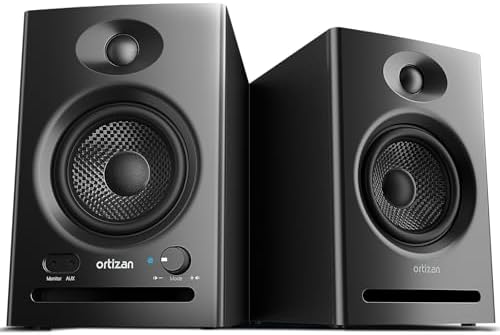
- Rca input and bt 5.3 wireless pairing
- Built-in 24-bit dac via usb connection
- 3.5 inch carbon fiber and 0.75inch silk tweeter
- Tuned for a flat response curve

- Designed for studio tracking and mixing
- 40 mm drivers with rare earth magnets
- Tuned for enhanced low frequency performance
- Circumaural design for sound isolation

- 50mm neodymium drivers, 20Hz-20kHz response
- Closed-back circumaural design for passive isolation
- 3M cable with 3.5mm and 6.35mm adapter
- Self-adjusting headband with leather cushion
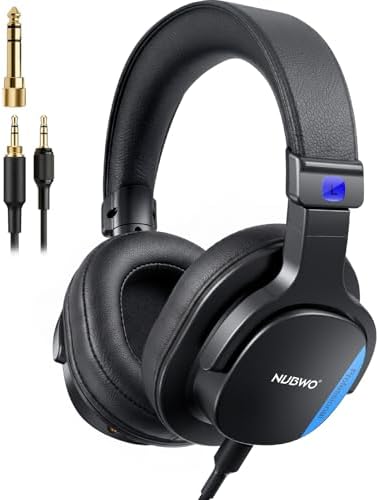
- Hi-res certified, 20Hz-40KHz, 50ohms impedance
- Weighs 241g with memory foam earpads
- Two 3.5mm cables and detachable 1/4" adapter
- Dual 3.5mm audio ports with twist-lock

- Up to 72 hours playtime in wireless mode
- 40mm neodymium drivers with aluminum fascia
- Foldable over-ear design with memory cotton
- Audio sharing via 6.35mm and 3.5mm jacks

- Foldable design for compact transport
- Padded headband and ear pads
- Closed-back dynamic design
- Snap-on 1/8” (3.5 millimeter) to 1/4” adapter

- Includes (2) Yamaha HS5 studio monitors
- 5 inch cone woofer and 1 inch tweeter
- Emphasizes sonic purity without coloring
- 54 hertz to 30 kilohertz, 70 watts total

- Eris 4.5 near field studio monitors
- Woven-composite woofers for tight bass
- 50 Watts class ab dual amplification
- 1-inch silk-dome transducers for stereo imaging
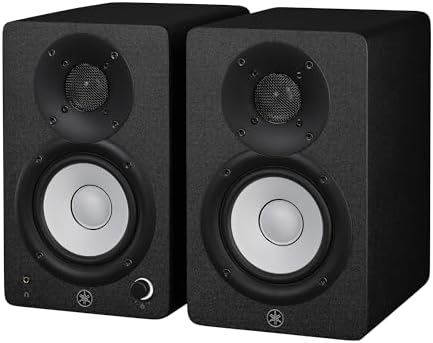
- Packaging includes a pair of speakers
- 4.5" cone woofer and 1" dome tweeter
- 60 Hz – 22 kHz frequency response (-10 dB)
- 26 W and above 26 W output power
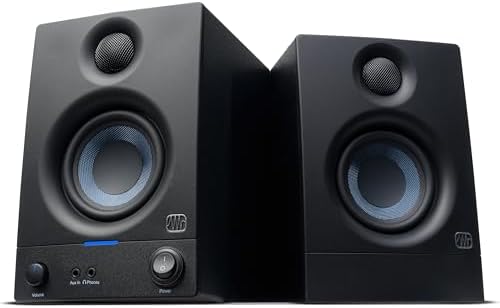
- Sold as a complete stereo pair
- 50 watts of built-in amplification
- 3.5” woven-composite woofers, 1” silk-dome tweeters
- Built-in high and low frequency tuning controls
1. Ortizan C7 Powered Studio Monitors Pair with Bluetooth 5.3
Best for: Guitarists wanting direct amp-style connections without extra adapters.
These powered speakers stand out because they list a 6.35mm TRS balanced input right on the panel. You also get RCA, 3.5mm AUX, and Bluetooth 5.3, so switching between practicing and streaming doesn’t require unplugging everything.
Inside, a 3.5-inch carbon fiber mid-bass driver pairs with a 0.75-inch silk dome tweeter. An electronic 2-way crossover splits the signal, and a built-in 24-bit DAC handles USB audio. The seller states the units are tuned for a flat response curve across all frequencies.
A front-panel headphone output lets you switch to silent monitoring instantly. Compared to the Yamaha HS5’s 5-inch woofer, the Ortizan’s 3.5-inch driver moves less air, which shapes how much low end you’ll feel during heavy riffing. It’s a compact setup meant for desks and small rooms rather than large studios.
Pros
- 6.35mm TRS input listed specifically for electric guitars
- Bluetooth 5.3 for wireless playback
- Built-in 24-bit DAC for USB audio
- 3.5-inch carbon fiber woofer and 0.75-inch silk tweeter
- Front-panel headphone output included
Cons
- 3.5-inch mid-bass driver limits low-frequency extension compared to larger woofers
2. Audio-Technica ATH-M20x Professional Studio Monitor Headphones
Best for: Players needing reliable isolation during loud tracking sessions.
This model is designed for studio tracking and mixing, using 40mm drivers equipped with rare earth magnets and copper clad aluminum wire voice coils. The listing states they’re tuned for enhanced low frequency performance. For guitarists, that means hearing the fundamental notes of lower strings clearly without artificial boosting.
The circumaural shape contours around the ears to block outside noise. If you’re recording in a room where other sounds bleed into the microphone, this closed design keeps your monitoring isolated. A single-side cable exit prevents wires from tangling around your neck while you hold a guitar. You won’t find wireless features here, as it relies entirely on a physical connection for signal transfer.
It’s a straightforward tool for listening accurately. The PreSonus Eris E4.5 offers ¼-inch TRS balanced inputs for professional devices on a speaker cabinet, whereas this headphone relies on a standard jack to connect to whatever interface or amp you already own. That makes it a dedicated listening piece rather than a standalone system.
3. JOYO JMH-02 Studio Headphones
Best for: Guitarists moving between amps, interfaces, and mixers constantly.
Fifty-millimeter neodymium drivers set these apart from the smaller options on this list. The listing specifies a flat frequency response from 20Hz to 20kHz.
A 3-meter straight cable gives you room to step back from an amp or move around a practice space. It terminates in a 3.5mm plug, and a 6.35mm adapter is included for guitar amplifiers and drum modules. The closed-back, over-ear design provides passive noise isolation.
Comfort comes from a self-adjusting leather-cushion headband and soft ear pads. The fit accommodates various head sizes, though the listing advises taking breaks during multi-hour sessions to manage pressure. At 50mm, its drivers are 5mm larger than the angled 45mm drivers found on the NUBWO HD01, pushing more air for monitoring.
Pros
- 50mm neodymium drivers
- 20Hz to 20kHz flat frequency response
- 3-meter straight cable included
- 3.5mm and 6.35mm adapter provided
- Self-adjusting leather-cushion headband
Cons
- Listed as compatible with any device sporting a standard 3.5mm or 6.35mm headphone output, and outside it this is the wrong buy.
4. NUBWO HD01 Studio Headphones Wired
Best for: Detail-oriented players analyzing high-frequency harmonics and overtones.
A frequency response of 20Hz to 40kHz earns these a Hi-Res certification. Most guitar fundamentals sit well below that ceiling, but extended highs capture the shimmer of reverb tails and the attack of a pick against strings.
They weigh 241g, featuring memory foam earpads and a reinforced headband. The earcups rotate 90 degrees and flip 180 degrees. Angled 45mm drivers direct sound toward the eardrums to improve spatial imaging.
Connectivity is handled through dual 3.5mm audio ports with a twist-lock mechanism. Plug it in, twist, and it locks to prevent accidental disconnections mid-performance. Two cables come in the box, and one includes a built-in microphone for calls.
Pros
- 20Hz to 40kHz Hi-Res frequency response
- Weighs only 241g
- Earcups rotate 90 and flip 180 degrees
- Dual 3.5mm ports with twist-lock design
- Angled 45mm drivers
Cons
- 50-ohm impedance may require higher volume settings from some audio interfaces
5. OneOdio A70 Bluetooth Over-Ear Headphones
Best for: Musicians practicing wirelessly away from their audio interface.
Wireless freedom is the main draw here, with the listing stating up to 72 hours of playtime in Bluetooth mode. When the battery finally drains, you can switch to wired mode using the included 3.5mm to 6.35mm or 3.5mm to 3.5mm cables.
Custom-made aluminum fascia and 40mm neodymium drivers handle the audio reproduction. The over-ear design uses soft memory cotton and protein leather for comfort. It’s also foldable and rotatable, saving space when you toss them into a gig bag.
An audio sharing feature lets you plug a second pair of headphones into the main set via the 6.35mm jack. The jack lock system secures the aux plug so it doesn’t pull out accidentally.
Pros
- Up to 72 hours of wireless playtime
- Includes 3.5mm to 6.35mm and 3.5mm to 3.5mm cables
- 40mm neodymium drivers
- Foldable and rotatable structure
- Jack lock system for secure wired connections
Cons
- Up to 72 hours of playtime in wireless mode, so a longer job means stopping to recharge.
6. TASCAM TH-02 Professional Studio Monitor Headphones
Best for: Traveling musicians needing a folding, lightweight monitoring solution.
The defining feature here is the foldable design meant for compact transport. If your guitar practice happens in different rooms or locations, collapsing these down makes them easy to carry. They use a closed-back dynamic design that delivers clean sound, rich bass response, and crisp highs according to the listing details.
Comfort comes from a tightly-stitched, padded headband and matching ear pads. The padding is essential when wearing them for long rehearsals. To connect to a guitar amplifier or professional interface, you use the included snap-on 1/8” (3.5mm) to 1/4” (6.3mm) adapter. It clicks onto the plug rather than threading on, speeding up changes between consumer and pro gear.
Pros
- Foldable design for compact transport
- Tightly-stitched padded headband and ear pads
- Closed-back dynamic design
- Snap-on 3.5mm to 6.3mm adapter included
Cons
- Relies on a snap-on adapter for 6.3mm connections, which is one more loose part to keep track of during travel
7. YAMAHA Hs5 Powered Studio Monitor
Best for: Home studios requiring powerful, uncolored near-field amplification.
Sold as a pair, these are 2-way bass reflex bi-amplified near field studio monitors. Each cabinet houses a 5-inch cone woofer and a 1-inch dome tweeter. The amplification is split: 45W for the low frequencies and 25W for the highs, totaling 70 watts per speaker.
The listing emphasizes sonic purity without coloring or alteration of the original sound. The frequency response spans 54 hertz to 30 kilohertz, reaching lower than many smaller desktop speakers manage.
On the back panel, XLR and TRS phone jack inputs accept balanced or unbalanced signals. You can run a TRS cable directly from an audio interface. Their 5-inch woofer extends down to 54Hz, compared to the 60Hz floor stated for the Yamaha HS4.
Pros
- Sold as a pair of monitors
- 5-inch cone woofer and 1-inch dome tweeter
- 70 watts total bi-amplified power per speaker
- 54Hz to 30kHz frequency response
- XLR and TRS phone jack inputs
Cons
- 70 watts of power amplification per speaker demands adequate room space to avoid overwhelming a small area
8. PreSonus Eris E4.5-2-Way 4.5″ Near Field Studio Monitor (Pair)
Best for: Desktop players tailoring sound to their specific room acoustics.
These near field monitors use woven-composite woofers sized at 4.5 inches. The listing explains that the weave results in tight bass you can feel alongside cleaner overall sound. Power comes from 50 watts of Class AB dual amplification, split evenly at 25W per side. That setup aims to provide volume without sacrificing tonal balance.
High frequencies are handled by 1-inch low-mass, silk-dome transducers. The seller claims these create an ultra-wide listening sweet spot, meaning you don’t have to sit perfectly centered to hear accurate stereo imaging. More importantly for room setup, high- and low-frequency tuning controls let you customize the output.
Connections cover almost everything: ¼-inch TRS balanced inputs, unbalanced RCA inputs, and a front-panel ⅛-inch TRS stereo aux. There’s also a front-panel headphone output with a built-in amplifier for quick switching. If you need more bass later, the listing mentions pairing these with a companion 8-inch subwoofer.
Pros
- 4.5-inch woven-composite woofers
- 50 watts Class AB dual amplification
- 1-inch silk-dome transducers
- High- and low-frequency tuning controls
- Front-panel headphone output and aux input
Cons
- Requires the separately mentioned Eris Sub 8BT companion subwoofer to add massive low-frequency boost
9. Yamaha HS4 Powered Studio Monitor in Black
Best for: Beginners wanting a complete speaker package ready out of the box.
This listing packages a pair of 2-way bass-reflex powered speakers. Each one holds a 4.5-inch cone woofer and a 1-inch dome tweeter. What makes this convenient is the included accessories: a stereo mini to RCA cable, a speaker cable, and an anti-slip pad. You don’t need to figure out which wires to buy separately to get started.
Output power is listed as 26 W and above 26 W. The frequency response runs from 60 Hz to 22 kHz (-10 dB). Like the larger models, these include room control and high trim response controls so you can adjust the output to match your desk or bookshelf placement. Inputs are highly versatile, featuring an XLR/TRS Phone combo jack, RCA, and Stereo Mini connections.
The combo jack is particularly useful for guitarists, as it accepts both XLR and TRS plugs in a single socket. You can plug an interface output directly in. Compared to the 5-inch woofer on the Yamaha HS5, the HS4 steps down to a 4.5-inch driver and a lower starting frequency of 60Hz instead of 54Hz.
The 60 Hz bottom end rolls off earlier than larger cabinets manage.
Pros
- Sold as a pair
- 4.5-inch cone woofer and 1-inch dome tweeter
- Room control and high trim response controls
- XLR/TRS combo, RCA, and Stereo Mini inputs
- Includes stereo mini-RCA cable, speaker cable, and anti-slip pad
Cons
- 60 Hz to 22 kHz frequency response (-10 dB) means deeper bass notes roll off sooner than on larger monitors
10. PreSonus Eris 3.5 Powered Studio Monitors
Best for: Casual players needing simple, immediate desktop connections.
Sold as a complete stereo pair, these active near-field monitors pack 50 watts of built-in amplification. The listing promises clear, dynamic sound at any volume, filling a room while remaining clean enough to hear details. They use 3.5-inch woven-composite woofers paired with 1-inch silk-dome tweeters. The stated frequency range covers 80 Hz to 20 kHz.
Built-in acoustic tuning controls for high and low frequencies let you tailor the sound to your space. Connectivity is heavily focused on desktop convenience. You get balanced TRS and RCA inputs on the back, plus a front-panel aux input for plugging in a phone or tablet quickly.
A front headphone jack allows for private listening without reaching behind the speakers. The 3.5-inch woofers are smaller than the 4.5-inch drivers on the PreSonus Eris E4.5, and the frequency response starts at 80 Hz rather than extending as low. That size difference dictates how much physical bass you’ll feel when playing guitar through them.
Pros
- 50 watts of built-in amplification
- 3.5-inch woven-composite woofers
- 1-inch silk-dome tweeters
- High- and low-frequency acoustic tuning controls
- Front-panel aux input and headphone jack
Cons
- 80 Hz–20 kHz frequency range means the lowest guitar notes won’t reproduce with the same depth as larger woofers
Also Worth Considering
OneOdio DJ Hi-Res Over-Ear Headphones. This is a wired, black over-ear set marketed for PC, keyboard, and guitar. The OneOdio A70 beats it for versatility by adding 72 hours of wireless playtime and a jack lock system, facts this title alone doesn’t claim. Guitarists who strictly want a wired-only headphone without wireless features might still consider it.
OneOdio Podcast Keyboard Guitar Laptop. Listed as a dark blue wired headset with 50mm neodymium drivers and a 1/4 to 3.5mm jack. The JOYO JMH-02 matches the 50mm driver size but adds a specific flat response across the entire audible spectrum and a 3-meter cable. Those wanting a distinct color option or basic podcast monitoring might look here.
P PUPGSIS Studio Monitor Headphones. A wired black DJ and studio set with 50mm drivers and 3.5/6.35mm connectivity. The NUBWO HD01 outclasses it on paper with a Hi-Res 20Hz-40kHz frequency response and a twist-lock dual-port design. Buyers needing basic 50mm over-ear coverage could still find this useful.
How We Chose
A product had to state its connection methods clearly to earn a place; listings missing basic specifications were excluded. Speaker pairs were separated from headphones to ensure each category offered distinct tools for guitar monitoring. Items lacking a 6.35mm adapter, TRS input, or a stated path for instrument connection were passed over unless they offered exceptional tuning controls or amplification power. The final ten represent the widest spread of features, from wireless Bluetooth playtime to bi-amplified wattage. Distinctions rest entirely on printed specifications like woofer diameter, impedance, and bundled cables. No external testing altered the selection.
How to Choose the Right Studio Monitors for Guitar
Connection types for your instrument
Decide how your guitar signal reaches the speaker or headphone first. Powered speakers like the Ortizan C7 list a 6.35mm TRS input specifically for instruments. Headphones such as the JOYO JMH-02 include a 6.35mm adapter for amplifiers. Match the listed inputs to the outputs on your pedalboard or interface.
Driver size and low frequencies
Larger drivers move more air, reproducing lower notes with greater physical impact. The Yamaha HS5 uses a 5-inch woofer reaching 54Hz, while the PreSonus Eris 3.5 relies on a 3.5-inch driver starting at 80Hz. Check the stated frequency response to ensure your guitar’s lowest tuning registers clearly.
Room tuning and placement controls
Desktop speakers interact with walls and desks, altering what you hear. The PreSonus Eris E4.5 and Yamaha HS4 both list high- and low-frequency tuning controls. These let you adjust the output to compensate for your specific room layout, ensuring your guitar tone remains accurate regardless of placement.
Wired versus wireless listening
Late-night practice often requires headphones, but mobility matters too. The OneOdio A70 lists up to 72 hours of Bluetooth playtime alongside wired cables. Purely wired models like the Audio-Technica ATH-M20x eliminate battery concerns entirely. Choose based on whether you pace the room or sit stationary at a desk.
Frequently Asked Questions
Can I plug my guitar directly into powered speakers?
Yes, if the speaker lists the correct input. The Ortizan C7 features a 6.35mm TRS balanced input that the listing states works with electric guitars. Most other speakers here, like the Yamaha HS5, require an audio interface or preamp first, as they only list XLR and TRS inputs meant for line-level signals.
Do I need an amplifier to use these headphones?
Not always. The NUBWO HD01 lists a 50-ohm impedance, which standard audio interfaces and laptop jacks drive easily. Higher impedance headphones might require dedicated amplification, but the models selected here are specified for direct connection to mixers, interfaces, and amps. Always check the ohm rating on your device.
Are closed-back headphones necessary for recording guitar?
They help significantly. The JOYO JMH-02 uses a closed circumaural design to provide passive noise isolation. The listing notes this prevents headphone bleed into your microphone during tracking. Open-back designs leak sound, which microphones pick up, so closed-back models are preferred when recording vocals or acoustic instruments simultaneously.
What does a flat frequency response actually do?
It reproduces audio without artificially boosting bass or treble. The Ortizan C7 listing states its speakers are tuned for a flat response curve to maintain true-to-source sound. For guitarists, this means the tone you hear reflects your actual amp or pedal settings, preventing you from making incorrect equalization adjustments during mixing.
Is Bluetooth suitable for live guitar monitoring?

Bluetooth introduces latency, which can feel delayed when striking strings. The OneOdio A70 solves this by including 3.5mm to 6.35mm cables for wired mode, ensuring zero delay when needed. Use wireless for casual listening or backing tracks, but switch to the included wired connection for real-time guitar playing.
Do I need to buy cables separately for these speakers?
It depends on the product. The Yamaha HS4 includes a stereo mini to RCA cable, a speaker cable, and an anti-slip pad right in the box. Other models, like the PreSonus Eris E4.5, list inputs but don’t mention bundled audio cables, meaning you’ll need to supply your own connections.
Conclusion
For most guitarists setting up a desk, the Ortizan C7 Powered Monitors offer the simplest path with their dedicated instrument input and multiple connection types. If you need silent practice instead, the JOYO JMH-02 provides large drivers and the exact adapters required to plug into any amp. Pick the format that fits your room, connect your guitar, and start playing.
As an Amazon Associate, Instrument Insight earns from qualifying purchases at no additional cost to you.