
The best studio monitor here is the Yamaha HS5, because it’s the only one sold as a pair with 70 watts of bi-amplified power and a frequency response reaching down to 54 hertz. That combination gives you the most complete setup for mixing right out of the box. This guide helps anyone building a home studio or upgrading a desk setup who needs honest sound without guessing what they’re buying.
- Best Overall: Yamaha HS5 — paired 70W bi-amped monitors covering 54Hz to 30kHz.
- Best Large Driver: PreSonus Eris E7 XT — 6.55-inch woofer with a 100-degree waveguide.
- Most Compact Reference: IK Multimedia iLoud Micro — 3-inch woofers with Bluetooth and DSP room correction.
- Best Mid-Size Desktop: PreSonus Eris E4.5 — 50W paired speakers with front-panel headphone output.
- Best Wireless Connectivity: Edifier MR3 — Bluetooth multi-point with Hi-Res Audio certification.
- Best Wired Desktop: M-Audio BX4 — zero-latency wired design with Kevlar woofers.
- Simplest to Use: Mackie CR3.5 — single tone knob, location switch, cables included.

- Includes 2 Yamaha HS5 studio monitors
- 2 way bass reflex bi amplified near field monitor
- 5 inch cone woofer and 1 inch dome tweeter
- 54 hertz to 30 kilohertz frequency response, 70 watts total

- 6.55-inch woven composite low-frequency transducer
- 1.25-inch (32 mm) silk-dome high-frequency transducer
- Includes Studio One Prime and Studio Magic plug-in suite
- 100˚(H) x 60˚(V) EBM waveguide for wide sweet spot

- Smallest active studio reference monitoring system in the world
- Internal DSP with true linear frequency response
- Class D amplifiers push a total of 50W RMS
- Low-end response down to 55Hz (-3dB)

- Eris 4.5 near field studio monitors
- Woven-composite woofers for tight bass
- 50 Watts of Class AB dual amplification (25W per side)
- 1-inch low-mass silk-dome transducers
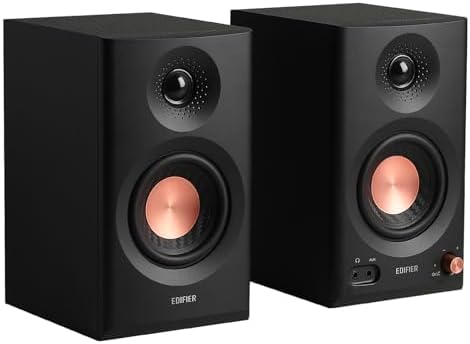
- Hi-Res Audio certified, flat response 52Hz to 40kHz
- Balanced TRS, RCA, AUX inputs, headphone output, Bluetooth
- 18W*2 RMS output with peak SPL of 92.5dB
- 3.5" mid-low drivers and 1" tweeters

- Zero-latency wired audio monitoring connection
- Bi-amplified power for studio monitor quality
- 4.5-inch Black Kevlar low-frequency drivers
- Natural silk dome tweeters for precise stereo imaging

- Sold as a pair, sized for desks and small studios
- Tone Knob dials voicing from your desk
- Location Switch corrects bass against wall or free
1. YAMAHA Hs5 Powered Studio Monitor
Best for: producers needing an accurate matched pair immediately
Yamaha built the HS5 to emphasize sonic purity without any coloring or alteration of the original sound. That philosophy shows in the specs: a 2-way bass reflex design with a 5-inch cone woofer and a 1-inch dome tweeter, driven by a bi-amp system delivering 45 watts to the low end and 25 watts to the highs. You get 70 watts of total power amplification per speaker, which is enough headroom for near-field mixing without distortion. Because this listing includes two monitors, you don’t have to buy a second unit to start working in stereo.
The frequency response runs from 54 hertz to 30 kilohertz, giving you a clear picture of both the deep lows and the airy highs in your tracks. On the back panel, XLR and TRS phone jack inputs accept balanced or unbalanced signals, so they connect cleanly to professional audio interfaces and consumer gear alike. A balanced connection rejects noise over long cable runs, which matters when your desk isn’t right next to your computer rack. Comparing the stated frequency response, the HS5 reaches 54 hertz against 52 hertz on the Edifier MR3, putting them very close in low-end extension while the Yamaha delivers significantly more amplifier power.
Pros
- Includes two monitors for immediate stereo mixing
- 70 watts of bi-amplified power per speaker
- Frequency response from 54 Hz to 30 kHz
- XLR and TRS inputs accept balanced or unbalanced signals
- Designed for sonic purity without coloration
Cons
- Frequency response bottoms out at 54 hertz, so tracking sub-bass below that requires adding a subwoofer later.
- The listing doesn’t mention what cables are included.
2. PreSonus Eris E7 XT 2-Way Active Studio Monitor with EBM
Best for: mixers who need deep bass from a single large driver
The Eris E7 XT uses a 6.55-inch woven composite low-frequency transducer designed to deliver deep lows. That larger driver moves more air than the 5-inch cone on the Yamaha HS5, which translates to a fuller bottom end before you even think about adding a subwoofer. Up top, a 1.25-inch ultra-low-mass silk-dome high-frequency transducer provides smooth highs, giving you a wider dispersion area for treble details compared to smaller domes.
What really separates this monitor is the EBM waveguide, engineered to a 100-degree horizontal and 60-degree vertical spread. The EBM waveguide yields a wide sweet spot and solid imaging. Acoustic tuning controls on the back let you tailor the monitor to your space, including Level, HPF, LF Trim, HF Trim, and Acoustic Space settings. It also ships with Studio One Prime and the Studio Magic plug-in suite, giving you software tools to start recording immediately. Keep in mind this is sold as a pack of one, so a stereo setup requires buying two.
Comparing the woofer sizes directly, the E7 XT features a 6.55-inch driver against the 4.5-inch driver on the PreSonus Eris E4.5, making it the clear choice for rooms where low-end extension matters most.
Producers working in tight bedroom studios might find the larger cabinet footprint takes up too much desk space, especially when placing two of them.
Pros
- 6.55-inch woven composite low-frequency transducer for deep bass
- 1.25-inch silk-dome tweeter for smooth high frequencies
- 100 x 60 degree EBM waveguide creates a wide sweet spot
- Five acoustic tuning controls for room adjustment
- Includes Studio One Prime and Studio Magic plug-in suite
Cons
- Sold as a pack of one, so building a stereo mixing station requires purchasing a second unit separately.
3. IK Multimedia iLoud Micro Monitor 50 watt Portable Wireless Bluetooth
Best for: traveling creators needing reference sound anywhere
IK Multimedia calls the iLoud Micro the smallest active studio reference monitoring system in the world, and the specs back up that claim. Each monitor sports a 3/4-inch silk dome tweeter and a 3-inch high-rigidity custom composite material woofer, paired with a large-flaring front-firing bass reflex port. Despite that tiny footprint, ultra-efficient class D power amplifiers push a total of 50 watts RMS, delivering low-end response down to 55 hertz at minus 3 decibels.
Internal DSP offers various EQ settings for optimizing bass and treble response, plus position compensation that lets you switch between a free field and desktop setup effortlessly. That room correction is crucial when you’re mixing on a hotel desk or a tour bus where acoustics change daily. For connectivity, Bluetooth readiness lets you pair phones or tablets wirelessly, while Stereo RCA and 1/8-inch aux inputs handle turntables and older players. The listing notes an optional matching travel bag, making these true travel companions for producing on the road.
Measuring the drivers, the iLoud Micro uses a 3-inch woofer against the 3.5-inch mid-low drivers on the Edifier MR3, trading raw displacement for extreme portability and internal DSP processing.
Engineers relying solely on physical acoustic treatment rather than digital room correction won’t benefit from the built-in DSP switching features.
Pros
- 50 watts RMS total power from class D amplifiers
- Internal DSP with free field and desktop position compensation
- Bass response extends down to 55 hertz
- Bluetooth wireless pairing alongside RCA and 1/8-inch aux inputs
- 3-inch custom composite woofer with front-firing bass reflex port
Cons
- The listing mentions an optional matching travel bag rather than including it, so protecting them on the road is a second purchase.
4. PreSonus Eris E4.5-2-Way 4.5″ Near Field Studio Monitor (Pair)
Best for: desktop producers wanting versatile connections and quick headphone switching
The Eris E4.5 packs 50 watts of Class AB dual amplification, splitting 25 watts per side to drive its woven-composite woofers. The woven-composite woofers are designed for accurate sound for music production, hi-fi audio listening, or multimedia reference. Up top, 1-inch low-mass silk-dome transducers provide a natural high-frequency response, creating superior stereo imaging from nearly any listening angle.
Where this pair really shines is connectivity. The back panel holds 1/4-inch TRS balanced inputs for professional audio devices and unbalanced RCA inputs for consumer electronics, while a convenient front-panel 1/8-inch TRS stereo aux input sits ready for your phone. An easy-access front panel headphone output with a built-in amplifier allows for plug-and-play media reference when you need to switch to cans quickly. High- and low-frequency tuning controls let you customize the audio output for your ears, room size, and speaker orientation.
Looking at the amplifier topology, the Eris E4.5 uses 50 watts of Class AB power against the 50 watts of Class D power on the IK Multimedia iLoud Micro, offering different efficiency profiles for desktop use.
Listeners who want to stream music wirelessly from their phones will notice the absence of Bluetooth on this model.
Pros
- 50 watts of Class AB dual amplification (25W per side)
- Woven-composite woofers deliver tight, expressive bass
- Front-panel mini aux input and headphone output with built-in amp
- 1/4-inch TRS balanced and RCA unbalanced rear inputs
- High- and low-frequency tuning controls for room customization
Cons
- Amplification is rated at 50 watts total, which sets a ceiling for volume before distortion in larger untreated rooms.
5. Edifier MR3 Powered Studio Monitor
Best for: users needing Bluetooth multi-point and app-based EQ control
Edifier earned Hi-Res Audio certification for the MR3, delivering a flat response across 52 hertz to 40 kilohertz. That upper limit reaches further than the 30 kilohertz ceiling on the Yamaha HS5, capturing ultra-high harmonics during precise monitoring or everyday listening. Inside the MDF cabinet, designed to reduce distortion, sit 3.5-inch mid-low drivers and 1-inch tweeters powered by 18 watts RMS per channel with a peak SPL of 92.5 decibels.
Connectivity is rich here. Balanced TRS, RCA, and AUX inputs cover almost every source, while a headphone output handles private sessions. Bluetooth supports multi-point connection, letting you keep your laptop and phone paired simultaneously without reconnecting constantly. RCA and AUX inputs enable simultaneous connection with multiple audio devices, so your turntable and computer can stay plugged in together. You can easily switch between Music, Monitor, and Custom modes, then fine-tune the sound precisely through the EDIFIER ConneX app for personalized EQ control.
Comparing the high-frequency limits, the MR3 reaches 40 kilohertz against 30 kilohertz on the Yamaha HS5, extending further into the ultra-high spectrum for detailed mastering work.
Mixers working in large studios will find that 18 watts RMS per channel hits a volume ceiling long before filling a spacious control room.
Pros
- Hi-Res Audio certified with 52 Hz to 40 kHz frequency response
- Bluetooth multi-point connection for simultaneous device pairing
- 18W RMS per channel output with 92.5 dB peak SPL
- MDF cabinet construction reduces unwanted distortion
- EDIFIER ConneX app allows in-depth EQ adjustments and mode switching
Cons
- Output is listed at 18 watts RMS per channel, so driving a large room to high volumes means hitting a power ceiling.
6. M-AUDIO BX4 4.5″ Wired Studio Monitors Pair
Best for: podcasters and streamers requiring zero-latency wired monitoring
M-Audio engineered the BX4 specifically for a latency-free wired connection, providing a pure, uninterrupted signal perfect for live streaming, gaming, podcasting, and studio work. That focus on wired performance means you won’t deal with Bluetooth delay when tracking vocals or playing virtual instruments in real time. The bi-amplified power upgrades standard computer speakers with crystal-clear studio monitor quality directly to your desktop.
Acoustic performance relies on 4.5-inch Black Kevlar low-frequency drivers, tailored for ultimate acoustic performance with a smooth, punchy bass response suited for music production. Natural silk dome tweeters handle the full spectrum of frequencies, providing precise stereo imaging and pristine highs. The cabinet uses acoustically-inert MDF wood construction paired with an advanced bass reflex design to stop unwanted vibration and enhance low-frequency immersion. Complete hook-up flexibility comes from rear 1/4-inch, mini, and RCA inputs, while a front panel mini AUX input lets you connect headphones directly for silent late-night mixing.
The BX4 utilizes 4.5-inch Kevlar woofers against the 4.5-inch woven-composite woofers on the PreSonus Eris E4.5, offering different diaphragm materials for the same driver diameter.
Producers who rely on wireless streaming from mobile devices will find the strictly wired architecture limits their setup options.
Pros
- Zero-latency wired connection engineered for live tracking and streaming
- 4.5-inch Black Kevlar low-frequency drivers for punchy bass
- Bi-amplified power delivery for studio-grade sound
- Rear 1/4-inch, mini, and RCA inputs offer complete hookup flexibility
- Acoustically-inert MDF cabinet with advanced bass reflex design
Cons
- The listing specifies a latency-free wired connection, so anyone wanting to stream audio wirelessly via Bluetooth must look elsewhere.
7. Mackie CR3.5 Studio Monitors (Pair)
Best for: beginners wanting everything needed in one box
Mackie sells the CR3.5 as a pair sized specifically for desks and small studios, promising you’ll hear your mix or stream the way it actually sounds rather than flattered. Instead of navigating complex menus or software apps, a single Tone Knob lets you dial the voicing directly from your desk.
Room placement often ruins small speakers, but a Location Switch corrects the bass whether the monitors sit flush against a wall or out in the free field. What truly sets this package apart is the box contents: both monitors, isolation pads, and all cables to start are included. You won’t need to figure out which wires fit or order foam pads separately to decouple the speakers from your desk surface.
Checking the driver size, the CR3.5 uses 3.5-inch woofers against the 6.55-inch transducer on the PreSonus Eris E7 XT, confirming it’s built for tight spaces rather than deep bass extension.
Audio engineers needing balanced XLR inputs for professional interfaces will see that this listing omits them entirely.
Pros
- Sold as a matched pair sized for desks
- Single Tone Knob adjusts voicing without menus
- Location Switch corrects bass for wall or free-field placement
- Box includes both monitors, isolation pads, and all cables to start
- Honest sound profile avoids flattering the mix
Cons
- Equipped with 3.5-inch woofers, which places a strict physical limit on how deep the bass response can reach compared to larger drivers.
Also Worth Considering
The YAMAHA HS4 Powered Studio Monitor is a black pair featuring a smaller footprint than the main list’s HS5. The HS5 beats it with a 5-inch woofer and 70 watts of bi-amplified power, making the HS4 better suited for buyers whose desks simply can’t fit the larger cabinets.
The Mackie CR4.5BT Powered Studio Monitors step up to 4.5-inch drivers and add Bluetooth capability. The M-Audio BX4 matches that 4.5-inch driver size while focusing purely on zero-latency wired performance, so the Mackie appeals to those prioritizing wireless streaming convenience over strict wired tracking.
The Edifier R1700BT Bluetooth Bookshelf Speaker is an active near-field 2.0 setup in a wooden enclosure pushing 66 watts RMS. The Edifier MR3 beats it with Hi-Res Audio certification and app-based EQ control, leaving the R1700BT for listeners who prefer higher raw wattage and a traditional bookshelf form factor.
How We Chose
To earn a place, a listing had to state its exact woofer dimensions, specify the amplification type or wattage, and clearly outline what arrives in the box. Products lacking these basic specifications were removed, as comparing them accurately proved impossible. Listings describing single units versus pairs were evaluated based on exactly what the seller printed, ensuring no assumptions were made about hidden contents. The final seven selections represent distinct approaches to near-field monitoring, separated by physical driver size, wireless capabilities, and connection flexibility.
How to Choose the Right Studio Monitor
Driver Size and Low-End Reach
Decide how deep your bass needs to go before picking a speaker. Larger woofers move more air, producing lower frequencies naturally. The PreSonus Eris E7 XT uses a 6.55-inch driver for deep lows, while the IK Multimedia iLoud Micro relies on a 3-inch woofer paired with DSP to reach 55 hertz. Match the driver size to your genre and room.
Connections and Signal Flow
Look at your audio interface first, then pick monitors with matching inputs. Balanced connections reject noise over distance. The Yamaha HS5 offers XLR and TRS jacks for professional gear, while the M-Audio BX4 covers 1/4-inch, mini, and RCA inputs. If you stream from phones, ensure Bluetooth or front-panel aux inputs are listed.
Room Correction and Placement Controls
Small rooms create acoustic problems that speakers must help solve. Physical switches or digital processing adjust the output for your specific desk. The Mackie CR3.5 includes a Location Switch to correct bass near walls, and the PreSonus Eris E7 XT provides five acoustic tuning controls. Without these, you’ll fight your room’s reflections constantly.
What Arrives in the Box
Check the included items carefully before ordering. Some products ship as single units, requiring a second purchase for stereo sound. The Mackie CR3.5 includes both monitors, isolation pads, and all cables to start, whereas the PreSonus Eris E7 XT is sold as a pack of one. Knowing what’s missing prevents delays.
Frequently Asked Questions
Do I need an audio interface to run these monitors?
Not always, but it depends on the inputs listed. Speakers like the Yamaha HS5 feature XLR and TRS inputs designed for balanced signals from professional interfaces. However, the PreSonus Eris E4.5 includes unbalanced RCA inputs and a front-panel mini aux jack, allowing direct connection to phones or consumer electronics without extra hardware.
Can I use Bluetooth monitors for professional mixing?
You can, but latency matters during recording. The Edifier MR3 supports Bluetooth multi-point connection for convenient streaming, which works well for referencing mixes. For live tracking where timing is critical, the M-Audio BX4 is engineered specifically for a zero-latency wired connection, making it the safer choice for recording sessions.
What does bi-amplified mean for my setup?
It means separate amplifiers power the woofer and tweeter independently. The Yamaha HS5 uses a 45-watt low-frequency and 25-watt high-frequency bi-amp system totaling 70 watts. This separation prevents the drivers from competing for power, resulting in clearer sound and better transient response compared to single-amplifier designs found on simpler multimedia speakers.
Why do some listings sell only one speaker?
Certain professional monitors are packaged individually so buyers can build custom surround systems or replace a single damaged unit. The PreSonus Eris E7 XT is listed as a pack of one. If you need stereo sound immediately, look for listings like the Mackie CR3.5, which explicitly states it’s sold as a pair.
How does room placement affect bass response?
Placing monitors against a wall artificially boosts low frequencies, muddying your mix. The Mackie CR3.5 solves this with a Location Switch that corrects bass whether the speakers sit against a wall or in the free field. Similarly, the PreSonus Eris E7 XT offers an Acoustic Space control to tailor the contour to your room’s boundaries.
Are isolation pads really necessary on a desk?

They prevent speaker vibrations from transferring into your desk surface, which causes unwanted resonance and muddy sound. The Mackie CR3.5 includes isolation pads directly in the box alongside all cables to start.
A monitor’s ability to reproduce sound accurately relies on minimizing cabinet resonance. The acoustic principles governing loudspeaker enclosures dictate why dense materials matter for clean playback. Both the Edifier MR3 and the M-Audio BX4 list MDF cabinet construction specifically to reduce distortion and stop unwanted vibration, ensuring the drivers’ movement translates into pure audio rather than rattling wood. Choosing a sealed or ported design ultimately shapes how that bass energy leaves the box.
Conclusion
The Yamaha HS5 remains a reliable choice for most people because it arrives as a matched pair with 70 watts of bi-amplified power and professional XLR inputs ready for any interface. If your setup demands less fuss and fewer separate purchases, the Mackie CR3.5 hands you both speakers, isolation pads, and every cable required in a single box. Pick the one that fits your desk, connect it to your interface, and start listening to your tracks honestly.
As an Amazon Associate, Instrument Insight earns from qualifying purchases at no additional cost to you.