
Finding the right studio monitors means balancing your desk space against the audio accuracy you need for your creative work. This guide helps you navigate the features that matter, focusing on how different designs impact your daily workflow and sound monitoring.
Quick Picks
- Best Overall: PreSonus Eris 3.5 — Versatile connectivity and compact size for any desk.
- Most Compact: IK Multimedia iLoud Micro — Smallest footprint with impressive low-end response.
- Best Sound Quality: Yamaha HS4 — Balanced frequency response for precise monitoring.
- Best Wireless Connectivity: Edifier MR3 — Multi-point Bluetooth support and app-based EQ.
- Simplest Controls: Mackie CR3.5 — Intuitive tone knob for quick sound adjustments.
- Best Larger Drivers: PreSonus Eris E4.5 — Larger woofers for a more expansive sound.
- Best Built-In DAC: Ortizan C7 — Direct USB audio support for minimal signal loss.
- Best Wired Latency: M-Audio BX3 — Dedicated design for zero-latency monitoring needs.
- Best High-Performance Output: Yamaha HS8 Powered Monitor — High-power output for demanding studio tasks.
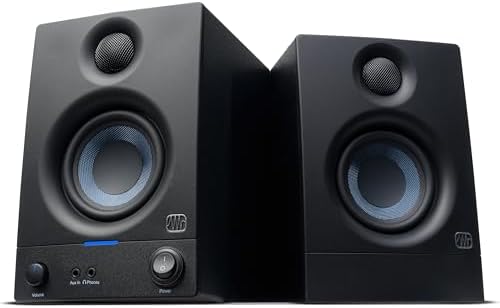
- TRUSTED STUDIO-QUALITY SOUND: True studio sound for music production, gaming, movies, streaming, and everyday audio. Sold as a complete stereo pair.
- POWERFUL, DISTORTION-FREE SOUND: 50 watts of built-in amplification drives clear, dynamic sound at any volume — powerful enough to fill the room,…
- ACCURATE, POWERFUL SOUND: 3.5” woven-composite woofers deliver deeper, tighter bass while 1” silk-dome tweeters smooth out harshness for clear,…
- DIAL IN PERFECT SOUND IN ANY ROOM: Built-in high- and low-frequency acoustic tuning controls let you tailor the sound to your space — no treatment or…

- The smallest active studio reference monitoring system in the world, iLoud Micro Monitor provides you with ultra-accurate true linear frequency…
- Whether you’re recording, editing, mixing or mastering audio, editing video, sound designing or gaming, iLoud Micro Monitor ensures your production…
- Let the bass bump: From writing songs and mixing audio on a tour bus to keeping the party going at the afterparty in the hotel room, iLoud Micro…
- Portable and lightweight: iLoud Micro Monitors are perfect travel companions delivering recording studio-quality sound that your favorite music…
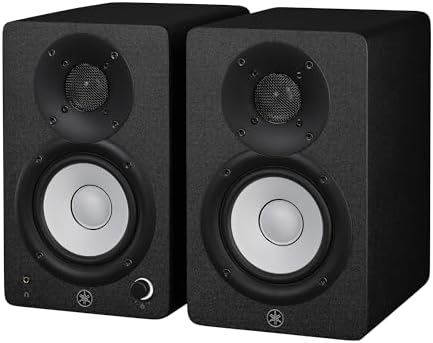
- Packaging: Pair
- 2-way bass-refiex powered speaker with 4.5" cone woofer and 1" dome tweeter
- 60 Hz – 22 kHz frequency response (-10 dB)
- 26 W and above 26 W output power
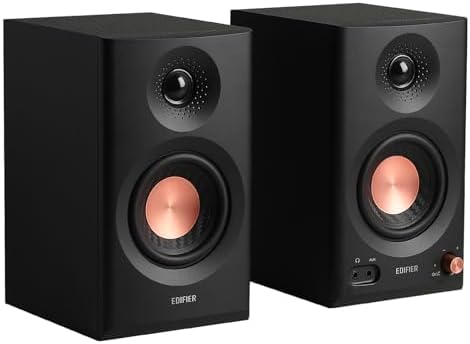
- Hi-Res Audio Certified – Experience superior sound with Hi-Res Audio certification, delivering a flat response across 52Hz to 40kHz for precise and…
- Rich Connectivity – Balanced TRS, RCA, and AUX inputs, headphone output, with Bluetooth supporting multi-point connection. RCA and AUX inputs enable…
- Powerful Sound Output – Enjoy 18W*2 RMS output with a peak SPL of 92.5dB, enhanced by 3.5" mid-low drivers and 1" tweeters for rich, full-range sound.
- Customizable Sound Experience – Easily switch between Music, Monitor, and Custom modes to suit your needs. Fine-tune your sound precisely through the…

- Sold as a pair, sized for desks and small studios
- Hear your mix or stream the way it actually sounds, not flattered
- Tone Knob: dial voicing from your desk without menus
- Location Switch: corrects bass whether they sit against a wall or free

- Eris 4.5 near field studio monitors
- Woven-composite woofers deliver tight bass
- 50 Watts of Class AB dual amplification (25W per side)
- 1-inch low-mass silk-dome transducers
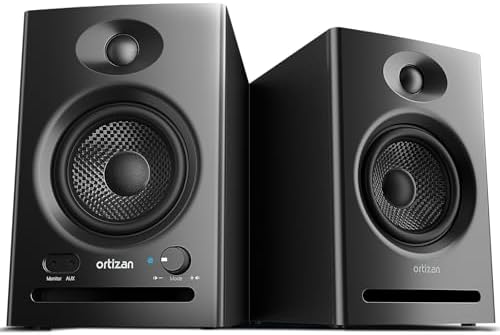
- 【Multiple INPUTS】The stereo speakers home audio is built with RCA which ensure a lossless connection surround sound system for TV; With the addition…
- 【HIFI BOOKSHELF SPEAKERS】The built-in 24-bit DAC captures digital audio directly via USB, minimizing signal loss during conversion and maximizing…
- 【3.5 INCH CARBON FIBER SPEAKER AND 0.75inch SILK DOME TWEETER】The 0.75-inch tweeter and 3.5-inch mid-bass golden acoustic combination, with a…
- 【PROFESSIONAL TUNING】Through extensive laboratory adjustments and meticulous comparisons, the speaker units have been finely tuned to achieve a flat…

- Latency Free Wired Connection – Engineered for zero-latency audio monitoring, these wired desktop speakers provide a pure, uninterrupted signal…
- Studio-Grade Sound – Upgrade your built-in computer speakers with crystal-clear, bi-amplified power that delivers professional studio monitor quality…
- 3.5-inch Kevlar Woofers – Designed for ultimate acoustic performance, the Black Kevlar low-frequency drivers provide a smooth, punchy bass response…
- Natural Silk Dome Tweeters – Experience the full spectrum of frequencies with natural silk dome tweeters that provide precise stereo imaging and…

- 38Hz – 30kHz frequency response
- 75W LF plus 45W HF bi-amp system for high-performance 120W power amplification
- 8-inch cone woofer, 1-inch dome tweeter
- Large magnets in an Advanced Magnetic Circuit design
1. PreSonus Eris 3.5 Powered Studio Monitors
Best for: Creators who need a versatile, all-in-one desktop solution.
These monitors are designed to provide a balanced sound profile while staying small enough for a crowded workspace. They feature 50 watts of total power, which is plenty for most home offices and smaller creative studios. The inclusion of both balanced TRS and unbalanced RCA inputs means you can connect a variety of gear without needing extra adapters or complex routing.
You can easily adjust the sound to your specific room using the high- and low-frequency tuning controls on the back. This is a helpful feature if your desk is pushed against a wall, as it lets you clean up the bass response. Compared to the 75W LF output on the Yamaha HS8 Powered Monitor, these are much smaller and better suited for tight spaces where you don’t need extreme volume.
Pros
- Includes both TRS and RCA inputs.
- Front-panel aux input for quick connections.
- Built-in high- and low-frequency tuning.
- Dedicated front-panel headphone jack.
Cons
- 80 Hz–20 kHz full range, so anyone needing lower bass has to plan around it.
2. IK Multimedia iLoud Micro Monitor 50 watt Portable Wireless Bluetooth
Best for: Traveling creators or those with extremely limited desk space.
These are the smallest monitors on this list, yet they pack a surprising amount of power into a tiny frame. Because they use internal digital signal processing, they can manage their frequency response effectively despite their small size. They’re particularly useful if you frequently move your setup between a home studio and a tour bus or hotel room.
The Bluetooth connectivity allows for easy wireless streaming, which is great for casual listening when you aren’t actively mixing. While they’re highly portable, they aren’t meant for someone who needs to fill a large room with sound. At 55Hz for their low-end response, they offer a different sonic character than the 38Hz reach of the Yamaha HS8 Powered Monitor.
Pros
- Extremely compact and lightweight design.
- Built-in Bluetooth for wireless audio.
- Internal DSP for optimized sound.
- Includes position compensation settings.
Cons
- Smallest drivers here, which limits the physical air movement compared to 8-inch speakers.
3. Yamaha HS4 Powered Studio Monitor in Black
Best for: Users who prioritize a neutral, flat frequency response for mixing.
The HS4 uses a 4.5″ woofer to provide a clean midrange and a defined low end. It includes a variety of inputs, including combo XLR/TRS jacks, which makes it easy to hook up professional audio interfaces.
The included anti-slip pads help decouple the speakers from your desk, which is a nice touch for keeping the sound clean. If you compare these to the Edifier MR3, you’ll find the Yamaha approach is strictly about neutral monitoring rather than app-based customization.
Pros
- 60 Hz – 22 kHz frequency response (-10 dB).
- Combo XLR/TRS inputs for pro gear.
- Includes anti-slip pads and cables.
- Room control and high trim switches.
Cons
- Lacks the wireless connectivity found on the Edifier MR3.
4. Edifier MR3 Powered Studio Monitor
Best for: Modern creators who want wireless convenience and app control.
The Edifier MR3 is built for the tech-savvy user who wants to control their sound via a smartphone app. With Hi-Res Audio certification, these speakers are designed to provide a high level of detail across a broad frequency range. The multi-point Bluetooth support is a major plus, allowing you to switch between devices without manual re-pairing.
Having both RCA and AUX inputs lets you keep multiple devices connected simultaneously, which reduces the need to crawl behind your desk to swap cables. Anyone who needs a strictly wired, latency-free professional setup might prefer the M-Audio BX3 instead, as wireless protocols can occasionally introduce slight delays.
5. Mackie CR3.5 Studio Monitors (Pair)
Best for: Beginners who want a no-fuss, simple setup.
Mackie focuses on ease of use with the CR3.5, placing a convenient tone knob right on the front for quick adjustments. This means you don’t have to mess with menus or rear-panel switches just to change the voicing of your speakers. They’re sold as a complete pair and include all the cables you need to get started immediately.
The location switch on the back is a smart addition, helping you correct the bass response based on whether the speakers are near a wall or out in the open. While this simplifies things, it doesn’t offer the deep, granular EQ control that you get with the Edifier MR3 app.
Pros
- Simple front-panel tone knob.
- Includes all necessary cables.
- Quick location switch for bass.
- Compact size for small studios.
Cons
- Tone knob offers less precision than the app-based EQ on the Edifier MR3.
6. PreSonus Eris E4.5-2-Way 4.5″ Near Field Studio Monitor (Pair)
Best for: Producers who want a bit more “punch” than smaller monitors offer.
Moving up to a 4.5-inch woofer provides a noticeable difference in how the low end feels in the room. These monitors are designed to provide a wider listening sweet spot, which is helpful if you move around your desk a lot while working. The 50 watts of Class AB amplification ensures there’s enough headroom to hear your mix clearly without distortion.
They include the same handy front-panel headphone output as the smaller Eris 3.5, making it easy to check your work in silence.
Pros
- Larger 4.5-inch woofers for better bass.
- Class AB amplification for clarity.
- Wide listening sweet spot.
- Front-panel headphone output.
Cons
- Auto engages after 40 minutes of idle time, so longer pauses mean stopping to restart.
7. Ortizan C7 Powered Studio Monitors Pair with Bluetooth 5.3
Best for: Digital creators who work directly from a computer USB port.
The Ortizan C7 is unique because it features a built-in 24-bit DAC, allowing you to connect via USB for a cleaner digital signal. This minimizes the conversion steps and potential noise that can occur with standard analog cables. It also includes a balanced TRS input, which is essential if you’re connecting to a professional mixing console.
The carbon fiber woofer and silk dome tweeter provide transparency.
Pros
- Built-in 24-bit USB DAC.
- Balanced TRS inputs for pro gear.
- Carbon fiber woofer for precision.
- Multiple AUX inputs for flexibility.
Cons
- Requires a USB connection to utilize the built-in DAC.
8. M-AUDIO BX3 3.5″ Wired Studio Monitors Pair
Best for: Podcasters and streamers who need zero-latency monitoring.
These speakers are engineered specifically to avoid latency, which is critical when you’re recording vocals or playing instruments live. The Kevlar woofers are a standout feature here, providing a punchy and durable response that handles transients well. They include a front-panel 1/8-inch AUX input for connecting headphones.
The MDF cabinet reduces unwanted vibrations.
Pros
- Zero-latency wired connectivity.
- Durable Kevlar woofers.
- Acoustically-inert MDF cabinet.
- Front-panel 1/8-inch AUX input.
Cons
- Lacks the digital USB input found on the Ortizan C7.
9. Yamaha HS8 8-Inch Powered Studio Monitor Pair
Best for: Serious mixers who need high-performance, full-range sound.
These are the heavy hitters of the group, featuring massive 8-inch woofers that can reach down to 38Hz. With 120 watts of total bi-amplified power, they’re designed to handle demanding studio tasks where you need to hear every detail in the low end. They’re significantly larger than any other monitor on this list.
The advanced magnetic circuit design helps in maintaining control over the woofer, ensuring the sound remains tight even at higher volumes.
Pros
- Powerful 120W bi-amp system.
- Large 8-inch woofers for deep bass.
- Wide 38Hz – 30kHz frequency response.
- Advanced magnetic circuit design.
Cons
- Large size requires significant desk or stand space.
Also Worth Considering
The Mackie CR4.5 Studio Monitors are a mid-sized option that fits between the smaller 3-inch and larger flagship models, though they lack the specific app-based tuning of the Edifier MR3. The YAMAHA Hs5 Powered Studio Monitor is a smaller alternative to the HS8, keeping the neutral sound profile but in a more manageable footprint.
How We Chose
Thirty-one Amazon listings were compared on frequency response range, driver size, and input connectivity, and near-duplicates were left out. Only monitors that explicitly stated their power output in watts or their frequency range were shortlisted to ensure consistency. Speakers that lacked basic professional inputs like TRS or RCA were removed to maintain a focus on studio-capable gear. The final selection prioritizes monitors that provide clear, accurate audio reproduction while offering enough flexibility to fit into a variety of home studio environments. Picks were categorized based on their unique strengths, such as wireless features, physical size, or specialized internal components like DACs.
How to Choose the Right Studio Monitors
Frequency Response and Your Needs
The frequency response tells you how much of the audio spectrum the speakers can reproduce. A wider range, like the 38Hz to 30kHz on the Yamaha HS8 Powered Monitor, allows for more detail in the deep bass and high treble. If you produce bass-heavy music, look for a wider range.
Size and Where It Has to Fit
Monitor size is usually dictated by the woofer diameter. A compact woofer, like that on the PreSonus Eris 3.5, fits easily on most desks. An 8-inch woofer, found on the Yamaha HS8 Powered Monitor, requires substantial space and often benefits from dedicated stands. Always measure your desk before choosing.
What Comes in the Box
Check if the listing includes necessary cables, such as the speaker wire or RCA cords. The Yamaha HS4 includes a stereo mini-to-RCA cable and anti-slip pads, which saves you from buying extra parts.
Frequently Asked Questions
Do I need an audio interface for these monitors?
Most monitors listed here, like the PreSonus Eris 3.5 or M-Audio BX3, accept RCA or AUX cables and can plug directly into a computer. However, using a dedicated audio interface provides a balanced connection that reduces noise and interference, which is why professional studios prefer TRS or XLR inputs.
Is Bluetooth good for studio monitoring?
Bluetooth is convenient for casual listening, but it isn’t ideal for professional mixing or recording. The Edifier MR3 and Ortizan C7 support wireless playback, but wireless signals can introduce latency and data compression.
How do I position my monitors for the best sound?
Place your monitors at ear level, angled inward toward your head to form an equilateral triangle. If your speakers are against a wall, use the rear-panel switches on models like the Mackie CR3.5 or PreSonus Eris E4.5 to adjust the bass response and prevent a muddy sound.
Can I use these for watching movies or gaming?
Yes, all these monitors are designed for multimedia use. Models with multiple inputs, such as the Ortizan C7 or PreSonus Eris 3.5, allow you to keep your computer and gaming console connected simultaneously.
Do I need a subwoofer?
A subwoofer provides the deep low-end power that smaller speakers cannot produce. While models like the Yamaha HS8 offer strong bass independently, smaller monitors like the PreSonus Eris E4.5 can be paired with external units to create a full-range 2.1 system.
The PreSonus Eris 3.5 is the best choice for most users because it balances quality, size, and connectivity in one package. If you have limited space, the IK Multimedia iLoud Micro is a capable alternative that fits almost anywhere. Check your desk space and input needs to determine the best fit.
Why is there a humming noise coming from my monitors?
A constant hum usually indicates a ground loop caused by plugging speakers and computers into different outlets. Plugging both devices into the same power strip often fixes this immediately.
What does bi-amplified mean for studio monitors?
Bi-amplification uses two separate internal amplifiers to power the woofer and tweeter independently. The Yamaha HS8 uses this system to split the workload, ensuring neither driver starves for power.
How far apart should I place my desk monitors?
The distance between your speakers determines the stereo image quality. For desktop models like the Mackie CR3.5, placing them three feet apart forms a proper listening triangle.
Do I need acoustic treatment for small monitors?
Small monitors interact with surfaces, so decoupling them from your desk is essential to stop vibrations. The Yamaha HS4 includes an anti-slip pad to prevent furniture resonance.
Can I connect a turntable directly to these speakers?
Most turntables require a preamp to boost their quiet phono signal to line level. If your turntable has a built-in preamp, you can connect it directly to the Edifier MR3.
What is the difference between near-field and mid-field monitoring?
Near-field monitors are designed to be listened to from an arm’s length away to minimize room reflections. Larger mid-field monitors, like the Yamaha HS8, are designed to fill bigger spaces and be heard clearly from several feet away.
Does the cabinet material change the sound quality?
MDF cabinets are acoustically inert, which helps prevent the box from vibrating and coloring the audio. The M-Audio BX3 and Edifier MR3 use MDF to ensure the sound comes from the woofers rather than the enclosure.
Should I choose front-firing or rear-firing bass ports?
A bass reflex port extends low-frequency response by allowing air to move in and out of the cabinet. The IK Multimedia iLoud Micro features a front-firing port, allowing placement against a wall.
How do silk dome tweeters compare to other types?
Silk-dome tweeters provide a natural high-frequency response that reduces harshness during long sessions. Models like the PreSonus Eris 3.5 use these soft domes to absorb sharp peaks that cause ear fatigue.
Is a wider frequency response always better for mixing?
A broad frequency range matters less than a flat response for professional mixing. The Yamaha HS8 covers 38Hz to 30kHz for deep sub-bass, while the Edifier MR3 prioritizes vocal clarity.
Do I need isolation pads under my monitors?
Isolation pads decouple speakers from your desk to prevent mechanical vibrations from muddying the bass. The Mackie CR3.5 and Yamaha HS4 include these pads to stop energy transfer into your furniture.
What does a built-in DAC actually do for audio quality?
A Digital-to-Analog Converter turns digital files into the analog signals your speakers need. The Ortizan C7 features an integrated 24-bit DAC that captures audio via USB, bypassing noisy internal sound cards.
How does Bluetooth multi-point connection work in practice?
Standard Bluetooth forces you to disconnect one device before pairing another, which interrupts your workflow if you switch between a laptop and a phone constantly. The Edifier MR3 supports Bluetooth multi-point connection, allowing it to maintain active links with two devices simultaneously. You can mix a track on your computer, then instantly play a reference song from your phone without navigating menus or re-pairing.
Are 50 watts enough for a home studio?
Total wattage determines how loud your monitors can play before the sound distorts. Both the PreSonus Eris 3.5 and the IK Multimedia iLoud Micro deliver 50 watts of power, which is sufficient for near-field listening at a desk where the speakers are only a few feet from your ears.
What is the benefit of a location switch on a monitor?
Room boundaries drastically alter how bass frequencies behave, causing a buildup of low-end energy when speakers sit near walls or corners. The Mackie CR3.5 includes a Location Switch that corrects bass whether they sit against a wall or free in the open room.
How do combo XLR/TRS inputs differ from standard RCA?
Professional audio interfaces output balanced signals, which use three conductors to cancel out electromagnetic interference picked up along the cable run. The Yamaha HS4 provides XLR/TRS Phone (COMBO) inputs, accepting both standard microphone-style XLR cables and quarter-inch TRS cables from pro interfaces.
Does the type of amplifier class matter for small monitors?
Amplifier class dictates how efficiently the speaker converts electrical power into sound. The IK Multimedia iLoud Micro uses ultra-efficient class D power amplifiers, which generate very little heat and draw less power, making them ideal for a tiny, enclosed chassis that travels in a bag. The PreSonus Eris E4.5 relies on Class AB dual amplification, a traditional design favored for its warm, linear sound characteristics in stationary studio environments.
Can I daisy chain multiple pairs of these monitors together?
Daisy chaining involves passing the audio signal from one set of speakers to another, which requires specific output jacks designed for that purpose. None of the monitors listed here, from the M-Audio BX3 to the Yamaha HS8 Powered Monitor, feature dedicated daisy-chain outputs in their specifications.
How important is the headphone amplifier built into a monitor?

Switching between speakers and headphones is a daily routine for anyone mixing late at night or checking a detail in isolation. The PreSonus Eris E4.5 features a built-in headphone amplifier accessible via the front panel, ensuring your headphones receive enough power to reproduce the audio accurately without relying on your computer’s weak internal jack.
What role does an electronic crossover play in monitor design?
A crossover splits the incoming audio signal into different frequency bands, sending the bass to the woofer and the treble to the tweeter. The Ortizan C7 pairs its drivers with an electronic 2-way crossover acoustic combination to provide a more layered sound performance.
Conclusion
Choosing the right pair is just the beginning of your creative journey. Once you’ve set them up, spend time listening to your favorite songs to understand how your new speakers handle different frequencies. You’ll soon find that your mixes sound clearer and more professional than they ever did before.
As an Amazon Associate, Instrument Insight earns from qualifying purchases at no additional cost to you.