
The Yamaha HS7 is the best studio monitors for mixing and mastering because it offers a balanced 6.5-inch woofer design that provides enough reach for most rooms without overwhelming your desk. These tools help creators ensure their sound is accurate across different playback systems.
Choosing the right equipment depends on your space and how much detail you need to hear. While some models focus on compact portability, others prioritize raw power and frequency range to help you make professional decisions during long sessions.
Quick Picks
- Best Overall: Yamaha HS7 — Balanced 6.5-inch design for reliable mixing accuracy.
- Most Compact Reference: IK Multimedia iLoud Micro — Smallest footprint with surprisingly deep low-end response.
- Best Coaxial Design: Tannoy Gold 7 — Point-source imaging for consistent, neutral sound.
- Best Large Woofer: Tannoy Reveal 802 — 8-inch driver provides significant low-frequency authority.
- Best Extended Bass: Yamaha HS8 — Higher accuracy with reach up to 30kHz.
- Best Translation Check: Avantone Pro MixCube — Single-driver design for testing mid-range clarity.
- Best Desktop Waveguide: Behringer Truth 3.5 — Wide sweet zone for flexible listening positions.
- Best Ultra-Compact: Yamaha HS3 — Small 3.5-inch size for very tight workspaces.
- Best Nearfield Accuracy: PreSonus Eris E5 — Includes extensive production software for new users.
- Best Flat Response: Edifier MR4 — Tuned for a neutral curve across different modes.

- 6.5" cone woofer and 1" dome tweeter
- 43Hz – 30kHz frequency response
- 60W LF plus 35W HF bi-amp system 95W total
- Room control and high trim response controls

- Smallest active studio reference monitoring system with internal dsp
- Class d amplifiers deliver 50W rms total power
- Low-end response down to 55Hz (-3dB)
- Portable and lightweight design

- Front-firing bass port allows near-wall placement
- Tannoy dual concentric driver technology for phase coherence
- Ultra precise neutral soundstage for extended listening

- Active 2-way Studio Reference Monitor with 8" Woofer
- 1/8" TRS Aux Input (each)
- Front-firing Bass Port
- 1" Tweeter

- Newly developed transducers, which deliver a higher degree of accuracy and an extended frequency response (up to 30kHz)
- Perfectly matched amp unit for consistently flat response
- Advanced noise reduction technology to meet the demands of professional production environments

- 60W Active Mini Full-range Reference Monitor with 5.25" Driver
- Built-in Stand Mounts (each) – Retro Cream
- Shielded Design

- Ultra-linear 64-Watt reference-class studio monitors
- Acclaimed TRUTH series monitors are well-received by the most demanding studios, but also ideal for home recordings, gaming, and multimedia…
- Advanced Waveguide technology creates ultimate acoustic dispersion and extremely large "sweet zone"
- Ultra-high resolution 1" silk dome tweeters for ultimate sound reproduction
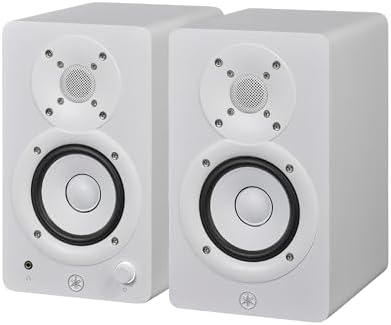
- Packaging: Pair
- 2-way bass-refiex powered speaker with 3.5" cone woofer and 0.75" dome tweeter
- 70 Hz – 22 kHz frequency response (-10 dB)
- 26 W + 26 W output power
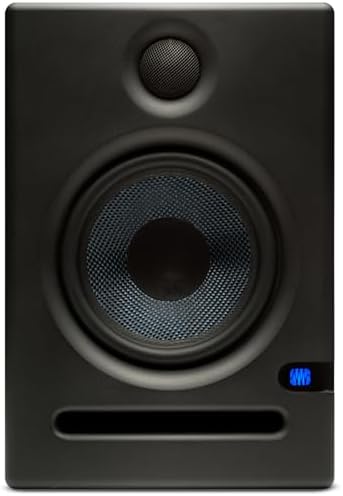
- An outstanding way to upgrade your monitoring so that your mixes translate.
- Now comes included with Studio One Prime and Studio Magic plug-in suite, over $1000 USD worth of music production software.
- 5.25-inch woven composite woofer delivers solid low-end sound with minimal bass distortion.
- 1-inch ultra-low-mass silk-dome tweeter eliminates harshness and provides balanced high-frequency sound.

- TRUE STUDIO MONITOR – Based on the highly rated Edifier bookshelf speakers professionally tuned to a responsive almost flat curve for artists and…
- STUDIO QUALITY SOUND – The 1" silk dome tweeter and 4" composite woofer produce clear, smooth, and overall sound. MDF wood texture helps reduce…
- FLEXIBLE CONNECTORS – 1/4" balanced TRS input, an unbalanced RCA input, an unbalanced AUX input and a front headphone output are equipped for…
- Thoughtful Dual Mode Design – Freely switch between monitor mode, to listen to real audio for music production and music mode, to enjoy daily music…
1. Yamaha HS7 100-Watt Series Monitor
Best for: Producers needing a standard, reliable reference in medium-sized rooms.
This model serves as a workhorse for many studios, providing a 6.5-inch cone woofer and 1-inch dome tweeter. The frequency response reaches from 43Hz up to 30kHz, which covers the range most engineers require for everyday mixing tasks. Its bi-amp system splits 95W of power to keep the high and low frequencies distinct and clean.
You can adjust the sound to fit your room using the built-in room control and high trim response switches on the back. These features are helpful if the speakers are placed close to walls, which can sometimes cause an artificial boost in the low end. Compared to the tiny driver on the Yamaha HS3, the HS7 offers a much deeper reach for bass-heavy tracks.
Pros
- 6.5″ woofer for balanced sound
- Room control and high trim switches
- XLR and TRS input options
- 95W total bi-amplified power
Cons
- The larger cabinet requires more desk space than compact alternatives
2. IK Multimedia iLoud Micro Monitor 50 watt Portable Wireless Bluetooth
Best for: Traveling creators or those with extremely limited desk space.
These speakers are designed to fit anywhere, using internal DSP to compensate for your environment. Despite their small 3-inch woofers, they deliver a solid low-end response down to 55Hz. The front-firing bass port helps maintain clarity even when the speakers are pushed back against a wall.
They include Bluetooth for wireless listening. You can switch between “free field” and “desktop” settings to keep the sound accurate regardless of where they sit. At 50W total, they provide enough power for nearfield work, though they lack the physical scale of the 8-inch Tannoy Reveal 802.
Pros
- Ultra-compact footprint for small desks
- Bluetooth wireless connectivity
- Internal DSP for room correction
- 55Hz low-end reach
Cons
- Optional matching travel bag means the box lacks it, so travel requires a second purchase.
3. Tannoy Gold 7 6.5-inch Powered Studio Monitor
Best for: Engineers who want precise imaging and a consistent sweet spot.
The dual concentric driver technology is the highlight here, placing the tweeter in the center of the woofer. This design helps the sound arrive at your ears at the same time, which is known as phase coherence. It creates a point-source image that’s helpful when you need to place instruments accurately in a mix.
Because the bass port is on the front, you don’t have to worry as much about placing them against a wall. The sound signature is neutral, intended to reduce ear fatigue during long mastering sessions. It offers a more focused soundstage than the broader dispersion found in the Behringer Truth 3.5.
Pros
- Dual concentric driver for phase coherence
- Front-firing port for easy placement
- Neutral, non-fatiguing sound
- Point-source imaging
Cons
- Listed as a 6.5-inch monitor, which anyone with a smaller desk has to plan around.
4. Tannoy Reveal 802 8-inch Powered Studio Monitor
Best for: Anyone who needs to hear deep bass without adding a separate subwoofer.
The 8-inch woofer is the main feature of this monitor, allowing it to move more air than smaller models. It’s an active 2-way system that includes a 1-inch tweeter to keep the highs crisp. The front-firing bass port is designed to minimize interference if you have to place the speakers near a wall.
Each monitor includes a convenient 1/8-inch aux input, making it easy to plug in a phone or laptop for quick testing. Because of the large driver, these are physically much wider than the Edifier MR4, so you’ll need a sturdy desk or stands to support them.
Pros
- Large 8-inch woofer for deep bass
- Front-firing bass port
- 1/8-inch aux input on each unit
- Active 2-way design
Cons
- 8-inch size limits placement options on smaller workstations
5. Yamaha HS8 W 8-Inch Powered Studio Monitor Speaker
Best for: Professionals working in larger rooms that need extended low-end accuracy.
This model builds on the reputation of the HS series with larger transducers and a frequency response that extends to 30kHz. The amp unit is matched to the drivers to ensure the response remains flat across the entire spectrum. It includes noise reduction technology to keep the signal clean for professional production.
Compared to the mid-tier Yamaha HS7, the HS8 provides more low-end extension, which is helpful if you’re mixing genres that rely on sub-bass. It’s a larger speaker overall, designed specifically for environments where you have the space to let the sound develop.
Pros
- Extended frequency response up to 30kHz
- Noise reduction technology
- Flat, accurate sound profile
- Advanced transducer design
Cons
- Frequency response extends up to 30kHz, ruling out anyone needing deeper sub-bass monitoring.
6. Avantone Pro Active MixCube 5.25 Inches Powered Studio Monitor
Best for: Checking how a mix will sound on small, consumer-grade speakers.
This is a single-driver monitor meant to act as a secondary reference. By using a 5.25-inch full-range driver, it helps you focus on the mid-range frequencies where vocals and instruments live. It doesn’t try to cover the full frequency spectrum, which is exactly why it’s a useful tool for translation checks.
The cabinet is shielded, so you can place it near other electronics without interference. It includes built-in stand mounts, making it easy to position on a desk or a dedicated monitor stand. This is a specialized tool, unlike the full-range PreSonus Eris E5 which is meant for primary mixing.
Pros
- Full-range 5.25-inch driver
- Shielded design prevents interference
- Built-in stand mounts
- Focused mid-range reference
Cons
- Title says each, so a stereo pair requires a second purchase.
7. Behringer Truth 3.5 Audiophile 3.5″ Studio Monitors with Advanced Waveguide
Best for: Multimedia creators and home studios needing a wide listening area.
These monitors use advanced waveguide technology to spread sound evenly across the room. This creates a large sweet zone, meaning you don’t have to sit perfectly still to hear a balanced mix. The 3.5-inch woofer uses a glass fiber cone that resists deformation, helping to keep the sound clear at various volumes.
The 64-watt power rating is plenty for a home workstation. While they provide a wide dispersion, they lack the specific point-source accuracy of the Tannoy Gold 7, which uses a different driver layout. They’re a good choice if you share your studio space with others who also need to hear the mix.
Pros
- Advanced waveguide for wide sweet zone
- Deformation-resistant glass fiber woofer
- 64-watt power output
- 1-inch silk dome tweeter
Cons
- The small woofer lacks deep sub-bass reach
8. Yamaha HS3 Powered Studio Monitor in White
Best for: Small home studios where every inch of desk space counts.
These are the smallest in the HS line, featuring a compact woofer and a 0.75-inch dome tweeter. They’re sold as a pair and provide a frequency response from 70Hz to 22kHz. The bi-amp design delivers 26W to each speaker, which is sufficient for close-proximity desk work.
Like their larger siblings, they include room control and high trim switches to help you adjust the sound for your specific workspace. They’re much smaller than the 5.25-inch PreSonus Eris E5, making them easier to fit on crowded computer desks.
Pros
- Compact footprint designed for tight spaces
- Room control and high trim switches
- Sold as a pair
- 26W + 26W output power
Cons
- 70Hz lower limit misses the deepest bass frequencies
9. PreSonus Eris E5 2-Way 5.25″ Near Field Studio Monitor
Best for: Beginners who want to start mixing and need software to get going.
This model is a 5.25-inch nearfield monitor that includes a suite of production software to help you get started. The woven composite woofer is designed to reduce bass distortion, and the 1-inch silk-dome tweeter helps keep high frequencies smooth. It provides 80W of Class AB power, which offers plenty of headroom.
The front-firing port is a nice touch, as it allows for cleaner bass reproduction without needing as much distance from the wall as rear-ported designs. It’s more feature-rich for the entry-level user than the Avantone Pro MixCube, which serves a much narrower purpose.
Pros
- Includes professional production software
- 5.25-inch composite woofer
- 80W Class AB amplification
- Front-firing acoustic port
Cons
- Class AB amps run warmer than Class D alternatives
10. Edifier MR4 Power Studio Monitor Speakers
Best for: Creators who need a flat response but also want to enjoy casual listening.
These monitors feature a 4-inch composite woofer and a 1-inch silk dome tweeter for clear, smooth sound. The MDF wood construction is built to reduce resonance, which helps in revealing the true sound of your tracks. You can switch between a “monitor” mode for production and a “music” mode for relaxing.
The front panel includes a volume knob and a headphone jack, which makes it very convenient for quick changes. It’s more versatile than the Yamaha HS7, which is strictly built for professional monitoring without the extra modes for casual playback.
Pros
- Dual modes for monitoring and music
- MDF cabinet reduces resonance
- Front headphone output
- 4-inch composite woofer
Cons
- Listed with a 4 inch woofer, which anyone needing deeper bass has to plan around.
Also Worth Considering
The M-AUDIO BX3 3.5″ Wired Studio Monitors are compact desktop speakers with a small driver, though they’re outmatched in deep-bass clarity by the 5.25-inch PreSonus Eris E5. They’re a good choice for someone who needs a very small, simple setup for light editing.
The YAMAHA MSP3A Studio Monitor Speaker features a 4-inch woofer and is built for durability, but the Yamaha HS7 offers a substantially larger woofer that provides more low-end detail for professional mixing. This is a solid option for those who prefer a more portable, rugged design.
The YAMAHA HS8 Powered Studio Monitor is a larger, more powerful version of the HS series. While the Yamaha HS3 is better for tiny desks, the HS8 is the preferred choice for anyone who needs to hear the full frequency spectrum without compromise.
How We Chose
To earn a place, a monitor had to state its frequency range or driver specifications clearly. Models that focused on consumer-grade features without mentioning professional tuning were excluded. The picks reflect a mix of sizes to suit different room needs, from small bedroom studios to larger, treated environments. Comparisons between models rely on the dimensions and power ratings provided in the official listings for each product.
How to Choose the Best Studio Monitors for Mixing and Mastering
Size and where it has to fit
The physical size of the woofer determines how much space you need. A compact model like the Yamaha HS3 fits on almost any desk, while an 8-inch model like the Tannoy Reveal 802 requires significant room to sound correct. Measure your desk before buying to ensure you have enough space for the speakers and your other gear.
Frequency range and accuracy
Accuracy is the goal of any monitor. Models like the Yamaha HS8 reach up to 30kHz, which provides more detail in the high end. If your work involves deep bass, look for a larger woofer or a model that reaches below 50Hz, such as the IK Multimedia iLoud Micro, to ensure you can hear the full picture.
Connectivity and control
Check what inputs your interface uses. Most monitors, including the PreSonus Eris E5, offer XLR and TRS connections for balanced audio. Also, look for room control switches on the back, like those on the Yamaha HS7, which let you adjust the sound to compensate for your room’s acoustics.
Software and added value
Some monitors, such as the PreSonus Eris E5, come with included production software, which can be helpful if you’re just starting out. While the sound quality is the most important factor, having a bundle of plug-ins can save time and money when setting up your new workstation.
Related guides
- How to Extend FL Studio to Second Monitor
- How To Clean Studio Monitors? (The Ultimate Maintenance Guide)
- How to Connect Studio Monitors to Mac
Frequently Asked Questions
Do I need a separate subwoofer for my studio?
Most users don’t need a subwoofer if they choose a monitor with a large woofer, such as the Tannoy Reveal 802. However, if you’re using a very compact speaker like the Yamaha HS3, you might find that you can’t hear the lowest frequencies, which is where a separate subwoofer would help.
Can I connect these monitors to my phone or laptop?
Yes, many monitors support this. The Edifier MR4 and Tannoy Reveal 802 include auxiliary inputs, and the IK Multimedia iLoud Micro features Bluetooth for wireless streaming. Always check the input specifications to see if you need an adapter to connect your specific device to the speakers.
What is the difference between active and passive monitors?
Active monitors, like all the models listed here, have built-in amplifiers. This means you don’t need to buy a separate amplifier to power them. You simply plug them into a power source and connect your audio interface.
How far apart should I place my studio monitors?

Place your monitors at an equal distance from each other and your listening position to form an equilateral triangle. This setup, often called the “sweet spot,” provides the most accurate stereo image. You can adjust the angle of the speakers toward your head to ensure the high frequencies are directed at your ears.
Should I use the “room control” switches?
Yes, these switches are designed to help you correct for the acoustics of your specific room. If your monitors are placed close to a wall, you may notice an unnatural boost in the bass. Using the room control settings on the Yamaha HS7 can help flatten this response and provide a more accurate sound.
Conclusion
Choosing the right monitors is the most important step in building a reliable studio. For most people, the Yamaha HS7 provides the best balance of accuracy and size. If you have very little space, the Yamaha HS3 is a simpler alternative that still gives you the professional sound you need to finish your tracks.
As an Amazon Associate, Instrument Insight earns from qualifying purchases at no additional cost to you.