
The Yamaha HS5 is the best studio monitor for home recording because its 54Hz-30kHz frequency response and Room Control let you tune it to your desk. This guide helps anyone setting up a small room who needs honest sound without guessing what the speakers are hiding. The one thing that separates these picks is how they handle low frequencies — some reach deep enough for bass guitar, while others need a subwoofer to do the same job.
If you’re buying your first pair of studio monitors, you’ll see a lot of numbers on spec sheets that don’t mean much until you put them in your room. A bigger woofer moves more air, but it also needs more space behind it to breathe.
- Best Overall: Yamaha HS5 — flat response down to 54Hz with built-in room tuning controls.
- Most Powerful: Yamaha HS8 — 120W bi-amp system reaches 38Hz without a subwoofer.
- Best Compact: Yamaha HS3 — 3.5-inch drivers sold as a matched pair for tight desks.
- Best for Beginners: M-Audio BX3 — Kevlar woofers with every cable input you’ll need.
- Best Mid-Size: Mackie CR4.5 — includes isolation pads and all cables right in the box.
- Best Connectivity: Ortizan C7 — Bluetooth 5.3 alongside USB DAC and balanced TRS inputs.
- Best Input Variety: Yamaha HS4 — combo XLR/TRS jacks plus RCA and stereo mini connections.
- Best Acoustic Controls: PreSonus Eris 3.5 — high and low tuning dials for any room setup.

- 2-way bass-reflex bi-amplified nearfield studio monitor
- 54Hz-30kHz frequency response
- 45W LF plus 25W HF bi-amp 70W system
- Room Control and High TRIM response controls

- 38Hz – 30kHz frequency response
- 75W LF plus 45W HF bi-amp 120W system
- 8-inch cone woofer, 1-inch dome tweeter
- Large magnets in Advanced Magnetic Circuit design
- Packaging: Pair
- 2-way bass-refiex speaker with 3.5" woofer, 0.75" tweeter
- 70 Hz – 22 kHz frequency response (-10 dB)
- 26 W + 26 W output power

- Latency free wired connection for audio monitoring
- Bi-amplified power for desktop speakers
- 3.5-inch Kevlar woofers for low-frequency drivers
- Natural silk dome tweeters for stereo imaging

- Sold as a pair, the step-up size for desks with more room
- Fuller low end than 3.5-inch monitors without needing a sub
- Tone Knob: front-panel voicing control
- Location Switch: wall or free-standing bass correction
- 【Multiple INPUTS】The stereo speakers home audio is built with RCA which ensure a lossless connection surround sound system for TV; With the addition…
- 【HIFI BOOKSHELF SPEAKERS】The built-in 24-bit DAC captures digital audio directly via USB, minimizing signal loss during conversion and maximizing…
- 【3.5 INCH CARBON FIBER SPEAKER AND 0.75inch SILK DOME TWEETER】The 0.75-inch tweeter and 3.5-inch mid-bass golden acoustic combination, with a…
- 【PROFESSIONAL TUNING】Through extensive laboratory adjustments and meticulous comparisons, the speaker units have been finely tuned to achieve a flat…
- Packaging: Pair
- 2-way bass-refiex powered speaker with 4.5" cone woofer and 1" dome tweeter
- 60 Hz – 22 kHz frequency response (-10 dB)
- 26 W and above 26 W output power
- TRUSTED STUDIO-QUALITY SOUND: True studio sound for music production, gaming, movies, streaming, and everyday audio. Sold as a complete stereo pair.
- POWERFUL, DISTORTION-FREE SOUND: 50 watts of built-in amplification drives clear, dynamic sound at any volume — powerful enough to fill the room,…
- ACCURATE, POWERFUL SOUND: 3.5” woven-composite woofers deliver deeper, tighter bass while 1” silk-dome tweeters smooth out harshness for clear,…
- DIAL IN PERFECT SOUND IN ANY ROOM: Built-in high- and low-frequency acoustic tuning controls let you tailor the sound to your space — no treatment or…
1. Yamaha HS5 Powered Studio Monitor
Best for: producers needing accurate nearfield monitoring in small rooms.
This monitor pairs a 5-inch cone woofer with a 1-inch dome tweeter inside a 2-way bass-reflex cabinet. It’s bi-amplified, meaning separate amps drive each driver: 45W for the lows and 25W for the highs, totaling 70W.
What makes this the top pick for most home studios is the Room Control switch on the back. It cuts the low end to stop the boominess you get when speakers sit close to a wall. Combined with the High TRIM control, you can shape the response without buying extra gear or acoustic panels. The frequency range stretches from 54Hz to 30kHz, which covers guitars, vocals, and synths cleanly.
You’ll find both XLR and TRS phone jack inputs here, accepting balanced or unbalanced signals. That means it plugs straight into a pro audio interface or a simpler mixer without adapters. The 54Hz floor is solid for tracking, though electronic producers might still want a sub for the deepest kicks. Compared to the Yamaha HS8, which lists a 38Hz bottom end, the HS5 stops short of full-range bass reproduction.
Anyone mixing heavy sub-bass music will outgrow the 54Hz limit and need a larger woofer or an added subwoofer.
Pros
- 70W bi-amplified system (45W LF, 25W HF)
- 54Hz-30kHz frequency response
- Room Control and High TRIM switches
- XLR and TRS inputs for balanced or unbalanced signals
Cons
- 54Hz low-end limit means deep sub-bass requires a separate subwoofer
2. Yamaha HS8 8-Inch Powered Studio Monitor Pair
Best for: engineers needing deep bass extension without adding a subwoofer.
An 8-inch cone woofer paired with a 1-inch dome tweeter gives this monitor its physical presence. The bi-amp system pushes 75W to the low frequencies and 45W to the highs, delivering 120W total. That output handles large rooms and loud playback sessions without straining the amplifiers or distorting the signal.
The main reason to step up to this model is the 38Hz-30kHz frequency response. Reaching 38Hz lets you hear kick drums and bass synth lines that smaller monitors simply roll off. Large magnets in an Advanced Magnetic Circuit design keep the motor structure stable at higher volumes. You won’t need to guess if your low end is muddy; you’ll hear exactly what’s there.
This listing bundles a pair of two monitors, so you’re getting a complete stereo setup in one box. That saves you from ordering twice and hoping the batches match. If you’re working in a treated room, the extra headroom matters.
Pros
- 120W total bi-amplified power (75W LF, 45W HF)
- 38Hz-30kHz frequency response
- 8-inch cone woofer with advanced magnetic circuit
- Bundle includes a pair of two monitors
Cons
- 38Hz frequency response, so anyone needing deeper bass has to plan around it.
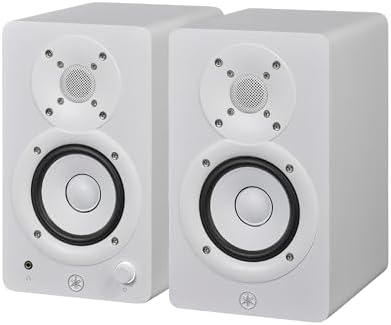
3. Yamaha HS3 Powered Studio Monitor in White
Best for: tight desktops where space limits speaker size completely.
Sold as a pair, these white monitors use a 3.5-inch cone woofer and a 0.75-inch dome tweeter in a 2-way bass-reflex design. They output 26W + 26W, giving you dedicated power for each driver despite the small footprint.
The frequency response is listed at 70Hz to 22kHz (-10 dB). That -10 dB note means the bass rolls off noticeably before reaching 70Hz, so don’t expect chest-thumping lows. However, for podcast editing, voiceover work, or basic tracking, the midrange clarity remains intact. You still get Room Control and High TRIM response controls to adjust for your desk placement.
Here, you can tame the boundary effect if they sit against a wall. The 26W per channel is modest; compared to the 50 watts of built-in amplification on the PreSonus Eris 3.5, the HS3 offers less overall headroom for louder playback.
The 70Hz (-10 dB) low-frequency limit rules this pair out for anyone producing bass-heavy music genres.
Pros
- Packaged as a matched pair
- 26W + 26W output power
- Room control and high trim response controls included
- 3.5-inch woofer fits very small workspaces
Cons
- Frequency response bottoms out at 70Hz (-10 dB), limiting bass accuracy
4. M-AUDIO BX3 3.5″ Wired Studio Monitors Pair
Best for: beginners wanting wired monitoring with flexible connection options.
These compact wired studio monitors focus on a latency-free connection, engineered for zero-latency audio monitoring. That matters when you’re tracking vocals or playing virtual instruments live. The bi-amplified power drives Black Kevlar low-frequency woofers and natural silk dome tweeters, aiming for precise stereo imaging across the spectrum.
The cabinet construction uses acoustically-inert MDF wood paired with an advanced bass reflex design. This stops unwanted vibration that plastic multimedia speakers often introduce. An enhanced bass reflex port extends the low-frequency response for beat-making and casual listening. It’s a sturdy build meant to sit permanently on a desktop rather than travel around.
Connectivity is where this pair really opens up. Rear inputs include 1/4-inch, 1/8-inch, and RCA jacks, covering DJ gear, instruments, and standard consumer electronics. There’s also a front panel 1/8-inch AUX input for plugging in headphones directly during late-night sessions. While the Ortizan C7 adds wireless Bluetooth 5.3, the BX3 relies entirely on its wired paths to guarantee that uninterrupted signal.
Relying solely on wired connections means streaming audio from a phone requires routing through a computer or adapter first.
Pros
- Zero-latency wired audio monitoring
- 3.5-inch Black Kevlar woofers
- Natural silk dome tweeters
- Acoustically-inert MDF cabinet with bass reflex design
- 1/4-inch, 1/8-inch, and RCA rear inputs plus front headphone jack
Cons
- The box lists a 1/8-inch interconnect cable and not 1/4-inch cables, so that is a second purchase.
5. Mackie CR4.5 Studio Monitors (Pair)
Best for: users wanting a complete out-of-the-box desk setup.
Sold as a pair, these monitors feature 4.5-inch woofers designed as a step-up size for desks with more room. The listing notes they deliver a fuller low end than the smallest desktop monitors without needing a sub. That middle ground suits guitarists and vocalists who need body in the sound but lack space for an 8-inch driver.
A front-panel Tone Knob gives you immediate voicing control without reaching behind the speakers. More importantly, the Location Switch applies wall or free-standing bass correction. This adjusts the low frequencies based on whether the speakers sit flush against a wall or out in the open, preventing the muddy buildup that ruins amateur mixes.
Everything required to start listening comes in the box: both monitors, isolation pads, and all cables. Isolation pads decouple the speakers from the desk surface, reducing resonance transfer. You don’t have to hunt down compatible wires or foam blocks after delivery. The 4.5-inch driver here bridges the gap between the smaller M-Audio BX3 and the larger 5-inch Yamaha HS5.
Pros
- 4.5-inch woofers provide fuller low end than 3-inch models
- Front-panel Tone Knob for instant voicing adjustments
- Location Switch corrects bass for wall or free-standing placement
- Box includes both monitors, isolation pads, and all cables
Cons
- Listed as the step-up size for desks with more room, and smaller desks make this the wrong buy.
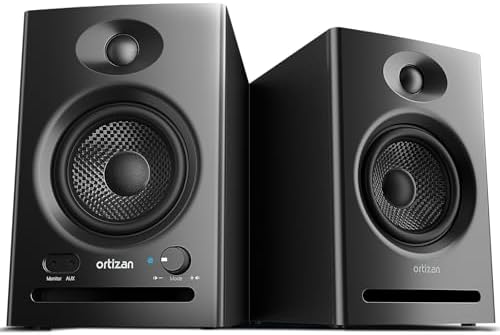
6. Ortizan C7 Powered Studio Monitors Pair with Bluetooth 5.3
Best for: producers switching frequently between wired interfaces and wireless devices.
This powered pair combines traditional studio inputs with modern wireless tech. Built-in Bluetooth 5.3 lets you pair a smartphone or tablet in about 2 seconds for quick reference checks. Alongside that, RCA inputs handle surround sound systems, and a 3.5mm AUX adapts to nearly any device with a headphone output.
For critical work, the built-in 24-bit DAC captures digital audio directly via USB, minimizing signal loss during conversion. The drivers consist of a 3.5-inch carbon fiber speaker and a 0.75-inch silk dome tweeter, arranged with a suspended sound structure. An electronic 2-way crossover splits the signal precisely between them for layered performance.
Professional integration isn’t forgotten. A 6.35mm TRS balanced input connects directly to mixing consoles, electric guitars, or digital pianos. The front panel houses two AUX unbalanced inputs and a headphone output for private monitoring. The listing states the units are tuned to achieve a flat response curve, though it doesn’t print specific frequency extremes like the 54Hz-30kHz range stated on the Yamaha HS5.
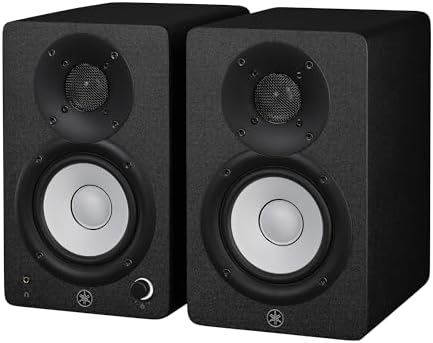
7. Yamaha HS4 Powered Studio Monitor in Black
Best for: creators needing multiple input types in a matched pair.
Packaged as a pair in black, these 2-way bass-reflex powered speakers use a 4.5-inch cone woofer and a 1-inch dome tweeter. The 1-inch tweeter matches the size found on the larger HS series, ensuring consistent high-frequency dispersion. Output power is listed as 26W and above 26W, providing dedicated amplification for each driver.
The frequency response spans 60Hz to 22kHz (-10 dB). Like the HS3, that -10 dB specification means the true usable bass starts slightly higher than 60Hz. Room control and high trim response controls are present to dial in the sound for untreated spaces. These features let you compensate for reflective surfaces common in home offices.
Input flexibility is extensive. You get XLR/TRS Phone (COMBO) jacks, RCA, and Stereo Mini connections on the back. The box also includes a stereo mini-to-RCA cable, a speaker cable, and an anti-slip pad. Having the combo jack means one socket accepts both mic-style XLR and instrument-style TRS plugs. The Mackie CR4.5 also uses 4.5-inch woofers, but the HS4 provides a larger high-frequency dome instead of a smaller one.
The 60Hz (-10 dB) rating indicates bass extension falls off before reaching true sub-frequencies.
Pros
- Sold as a complete pair
- 4.5-inch cone woofer and 1-inch dome tweeter
- XLR/TRS combo, RCA, and Stereo Mini inputs
- Includes stereo mini-RCA cable, speaker cable, and anti-slip pad
- Room control and high trim response controls
Cons
- Frequency response drops at 60Hz (-10 dB), requiring a subwoofer for deep bass tracks
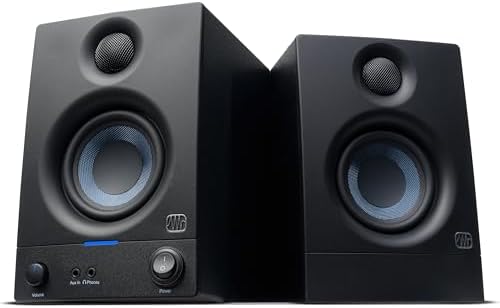
8. PreSonus Eris 3.5 Powered Studio Monitors
Best for: users wanting simple acoustic tuning without external processing.
Sold as a complete stereo pair, these active nearfield monitors pack 50 watts of built-in amplification. That power drives 3.5-inch woven-composite woofers and 1-inch silk-dome tweeters. The stated goal is distortion-free sound that fills a room while remaining clean enough to hear fine details during production, gaming, or streaming.
The frequency range covers 80Hz to 20kHz. Because the low end starts at 80Hz, bass guitars and kick drums will lack fundamental weight unless you add a subwoofer later. To manage what is there, built-in high- and low-frequency acoustic tuning controls let you tailor the output to your specific space. You won’t need extra treatment gear just to get a balanced starting point.
Connection options cover almost everything on a typical desk. Balanced TRS and RCA inputs sit on the rear, while a front-panel aux input handles phones or tablets quickly. A front headphone jack mutes the speakers for private listening sessions. With 50 watts total, it outputs nearly double the 26W + 26W configuration listed for the Yamaha HS3, offering more headroom for dynamic peaks.
An 80Hz low-frequency floor means bass-heavy genres can’t be mixed accurately without supplemental low-end support.
Pros
- 50 watts of built-in amplification
- 3.5-inch woven-composite woofers and 1-inch silk-dome tweeters
- 80Hz–20 kHz frequency response
- High- and low-frequency acoustic tuning controls
- Balanced TRS, RCA, front aux input, and front headphone jack
Cons
- 80Hz low-frequency limit prevents accurate monitoring of bass instruments without a subwoofer
Also Worth Considering
PreSonus Bundle Eris Studio Monitors is a comprehensive recording package that adds an AudioBox 96 USB interface, condenser microphone, isolation shield, HAS-10 headphones, stands, cables, and Studio One software to the Eris 3.5 monitors. The standalone PreSonus Eris 3.5 beats it for buyers who already own an interface and headphones, since those components duplicate existing gear. Someone starting entirely from scratch with zero equipment might prefer having everything arrive together.
Edifier MR3 Powered Studio Monitor is an active Hi-Res speaker featuring Bluetooth connectivity. The Ortizan C7 surpasses it for studio-specific tasks by listing a 24-bit USB DAC, 6.35mm TRS balanced inputs, and carbon fiber drivers aimed at flat monitoring. Buyers who prioritize casual living room listening over strict mixing accuracy might still consider the Edifier for its Hi-Res designation.
How We Chose
Forty-one Amazon listings were compared on stated frequency response, included accessories, and input types, and near-duplicates — another colour, another size of one already here — were left out. A product had to state its woofer size and amplification method to earn a place. Listings lacking clear driver specifications or those marketed solely as generic computer speakers were excluded. What separates the remaining picks is how they address room boundaries: some offer rear switches for wall placement, while others rely on physical isolation pads included in the box. Bi-amplified designs were prioritized over single-amp models because separate power for the woofer and tweeter reduces intermodulation distortion. Bundled pairs were favored over single units to ensure stereo matching without requiring multiple checkout steps.
How to Choose the Best Studio Monitors for Home Recording
Woofer size and bass extension
Decide how low your music needs to go before buying anything. A 3.5-inch driver typically stops around 80Hz, as seen on the PreSonus Eris 3.5. An 8-inch woofer like the Yamaha HS8 reaches 38Hz. If you produce hip-hop or electronic music, larger drivers prevent you from mixing blind in the low end.
Inputs matching your gear
Check what cables your audio interface outputs before selecting monitors. Professional interfaces use balanced XLR or TRS connections, which the Yamaha HS5 supports directly. Consumer laptops only offer a 3.5mm headphone jack. The M-Audio BX3 solves this by listing 1/4-inch, 1/8-inch, and RCA inputs on the same rear panel.
Room correction features
Untreated bedrooms boost bass artificially when speakers sit near walls. Look for built-in switches that cut those problem frequencies. The Yamaha HS4 includes Room Control and High TRIM dials for this exact purpose. Alternatively, the Mackie CR4.5 uses a Location Switch to toggle between wall and free-standing bass profiles instantly.
What comes in the box
Buying speakers individually means hunting down matching cables and isolation foam separately, but the Mackie CR4.5 includes both monitors, isolation pads, and all necessary cables so you can start mixing the moment the package is opened.
Related guides
- Can You Transfer FL Studio to Another Computer
- How to Record Songs from Amazon Music
- Does PreSonus AudioBox Work With FL Studio
Frequently Asked Questions
Do I need an audio interface for these speakers?
Not always, but it improves signal quality. Models with RCA or 3.5mm inputs, like the M-Audio BX3, plug directly into a computer’s headphone jack. However, balanced TRS or XLR connections require an interface to send a noise-free signal. The Yamaha HS5 lists XLR and TRS inputs, making an interface practically mandatory for clean monitoring.
Can I connect these monitors to my TV?
Yes, if the speakers list RCA or optical-compatible inputs. The Ortizan C7 specifically mentions RCA connections that ensure a lossless link to a surround sound system for TV use. Speakers lacking RCA, relying only on balanced TRS, would need an adapter to accept a television’s standard audio output safely.
Why do some listings say “-10 dB” next to the frequency?
That notation indicates where the speaker’s output drops significantly below its normal volume level. The Yamaha HS3 lists 70Hz – 22kHz (-10 dB), meaning bass at 70Hz plays much quieter than the midrange. Without that tag, a number like 80Hz on the PreSonus Eris 3.5 implies a standard measurement threshold.
Are Bluetooth monitors good for mixing?
They’re useful for reference listening, not final decisions. The Ortizan C7 includes Bluetooth 5.3 for quick smartphone pairing, but critical mixing requires the wired 6.35mm TRS or USB DAC path to avoid wireless compression. Always finalize balances using the wired connection to ensure the audio file translates accurately elsewhere.
Do I really need the isolation pads?

Placing speakers directly on a hollow desk transfers vibrations into the wood, coloring the bass you hear. The Mackie CR4.5 includes isolation pads in the box specifically to prevent this resonance. Understanding nearfield monitor placement ensures the acoustic tuning controls work as intended rather than fighting desk reflections.
Can one monitor handle a whole room alone?
Studio mixing requires a stereo pair to hear panning and spatial effects correctly. The Yamaha HS5 is sold individually, so you must buy two. Listings explicitly marked as a pair, like the Yamaha HS3 or PreSonus Eris 3.5, provide both left and right channels immediately. Never attempt to mix a song using only a single speaker.
Conclusion
For most home studios, the Yamaha HS5 delivers the flattest response and the most practical room-tuning controls in a manageable size. If your desk is too small for a 5-inch woofer, the Mackie CR4.5 offers a complete package with pads and cables included so you can start working immediately. Pick the one that fits your physical space, connect it to your interface, and trust your ears.
As an Amazon Associate, Instrument Insight earns from qualifying purchases at no additional cost to you.