
The Yamaha HS8 is the best speaker monitors for home studio setups because its 8-inch woofer and 120W bi-amp system provide a frequency response reaching down to 38Hz. This guide helps producers and creators choose the right audio tools by comparing how these units handle sound, size, and connectivity. The one thing that separates these picks is how they balance physical footprint with the power needed for accurate mixing.
QUICK PICKS
- Best Overall: Yamaha HS8 — widest frequency response for detailed professional-grade monitoring.
- Best for Precision: Yamaha HS5 — includes specific room control and high trim response settings.
- Best Compact: PreSonus Eris 3.5 — small profile that fits easily into limited desk space.
- Best Near-Field: Yamaha HS4 — professional-grade 4-inch performance with multiple input options included.
- Best 3-Way Design: ULTIMEA BS-3 — dedicated midrange driver for clearer vocal and instrument separation.
- Best Waveguide Technology: PreSonus Eris Studio 4 — EBM waveguide ensures a wider sweet spot for imaging.
- Best for Small Studios: Mackie CR3.5 — includes isolation pads and tone controls for desk environments.
- Best Connectivity: Edifier MR3 — offers Bluetooth multi-point and high-resolution audio certification.
- Best Wooden Enclosure: Edifier R1700BT — angled cabinet design directs audio directly toward the listener.
- Simplest to Use: Edifier R980T — straightforward setup with dual auxiliary inputs for quick connection.

- 38Hz – 30kHz frequency response
- 75W LF plus 45W HF bi-amp, 120W total
- 8-inch cone woofer, 1-inch dome tweeter
- Large magnets in Advanced Magnetic Circuit design

- 5" cone woofer and 1" dome tweeter
- 54Hz-30kHz frequency response
- 45W LF plus 25W HF bi-amp, 70W total
- Room Control and High TRIM response controls
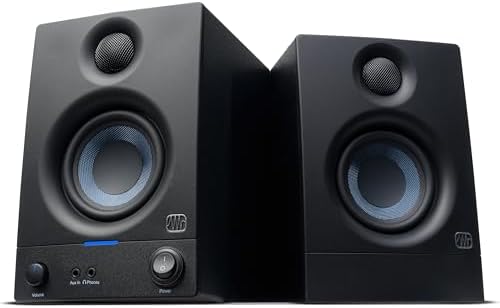
- Sold as a complete stereo pair
- 50 watts of built-in amplification
- 3.5” woven-composite woofers and 1” silk-dome tweeters
- Built-in high- and low-frequency acoustic tuning controls
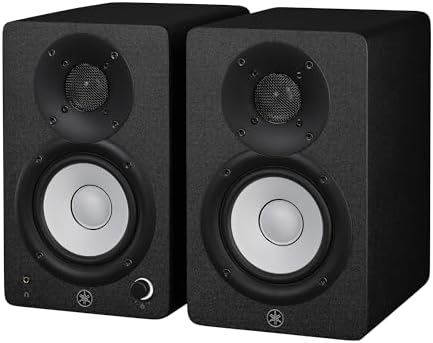
- Packaging: Pair
- 4.5" cone woofer and 1" dome tweeter
- 60 Hz – 22 kHz frequency response (-10 dB)
- 26 W and above 26 W output power

- 5.25" woofer, midrange driver, and tweeter
- Advanced Edge Horn Technology for treble direction
- 5.25” woofer with 15mm long-excursion reaches 50Hz
- 70W RMS output with 0.1% low distortion

- Professional studio monitors for audio production
- 1-inch (25 mm) silk-dome high-frequency transducer
- 120˚(H) x 60˚(V) EBM waveguide
- 4.5-inch woven-composite low-frequency drivers

- Sold as a pair, sized for desks and small studios
- Hear your mix or stream the way it actually sounds, not flattered
- Tone Knob: dial voicing from your desk without menus
- Location Switch: corrects bass whether they sit against a wall or free
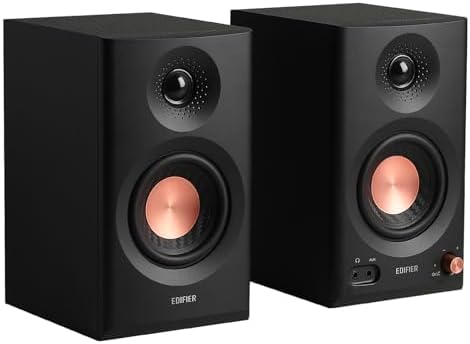
- Hi-Res Audio Certified – Experience superior sound with Hi-Res Audio certification, delivering a flat response across 52Hz to 40kHz for precise and…
- Rich Connectivity – Balanced TRS, RCA, and AUX inputs, headphone output, with Bluetooth supporting multi-point connection. RCA and AUX inputs enable…
- Powerful Sound Output – Enjoy 18W*2 RMS output with a peak SPL of 92.5dB, enhanced by 3.5" mid-low drivers and 1" tweeters for rich, full-range sound.
- Customizable Sound Experience – Easily switch between Music, Monitor, and Custom modes to suit your needs. Fine-tune your sound precisely through the…

- Built-in amplifier (33 watts x 2 speakers) so there is no need for outside amplifier or receiver—just plug into source and play
- Frequency response: 55 Hz to 20 kHz
- Bluetooth pairing capability to stream audio playback from compatible devices
- 10° tilt angle directs sound toward ears to create a better listening experience

- 24 WATTS RMS POWER OUTPUT – Active bookshelf speaker system with 24W total power output with calibrated, flared bass reflex port in front.
- CLASSIC WOOD FINISH – 100% wooden enclosures to minimize acoustic resonance.
- CABLES INCLUDED – RCA and 3.5mm cables and speaker wire included. Universal 110V-240V power supply.
- 2 X AUX INPUT – Convenient connection to any device that has a 3.5mm headphone output or dual RCA output. Connect to two devices via AUX at the same…
1. Yamaha HS8 8-Inch Powered Studio Monitor Pair
Best for: Producers who need an extended low-end for professional mixing.
These monitors stand out for their large 8-inch cone woofers, which reach down to 38Hz. This frequency reach helps you hear deep bass notes that smaller speakers often miss. The bi-amp system delivers 120W of total power, providing enough headroom for clean audio even during long sessions.
The Advanced Magnetic Circuit design is built to keep the sound stable and consistent. Because these are larger than the others, you should ensure you have enough desk space to accommodate them safely. They’re designed for serious work where hearing the full spectrum of your mix is the top priority.
Compared to the 54Hz floor on the Yamaha HS5, these monitors offer significantly more depth for bass-heavy projects. Anyone who lacks the desk space for a pair of 8-inch monitors should look at a smaller alternative.
Pros
- 38Hz low-end frequency response
- 120W bi-amp power system
- 8-inch cone woofer
- Includes two monitors per bundle
Cons
- Large footprint requires significant desk space
2. Yamaha HS5 Powered Studio Monitor
Best for: Users who need to adjust their sound based on room acoustics.
These speakers provide a more focused 5-inch woofer, making them a great fit for mid-sized rooms. The inclusion of Room Control and High Trim response switches is a major advantage. These controls let you adjust the speaker output to match the specific acoustic properties of your home studio.
The 54Hz to 30kHz frequency response ensures that your highs remain crisp and clear. With 70W of total power, they provide a balanced sound profile that stays accurate at various volume levels. The XLR and TRS inputs offer professional-grade connection options for your audio interface.
At 54Hz, the bass response is less deep than the 38Hz floor found on the Yamaha HS8.
Pros
- Room Control and High Trim switches
- Balanced and unbalanced signal support
- 5-inch woofer for accurate mids
- 70W total bi-amp power
Cons
- Limited low-end reach for deep bass
3. PreSonus Eris 3.5 Powered Studio Monitors
Best for: Creators working in a tight or shared living space.
The Eris 3.5 is designed for versatility, fitting easily onto crowded desks while maintaining a clear, balanced sound. The 3.5-inch woven-composite woofer provides a tight bass response, while the silk-dome tweeter keeps the highs from sounding harsh. It delivers 50W of power, which is plenty for near-field monitoring in a bedroom or office.
Connectivity is a strong point, as you get TRS, RCA, and front-panel aux inputs. This allows you to connect your interface, phone, or gaming console without needing extra adapters. The front-facing headphone jack is a smart touch for those moments when you need to work in total silence.
Compared to the 70W output of the Yamaha HS5, these are less powerful for larger rooms. Anyone who needs to fill a professional studio space will find the 50W output limited for their needs.
Pros
- Front-panel aux and headphone jack
- Balanced TRS and RCA inputs
- Acoustic tuning controls for room tailoring
- Compact 3.5-inch footprint
Cons
- Lower power output limits room size
- Frequency response starts at 80Hz
4. Yamaha HS4 Powered Studio Monitor in Black
Best for: Near-field monitoring with a compact, professional setup.
These 4.5-inch monitors are built for precision in small environments. The 60Hz to 22kHz response provides a clean range for editing and mixing. The inclusion of Room Control and High Trim switches allows you to fine-tune the sound to fit your specific desk setup, which is rare for speakers of this size.
The combo XLR/TRS inputs, along with RCA and stereo mini inputs, make these very flexible. You can connect a wide range of gear, from professional interfaces to basic media players. The package even includes the cables and anti-slip pads you need to get started.
When you look at the 60Hz floor here against the 38Hz floor on the Yamaha HS8, it’s clear that these are meant for detail work rather than heavy bass. This model isn’t built for a producer who needs to track sub-frequencies without a separate subwoofer.
Pros
- Room Control and High Trim switches
- Includes anti-slip pads and cables
- Combo XLR/TRS input support
- 4.5-inch woofer size
Cons
- Higher frequency floor than larger monitors
- 26W per speaker power limit
5. ULTIMEA 3-Way Powered Bookshelf Speakers
Best for: Listeners who want dedicated drivers for different frequencies.
The BS-3 uses a 3-way design, which is unique in this list. By separating the woofer, midrange driver, and tweeter, these speakers aim to keep vocals and instruments distinct. The 5.25-inch woofer uses BassMX technology to reach 50Hz, giving you a solid low-end without needing to add a separate box under your desk.
The Advanced Edge Horn technology helps direct sound toward your ears, which improves the clarity of the highs. With 70W of power and HDMI ARC support, these speakers work just as well for home cinema as they do for music production. You can also use the app to change the EQ settings on the fly.
Against the 2-way design of the PreSonus Eris Studio 4, the 3-way setup here is more complex for standard desk mixing. Anyone who prefers a simple, traditional studio monitor setup might find the extra driver count unnecessary.
Pros
- 3-way speaker design
- 70W RMS power output
- HDMI ARC and Bluetooth support
- Dedicated app for EQ control
Cons
- Complex driver setup might be overkill for simple tasks
- Larger physical size compared to 2-way units
6. PreSonus Eris Studio 4 4.5-inch 2-Way Active Studio Monitor
Best for: Producers who need a consistent sound across a wide seating area.
The Eris Studio 4 features EBM waveguide technology, which shapes the sound to cover a wider area. This creates a large “sweet spot,” so you don’t have to keep your head in one exact position to hear the mix accurately. The 4.5-inch woven-composite driver provides a smooth bass response for its size.
It offers 50W of Class AB bi-amplification, which helps maintain tonal balance even when you turn the volume up. The front-firing acoustic port is helpful if you have to place your speakers close to a wall, as it reduces the risk of bass buildup. It includes XLR, TRS, and RCA inputs for easy integration.
Compared to the 120W in the Yamaha HS8, these have less power for large studios. Anyone who requires deep sub-bass monitoring will find the 55Hz floor limiting for their specific mixing needs.
Pros
- EBM waveguide for wide imaging
- Front-firing acoustic port
- Class AB bi-amplification
- Professional balanced input options
Cons
- 55Hz floor misses the deepest bass notes
- 50W power is modest for larger rooms
7. Mackie CR3.5 Studio Monitors (Pair)
Best for: Beginners who want a complete kit for their desk.
The Mackie CR3.5 is built for simplicity and speed. It comes with everything you need, including isolation pads and all necessary cables, so you don’t have to hunt for extra parts. The tone knob on the front allows you to change the voicing quickly, which is great for checking your mix on the fly.
The location switch is a helpful feature, allowing you to tell the speaker if it’s near a wall or out in the open. This helps keep the bass response accurate for your specific space. Its small size is perfect for tight desks where space is at a premium.
This speaker is less powerful than the 70W Yamaha HS5.
Pros
- Includes isolation pads and cables
- Convenient front-panel tone knob
- Location switch for acoustic correction
- Compact footprint for small desks
Cons
- Limited low-end frequency reach
8. Edifier MR3 Powered Studio Monitor
Best for: Users who need wireless flexibility alongside professional connections.
The Edifier MR3 stands out with its Hi-Res Audio certification, ensuring a flat and accurate response from 52Hz to 40kHz. It’s packed with connectivity, including Bluetooth multi-point, which lets you switch between devices without manual unplugging. The app-based EQ control makes it easy to fine-tune the sound to your liking.
The MDF cabinet is built to reduce unwanted vibration, which keeps the sound clean during edits. It includes balanced TRS inputs, which is a big plus for those connecting to a professional audio interface. This speaker is a strong hybrid for both creation and daily listening.
At 92.5dB peak SPL, it’s quieter than the 99dB peak found on the PreSonus Eris Studio 4. This model isn’t meant for producers who need to monitor at very high volumes in a large studio.
Pros
- Hi-Res Audio certification
- Bluetooth multi-point connectivity
- Balanced TRS and RCA inputs
- App-based EQ adjustments
Cons
- Lower peak volume than some professional monitors
9. Edifier R1700BT Bluetooth Bookshelf Speaker
Best for: Listeners who want an angled design for better sound direction.
The R1700BT features a 10-degree tilt, which is designed to direct sound toward your ears. This is a simple but effective way to get better imaging when the speakers are sitting on a standard desk. The wooden enclosure adds a classic look and helps minimize acoustic resonance for a cleaner sound.
With 66W of power and Bluetooth, it’s a versatile choice for a home office that doubles as a studio. The dual RCA inputs allow you to keep two different devices connected at the same time, saving you the trouble of switching cables. It’s a straightforward 2.0 system that works right out of the box.
Compared to the 55Hz floor of the PreSonus Eris Studio 4, the 55Hz here is similar, but the lack of balanced inputs makes it less ideal for professional interfaces. This speaker isn’t meant for users who require the low-noise floor provided by balanced XLR connections.
10. Edifier R980T 4″ Active Bookshelf Speakers
Best for: Users who want a no-fuss setup for basic monitoring.
The Edifier R980T is the simplest option here. It’s a basic 2.0 active system with 24W of power, designed for people who just want to plug in and start working. The front-facing bass reflex port means you can place them closer to walls without worrying about muddying the sound.
The wooden cabinets are sturdy and help keep the audio clean. With dual aux inputs, you can connect your computer and another device simultaneously. It includes all the cables you need to get started, making it a very accessible choice for a first-time studio owner.
This system provides 24W of power, which is significantly less than the 70W found on the Yamaha HS5. Anyone who needs professional-grade monitoring power for critical mixing will find these speakers underpowered for their needs.
Pros
- Front-facing bass port for placement
- Wooden cabinets for resonance control
- Dual AUX inputs included
- All cables provided in the box
Cons
- Lowest power output on this list
Also Worth Considering
The Edifier R1280T is a classic bookshelf monitor that relies on a 2.0 near-field design. It’s beaten by the Yamaha HS4 for professional mixing due to the latter’s wider input range and dedicated room control. The Edifier R1280DB includes optical and Bluetooth inputs for those who need wireless options, though the PreSonus Eris 3.5 is more suitable for those who prioritize a balanced signal path. Finally, the OHAYO Computer Speakers offer 60W of power and Bluetooth 5.3, but they lack the studio-grade frequency accuracy found in the Yamaha HS8.
How to Choose the Best Speaker Monitors for a Home Studio
Size and where it has to fit
The size of your woofer is the most important factor for low-end accuracy. Larger 8-inch models like the Yamaha HS8 reach deeper frequencies, but they take up significant desk space. If your room is small, a 4-inch or 5-inch monitor like the Yamaha HS4 provides a better balance between footprint and detail.
What comes in the box
Some monitors are sold as complete kits, which saves you from buying extra gear. The Mackie CR3.5 and Yamaha HS4 include cables and pads, which are essential for getting started. Always check if you need to buy your own balanced cables, as some professional speakers don’t include them in the bundle.
Connectivity for your gear
Your connection needs will depend on your audio interface. If you use a professional interface, look for balanced TRS or XLR inputs like those on the PreSonus Eris Studio 4. For casual home setups, RCA or 3.5mm inputs like those on the Edifier R980T offer quick, simple connectivity for your computer or phone.
Frequently Asked Questions
Do I need a subwoofer with these monitors?
Whether you need a subwoofer depends on the frequency response of your speakers. Monitors with 8-inch woofers, like the Yamaha HS8, reach low enough for many mixing tasks. If you choose a smaller 3.5-inch or 4-inch model, you may need a subwoofer to hear the sub-bass frequencies accurately.
What is the difference between balanced and unbalanced inputs?
Balanced inputs like XLR and TRS are designed to reject interference and noise, which is vital in a professional studio environment. Unbalanced inputs like RCA are more common in consumer audio but are more susceptible to hum and noise over long cable runs.
How far should I sit from my monitors?
Near-field monitors are designed to be placed close to the listener, usually within a few feet. You should position them in an equilateral triangle with your head to create the best stereo image. Speakers with waveguide technology, such as the PreSonus Eris Studio 4, are designed to maintain this image even if you move slightly.
Can I connect these to my TV?

Yes, but you must check the input requirements. Some monitors like the ULTIMEA BS-3 have HDMI ARC, which makes connecting to a TV simple. For others, you’ll need to use an RCA or 3.5mm output from your TV to the speaker inputs, provided your TV has the correct connection ports.
Do I need to buy an external amplifier?
Most studio monitors reviewed here are “active” or “powered,” meaning the amplifier is built inside the speaker cabinet. You don’t need an external receiver or amplifier for these models. Passive speakers require a separate amplifier, but every model listed here includes its own internal power source.
Conclusion
The Yamaha HS8 remains the best choice for most producers who need a wide, accurate frequency range for professional mixing. If you have a smaller desk and need something more compact, the PreSonus Eris 3.5 is a simpler, reliable alternative that covers all the basics. Check your desk space and pick the size that fits your room best.
As an Amazon Associate, Instrument Insight earns from qualifying purchases at no additional cost to you.