
The PreSonus Eris 3.5 is the top pick among the best budget studio monitor speakers because it pairs 50 watts of amplification with a stated 80 Hz–20 kHz frequency range and three rear inputs plus a front aux jack. This guide helps anyone setting up a desk for music, gaming, or mixing who needs honest sound without hunting down extra gear.
- Best Overall: PreSonus Eris 3.5 — 50 watts, 80 Hz floor, and every input you need.
- Best for Latency-Free Monitoring: M-AUDIO BX3 — Wired signal path built specifically for zero-latency tracking.
- Most Complete Box: Mackie CR3.5 — Ships with isolation pads and all cables included.
- Best for Accurate Mixing: PreSonus Eris E4.5 — 4.5-inch woven woofers deliver deeper bass extension.
- Best Hi-Res Audio: Edifier MR3 — Certified response reaching 40 kHz via app-controlled EQ.
- Best Professional Standard: Yamaha HS4 — XLR/TRS combo inputs match professional interface outputs.
- Best Natural Sound: Edifier R1280T — Side-panel controls and dual RCA inputs for simple setups.
- Best Carbon Fiber Drivers: Sanyun SW208 — 3-inch carbon fiber units with a built-in 24-bit DAC.
- Best Wooden Enclosure: Edifier R1700BT — 66 watts RMS inside a tilted wooden cabinet.
- Best High-Output Compact: OHAYO 60W Speakers — 30 watts per channel with Bluetooth 5.3 connectivity.
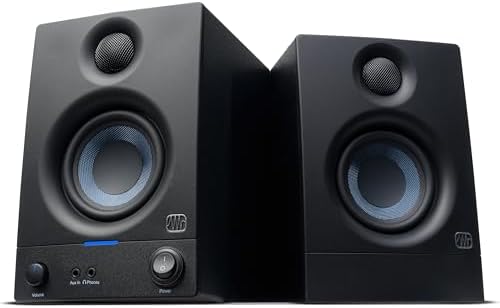
- TRUSTED STUDIO-QUALITY SOUND: True studio sound for music production, gaming, movies, streaming, and everyday audio. Sold as a complete stereo pair.
- POWERFUL, DISTORTION-FREE SOUND: 50 watts of built-in amplification drives clear, dynamic sound at any volume — powerful enough to fill the room,…
- ACCURATE, POWERFUL SOUND: 3.5” woven-composite woofers deliver deeper, tighter bass while 1” silk-dome tweeters smooth out harshness for clear,…
- DIAL IN PERFECT SOUND IN ANY ROOM: Built-in high- and low-frequency acoustic tuning controls let you tailor the sound to your space — no treatment or…

- Latency Free Wired Connection – Engineered for zero-latency audio monitoring, these wired desktop speakers provide a pure, uninterrupted signal…
- Studio-Grade Sound – Upgrade your built-in computer speakers with crystal-clear, bi-amplified power that delivers professional studio monitor quality…
- 3.5-inch Kevlar Woofers – Designed for ultimate acoustic performance, the Black Kevlar low-frequency drivers provide a smooth, punchy bass response…
- Natural Silk Dome Tweeters – Experience the full spectrum of frequencies with natural silk dome tweeters that provide precise stereo imaging and…

- Sold as a pair for desks and small studios
- Tone knob for voicing adjustment from desk
- Location switch corrects bass near walls

- HONEST. Eris 4.5 near field studio monitors deliver studio-quality, accurate sound perfect for music production, hi-fi audio listening, or multimedia…
- EXPRESSIVE. Clear, accurate audio with a big low end — Eris 4.5’s woven-composite woofers’ weave and nature result in tight bass that you can feel,…
- POWERFUL. Compact speakers that pack a punch — 50 Watts of Class AB dual amplification (25W per side) provide all the volume and loudness you want…
- ULTRA-WIDE LISTENING SWEET SPOT. The natural high-frequency response of the 1-inch low-mass, silk-dome transducers (tweeters) provide superior stereo…
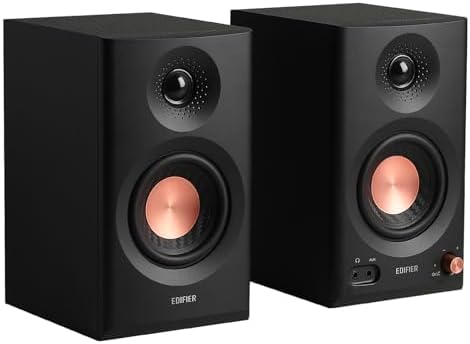
- Hi-Res Audio Certified – Experience superior sound with Hi-Res Audio certification, delivering a flat response across 52Hz to 40kHz for precise and…
- Rich Connectivity – Balanced TRS, RCA, and AUX inputs, headphone output, with Bluetooth supporting multi-point connection. RCA and AUX inputs enable…
- Powerful Sound Output – Enjoy 18W*2 RMS output with a peak SPL of 92.5dB, enhanced by 3.5" mid-low drivers and 1" tweeters for rich, full-range sound.
- Customizable Sound Experience – Easily switch between Music, Monitor, and Custom modes to suit your needs. Fine-tune your sound precisely through the…
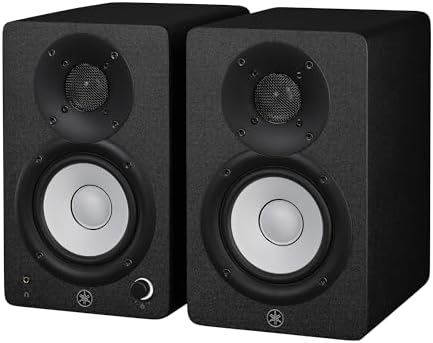
- Packaging: Pair
- 2-way bass-refiex powered speaker with 4.5" cone woofer and 1" dome tweeter
- 60 Hz – 22 kHz frequency response (-10 dB)
- 26 W and above 26 W output power

- 2 x AUX INPUT – Convenient connection to any device that has a 3.5mm headphone output or dual RCA output. Connect to two devices via AUX at the same…
- STUDIO SOUND QUALITY – Natural sound reproduction from 13mm silk dome tweeter and 4 inch full range unit
- REMOTE CONTROL – Adjust volume at your figure tips. Bass and treble control located on the side of main speaker.
- CLASSIC WOOD FINISH – High quality MDF wood build finished with wood effect vinyl serves as a great compliment to any home decor.

- 【SMALL HIFI BOOKSHELF SPEAKERS】Small bookshelf speakers with HiFi sound quality. SW208 adopts standard bookshelf speaker system design, i.e.…
- 【30Wx2 CARBON FIBER SEPAKER UNIT】The speaker unit is designed with carbon fiber material and multi-layer voice coil technology, which is proprietary…
- 【24bit DAC USB CONNECTION AND BLUETOOTH 5.0】Bluetooth 5.0 connection, stable transmission. When connecting with USB cable, the built-in 24bit DAC can…
- 【TREBLE AND BASS ADJUSTMENT】To achieve true HiFi sound quality, set the total volume, treble and bass adjustment knobs on the side of main speaker.…

- Built-in amplifier (33 watts x 2 speakers) so there is no need for outside amplifier or receiver—just plug into source and play
- Frequency response: 55 Hz to 20 kHz
- Bluetooth pairing capability to stream audio playback from compatible devices
- 10° tilt angle directs sound toward ears to create a better listening experience

- 【SMALL HIFI BOOKSHELF SPEAKERS】With its modern aesthetic and compact design, this stylish black speaker complements contemporary home or office…
- 【Experience powerful sound】Unleash powerful 30Wx2 distortion-free sound. Featuring a 0.75-inch carbon fiber silk dome tweeter and a 3-inch carbon…
- 【Durable Performance】Built with a premium MDF wooden enclosure, this computer speakers with subwoofer effectively reduces box resonance for clearer,…
- 【Multiple Input Options】These speakers are designed to offer versatile connectivity, featuring Bluetooth 5.3 along with RCA, AUX, and USB inputs.…
1. PreSonus Eris 3.5 Powered Studio Monitors
Best for: producers needing balanced connections on a small desk
Fifty watts of built-in amplification drives the 3.5-inch woven-composite woofers and 1-inch silk-dome tweeters, covering a stated 80 Hz to 20 kHz range. The high- and low-frequency acoustic tuning controls on the back let you adjust the output for your room’s shape, so you aren’t stuck with whatever default voicing the factory set.
You’ll find balanced TRS, RCA, and a front-panel aux input, meaning an audio interface, a phone, and a turntable can all stay plugged in at once. A front headphone jack cuts the speakers when you need to listen quietly.
Anyone working in a large untreated room will hit the limits of that 80 Hz low-frequency floor before hearing deep sub-bass.
Pros
- Built-in amplification sized to fill a desktop listening space without strain
- Balanced TRS, RCA, and front aux inputs
- High- and low-frequency tuning controls
- Front-panel headphone jack
- Sold as a complete stereo pair
Cons
- Frequency response starts at 80 Hz, so deep sub-bass below that point won’t reach your ears without adding a separate subwoofer
2. M-AUDIO BX3 3.5″ Wired Studio Monitors Pair
Best for: podcasters and streamers tracking live audio feeds
A wired connection engineered for zero latency is the headline feature here, keeping your voice perfectly synced with your headphones while you record. The 3.5-inch Black Kevlar low-frequency drivers handle the bottom end, while natural silk dome tweeters take care of the highs for precise stereo imaging. Bi-amplified power splits the signal so each driver gets its own dedicated drive stage, which keeps the sound clean across the spectrum.
The cabinet uses acoustically-inert MDF wood paired with a bass reflex design to stop unwanted vibration from muddying your mixes. On the back, you’ll find 1/4-inch, 1/8-inch, and RCA inputs, giving you instant compatibility with DJ gear, instruments, and standard computer outputs. A front panel 1/8-inch AUX input lets you plug in headphones directly for silent sessions.
Pros
- Engineered for zero-latency wired monitoring
- 3.5-inch Black Kevlar low-frequency drivers
- Bi-amplified power delivery
- Acoustically-inert MDF cabinet with bass reflex design
- 1/4-inch, 1/8-inch, and RCA rear inputs
Cons
- Built strictly for wired use, so streaming audio from a phone over Bluetooth isn’t possible without adding an external receiver
3. Mackie CR3.5 Studio Monitors (Pair)
Best for: beginners wanting everything needed in one box
This pair is sized specifically for desks and small studios, and the listing states it ships with both monitors, isolation pads, and all cables to start. You hear your mix or stream the way it actually sounds rather than flattered by artificial boosts.
A single tone knob lets you dial the voicing right from your desk without digging through software menus. The location switch corrects the bass response depending on whether the speakers sit flush against a wall or out in the open, solving a common problem for tight bedroom setups.
Pros
- Sized for desks and small studios
- Tone knob for quick voicing adjustments
- Location switch corrects bass for wall placement
- Isolation pads included in the box
- All necessary cables included to start
Cons
- The box includes both monitors, isolation pads, and cables, but not a subwoofer, so deep bass extension requires a separate purchase
4. PreSonus Eris E4.5-2-Way 4.5″ Near Field Studio Monitor (Pair)
Best for: home producers mixing bass-heavy music tracks
A 4.5-inch woven-composite woofer gives this pair a bigger low end, keeping the overall sound clean and tight. Class AB dual amplification—split evenly between the two cabinets—provides the volume needed for reference work without sacrificing tonal balance. The 1-inch low-mass silk-dome tweeters create an ultra-wide listening sweet spot, so moving slightly off-center doesn’t ruin your stereo image.
High- and low-frequency tuning controls let you customize the output for your room. You get ¼-inch TRS balanced inputs for professional interfaces, unbalanced RCA inputs for consumer gear, and a front-panel ⅛-inch TRS aux input for a phone. A front-panel headphone output with a built-in amplifier handles private reference checks instantly.
Pros
- Larger woven-composite woofers for tighter bass
- Class AB dual amplification split evenly between the two cabinets
- 1-inch low-mass silk-dome tweeters
- ¼-inch TRS, RCA, and front ⅛-inch inputs
- Built-in headphone amplifier on the front panel
Cons
- Class AB amplification provides substantial headroom, so a longer overnight session in a shared apartment means relying on the headphone output to avoid waking others
5. Edifier MR3 Powered Studio Monitor
Best for: audiophiles needing certified high-resolution playback
Hi-Res Audio certification is the main draw here, delivering a flat response across a massive 52 Hz to 40 kHz range for precise monitoring. That upper limit captures the harmonic overtones that give cymbals and vocals their natural air. Eighteen watts per channel RMS drives the 3.5-inch mid-low drivers and 1-inch tweeters to a peak SPL of 92.5 dB, which is plenty loud for near-field desk work.
Balanced TRS, RCA, and AUX inputs cover professional and consumer sources, while Bluetooth supports multi-point connection so two devices stay paired simultaneously. You can switch between Music, Monitor, and Custom modes depending on whether you’re producing a track or just watching a video. The EDIFIER ConneX app offers in-depth adjustments and personalized EQ control, letting you fine-tune the sound precisely from your phone.
Pros
- Hi-Res Audio certified for 52 Hz to 40 kHz response
- 18W per channel RMS with 92.5 dB peak SPL
- Balanced TRS, RCA, AUX, and multi-point Bluetooth
- Music, Monitor, and Custom listening modes
- EDIFIER ConneX app for personalized EQ control
Cons
- 18 watts RMS per channel sets a ceiling, so filling a large living room for a party means the 92.5 dB peak SPL is the maximum you’ll reach
6. Yamaha HS4 Powered Studio Monitor in Black
Best for: engineers connecting professional audio interfaces directly
A 2-way bass-reflex design houses a 4.5-inch cone woofer and a 1-inch dome tweeter, delivering a stated frequency response of 60 Hz to 22 kHz (-10 dB). Output power is listed at 26 W and above, providing enough clean headroom for critical listening in a treated space. Room control and high trim response controls let you tame boundary effects and bright reflections without touching external software.
The input selection stands out because it includes XLR/TRS Phone combo jacks alongside RCA and Stereo Mini connections. Combo jacks accept professional microphone cables or standard quarter-inch instrument leads without adapters. The box also includes a Stereo mini-to-RCA cable, a speaker cable, and an anti-slip pad, so the physical setup is handled immediately.
Pros
- A mid-sized cone woofer paired with a 1-inch dome tweeter
- 60 Hz to 22 kHz frequency response (-10 dB)
- XLR/TRS Phone combo inputs for pro gear
- Room control and high trim response switches
- Anti-slip pad and cables included in the box
Cons
- The box lists the monitors, cables, and an anti-slip pad, but not a Bluetooth module, so wireless streaming requires a separate adapter
7. Edifier R1280T Powered Bookshelf Speakers -2.0 Near Field Studio Monitor
Best for: listeners wanting classic wood styling and simple controls
Natural sound reproduction comes from a 13 mm silk dome tweeter paired with a 4-inch full-range unit, designed to keep vocals and acoustic instruments sounding true to life. Two AUX inputs let you connect any device with a 3.5 mm headphone output or dual RCA output simultaneously.
Bass and treble controls sit on the side panel of the active speaker, putting adjustments right at your fingertips. A remote control is also included, allowing you to change the volume from across the room without standing up. The MDF wood build is finished with a wood effect vinyl that fits naturally into living rooms or home offices.
Placing these against a back wall requires care, as the listing doesn’t mention a boundary correction switch to tame the resulting bass buildup.
Pros
- 13 mm silk dome tweeter and 4-inch full-range unit
- Dual AUX inputs for simultaneous device connections
- Side panel bass and treble control knobs
- Remote control included for volume adjustments
- MDF wood build with wood effect vinyl finish
Cons
- Bass and treble knobs are located on the side of the main speaker, so placing that speaker tight against a wall or bookshelf blocks easy access to the controls
8. Sanyun SW208 3″ Active Bluetooth 5.0 Bookshelf Speakers
Best for: desktop users wanting direct USB digital audio conversion
Carbon fiber material and multi-layer voice coil technology define the 3-inch speaker units here, aiming for warm mids, deep lows, and clear highs. The bookshelf direct/reflective design creates a rich stereo sense and strong sound pressure on a desk.
A built-in 24-bit DAC handles USB connections by taking the digital audio signal directly from your device, reducing loss during conversion. Bluetooth 5.0 provides a stable wireless transmission path when cables aren’t convenient. Total volume, treble, and bass adjustment knobs sit on the side of the main speaker, letting you tailor the output to different genres.
Streaming high-resolution files wirelessly hits a wall with Bluetooth 5.0, which compresses data compared to the lossless path the USB DAC provides.
Pros
- 3-inch carbon fiber speaker units with multi-layer voice coils
- Built-in 24-bit DAC for direct USB digital connection
- Bluetooth 5.0 for stable wireless streaming
- Side-mounted total volume, treble, and bass knobs
- Built-in noise elimination system for quiet standby
Cons
- 30Wx2 total output defines the ceiling, so driving a large open-plan office means stopping short of the volume larger cabinets produce
9. Edifier R1700BT Bluetooth Bookshelf Speaker
Best for: rooms needing higher volume and angled sound projection
Sixty-six watts RMS total—listed as 33 watts per speaker—means there’s no need for an outside amplifier or receiver to fill a room. The frequency response covers 55 Hz to 20 kHz, reaching lower than many compact desktop models to give kick drums and bass guitars more weight. A 10° tilt angle directs the sound upward toward your ears, creating a better listening experience when the speakers sit flat on a desk.
Bluetooth pairing lets you stream audio from compatible phones and tablets wirelessly. Dual RCA inputs allow two wired sources to remain connected at once, avoiding tedious plugging and unplugging when switching from a computer to a CD player. The wooden enclosure serves both an acoustic and aesthetic purpose, damping internal resonance while looking like traditional hi-fi gear.
Pros
- 66 watts RMS total (33 watts x 2 speakers)
- 55 Hz to 20 kHz frequency response
- Bluetooth pairing for wireless streaming
- 10° tilt angle directs sound toward ears
- Dual RCA inputs for multiple wired sources
Cons
- Dual RCA inputs are the only wired connections listed, so hooking up a professional interface with balanced TRS outputs requires buying separate adapter cables
10. OHAYO 60W Computer Speakers
Best for: gamers needing loud output and modern Bluetooth connectivity
Thirty watts per channel delivers distortion-free sound driven by a 0.75-inch carbon fiber silk dome tweeter and a 3-inch carbon fiber full-range driver. The rear bass port amplifies low-end depth, while an integrated independent sound card ensures smooth, detailed playback straight from your PC. It’s a setup built to handle intense gaming sessions where sudden explosions and quiet footsteps need equal clarity.
Bluetooth 5.3 joins RCA, AUX, and USB inputs, ensuring compatibility with smartphones, turntables, TVs, and media players alike. The premium MDF wooden enclosure effectively reduces box resonance for clearer, more precise sound compared to plastic alternatives. An easy-to-reach volume control knob on the front panel allows for quick adjustments mid-game without tabbing out of your software.
Tracking live instruments demands zero latency, making the inherent delay of Bluetooth 5.3 a dealbreaker for recording artists.
Pros
- 30Wx2 distortion-free sound output
- 0.75-inch tweeter and 3-inch carbon fiber driver
- Bluetooth 5.3, RCA, AUX, and USB inputs
- Integrated independent sound card
- Front panel volume control knob
Cons
- The 3-inch carbon fiber full-range driver sets a physical limit, so reproducing the lowest synthesizer notes requires adding the subwoofers mentioned in its compatibility list
Also Worth Considering
The Ortizan C7 Powered Studio Monitors are a pair featuring Bluetooth 5.3 in black. The Edifier MR3 already covers multi-point Bluetooth alongside balanced TRS inputs and Hi-Res certification, making it a strong choice for serious production work.
The Logitech Z207 Stereo Computer Speakers offer a 2.0 setup with Bluetooth. The M-AUDIO BX3 beats it for anyone focused on audio quality, thanks to its bi-amplified design, Kevlar woofers, and zero-latency wired engineering.
How We Chose
Eighteen Amazon listings were compared on driver size, stated amplification power, and available input types, and near-duplicates — another colour, another size of one already here — were left out. To earn a place, a listing had to state its wattage or frequency response clearly, proving it was built for actual audio reproduction rather than casual background noise. Products lacking basic specifications like driver dimensions or connection options were removed immediately.
How to Choose the Right Studio Monitor Speakers
Driver size and bass extension
Decide how low your music needs to go before picking a speaker. A 3.5-inch woofer like the one on the PreSonus Eris 3.5 starts at 80 Hz, which misses deep synth lines. The Edifier R1700BT reaches 55 Hz with larger drivers, handling bass-heavy genres much better without requiring you to buy a separate subwoofer later.
Inputs matching your existing gear
Look at the cables coming from your computer or mixer first. Professional audio interfaces usually output balanced signals, making the XLR/TRS combo jacks on the Yamaha HS4 essential. If you only use a laptop’s headphone jack, the dual 3.5 mm AUX inputs on the Edifier R1280T let you connect two devices at once without adapters.
Amplification power for your room
Match the wattage to the space you’re trying to fill. A small bedroom desk works fine with the 18 watts per channel on the Edifier MR3. Larger living rooms or spaces where you mix at higher volumes need the 66 watts RMS total provided by the Edifier R1700BT to prevent distortion when you turn the knob up.
What comes in the box
Check the included accessories so you know what else to buy. The Mackie CR3.5 ships with isolation pads and all necessary cables, letting you start immediately. Other models, like the Yamaha HS4, include an anti-slip pad and specific audio cables, saving you a trip to the store before your first listening session.
Frequently Asked Questions
Do I need an external amplifier for these speakers?
No, every model listed here is active, meaning the amplifier is built inside the cabinet. The Edifier R1700BT states this explicitly: “there’s no need for outside amplifier or receiver—just plug into source and play.” You only need to provide power from a wall outlet and an audio signal from your computer or phone.
Can I connect these to a turntable?
Yes, if your turntable has a built-in preamp. Models with RCA inputs, like the PreSonus Eris 3.5 and the Edifier R1280T, accept the standard red and white cables most turntables use. Without a phono preamp inside the turntable itself, the signal will be too quiet regardless of which speakers you choose.
What does Hi-Res Audio certification actually mean?
It means the hardware is capable of reproducing frequencies beyond standard CD quality. The Edifier MR3 carries this certification, listing a response of 52 Hz to 40 kHz. The Japan Audio Society governs this standard, defining Hi-Res Audio requirements for equipment capable of handling high-fidelity digital formats.
Will Bluetooth cause a delay when editing video?
Yes, wireless connections introduce latency that makes lip-sync difficult during video editing. The M-AUDIO BX3 is engineered specifically for “zero-latency audio monitoring” via a wired connection to solve this exact problem. If you edit video or track live instruments, always use the physical cables provided instead of Bluetooth.
Do I really need the isolation pads?

They help significantly if your desk vibrates when bass plays. The Mackie CR3.5 includes isolation pads in the box to decouple the speakers from the desk surface. Without them, the wood or metal of your desk resonates along with the woofers, muddying the low frequencies and making your mixes sound less accurate.
Are 3-inch drivers too small for mixing?
They limit how much low bass you can hear, but they work for checking levels and panning. The Sanyun SW208 uses 3-inch carbon fiber drivers, which is fine for podcasts or acoustic guitar. For heavy electronic music or hip-hop production, stepping up to the larger woofers on the PreSonus Eris E4.5 reveals much more detail.
Conclusion
The PreSonus Eris 3.5 features ample power, balanced inputs, and tuning controls. If you just need something simpler that arrives ready to play, the Mackie CR3.5 puts pads and cables right in the box. Pick the one that matches your current cables, clear a space on your desk, and start listening.
As an Amazon Associate, Instrument Insight earns from qualifying purchases at no additional cost to you.