
The Yamaha HS8 is the top pick among these best home studio monitors because it delivers 120W of bi-amped power and a 38Hz low end. This guide helps anyone building a home setup who needs clear, honest sound from their speakers. The one thing that separates these picks is how much room they need to work properly.
A big driver moves more air, so you hear deep notes without adding a subwoofer. A small one fits on a crowded desk but stops short on bass. Pick the size that matches your space first, then look at the connections you already own.
- Best Overall: Yamaha HS8 — 120W bi-amp system with an 8-inch woofer.
- Best Reference Imaging: JBL 305P MkII — patented waveguide gives a wide, precise sweet spot.
- Best Mid-Range Professional: PreSonus Eris Studio 4 — custom-tuned waveguide and Class AB amplification.
- Best Compact Bluetooth: Edifier MR3 — wireless multi-point connection in a small cabinet.
- Best Small Desktop: PreSonus Eris 3.5 — front-panel aux input for quick phone hookups.
- Simplest to Use: Mackie CR3.5 — single tone knob and included isolation pads.
- Best 3-Way Design: ULTIMEA BS-3 — dedicated midrange driver separates vocals cleanly.
- Best Bi-Amplified Nearfield: Yamaha HS5 — sonic purity emphasized with 70W total output.
- Best Powered Bass-Reflex: Yamaha HS4 — room control switches and cables included in the box.

- 38Hz – 30kHz frequency response
- 75W LF plus 45W HF bi-amp, 120W total
- 8-inch cone woofer, 1-inch dome tweeter
- Large magnets in advanced magnetic circuit design

- Includes two 305P MkII powered monitors
- Image control waveguide for wide sweet spot
- Dual 41-Watt amplifiers with 5-inch woofer
- Boundary EQ and HF trim adjust frequencies

- 1-inch silk-dome high-frequency transducer
- 120˚(H) x 60˚(V) EBM waveguide
- 4.5-inch woven-composite low-frequency drivers
- 52Hz to 40kHz flat response range
- TRS, RCA, AUX inputs and Bluetooth multi-point
- 18W*2 RMS output, 92.5dB peak SPL
- 3.5" mid-low drivers and 1" tweeters
- Sold as a complete stereo pair
- 50 watts of built-in amplification
- 3.5” woofers and 1” tweeters, 80 Hz–20 kHz
- High- and low-frequency acoustic tuning controls

- Sold as a pair for desks
- Tone knob adjusts voicing from desk
- Location switch corrects bass near walls

- 3-Way Powered Bookshelf Speakers: ULTIMEA BS-3 features a 5.25" woofer, dedicated midrange driver, and tweeter for more balanced, separated sound…
- Advanced Edge Horn Technology: By directing treble toward the listening area instead of scattering energy, this structure optimizes high-frequency…
- Deep, Impactful Bass: Featuring a 5.25” woofer with a 15mm long-excursion and our proprietary BassMX technology, this speaker moves more air to reach…
- Powerful 70W RMS Output: Delivering 70W RMS of consistent, high-output amplification, these speakers produce clean, dynamic sound with 0.1% low…

- Includes (2) Yamaha HS5 studio monitors
- 2 Way bass reflex bi amplified near field studio monitor with 5 inch Cone woofer and 1 inch dome tweeter
- Has monitors emphasize sonic purity without any coloring or alternation of the original sound
- 54 hertz to 30 kilohertz frequency response; 45W LF plus 25W HF bi amp system for high-performance 70 watts power amplification
- Packaging: Pair
- 2-way bass-refiex powered speaker with 4.5" cone woofer and 1" dome tweeter
- 60 Hz – 22 kHz frequency response (-10 dB)
- 26 W and above 26 W output power
1. Yamaha HS8 8-Inch Powered Studio Monitor Pair
Best for: producers mixing bass-heavy music in treated rooms
This pair arrives as a complete stereo set, so you don’t have to hunt for a second speaker later. The 8-inch cone woofer is the largest driver here, and it reaches down to 38Hz. That means kick drums and synth bass lines stay full without needing a separate subwoofer on your desk.
A 75W low-frequency amp drives that big cone while a 45W high-frequency amp handles the 1-inch dome tweeter. Together they make 120W of bi-amplified power. Bi-amping splits the signal before it hits the amps, which keeps distortion down when you push the volume during long sessions. The Advanced Magnetic Circuit design uses large magnets to keep the motor structure stable under heavy use.
Comparing specs across this list, the 38Hz bottom end on the HS8 sits well below the 54Hz floor stated for the Yamaha HS5. You’ll feel that difference whenever a track relies on deep sub-bass energy. The extra wattage also gives you headroom, so the speakers don’t strain when you check a loud mix.
Anyone working in a tiny bedroom should skip this one, because the 120W bi-amp system and 8-inch woofer demand physical space and proper acoustic treatment to avoid muddy reflections.
Pros
- 38Hz to 30kHz frequency response covers the full musical range
- 120W total bi-amped power (75W LF plus 45W HF)
- 8-inch cone woofer paired with a 1-inch dome tweeter
- Large magnets in an Advanced Magnetic Circuit design
- Bundle includes a matched pair of two monitors
Cons
- The 8-inch woofer and 120W amplification require a room large enough to handle deep bass without excessive reflection.
2. (2) JBL 305P MkII 5″ 2-Way Active Powered Studio Reference
Best for: podcasters and producers needing a wide sweet spot
The standout feature here is the patented Image Control Waveguide. It shapes how sound leaves the tweeter, creating a wide sweet spot. If you move your head slightly while editing a podcast or balancing a track, the stereo image stays locked instead of collapsing to one side.
Dual 41-Watt Class-D amplifiers drive a 5-inch woofer and a Slip Stream port. The Boundary EQ switch lets you cut low frequencies if you have to push these against a wall, while the HF Trim adjusts the highs to match your room’s brightness.
Inputs include both XLR and TRS, fitting standard audio interfaces without adapters. The MDF enclosure adds rigidity to stop the cabinet from vibrating along with the music. Against the lower power of the Yamaha HS5, the combined output here offers plenty of power for nearfield listening.
Mixing cinematic soundscapes with deep sub-bass will expose limits, since the 5-inch woofer can’t displace air like the significantly larger driver on the Yamaha HS8.
Pros
- Patented Image Control Waveguide for crystal-clear imaging
- Dual 41-Watt Class-D amplifiers deliver dynamic range
- Boundary EQ and HF Trim adjust to room acoustics
- XLR and TRS inputs accept balanced connections
- Slip Stream port supports deep bass reproduction
Cons
- The 5-inch woofer sets a physical ceiling on low-end extension compared to larger drivers listed here.
3. PreSonus Eris Studio 4 4.5-inch 2-Way Active Studio Monitor
Best for: project studios needing accurate stereo imaging
A 1-inch silk-dome tweeter sits inside a custom-tuned EBM waveguide measuring 120 degrees horizontal by 60 degrees vertical. That specific spread directs high frequencies toward your ears and away from the desk surface, reducing early reflections that smear detail. You get a wider sweet spot without treating every wall in the room.
The 4.5-inch woven-composite low-frequency driver works with a front-firing acoustic port. Front ports let you place the speaker closer to a back wall than rear-ported designs allow. Internal bracing suppresses cabinet resonance, keeping the midrange clean when the 50W Class AB biamplification pushes up to 99 dB SPL at one meter.
Frequency response runs from 55 Hz to 20 kHz. Balanced XLR, balanced quarter-inch TRS, and unbalanced RCA inputs cover professional interfaces and consumer gear alike. The stated 55 Hz low end reaches deeper than the 60 Hz limit printed for the Yamaha HS4.
Producers relying on heavy electronic sub-bass will find the 55 Hz floor insufficient, meaning a separate subwoofer becomes necessary to hear everything below that point.
Pros
- Custom-tuned 120˚ x 60˚ EBM waveguide for wide sweet spot
- 1-inch ultra-low-mass silk-dome high-frequency transducer
- 4.5-inch woven-composite low-frequency driver
- 50W Class AB biamplification reaching 99 dB SPL peak
- Front-firing acoustic port with resonance-suppressing internal bracing
Cons
- The 55 Hz to 20 kHz frequency response stops above the deepest sub-bass notes found in modern electronic tracks.
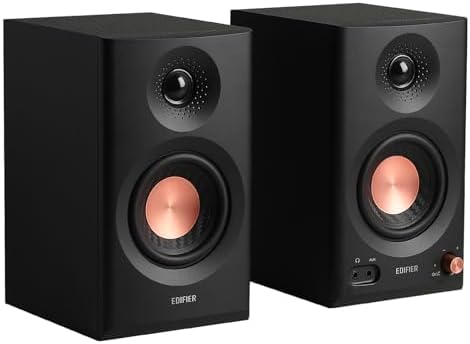
4. Edifier MR3 Powered Studio Monitor
Best for: creators switching between phones and audio interfaces
Hi-Res Audio certification guarantees a flat response from 52Hz to 40kHz. An MDF cabinet reduces panel vibration, keeping the sound tight even when placed directly on a desk.
Bluetooth multi-point connection lets you pair a laptop and a phone simultaneously. You can edit a video using wired TRS inputs, then switch to streaming music from your phone without unplugging anything. RCA and AUX inputs remain active alongside the wireless link, supporting multiple audio devices at once.
Output comes from 18W per channel RMS, hitting a peak SPL of 92.5dB through 3.5-inch mid-low drivers and 1-inch tweeters. The EDIFIER ConneX app unlocks Music, Monitor, and Custom modes, giving you EQ control right from your screen. Its 52Hz low end beats the 60Hz floor stated for the Yamaha HS4.
Those needing to fill a large living room should look elsewhere, as the 18W per channel RMS output is designed for nearfield desktop listening rather than high-volume playback.
Pros
- Hi-Res Audio Certified with 52Hz to 40kHz flat response
- Bluetooth multi-point connection for simultaneous device pairing
- Balanced TRS, RCA, AUX inputs plus headphone output
- 18W*2 RMS output reaching 92.5dB peak SPL
- EDIFIER ConneX app provides Music, Monitor, and Custom EQ modes
Cons
- The 18W*2 RMS output sets a ceiling on maximum volume for larger rooms.
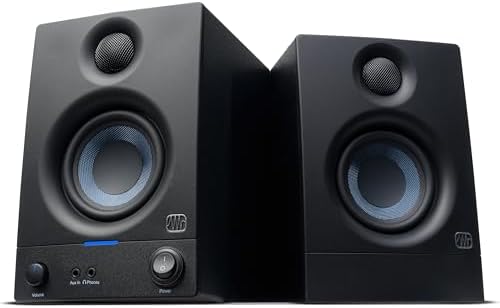
5. PreSonus Eris 3.5 Powered Studio Monitors
Best for: gamers and musicians with tight desk space
Sold as a complete stereo pair, these fit neatly beside a computer monitor. The PreSonus Eris 3.5 features 3.5-inch woven-composite woofers. A front-panel aux input lets you plug in a phone or tablet instantly without reaching behind the cabinet.
Fifty watts of built-in amplification drives the system. High- and low-frequency acoustic tuning controls sit on the back, letting you dial out boominess if the speakers must sit in a corner.
Connections include balanced TRS and RCA alongside that front aux jack. A front headphone jack mutes the speakers automatically for late-night private listening. Compared to the 55 Hz bottom end on the PreSonus Eris Studio 4, the 80 Hz limit here means you lose the lowest octave of a bass guitar.
Bass-heavy music production requires more extension, because the stated 80 Hz lower limit cuts off the fundamental frequencies of kick drums and deep synths.
Pros
- Sold as a complete stereo pair
- 50 watts of built-in amplification
- 3.5-inch woven-composite woofers and 1-inch silk-dome tweeters
- Built-in high- and low-frequency acoustic tuning controls
- Front-panel aux input and front headphone jack
Cons
- The 80 Hz–20 kHz frequency response cuts off fundamental bass notes needed for full-range music production.
6. Mackie CR3.5 Studio Monitors (Pair)
Best for: beginners wanting instant setup without menus
Everything you need arrives together in a single package: both monitors, isolation pads, and all cables to start. Having the cables included means you can go from unboxing to listening in minutes.
A single Tone Knob sits right on the front panel. Instead of navigating software menus or flipping tiny rear switches, you just turn it to adjust the voicing while sitting in your chair. The Location Switch corrects bass buildup depending on whether you push them against a wall or leave them free-standing.
The 3.5-inch woofers are sized specifically for desks and small studios. The straightforward layout contrasts sharply with the app-based EQ required to adjust the Edifier MR3.
Audio engineers needing balanced XLR inputs for professional interfaces will find the connectivity options too limited for high-end studio routing.
Pros
- Sold as a pair, sized for desks and small studios
- Tone Knob allows immediate voicing adjustments from the desk
- Location Switch corrects bass response for wall placement
- Box includes both monitors, isolation pads, and all cables
- Designed to reproduce mixes accurately without coloration
Cons
- The box lists both monitors, isolation pads, and cables, but no balanced XLR inputs are stated for professional interface connections.
7. ULTIMEA 3-Way Powered Bookshelf Speakers
Best for: users combining music production with home theater
A dedicated midrange driver separates vocals and guitars from the bass and treble. Most speakers in this review use two-way designs, forcing one cone to handle both mids and lows. Here, the 5.25-inch woofer focuses entirely on bass, while the midrange driver keeps instruments distinct and the tweeter handles detail.
Advanced Edge Horn Technology directs treble straight at the listening area instead of scattering it. This keeps high frequencies focused and natural across the room. BassMX technology pairs with a 15mm long-excursion woofer to reach 50Hz lows, moving enough air to feel impactful without adding a subwoofer immediately.
Seventy watts RMS of amplification maintains 0.1% low distortion at higher volumes. HDMI ARC connects directly to modern TVs, while a dedicated SUB OUT port lets you add an external subwoofer later. Optical, RCA, USB, Bluetooth, and Auracast inputs cover almost any source. The 70W RMS output matches the combined 70W system on the Yamaha HS5, but routes it through three distinct drivers.
Critical mixing engineers requiring pure stereo reference monitoring may find the app-driven EQ settings and home theater features introduce unwanted coloration to the sound.
Pros
- 3-way design with 5.25″ woofer, dedicated midrange, and tweeter
- Advanced Edge Horn Technology directs treble toward listeners
- 70W RMS output with 0.1% low distortion
- HDMI ARC and dedicated SUB OUT port included
- Ultimea App provides pro-grade EQ settings
Cons
- The 70W RMS output is tuned for room-filling home theater use, which may overpower a small nearfield mixing desk.
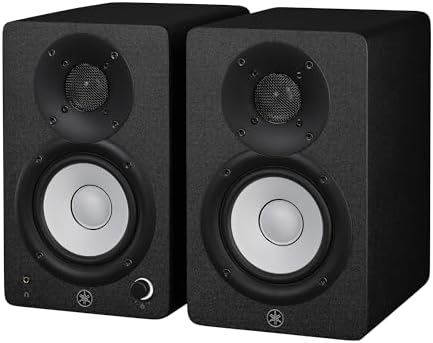
8. YAMAHA Hs5 Powered Studio Monitor
Best for: engineers prioritizing uncolored nearfield accuracy
These monitors emphasize sonic purity without any coloring or alteration of the original sound. That philosophy means you hear exactly what is in your recording, flaws included. If a mix translates well on speakers that hide nothing, it will sound good anywhere else you play it.
A 5-inch cone woofer and a 1-inch dome tweeter operate in a 2-way bass reflex configuration. Bi-amplification splits the workload: 45W goes to the low frequencies and 25W to the highs, totaling 70 watts of power.
Frequency response spans 54 hertz to 30 kilohertz. XLR and TRS phone jack inputs accept both balanced and unbalanced signals from your interface or mixer. The package includes two matching monitors ready for stereo placement. Where the Yamaha HS8 uses a 120W system to drive its largest available cone, this model scales that architecture down for smaller rooms.
Producers working with orchestral scores or deep electronic genres will notice the 54 hertz low-end limit rolls off before the lowest fundamentals arrive.
Pros
- Includes two matching Yamaha HS5 studio monitors
- 2-way bass reflex bi-amplified nearfield design
- Emphasizes sonic purity without coloring the original sound
- 54 hertz to 30 kilohertz frequency response
- 45W LF plus 25W HF for 70 watts total amplification
Cons
- The 54 hertz to 30 kilohertz frequency response stops above the deep sub-bass region required for certain electronic genres.
9. Yamaha HS4 Powered Studio Monitor in Black
Best for: compact setups needing flexible input options
Room control and high trim response controls let you adapt the sound to your environment. The room control switch cuts low-end buildup when speakers sit near walls, while the high trim adjusts treble brightness. These hardware switches make acoustic correction fast without opening any software.
A 4.5-inch cone woofer and 1-inch dome tweeter form a 2-way bass-reflex powered system. Output power is listed at 26 W and above 26 W. Frequency response covers 60 Hz to 22 kHz, measured at -10 dB. The black finish blends easily into home offices or living spaces where professional gear might look out of place.
Connectivity is broad: XLR/TRS combo jacks, RCA, and Stereo Mini inputs handle interfaces, phones, and CD players alike. The packaging includes a stereo mini-to-RCA cable, a speaker cable, and an anti-slip pad. You get everything needed to connect immediately. Compared to the 54Hz floor on the Yamaha HS5, the 60Hz limit here reflects the smaller 4.5-inch driver.
Bass-heavy tracking sessions demand more extension, as the 60 Hz starting point means you won’t hear the lowest notes of a five-string bass guitar.
Pros
- Sold as a pair in black
- 2-way bass-reflex powered speaker design
- Room control and high trim response controls included
- XLR/TRS combo, RCA, and Stereo Mini inputs
- Stereo mini-RCA cable, speaker cable, and anti-slip pad included
Cons
- The 60 Hz – 22 kHz frequency response (-10 dB) sets a hard limit on deep bass reproduction.
Also Worth Considering
The Ortizan C7 Powered Studio Monitors come as a pair featuring Bluetooth 5.3. They offer wireless convenience, but the Edifier MR3 already provides multi-point Bluetooth alongside a wider 52Hz to 40kHz certified frequency response. Buyers who specifically want Bluetooth 5.3 might still prefer this set.
The Edifier R1280T Field Studio Monitor is a 2.0 near-field bookshelf speaker. It serves basic desktop needs, yet the PreSonus Eris 3.5 delivers 50 watts of amplification and includes a front headphone jack for easier daily use. Someone wanting a simple wood-grain bookshelf style could consider it.
The Edifier R1280DB Bluetooth Bookshelf Speakers add optical input and 42w RMS to the R1280T formula. While versatile, the ULTIMEA BS-3 offers a 3-way driver design and HDMI ARC for a fuller home theater experience. Those needing optical specifically for an older TV might still choose this one.
How We Chose
The listing doesn’t mention the power output for the Mackie CR3.5. Products missing basic specifications or offering only a single speaker without a pair option were removed. The remaining nine selections represent distinct configurations, ranging from the largest woofers in the lineup to compact 3.5-inch desktop models. Separation between the picks relies on verifiable differences in stated wattage, physical driver dimensions, and the types of inputs printed in each description. Features like bi-amplification, waveguide technology, and bundled accessories further distinguish the final choices from one another.
How to Choose the Right Home Studio Monitors
Driver size and bass extension
Decide how low your music needs to go before picking a speaker. Larger woofers move more air. The Yamaha HS8 lists an 8-inch cone reaching 38Hz, handling deep bass alone. Smaller drivers like the 3.5-inch cones on the PreSonus Eris 3.5 stop at 80Hz, requiring a subwoofer for full-range tracks.
Amplification type and power
Match the wattage to your room size. Bi-amped systems split power between drivers. The Yamaha HS5 delivers 70 watts total via 45W LF and 25W HF amps. Single-amp designs like the Edifier MR3 provide 18W per channel. Larger rooms need the higher output found on the ULTIMEA BS-3’s 70W RMS.
Inputs and desk connections
Check what cables your audio interface uses. Balanced XLR and TRS inputs prevent noise over long runs, found on the JBL 305P MkII. Consumer gear needs RCA or AUX jacks. The Yamaha HS4 includes a Stereo Mini input and the actual cable, saving a trip to the electronics store.
Room correction features
Untreated rooms cause bass buildup and harsh reflections. Hardware switches fix this instantly. The Mackie CR3.5 has a Location Switch for wall placement. The PreSonus Eris Studio 4 uses a front-firing port to reduce boundary issues. Software EQ, like the app on the Edifier MR3, offers deeper customization.
Frequently Asked Questions
Do I need an audio interface for these speakers?
Not always, but it helps. Models like the Yamaha HS8 and JBL 305P MkII list XLR and TRS inputs, which connect directly to professional interfaces for clean, balanced signals. However, the PreSonus Eris 3.5 and Yamaha HS4 include RCA and aux inputs, allowing direct connections from phones or laptops without extra gear.
Can I add a subwoofer later?
Yes, if the speaker provides the right output. The ULTIMEA BS-3 explicitly lists a dedicated SUB OUT port for connecting an external subwoofer. For other models like the Yamaha HS5, you would need an interface or controller that manages the crossover, since the listings don’t state a dedicated subwoofer output.
What does bi-amplified mean?
It means separate amplifiers power the woofer and the tweeter. The Yamaha HS8 uses a 75W amp for lows and a 45W amp for highs. Yamaha explains their HS Series bi-amp design to show how splitting the signal reduces distortion. This keeps loud bass from interfering with delicate high frequencies.
Are Bluetooth monitors good for mixing?
They work for casual creation, but latency can be an issue. The Edifier MR3 lists Bluetooth with multi-point connection, making it great for switching between devices quickly. For critical mixing where timing matters, use the wired balanced TRS inputs also listed on that same speaker to avoid any wireless delay.
Do isolation pads really matter?

They stop desk vibrations. The Mackie CR3.5 includes isolation pads directly in the box, ensuring the cabinet doesn’t transfer energy into your furniture. Without them, a bare desk acts like a resonator, artificially boosting muddy bass frequencies and masking the true sound the speaker was tuned to produce.
Why do some list frequency response with “-10 dB”?
That notation shows how far the sound drops off. The Yamaha HS4 states “60 Hz – 22 kHz frequency response (-10 dB)”, meaning those extremes are quieter than the middle range.
Conclusion
The Yamaha HS8 remains the strongest choice for most buyers, thanks to its 120W bi-amped power and 38Hz reach. If your desk is small, the Mackie CR3.5 offers the simplest setup with pads and cables included. Measure your space, pick the driver size that fits, and order the pair that matches your current cables.
As an Amazon Associate, Instrument Insight earns from qualifying purchases at no additional cost to you.