
The PreSonus Eris 3.5 is the top pick among inexpensive studio monitors because its listing states 50 watts of amplification, a frequency range down to 80 Hz, and built-in acoustic tuning controls. That combination covers what most home producers actually need for a small desk or bedroom studio that requires clear sound without guessing which specs matter. The real difference between these ten picks comes down to driver size, connection types, and whether they include extras like isolation pads or Bluetooth.
- Best Overall: PreSonus Eris 3.5 — 50 watts of power with dedicated high- and low-frequency tuning controls.
- Simplest Controls: Mackie CR3.5 — single tone knob plus a location switch for fast room correction.
- Most Compact Wired: M-Audio BX3 — bi-amplified wired design with Kevlar woofers and zero latency.
- Best Bluetooth Connectivity: Ortizan C7 — Bluetooth 5.3 alongside USB, RCA, TRS, and AUX inputs.
- Best Hi-Res Audio: Edifier MR3 — certified response reaching 40kHz with app-controlled EQ modes.
- Best Midrange Clarity: PreSonus Eris E4.5 — larger 4.5-inch woven-composite woofers for tighter bass.
- Best Wireless Desktop: Mackie CR3.5BT — adds wireless streaming to the same simple tone-knob layout.
- Best Larger Driver: PreSonus Eris E5 — 5.25-inch woofer paired with 80 watts of bi-amplification.
- Best Professional Sound: KRK Kreate 3 — glass aramid composite woofer designed for clear midrange.
- Best Entry-Level Studio: Yamaha HS5 — 70 watts of total power emphasizing sonic purity across the mix.
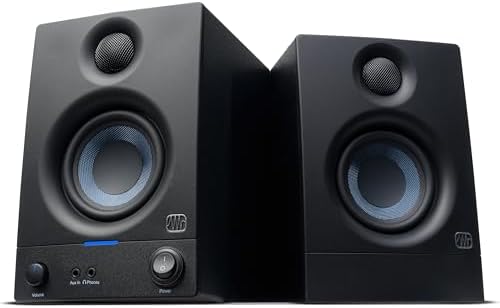
- Sold as a complete stereo pair
- 50 watts of built-in amplification
- 3.5” woven-composite woofers and 1” silk-dome tweeters
- Frequency response from 80 Hz–20 kHz

- Sold as a pair for desks and small studios
- Tone knob adjusts voicing from your desk
- Location switch corrects bass near walls or free

- Wired connection engineered for zero-latency monitoring
- Bi-amplified power for studio monitor quality
- 3.5-inch Kevlar woofers for smooth bass response
- Natural silk dome tweeters for precise stereo imaging

- RCA inputs and BT 5.3 wireless pairing
- Built-in 24-bit DAC captures audio via USB
- 3.5 inch carbon fiber speaker and 0.75inch silk dome tweeter
- Professional tuning for flat frequency response curve
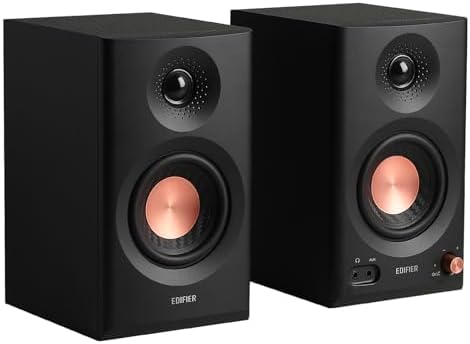
- Hi-Res Audio certified, 52Hz to 40kHz response
- Balanced TRS, RCA, AUX inputs and headphone output
- 18W*2 RMS output with peak SPL of 92.5dB
- Music, Monitor, Custom modes via EDIFIER ConneX app

- Eris 4.5 near field studio monitors sold as pair
- Woven-composite woofers deliver tight bass sound
- 50 Watts of Class AB dual amplification, 25W per side
- 1-inch low-mass silk-dome transducers for stereo imaging

- Sold as a pair, works wired or over Bluetooth
- Desk-sized monitors that double as daily speakers
- Bluetooth enables instant streaming from any device
- Tone Knob + Location Switch tune to your room
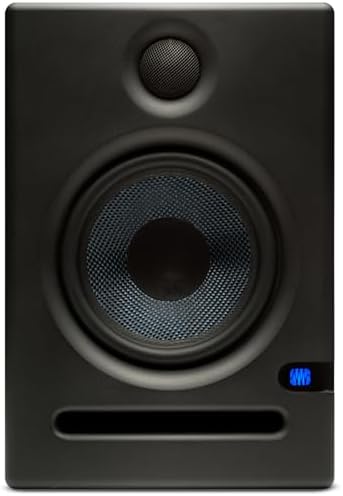
- Includes Studio One Prime and Studio Magic plug-in suite
- Over $1000 USD worth of music production software
- 5.25-inch woven composite woofer for solid low-end
- 1-inch ultra-low-mass silk-dome tweeter eliminates harshness

- Textile dome tweeter for pristine highs
- Lightweight woven glass fiber composite woofer
- 3.5” Glass Aramid Woofer with 1" Textile Dome Tweeter
- Bluetooth input for wireless audio streaming

- Includes (2) Yamaha HS5 studio monitors
- 2 Way bass reflex bi amplified near field monitor
- Monitors emphasize sonic purity without coloring sound
- 54 hertz to 30 kilohertz frequency response, 70 watts total
1. PreSonus Eris 3.5 Powered Studio Monitors
Best for: home producers needing balanced sound and easy connections.
This pair uses 3.5-inch woven-composite woofers and 1-inch silk-dome tweeters to cover a frequency range from 80 Hz to 20 kHz. You get 50 watts of built-in amplification driving both speakers together, which is enough to fill a small room without distortion. High- and low-frequency tuning knobs on the back let you adjust the output to match your space, so you don’t have to buy acoustic panels right away.
Connecting gear is straightforward here. The back panel holds balanced TRS and RCA inputs, while the front offers an aux jack and a headphone output. You can plug in a computer, mixer, or phone without hunting for adapters. It’s a complete stereo pair ready for music production, gaming, or everyday listening straight out of the box.
Comparing the specs, it delivers powerful amplification compared to the lower output of the Edifier MR3. That extra headroom matters when you’re mixing tracks that demand sudden dynamic shifts. Anyone working in a large living room will find the low-end limit too high for deep sub-bass reproduction without adding a separate subwoofer later.
Pros
- 50 watts of built-in amplification
- 3.5-inch woven-composite woofers and 1-inch silk-dome tweeters
- Frequency response from 80 Hz to 20 kHz
- High- and low-frequency acoustic tuning controls
- Front-panel aux input and headphone jack alongside rear TRS and RCA
Cons
- The stated frequency range begins at 80 Hz, so producing bass-heavy electronic music requires a separate subwoofer to hear the lowest notes.
2. Mackie CR3.5 Studio Monitors (Pair)
Best for: beginners who want fast setup without reading manuals.
Mackie keeps the controls incredibly simple on this pair. Instead of separate dials for highs and lows, you get a single tone knob right on the front to shape the voicing from your desk. A location switch on the back corrects the bass response depending on whether the speakers sit flush against a wall or out in the open.
The box includes both monitors, isolation pads, and all the cables needed to start playing audio immediately. That means you won’t have to figure out which wires fit before making any sound. They’re sized specifically for desks and small studios, keeping the footprint tight while still delivering unflattered audio for mixing or streaming.
Its single tone knob simplifies daily use compared to the separate high and low tuning controls on the PreSonus Eris 3.5. People who already own studio-grade isolation pads and interconnect cables might view the included accessories as unnecessary clutter taking up drawer space.
3. M-AUDIO BX3 3.5″ Wired Studio Monitors Pair
Best for: streamers and podcasters needing a strictly wired connection.
Latency ruins live monitoring, so M-Audio engineered these for a purely wired signal path. The bi-amplified design drives 3.5-inch Black Kevlar woofers and natural silk dome tweeters to produce studio-grade sound directly on your desktop. An acoustically-inert MDF cabinet with a bass reflex port stops unwanted vibration and extends the low end for beat-making or movie watching.
Hooking up different devices is easy thanks to the rear panel offering 1/4-inch, 1/8-inch, and RCA inputs. You can connect DJ gear, instruments, or standard consumer electronics without adapters. A front-panel 1/8-inch aux input lets you plug headphones directly into the speaker for silent late-night mixing sessions.
The listed Kevlar woofers contrast with the woven-composite drivers found on the PreSonus Eris 3.5.
Pros
- Zero-latency wired connection for live monitoring
- Bi-amplified power driving compact Black Kevlar woofers
- Natural silk dome tweeters for precise stereo imaging
- Acoustically-inert MDF cabinet with enhanced bass reflex design
- Rear 1/4-inch, 1/8-inch, and RCA inputs plus front headphone aux
Cons
- The listing specifies a latency-free wired connection, meaning there’s no Bluetooth option for users who prefer streaming audio from a tablet.
4. Ortizan C7 Powered Studio Monitors Pair with Bluetooth 5.3
Best for: creators switching constantly between phones and interfaces.
Wireless convenience meets professional routing in this white pair. Bluetooth 5.3 lets you pair a smartphone or tablet in about two seconds for instant playback. When you need accuracy, the built-in 24-bit DAC captures digital audio directly via USB to minimize signal loss during conversion.
The physical drivers combine a compact carbon fiber mid-bass unit with a 0.75-inch silk dome tweeter. An electronic 2-way crossover splits the frequencies cleanly, while dozens of professional laboratory adjustments aim for the flat curve monitor speakers require. You’ll also find a 6.35mm TRS balanced input for connecting mixing consoles or instruments like electric guitars.
It pairs Bluetooth 5.3 with a 24-bit USB DAC, whereas the Mackie CR3.5BT relies solely on standard wireless streaming. The listed 0.75-inch tweeter sits below the 1-inch silk domes used by several other models here.
Pros
- Bluetooth 5.3 for rapid wireless pairing
- Built-in 24-bit DAC for direct USB digital audio capture
- Compact carbon fiber speaker and 0.75-inch silk dome tweeter
- 6.35mm TRS balanced input for professional equipment
- Electronic 2-way crossover for layered sound performance
Cons
- The tweeter is listed at 0.75 inches, which is smaller than the 1-inch tweeters on the PreSonus Eris 3.5.
5. Edifier MR3 Powered Studio Monitor
Best for: audiophiles wanting certified high-resolution frequency extension.
This pair carries Hi-Res Audio certification, delivering a flat response spanning from 52Hz all the way up to 40kHz. Inside the MDF cabinet, compact mid-low drivers and silk-dome tweeters push 18 watts per channel RMS, reaching a peak SPL of 92.5dB.
You can switch between Music, Monitor, and Custom modes depending on the task. The EDIFIER ConneX app provides personalized EQ control for fine-tuning the output precisely. Connections are plentiful: balanced TRS, RCA, and AUX inputs sit on the back, alongside a headphone output and multi-point Bluetooth for streaming from multiple devices simultaneously.
The stated 52Hz low-end reaches deeper than the 80Hz floor printed on the PreSonus Eris 3.5. Relying on the EDIFIER ConneX app for in-depth adjustments means producers who prefer physical knobs on the speaker itself will miss tactile control.
Pros
- Hi-Res Audio Certified with a 52Hz to 40kHz frequency response
- 18W per channel RMS output with a 92.5dB peak SPL
- Switchable Music, Monitor, and Custom modes
- EDIFIER ConneX app for personalized EQ control
- Balanced TRS, RCA, AUX inputs plus multi-point Bluetooth
Cons
- The output is listed at 18 watts per side, so filling a large untreated room requires turning the volume higher than the 25-watt-per-side PreSonus Eris E4.5.
6. PreSonus Eris E4.5-2-Way 4.5″ Near Field Studio Monitor (Pair)
Best for: musicians needing a wider sweet spot for collaboration.
Stepping up to a 4.5-inch woven-composite woofer gives this pair a noticeably bigger low end. The weave and nature of the driver material result in tight bass you can feel, alongside cleaner overall sound for hi-fi listening or multimedia reference. Fifty watts of Class AB dual amplification—split as 25W per side—provides plenty of loudness without sacrificing tonal balance.
Low-mass silk-dome transducers deliver an ultra-wide listening sweet spot, maintaining superior stereo imaging even when you aren’t sitting dead center. High- and low-frequency tuning controls let you contour the audio for your specific room size and speaker orientation. A front-panel headphone output with a built-in amplifier allows quick switching to private media reference.
Its 4.5-inch woofer moves more air than the 3.5-inch driver on the PreSonus Eris 3.5. Because the listing highlights compatibility with the companion Eris Sub 8BT, buyers expecting massive sub-bass straight out of the box still need to purchase that separate 8-inch unit.
Pros
- 4.5-inch woven-composite woofers for expressive low end
- 50 watts of Class AB dual amplification (25W per side)
- Low-mass silk-dome tweeters for an ultra-wide sweet spot
- High- and low-frequency precision tuning controls
- Front-panel headphone output with a built-in amplifier
Cons
- Power-saving mode auto engages after 40 minutes, so idle time requires a restart.
7. Mackie CR3.5BT Studio Monitors (Pair)
Best for: casual listeners who also edit audio occasionally.
This model takes the straightforward layout of the standard CR3.5 and adds Bluetooth for instant streaming from any device. You can use them as serious desk-sized monitors for mixing, then switch seamlessly to playing music from your phone during downtime. The single tone knob and location switch remain, letting you tune the room response in seconds without navigating menus.
Like its wired sibling, the box includes both monitors, isolation pads, and all necessary cables to get started immediately. Having everything required in one package removes the guesswork from setup. They function equally well as daily desktop speakers and entry-level mixing tools.
Adding Bluetooth separates it from the strictly wired M-Audio BX3. Users who rely entirely on balanced XLR connections for professional studio interfaces will find those absent from the listed specifications.
Pros
- Works wired or over Bluetooth for versatile playback
- Tone knob and location switch for fast room tuning
- Sold as a pair sized perfectly for desktops
- Includes both monitors, isolation pads, and all cables
Cons
- The included cables serve standard connections, but the listing doesn’t mention balanced XLR options for high-end professional interfaces.
8. PreSonus Eris E5 2-Way 5.25″ Near Field Studio Monitor
Best for: serious mixers needing extended low-end headroom.
A 5.25-inch woven composite woofer sets this monitor apart, delivering solid low-end sound with minimal bass distortion. That larger cone moves significantly more air than the smaller drivers in this lineup, helping your mixes translate accurately to other systems. An 80-watt Class AB bi-amplification system provides ample volume and headroom for critical nearfield monitoring tasks.
The ultra-low-mass silk-dome tweeter eliminates harshness while maintaining balanced high-frequency detail. A front-firing acoustic port enhances bass-frequency reproduction further, allowing flexible placement near walls. On the back, balanced XLR and 1/4-inch inputs join unbalanced RCA connections to accommodate virtually any audio interface or mixer.
The bi-amplification provides significantly more power than the output found on the Edifier MR3.
9. KRK Kreate 3 Powered Studio Monitors Pair
Best for: producers prioritizing clear midrange articulation.
KRK builds this pair around a compact Glass Aramid woofer made from lightweight, woven glass fiber composite. That specific material choice targets clear midrange reproduction and tight bass response. Up top, a textile dome tweeter handles pristine highs.
Bluetooth input allows wireless audio streaming when you just want to listen casually. Multiple additional audio inputs ensure universal connectivity in almost any studio environment. You can route instruments, computers, or phones into the system without swapping cables constantly.
The Glass Aramid woofer differs from the carbon fiber driver inside the Ortizan C7.
Pros
- Compact lightweight woven glass fiber composite woofer
- 1-inch textile dome tweeter for pristine highs
- Bluetooth input for wireless audio streaming
- Multiple audio inputs for universal studio connectivity
Cons
- The 3.5-inch woofer size matches the PreSonus Eris 3.5, meaning it can’t displace as much air as the 5.25-inch driver on the PreSonus Eris E5.
10. YAMAHA Hs5 Powered Studio Monitor
Best for: engineers seeking uncolored sonic purity for translation.
Yamaha designs the HS series to emphasize sonic purity without coloring or altering the original sound. This 2-way bass reflex monitor uses a 5-inch cone woofer and a 1-inch dome tweeter driven by a bi-amp system. You get 45 watts dedicated to low frequencies and 25 watts for highs, totaling 70 watts of power amplification.
The frequency response spans from 54 hertz to 30 kilohertz, covering the essential musical range accurately. Both XLR and TRS phone jack inputs accept balanced or unbalanced signals, fitting neatly into professional studio racks. This listing includes two monitors, giving you a complete stereo setup right away.
Its 70 watts of total bi-amplified power trails the 80 watts listed for the single PreSonus Eris E5. Engineers who prefer a boosted, flattering low end for casual enjoyment will find the stated emphasis on uncolored sonic purity too revealing for relaxed listening.
Pros
- 5-inch cone woofer and 1-inch dome tweeter
- 70 watts total power (45W LF plus 25W HF bi-amp)
- Frequency response from 54 hertz to 30 kilohertz
- XLR and TRS phone jack inputs for balanced or unbalanced signals
- Emphasizes sonic purity without coloring the original sound
Cons
- The design emphasizes sonic purity without alteration, so listeners wanting artificially boosted bass for casual music enjoyment will find the response too flat.
Also Worth Considering
The YAMAHA HS4 Powered Studio Monitor is a black pair featuring a smaller form factor than the main list’s Yamaha HS5. The HS5 beats it with a stated 5-inch cone woofer and 70 watts of power amplification, but someone with a very shallow desk might still prefer the compact HS4 pair.
The PreSonus 5BT Bluetooth Studio Monitors come as a pair of powered bookshelf speakers with 5.25-inch drivers aimed at near field music production. The PreSonus Eris E5 matches that 5.25-inch woofer size and adds 80 watts of Class AB bi-amplification, yet buyers specifically needing built-in Bluetooth streaming could lean toward the 5BT instead.
The M-AUDIO 4.5″ Wired Studio Monitors are a pair stepping up to a 4.5-inch driver. The PreSonus Eris E4.5 also uses a 4.5-inch woofer but lists 50 watts of Class AB dual amplification and an ultra-wide sweet spot, though fans of M-Audio’s bi-amplified Kevlar approach might stick with the BX4.
How We Chose
To earn a place, a listing had to state the exact woofer dimensions, the power output, and the available input types clearly in its bullet points. What separates the final ten picks is how they balance physical driver size against stated power and routing flexibility. Larger woofers naturally claim spots for bass-heavy work, while models packing Bluetooth or extensive cable bundles suit desktop creators needing versatility. Every chosen monitor presents a distinct combination of these listed facts, ensuring each serves a specific type of buyer without overlapping identically with another entry on the final roster.
How to Choose the Right Studio Monitors
Driver size and bass extension
Decide how low your music needs to go before picking a speaker. The Yamaha HS5 reaches 54 hertz with a 5-inch cone, while the PreSonus Eris 3.5 stops at 80 Hz with a 3.5-inch woofer. Larger drivers move more air for bass-heavy genres, whereas smaller ones save desk space.
Amplification power and headroom
Look at the total wattage to know how loud the speakers play cleanly. The PreSonus Eris E5 lists 80 watts of bi-amplification for serious headroom. The Edifier MR3 provides 18 watts per side, which suits quiet bedrooms. More power prevents distortion during dynamic peaks.
Inputs and wireless features
Check what plugs into the back before buying. The Ortizan C7 offers Bluetooth 5.3, USB, TRS, and RCA connections. The M-Audio BX3 stays strictly wired with 1/4-inch and RCA jacks. Match the inputs to your existing audio interface or streaming habits.
What comes in the box
Some listings include extras that save a second shopping trip. The Mackie CR3.5 ships with isolation pads and all cables needed to start. The PreSonus Eris E5 listing describes a single monitor, meaning you must buy two separately to build a stereo pair.
Frequently Asked Questions
Do I need an audio interface for these speakers?
Not always, but it improves quality. Models like the PreSonus Eris 3.5 feature RCA and aux inputs that connect directly to a laptop’s headphone jack. However, using the balanced TRS inputs found on the Yamaha HS5 with a dedicated interface reduces electrical noise and provides a cleaner signal path.
Can I add a subwoofer to these setups later?
Yes, if the monitors lack deep bass. The PreSonus Eris E4.5 listing explicitly mentions pairing with the Eris Sub 8BT for added low end. Speakers starting at 80 Hz, like the PreSonus Eris 3.5, benefit greatly from a subwoofer when mixing bass-heavy electronic music.
What does bi-amplification actually do?
It powers the woofer and tweeter separately. The Yamaha HS5 dedicates 45 watts to low frequencies and 25 watts to highs, preventing one driver from stealing power from the other.
Are Bluetooth monitors okay for mixing?
They work for referencing, but wired is safer for timing. The Ortizan C7 includes Bluetooth 5.3 alongside a 24-bit USB DAC for lossless wired capture. If your primary goal is critical mixing where milliseconds matter, relying on the wired inputs of the M-Audio BX3 ensures zero latency.
Why do some monitors have a location switch?

Placing speakers against a wall artificially boosts bass frequencies. The Mackie CR3.5 includes a location switch that corrects this boundary effect, tailoring the low end whether the cabinets sit flush against drywall or out in the open. Without it, your mixes might sound thin on other systems.
How important is an MDF cabinet?
Medium-density fiberboard reduces resonance compared to hollow plastic enclosures. The M-Audio BX3 lists an acoustically-inert MDF cabinet paired with a bass reflex design to stop unwanted vibration. The Edifier MR3 similarly uses an MDF enclosure to keep distortion low during loud playback sessions.
Conclusion
For most people setting up a small workspace, the PreSonus Eris 3.5 remains a reliable choice because its 50 watts of power and acoustic tuning controls handle nearly any room. If you want fewer dials and faster setup, the Mackie CR3.5 strips things down to a single tone knob. Pick the one that fits your desk, connect your interface, and start mixing.
As an Amazon Associate, Instrument Insight earns from qualifying purchases at no additional cost to you.