
The Edifier R1700BT is the top pick among these low cost studio monitors because its 66 watts of total power and 55 Hz frequency response provide more output and deeper bass than the other options. These speakers suit small home studios, video editing, or desk setups. The differences between these five models come down to their connectivity, space requirements, and necessary additional equipment.
- Best Overall: Edifier R1700BT — 66 watts RMS and dual RCA inputs handle any desktop setup.
- Best Wireless Connectivity: Edifier R1280DB — Optical and coaxial inputs join Bluetooth for lossless digital audio.
- Most Compact Design: IK Multimedia iLoud Micro — Internal DSP and a tiny footprint fit anywhere.
- Simplest Connections: PreSonus Eris 3.5 — Balanced TRS, RCA, and front aux plug into everything.
- Most Powerful Output: PreSonus Eris E4.5 — Class AB amplification drives larger woofers for serious volume.

- Built-in 33 watts x 2 amplifier
- Frequency response 55 Hz to 20 kHz
- Bluetooth audio streaming
- 10° tilt angle for sound direction

- Bluetooth wireless connectivity
- 4 inch bass and 13mm silk tweeter
- Optical and coaxial digital inputs
- Remote control with side tone controls

- Internal DSP for accurate frequency response
- Suitable for recording and mixing
- Class D amplifiers with 50W RMS
- Portable and lightweight design
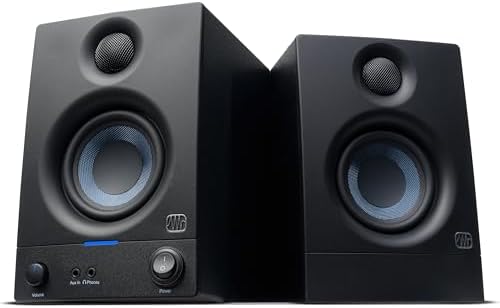
- Stereo pair for studio-quality sound
- 50 watts of built-in amplification
- 3.5” woofers and 1” silk-dome tweeters
- High- and low-frequency acoustic tuning

- Near field studio monitor design
- Woven-composite woofers for tight bass
- 50 Watts Class AB dual amplification
- 1-inch silk-dome tweeters
1. Edifier R1700BT Bluetooth Bookshelf Speaker
Best for: producers needing strong output without extra gear
The built-in amplifier pushes 33 watts per speaker, giving you 66 watts RMS in total. That means there’s no need for an outside receiver or amp block cluttering your desk. You plug straight into your source and play, which keeps the whole setup fast and simple. A 10° tilt angle points the drivers right at your ears, so you don’t have to stack books underneath to get the sound where it belongs.
Dual RCA inputs let you keep two devices connected at once. You can leave your audio interface plugged into one set and a phone or turntable on the other, avoiding tedious plugging and unplugging every time you switch tasks. Bluetooth pairing is also built in, so streaming from a tablet or laptop takes seconds instead of cables. The wooden enclosure isn’t just for looks; it helps reduce resonance that plastic boxes tend to amplify when the bass hits hard.
Comparing the specs and features, the frequency response starts at 55 Hz and reaches 20 kHz, matching the low-end figure on the IK Multimedia iLoud Micro while offering 16 more watts of total power. That extra headroom matters when you’re mixing tracks that rely on deep kick drums or heavy synth lines. Anyone working in a very tight space should look elsewhere, since these bookshelf speakers need real desk width to sit properly without crowding your screen.
Pros
- Built-in amplifier delivers 66 watts RMS total
- Frequency response covers 55 Hz to 20 kHz
- Dual RCA inputs allow two simultaneous connections
- 10° tilt angle directs sound toward the listener
- Bluetooth pairing supports wireless playback
Cons
- Wooden bookshelf enclosures take up significant desk space compared to smaller monitors
- Dual RCA inputs require adapters if your audio interface only outputs balanced TRS
2. Edifier R1280DB Powered Bluetooth Bookshelf Speakers
Best for: users wanting digital inputs alongside wireless streaming
This model brings optical and coaxial inputs to the table, letting you run a lossless connection straight from a TV or computer. That’s a big deal if you hate the hiss that sometimes creeps in over older analog cables. You still get Bluetooth wireless streaming for your phone or tablet, so switching between a wired desktop session and casual listening from the couch doesn’t mean crawling behind the speakers to swap cords.
A 4-inch bass driver and a 13mm silk dome tweeter handle the sound reproduction. The listing notes this setup is naturally fine-tuned, aiming for a balanced profile out of the box without forcing you to hunt for software EQ. Side panel controls on the active speaker give you physical knobs for bass and treble, so dialing in your preference happens by feel rather than clicking through menus. A remote control is included too, letting you toggle inputs and adjust volume from your chair.
Total output sits at 42 watts RMS, which falls short of what the Edifier R1700BT delivers. That difference shows up when you push the volume high in a large room, though for near-field desk work it’s usually plenty.
Pros
- Optical and coaxial inputs support lossless digital connections
- Bluetooth wireless connects to phones, tablets, and computers
- Remote control adjusts volume and toggles inputs
- Side panel knobs provide physical bass and treble control
- 4-inch bass driver paired with a 13mm silk dome tweeter
Cons
- 42 watts RMS total output leaves less headroom than higher-powered options
3. IK Multimedia iLoud Micro Monitor 50 watt Portable Wireless Bluetooth
Best for: traveling creators and extremely tight desk spaces
Calling itself the smallest active studio reference monitoring system in the world, this pair fits where normal speakers simply can’t. Each unit packs a 3/4-inch silk dome tweeter and a 3-inch high-rigidity composite woofer. Despite that tiny footprint, class D amplifiers push 50 watts RMS total, and the bass reflex port fires from the front so you can shove them right against a wall without choking the low end.
Internal DSP handles the heavy lifting for room correction. You get switches for optimizing bass and treble response, plus position compensation that lets you jump between a free field setup and a desktop arrangement instantly. That means your mix translates better whether you’re in a hotel room or a treated project studio. The listing states the frequency response drops down to 55 Hz at -3dB, keeping the low end solid for such compact boxes.
Connectivity covers all the bases: Bluetooth pairing for wireless streaming, stereo RCA inputs, and a 1/8-inch aux jack for older players or turntables. It matches the 55 Hz low-end reach of the Edifier R1700BT while taking up a fraction of the desk space, though the R1700BT’s larger wooden enclosure moves more air overall. Buyers who already own a full-sized audio interface with balanced TRS outputs will notice these lack that specific input type, relying instead on RCA and aux connections.
Pros
- Internal DSP offers EQ settings and position compensation
- Class D amplifiers deliver 50 watts RMS total
- Front-firing bass reflex port allows placement against walls
- Frequency response reaches 55 Hz (-3dB)
- Bluetooth, stereo RCA, and 1/8-inch aux inputs included
Cons
- RCA and 1/8-inch inputs require adapters for interfaces with balanced TRS outputs
4. PreSonus Eris 3.5 Powered Studio Monitors
Best for: beginners needing balanced inputs and acoustic tuning
Fifty watts of built-in amplification drives this complete stereo pair, giving you enough power to fill a room without distortion. The 3.5-inch woven-composite woofers aim for tighter bass, while 1-inch silk-dome tweeters smooth out harshness across the 80 Hz to 20 kHz frequency range. That starting point of 80 Hz means deep sub-bass won’t shake your desk, but vocals, guitars, and synths stay clear and present right where you need them.
Built-in high- and low-frequency acoustic tuning controls sit on the back, letting you tailor the sound to your exact room size. You don’t need extra gear or acoustic treatment panels to get a balanced listen. Connection options are arguably the most flexible here: balanced TRS inputs for pro interfaces, unbalanced RCA for consumer electronics, and a front-panel aux input for quick phone hookups. There’s even a front headphone jack for private sessions.
Against the PreSonus Eris E4.5, both share identical amplification, but the Eris 3.5 uses smaller 3.5-inch woofers and starts its frequency response at 80 Hz rather than reaching deeper into the bass. That makes it ideal for podcasting or casual mixing, but less suited for heavy electronic music production. If your mixes rely on feeling the lowest notes, the 80 Hz floor listed here rules this pair out for bass-heavy genres.
Pros
- 50 watts of built-in amplification drives the stereo pair
- Balanced TRS, RCA, and front-panel aux inputs included
- High- and low-frequency acoustic tuning controls built in
- 1-inch silk-dome tweeters and 3.5-inch woven-composite woofers
- Front headphone jack allows private listening
Cons
- Frequency response starts at 80 Hz, limiting deep bass reproduction
- 3.5-inch woofers displace less air than larger drivers in bigger rooms
5. PreSonus Eris E4.5-2-Way 4.5″ Near Field Studio Monitor (Pair)
Best for: serious mixing requiring larger drivers and loud volume
These near field monitors step up to 4.5-inch woven-composite woofers, and their weave is designed to deliver tight bass you can actually feel. Paired with 1-inch low-mass silk-dome tweeters, the goal is accurate audio with superior stereo imaging from almost any listening angle. That ultra-wide sweet spot matters when you’re leaning back in your chair or showing a track to someone sitting next to you.
Power comes from 50 watts of Class AB dual amplification, split as 25 watts per side. Class AB topology is known for maintaining tonal balance even when pushed hard, so you get loudness without sacrificing clarity. High- and low-frequency tuning controls let you customize the output for your room size and speaker orientation. An easy-access front panel headphone output includes a built-in amplifier, making quick switches to headphones seamless during long sessions.
You get 1/4-inch TRS balanced inputs, RCA inputs, and a front 1/8-inch TRS aux jack. The listing also mentions compatibility with the companion Eris Sub 8BT, an 8-inch subwoofer that adds Bluetooth connectivity and turns this into a 2.1 system. Compared to the PreSonus Eris 3.5, the 4.5-inch woofers here move significantly more air, though both setups are driven by the same amount of built-in amplification. Anyone who needs absolute silence in a shared apartment might find the deep bass extension travels through floors faster than smaller drivers do.
Also Worth Considering
The Sanyun SW208 is a 3-inch active Bluetooth 5.0 bookshelf speaker pair featuring a built-in 24-bit DAC. It earns a mention for handling digital conversion internally, which simplifies computer hookups. However, the PreSonus Eris 3.5 beats it for studio work by offering balanced TRS inputs and dedicated acoustic tuning controls that the Sanyun’s title doesn’t claim. Casual listeners who want a simple wireless setup with clean digital processing might still prefer it for a bedroom desk.
How We Chose
The final five were separated by how they handle connectivity and space constraints. Some prioritize raw power and large wooden enclosures, while others focus on internal digital signal processing or compact footprints for travel. Every selected monitor includes built-in amplification, removing the need for external receivers. The resulting lineup covers distinct setups, ensuring each recommendation solves a specific problem found directly in the seller’s provided specifications.
How to Choose the Best Low Cost Studio Monitors
Power output and driver size
Decide how loud your room needs to be before picking a pair. Total wattage dictates headroom, while driver diameter determines how much air gets moved for bass. The Edifier R1700BT leads here with 66 watts RMS pushing its bookshelf drivers, whereas the PreSonus models split 50 watts across smaller cones. Match the wattage to your room size so your mixes don’t distort when turned up.
Input connections on the back panel
Look at the gear you already own before buying speakers. If your audio interface uses balanced cables, you need TRS inputs like those on the PreSonus Eris 3.5. Older turntables or TVs might require RCA or optical connections, which the Edifier R1280DB provides. Buying monitors that lack your interface’s output type means purchasing adapters before you can make any sound.
Room size and desk space
Measure the flat surface where your speakers will sit. Large wooden enclosures like the Edifier R1700BT demand wide desks and careful placement to avoid blocking your screen. Smaller units like the IK Multimedia iLoud Micro tuck into tight corners easily. Choosing a monitor that physically overwhelms your workspace forces you to angle them poorly, ruining the stereo image you’re trying to create.
Acoustic tuning and EQ controls
Every room colors sound differently, so onboard adjustment knobs save you from installing acoustic panels immediately. Both PreSonus models feature high- and low-frequency tuning controls to dial in the response for your specific space. The IK Multimedia iLoud Micro uses internal DSP switches for similar results. Without these tools, you’re stuck mixing based on what your untreated room decides to show you.
Frequently Asked Questions
Do I need an external amplifier for these speakers?
No, every monitor listed here is active, meaning the amplifier is built inside the cabinet. The Edifier R1700BT lists 33 watts per channel internally, and the PreSonus pairs house their own matching dual-channel amplifiers. You simply connect your audio source directly to the speakers using the provided inputs.
Can I connect these monitors to my television?
Yes, but you must check the input types first. The Edifier R1280DB specifically lists optical and coaxial inputs designed for lossless connections to most TVs. Other models like the PreSonus Eris E4.5 rely on RCA or TRS inputs, which require your TV to have matching analog audio outputs or a separate digital-to-analog converter box to function correctly.
Will Bluetooth introduce delay when editing video?
The IK Multimedia iLoud Micro and both Edifier models list Bluetooth pairing for wireless streaming. When syncing audio to picture frame-by-frame, plug directly into the wired RCA, TRS, or optical inputs instead to ensure the sound hits exactly when the action happens on screen.
What does a front-firing bass port change?
A front-firing port lets you push the speakers closer to a wall without muffling the low frequencies. The IK Multimedia iLoud Micro lists a large-flaring front-firing bass reflex port specifically for this reason. Rear-ported speakers need several inches of clearance behind them to breathe properly. If your desk sits flush against a wall, front ports prevent muddy, booming bass buildup.
Are silk dome tweeters better than metal ones?

Silk dome tweeters aim for a smoother, less fatiguing high-frequency response during long mixing sessions. The PreSonus Eris 3.5, PreSonus Eris E4.5, and IK Multimedia iLoud Micro all list silk-dome tweeters in their specifications. Metal domes can sometimes sound brighter or harsher at high volumes. For near-field desktop listening where the speakers sit close to your ears, silk is generally preferred.
How do room tuning controls actually work?
These physical knobs adjust the speaker’s output to compensate for your specific environment. The PreSonus Eris E4.5 lists high- and low-frequency tuning controls that let you cut or boost certain ranges. If your desk sits in a corner that artificially inflates bass, turning the low-frequency knob down flattens the response. Proper acoustic treatment shapes sound so these dials can be set accurately for honest mixing.
Conclusion
The Edifier R1700BT remains a reliable choice for most buyers thanks to its 66 watts of power and flexible dual RCA inputs. If you need something that vanishes into a crowded desk, the IK Multimedia iLoud Micro handles tight spaces without losing its reference quality. Measure your desk, check your interface’s outputs, and pick the pair that fits your actual room.
As an Amazon Associate, Instrument Insight earns from qualifying purchases at no additional cost to you.