
Choosing the right set can feel overwhelming, but the primary difference between these options is the core material and the intended playing style, which directly impacts your tone and ease of articulation.
- Best Overall: Thomastik-Infeld Dominant Pro — Balanced sound with powerful projection for diverse playing styles.
- Most Expressive Tone: Pirastro Evah Pirazzi — Engineered for high-level expression and nuanced tonal performance.
- Best for Professionals: Thomastik-Infeld Rondo Gold — Provides unique tonal intensity and a vast dynamic range.
- Best Tonal Range: Thomastik-Infeld Peter Infeld — Blends power and elegance with a wide array of sound colors.
- Best for Students: D’Addario Prelude — Durable solid steel core design that resists humidity and temperature changes.
- Best Hybrid Set: Vio JSI Special Set — Combines specific gold-label and synthetic core components.

- Balanced sound with broad color range
- DP100 set for chamber and orchestral use
- Immediate bow response with focused core
- Multi-strand synthetic core resists humidity
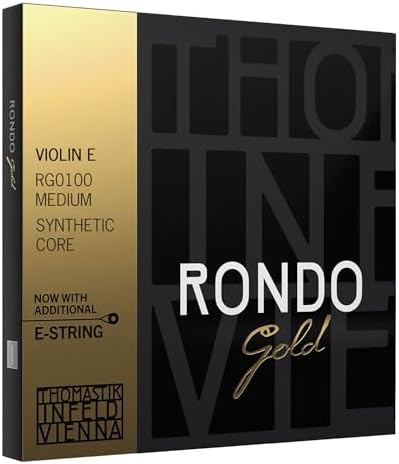
- Professional strings with wide dynamic range
- Includes two E strings
- Tin, gold, aluminum, and silver wound strings
- Warm, shiny sound with focused response

- Blend of power and sound colors
- Synthetic core for tuning stability
- Quick and precise bow response
- PI101 set with tin-plated E string

- Quick bow response for students
- Solid steel core for durability
- Sealed pouches protect against corrosion
- Warm tone in steel core design
1. Thomastik-Infeld Dominant Pro Violin Strings DP100
Best for: Chamber and orchestral violinists who need versatility.
These strings build on a long-standing reputation, providing a focused core sound that reacts quickly to the bow. They offer a balance of brilliance and warmth, which allows you to shape your dynamics easily from quiet passages to loud, room-filling tones. Because they feature a flexible multi-strand synthetic core, they mimic the feel of gut strings while handling humidity shifts better than traditional options.
This set is specifically designed for advanced violinists who want a modern, reliable sound. You’ll find that they provide a bell-like character, making them well-suited for solo performances and group settings alike. Compared to the D’Addario Prelude, which uses a solid steel core, these synthetic-core strings offer a different feel that’s generally preferred by those who prioritize complex tonal colors over maximum durability.
Anyone who prefers a traditional solid steel core for its specific resistance might find this synthetic option too flexible for their personal technique.
Pros
- Focused core sound with balanced brilliance and warmth
- Immediate, effortless response to the bow
- Flexible multi-strand synthetic core for gut-like feel
- Stable in varying humidity conditions
Cons
- Multi-strand synthetic core, so those who demand a solid steel core will need a different design.
2. Pirastro Evah Pirazzi 4/4 Violin String Set

Best for: Performers who prioritize a highly expressive, nuanced tone.
This model is a recognized choice for players who want to push their instrument’s tonal limits. It comes with a gold-plated E string, which contributes to the specific sound profile that many advanced players seek. The construction is focused on delivering a rich, complex output that responds to subtle changes in bow pressure and speed, allowing for significant artistic control.
When you compare these to the Thomastik-Infeld Dominant Pro, the Evah Pirazzi is often cited for its intense, colorful character. While both are meant for advanced users, this set is tailored specifically for those who want to maximize the expressive potential of their violin.
Anyone who requires a string set with a lower tension profile should look elsewhere, as this model is designed for a specific medium-gauge response that demands a certain level of playing experience.
Pros
- Includes gold-plated E string for enhanced tone
- Designed for high-level expression
- Medium gauge suited for a wide range of violinists
- Responsive to nuanced bow control
Cons
- Medium-gauge tension, so players needing ultra-light or heavy tension will find this fit incorrect.
3. Thomastik-Infeld Rondo Gold Violin Set with 2 E Strings RG100
Best for: Professionals who demand a vast dynamic range.
These strings are crafted to provide unique tonal intensity, which is why they’re a common pick among professionals. The set is notable for including two different E strings: one tin-plated and one gold-plated. This gives you the flexibility to choose the response and brilliance that best matches your instrument’s specific characteristics.
The sound is characterized by a warm, shiny quality with a focused response that works well for demanding solo work. Against the Thomastik-Infeld Peter Infeld, which also features a tin-plated E string, the Rondo Gold stands out by offering the additional gold-plated option for greater customization.
Players who are still in the early stages of their training may find the intensity of these strings challenging to manage compared to more forgiving student options.
Pros
- Includes two types of E strings for tonal customization
- Shiny, warm sound with a focused response
- Developed specifically for professional performance
- Offers a vast dynamic range for expressive playing
Cons
- Professional-grade intensity, so those who are still learning basic bow control might find them difficult to manage.
4. Thomastik-Infeld Peter Infeld Violin String Set
Best for: Soloists looking for a perfect blend of power and elegance.
These strings are known for their ability to project across a large space while maintaining a wide range of sound colors. The synthetic core technology used here is designed for a fast break-in time, which is a major benefit if you’re preparing for a performance on short notice. They also offer superior tuning stability, which helps you stay focused on your music rather than constant adjustments.
The bow response is quick and precise, providing the articulation you need for complex phrasing. When measured against the Thomastik-Infeld Rondo Gold, the Peter Infeld set emphasizes a broader palette of colors, whereas the Rondo focuses more on intense dynamic output.
Musicians who prefer a purely traditional gut-core feel will likely find the synthetic construction of these strings too modern for their specific taste.
Pros
- Fast break-in time for immediate use
- Excellent tuning stability and durability
- Quick, precise bow response for articulation
- Broad range of sound colors for solo performance
Cons
- Synthetic core construction, so those who exclusively use traditional gut strings will find this material different.
5. D’Addario Prelude Violin String Set
Best for: Students who need a durable, reliable set.
These strings are a top choice for educators because they’re designed to be forgiving and easy to play. The solid steel core makes them incredibly durable, which is helpful for students who practice frequently. They’re also unaffected by changes in temperature and humidity, meaning they stay in tune better when moving between different practice environments.
The sound is warm, which is often difficult to achieve in steel-core strings. Compared to the Thomastik-Infeld Dominant Pro, which uses a synthetic core, the Prelude offers a more consistent, robust feel that’s better suited for someone still developing their technique.
Anyone who is looking for the complex, nuanced sound colors required for professional solo work will find these strings too simple for their needs.
Pros
- Solid steel core for maximum durability
- Unaffected by humidity and temperature changes
- Easy bow response for beginner technique
- Warm tone despite the steel construction
Cons
- Solid steel core, so professionals needing a more complex, synthetic-like response will find this choice lacking in tonal variety.
6. JSI Special 4/4 Violin String Set

Best for: Violinists who want a pre-mixed combination of popular string types.
This set is a hybrid option, combining a gold-label E string with Dominant A, D, and G strings. By mixing these components, you get a distinct response from the E string that differs from the synthetic-core lower strings. It provides a unique balance for those who want the specific brightness of a gold-label E but the warmth of a standard synthetic set for the rest of the instrument.
The listing doesn’t provide specific technical details about the core materials or tension profiles. When compared to the Thomastik-Infeld Dominant Pro, which is a cohesive set from one manufacturer, the Vio JSI Special Set is a curated selection that brings together different characteristics into one package.
Musicians who prefer a matched set from a single brand for maximum tonal consistency might find this hybrid approach less predictable.
Pros
- Includes a gold-label E string for brightness
- Features well-known synthetic core lower strings
- Conveniently pre-packaged hybrid configuration
- Balanced response for daily practice
Cons
- Hybrid set, so those who require a perfectly matched single-brand set for tonal uniformity will find this design less ideal.
Also Worth Considering
The Yeshone Strings Universal Full Set is a steel-core option for beginners to intermediate players, featuring corrosion-resistant alloy material. The Thomastik-Infeld Dominant Violin E String is a classic individual component. It is surpassed by full sets like the Thomastik-Infeld Dominant Pro, which are designed to harmonize across all four strings, but it is a useful choice if you only need to replace a single E string. The PANSHA Violin Strings Full Set is another entry-level choice. It is often compared to the D’Addario Prelude, which is widely used in educational settings, but it may serve those looking for a simple replacement string set for practice.
How to Choose the Right Violin Strings
Core material and its impact
The core material determines how your violin feels and sounds. Synthetic cores, like those in the Thomastik-Infeld Dominant Pro, offer a warm, gut-like feel with stable tuning. Solid steel cores, found in the D’Addario Prelude, are more durable and resistant to environmental shifts, making them better for students and consistent practice.
Matching your skill level
Professional strings like the Thomastik-Infeld Rondo Gold are designed for nuanced tonal control and dynamic range, which requires advanced technique. Student-focused options prioritize ease of response and durability. Always check the manufacturer’s intended user group to ensure the string’s response matches your current ability.
What comes in the box
Some sets, such as the Thomastik-Infeld Rondo Gold, include extra E strings for customization. Others, like the Vio JSI Special Set, provide a mix of different string types. Check if your set includes a ball-end or loop-end E string, as this must match your violin’s fine tuners to ensure proper installation.
Related guides
Frequently Asked Questions
How often should I change my violin strings?
Most professionals replace their strings every few months, but this depends on how often you play. If the sound becomes dull or the strings show signs of fraying, it’s time for a new set.
Can I mix strings from different sets?
Yes, many violinists mix strings to achieve a specific sound. For example, using a brighter E string from one set with warmer D and G strings from another can balance the instrument’s output. The Thomastik-Infeld strings guide explains how different core materials interact to help you build a custom set that fits your violin.
What is the difference between ball-end and loop-end strings?
The end type depends on your violin’s fine tuners. A ball-end string has a small metal ball that sits in the fine tuner, while a loop-end string hooks onto a small metal pin. Check your tailpiece to see which type you need before purchasing, as they aren’t interchangeable.
Are more expensive strings always better?
Performance depends on your specific instrument and playing style. A professional player might prefer a specific synthetic set for its tonal colors, while a student might find a durable steel set more useful. Focus on the core material and intended use instead.
Do I need special tools to change my strings?
You don’t need special tools, but you should change one string at a time to keep the bridge in place. Keeping the other strings tight prevents the bridge from collapsing. If you are unsure, consult a luthier to avoid damaging your instrument’s bridge or soundpost.
Why do my new strings sound metallic or harsh?
New strings require a short break-in period to reach their full tonal potential. Synthetic core strings like the Thomastik-Infeld Peter Infeld take a few days to lose brightness, while solid steel strings like the D’Addario Prelude settle into their final pitch. Ensure your bridge is positioned correctly for optimal vibration.
Does the gauge of the string change how hard I have to press?
Yes, string gauge directly affects the physical effort required to depress the string. Medium gauge strings, such as the Pirastro Evah Pirazzi, balance tension and response for most players. If you find the resistance excessive, consult your instructor to ensure your technique is efficient or check your instrument’s bridge height.
How do I store spare violin strings to prevent corrosion?
Humidity and temperature fluctuations are the primary enemies of string longevity, as they can cause oxidation on the metal windings. The D’Addario Prelude strings are noted for their sealed pouch design, which provides a protective barrier against these elements. For other sets, keep them in their original airtight packaging and store them in a cool, dry area of your home, away from direct sunlight or kitchen or bathroom moisture.
What should I do if a string breaks while tuning?
If a string breaks, loosen the remaining strings to prevent uneven pressure on the bridge. When installing a replacement, ensure the end is seated properly in the tailpiece. If you frequently break strings, check the nut and bridge grooves for rough edges that might be cutting into the string material.
Is it necessary to use a different set for solo versus ensemble playing?
Some professionals switch sets depending on the setting, as solo work benefits from the projection of the Thomastik-Infeld Peter Infeld. However, many players prefer one consistent set for a familiar feel. Ensemble players often prioritize the balanced, room-filling sound of the Thomastik-Infeld Dominant Pro to blend well with other instruments.
How do I know if my violin needs a setup adjustment?
If you experience poor response, the issue may lie with the violin’s setup. A luthier can adjust the soundpost, bridge height, and nut slots to optimize string interaction. Strings like the Thomastik-Infeld Dominant Pro are designed for high performance, but they cannot compensate for a bridge that is incorrectly adjusted.
Do synthetic core strings require different care than steel strings?
Synthetic core strings are sensitive to environmental changes but do not require specialized cleaning tools. Use a soft, dry cloth to wipe rosin dust off the strings after every session, as buildup dampens vibration. Avoid liquid cleaners, which can damage the synthetic core or metal winding and lead to breakage.
Why is there a difference in tone between the D and G strings?

D and G strings are wound with different materials to achieve specific frequency ranges, with the G string featuring thicker winding. This mass difference causes them to respond differently to bow pressure. A matched set like the Thomastik-Infeld Dominant Pro ensures a smooth, consistent transition and balanced tonal output across the instrument.
Can I use full-size strings on a fractional violin?
Never use full-size strings on a fractional violin, as the excess length prevents proper tuning and fitting. Fractional violins require strings designed for their specific scale length to ensure correct intonation. Always verify that the set matches your instrument’s size before installation, as using the wrong size hinders playability.
Final Thoughts
Don’t be afraid to experiment with a few different brands to find what suits your instrument’s unique voice. It’s a personal journey, so trust your ears as you play. Once you’ve settled on a favorite set, you’ll find that practicing feels much more rewarding when your violin sounds exactly how you want.
As an Amazon Associate, Instrument Insight earns from qualifying purchases at no additional cost to you.