
The Thomastik-Infeld Dominant Pro is the best strings for violin for most players because they provide a powerful, balanced sound that adapts to different playing styles. Choosing the right set can feel overwhelming with so many options, but the primary difference between these sets is the core material and the intended performance environment. This guide helps you find the right match for your playing level and goals.
Quick Picks
- Best Overall: Thomastik-Infeld Dominant Pro — Balanced sound with exceptional power and broad color range.
- Most Responsive: Pirastro Evah Pirazzi — Engineered for immediate bow response and high-performance play.
- Best Tonal Range: Thomastik-Infeld Peter Infeld — Offers wide sound colors for nuanced, expressive phrasing.
- Best for Professionals: Thomastik-Infeld Rondo Gold — Features intense sound with two different E-string options.
- Best for Students: D’Addario Prelude — Durable steel core design that resists humidity and temperature changes.
- Best Hybrid Set: Vio JSI Special Set — Combines a gold-label E-string with synthetic core strings.

- Balanced sound with wide color range
- DP100 set for chamber and orchestral use
- Immediate bow response with focused core
- Multi-strand synthetic core resists humidity

- Wide tonal range for solo and ensemble
- Synthetic core for stability and durability
- Quick and precise bow response
- Includes PI01SN tin-plated E-string
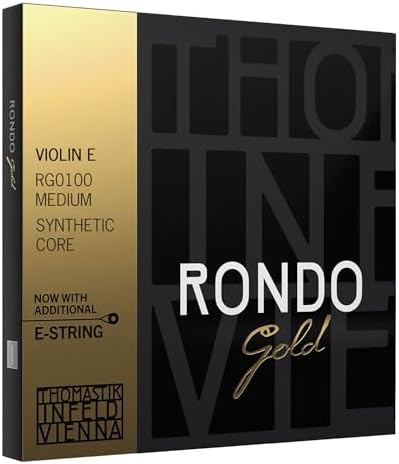
- High tonal intensity and dynamic range
- Includes two E strings
- Tin-plated E, gold-plated E, and wound strings
- Warm sound with focused response

- Quick bow response for students
- Solid steel core for durability
- Sealed pouches protect against corrosion
- Warm tone in solid steel design
1. Thomastik-Infeld Dominant Pro Violin Strings DP100
Best for: Orchestral and chamber musicians seeking a versatile, modern sound.
These strings build on a long-standing reputation by offering a contemporary feel that responds immediately to the bow. They’re designed to be easy to play, making them a strong choice for those who need to shift dynamics quickly from whisper-soft to powerful projection. The multi-strand synthetic core mimics the warmth of gut strings while handling environmental humidity changes better than traditional natural materials.
It’s a flexible set that works well for both soloists and ensemble players. You’ll find that the focused core sound provides a bell-like quality, which helps in shaping phrases without excessive effort. This set is designed to fill a room, making it a reliable choice for stage performances where clarity and power are equally important.
Anyone who prefers a traditional, dark, and muted sound might find these too brilliant compared to the warmer D’Addario Prelude, which features a solid steel core.
2. Pirastro Evah Pirazzi 4/4 Violin String Set

Best for: Performers who need immediate, precise bow response.
This set is specifically engineered for responsiveness, making it a favorite for those who prioritize clarity and speed in their articulation. The construction focuses on delivering a sound that reacts instantly, which is vital for fast passages or complex technical work. While the listing provides minimal details, the reputation of this model is built on its ability to handle intense playing requirements.
Compared to the Thomastik-Infeld Dominant Pro, which emphasizes a broad range of sound colors, this set leans heavily into the mechanical precision of the string. It’s a straightforward choice for a musician who knows they need a high-performance string that won’t lag during quick bow changes. You get a gold-plated E-string included, which is often favored for its specific tonal brightness.
Anyone who is still learning to control their bow pressure might find the sensitivity of these strings difficult to manage compared to the more forgiving D’Addario Prelude.
- Pros:
- Immediate and precise bow responseIncludes a gold-plated E-stringReliable medium gauge tension
- Cons:
- Lacks the multi-strand synthetic core technology found in the Dominant Pro.
3. Thomastik-Infeld Peter Infeld Violin String Set
Best for: Experienced violinists requiring a high degree of expressive control.
These strings are crafted to offer a blend of power and elegance. They’re particularly effective for players who need to execute nuanced phrasing in both solo and ensemble settings. The set is noted for its ability to provide a substantial range of sound colors, which allows the performer to change the character of their music on command.
The synthetic core technology here is designed for a fast break-in time, which is a major advantage for professionals who can’t afford to wait days for their instrument to settle. You’ll notice a quick bow response that enhances your ability to articulate clearly. The tin-plated E-string provides a clear and balanced top end that complements the warmer, more complex lower strings.
Musicians who strictly play in humid or outdoor conditions might prefer the D’Addario Prelude, as the steel core of the Prelude is explicitly marketed as being unaffected by such variables, unlike the synthetic core of this set.
- Pros:
- Fast break-in timeSuperior tuning stabilityExceptional durability for synthetic stringsWide range of sound colors
- Cons:
- Listed as 4/4 size, so anyone with a different violin size is the wrong buy
4. Thomastik-Infeld Rondo Gold Violin Set with 2 E Strings RG100
Best for: Professional violinists who want intense sound and dynamic variety.
This set is specifically designed for the professional who needs a unique tonal intensity. It provides a warm and shiny sound that’s well-suited for high-level performance. A distinct feature of this set is the inclusion of two different E-strings—one tin-plated and one gold-plated—allowing the player to choose the specific brightness and response that best fits their violin and personal taste.
The focus here is on a strong, shiny sound character that maintains a focused response. It’s a highly capable set for those who are striving for a professional level of play and need a reliable, high-quality output. When you compare this to the Thomastik-Infeld Peter Infeld, you see that the Rondo Gold prioritizes a “shiny” tonal signature against the “elegant” and broad range of the Peter Infeld set.
Anyone who isn’t comfortable experimenting with different E-string materials should avoid this set, as the dual inclusion is a central part of the value.
- Pros:
- Includes two distinct E-string optionsWarm and shiny sound profileFocused bow responseDesigned for professional intensity
- Cons:
- Listed as 4/4 full set, so anyone with a different violin size is the wrong buy
5. D’Addario Prelude Violin String Set
Best for: Students and beginners who need durability and consistency.
These strings are the educator’s choice because they’re built to withstand the rigors of frequent practice and changing environments. The solid steel core construction makes them incredibly durable, and they’re essentially unaffected by temperature or humidity fluctuations. This makes them ideal for students who require a low-maintenance string.
The sound is characterized as the warmest available for a solid steel string, providing a good baseline for learners to develop their ear. Because they’re designed for ease of use, they offer a quick bow response that helps beginners gain confidence. You’ll find these are a practical, low-maintenance choice that keeps the violin ready to play at any time.
Anyone who is an advanced player or a professional should look elsewhere, as the steel core lacks the complex tonal range and warmth of synthetic options like the Thomastik-Infeld Dominant Pro.
- Pros:
- Solid steel core for maximum durabilityUnaffected by humidity and temperatureQuick bow response for ease of useEducator-preferred design
- Cons:
- The solid steel core lacks the tonal complexity of synthetic strings.
6. JSI Special 4/4 Violin String Set

Best for: Players who want a custom hybrid setup without buying individual strings.
This set is a hybrid, meaning it mixes a high-quality gold-label E-string with the standard Dominant strings for the A, D, and G positions. This combination is often sought after by players who love the warmth of the Dominant synthetic core but want the specific brilliance that a gold-plated E-string provides. It’s a convenient way to get a professional-style setup in a single package.
Because this is a hybrid, you’re getting the best of both worlds. You maintain the reliability of the Dominant strings for your lower registers while upgrading your top end for better projection. It’s a smart move for someone who wants to experiment with their sound but prefers the simplicity of a pre-packaged set.
Anyone who prefers the consistency of a full set from a single manufacturer might find this mix less predictable than the Thomastik-Infeld Dominant Pro.
Also Worth Considering
Yeshone Strings Universal Full Set is a basic, all-in-one package that covers the essential G, D, A, and E strings. While it serves as a functional replacement, it lacks the specialized synthetic or professional-grade materials found in the Thomastik-Infeld Dominant Pro, which provides a much broader range of sound colors for the discerning player.
How We Chose
Thirty Amazon listings were compared on string core material, intended playing level, and included components, and near-duplicates were left out. To earn a place, a product had to provide clear information regarding its intended use, such as student versus professional application, and its construction. Products that offered unique features, such as dual E-string sets or specific hybrid combinations, were prioritized to offer a range of solutions for different playing styles. Consistency in the availability of technical details allowed for a direct comparison between synthetic and steel core sets.
How to Choose the Right Violin Strings
Core Material and Sound
The core of the string—whether synthetic, steel, or gut—defines the character of your instrument. Synthetic cores, like those in the Thomastik-Infeld Dominant Pro, offer a balance of warmth and stability. Steel cores, used in the D’Addario Prelude, are better for durability and resistance to climate changes. Choose based on whether you prioritize tone or longevity.
Bow Response and Feel
Response refers to how quickly the string speaks when the bow touches it. High-performance strings like the Pirastro Evah Pirazzi are designed for instant articulation, which is necessary for fast, complex pieces. Students often prefer strings that are more forgiving, as they allow for a wider margin of error while learning.
Professional vs. Student Needs
Professional sets like the Thomastik-Infeld Rondo Gold focus on tonal intensity and variety, often including extra options like multiple E-strings. Student sets emphasize stability and durability, ensuring that the strings don’t break easily or lose tuning due to environmental shifts. Always match the string set to your current level of technical development.
Related guides
Frequently Asked Questions
How often should I change my violin strings?
Most players change their strings every few months, depending on how often they play. If the sound becomes dull or the strings lose their ability to hold a tune, it’s time for a new set. The D’Addario Prelude strings, with their steel core, generally maintain their structural integrity longer than synthetic alternatives.
Are all violin strings compatible with any violin?
Most standard 4/4 violin strings are compatible with any full-size violin. However, it’s essential to ensure you’re buying the correct size if you’re playing a fractional violin, such as a 3/4 or 1/2 size. Always check the string length requirements provided by your instrument’s manufacturer to ensure a proper fit.
Do I need to replace all four strings at once?
It’s best practice to replace the entire set together to ensure a balanced tone across the instrument. When strings are at different stages of wear, the tension and tonal quality become uneven. Using a full set, like the Thomastik-Infeld Dominant Pro, ensures that all strings are designed to work together perfectly.
What is the advantage of a gold-plated E-string?
Gold-plated E-strings, found in the Pirastro Evah Pirazzi and Thomastik-Infeld Rondo Gold sets, are often used to provide a brighter, more brilliant sound. They’re also known for being more resistant to corrosion than standard steel or tin-plated strings. This makes them a popular choice for performers who need extra projection and clarity.
Can I mix and match strings from different sets?
While it’s possible to mix strings, it’s generally recommended to use a complete set, especially for beginners. Professional players may experiment with hybrids, like the Vio JSI Special Set, to achieve a specific sound profile. For a balanced and predictable performance, starting with a matched set is the most reliable path.
How do I maintain my strings?
Wipe your strings with a clean, dry cloth after every practice session to remove rosin dust and skin oils. This simple habit prevents the buildup of residue that causes corrosion, which is essential for maintaining the longevity of your instrument.
The Thomastik-Infeld Dominant Pro remains the best choice for the majority of violinists due to its reliable balance and versatile sound. If you’re a student or someone who needs a highly durable, low-maintenance option, the D’Addario Prelude is a simpler, effective alternative.
How do I break in a new set of strings?
New strings, particularly synthetic ones like the Thomastik-Infeld Dominant Pro, need time to stretch and stabilize. After installing them, tune the violin and play it for 15 to 30 minutes to help the materials settle. You’ll likely need to retune frequently during the first few days of use until the pitch stabilizes.
Does the core material affect how long strings last?
Yes, core material is the primary factor in a string’s longevity and stability. Solid steel strings, such as the D’Addario Prelude, are the most resistant to environmental changes and mechanical wear. Synthetic cores, while providing a richer tone, are more sensitive to humidity and temperature fluctuations.
What should I do if a string breaks while tuning?
If a string breaks during installation, it’s often due to excessive tension or a sharp edge on the bridge or nut. Check your instrument’s contact points for burrs that might be cutting the string. When replacing, ensure the string is wound evenly on the peg to prevent overlap, which can cause premature snapping.
Is there a difference between medium and high tension?
Medium tension is the industry standard and provides a balance of playability and projection, which is why the Pirastro Evah Pirazzi and Thomastik-Infeld Peter Infeld are popular in this gauge. High-tension strings offer more power and a faster response, but they require more finger strength and place greater pressure on the violin’s bridge and top plate.
Can humidity damage my strings even when they aren’t in use?
Yes, extreme fluctuations in humidity can cause the synthetic cores of high-quality strings to expand or contract, affecting their pitch and long-term durability. Storing your violin in a case with a humidity control system is the best way to protect your investment. Steel strings, like those in the D’Addario Prelude set, are the only ones designed to be largely immune to these environmental shifts.
Why do some E-strings have a ball end and others a loop end?
The end type depends on the fine tuner design on your violin’s tailpiece. A ball end is the most common and is compatible with almost all modern fine tuners. A loop end is generally used for specific types of hook-style fine tuners. Always check your tailpiece configuration before purchasing, as the Pirastro Evah Pirazzi is specifically listed with a ball end.
Do I need to clean my strings with alcohol?
No, never use alcohol or harsh solvents to clean your strings, as this can strip the winding and damage the core. Alcohol can also leak onto the varnish of your violin, causing permanent damage to the finish. Use only a soft, dry cloth to remove rosin buildup, as this is all that’s required for the Thomastik-Infeld and D’Addario sets.
How does the string gauge affect the sound of my violin?
Gauge refers to the diameter of the string, and it directly influences the volume and tonal color. Thicker strings generally provide more power and volume but require more effort to vibrate. Thinner strings are more responsive and brilliant, making them easier to play for intricate passages, though they may lack the depth found in medium or heavy gauges.
Why do professional violinists carry spare E-strings?
The E-string is the thinnest and under the most tension. Professional sets, such as the Thomastik-Infeld Rondo Gold, often include two E-strings specifically to provide a backup. This practice ensures that a player can continue their performance without interruption if a string snaps during a concert or rehearsal.
Can old strings negatively affect the violin’s bridge?
Old, oxidized strings can become brittle and uneven, which may cause them to dig into the bridge or nut slots. This friction can lead to damage on the wooden components of the violin. Regularly replacing strings with fresh sets, such as the Thomastik-Infeld Peter Infeld, keeps the pull on the instrument consistent and protects the integrity of the bridge.
Does the brand of the string matter if the material is the same?

Yes, while the core material is a major factor, the manufacturing process, how tightly the string is wound, and surface treatment vary by brand. Thomastik-Infeld, for example, uses proprietary technology for their synthetic cores that differs from the construction methods of other manufacturers. Even if a pair of strings are both synthetic, the specific blend of materials and winding techniques creates a unique tonal signature.
What is the benefit of a tin-plated E-string?
Tin plating helps protect the steel core from corrosion caused by sweat and skin oils, significantly increasing the string’s lifespan. It also provides a smooth surface that’s comfortable to the touch. This feature is a standard component in the Thomastik-Infeld Dominant Pro and Peter Infeld sets, ensuring a clear and balanced sound for the top range of the instrument.
Final Thoughts
Finding your perfect sound is a journey, so don’t be afraid to experiment with different tensions or materials. You’ll eventually discover the set that makes your instrument truly sing. Visit your local luthier this weekend to try a new brand; you might be surprised by how much they’ll improve your daily practice.
As an Amazon Associate, Instrument Insight earns from qualifying purchases at no additional cost to you.