
The Thomastik-Infeld Dominant Pro set is designed for advanced violinists and is suited for chamber and orchestral work. Choosing the right strings is a personal task, and the main factor that separates these options is the core material, which dictates how the instrument feels under the bow and how it projects sound in different environments. Whether you’re a student or a soloist, identifying your preferred tone and response is key to finding the right set.
- Best Overall: Thomastik-Infeld Dominant Pro — Provides a balanced, powerful sound with excellent dynamic range.
- Most Responsive: Pirastro Evah Pirazzi — Engineered for immediate bow response and clear tonal articulation.
- Widest Tonal Range: Thomastik-Infeld Peter Infeld — Offers a sophisticated blend of power and sound color variety.
- Professional Choice: Thomastik-Infeld Rondo Gold — Features two E-string options for intense, shiny tonal output.
- Best for Students: D’Addario Prelude — Uses a durable steel core that resists environmental humidity changes.
- Best Hybrid Set: Vio JSI Special Set — Combines a gold-label E-string with classic synthetic core strings.

- Balanced sound with broad color range
- DP100 set for chamber and orchestral use
- Focused core with warmth and brilliance
- Multi-strand synthetic core resists humidity

- Wide tonal range for solo and ensemble
- Synthetic core for stability and durability
- Quick and precise bow response
- Includes PI01SN tin-plated E-string
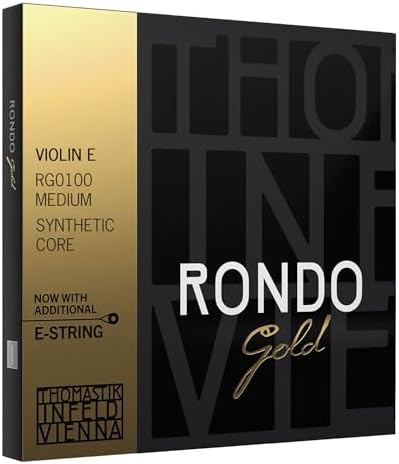
- High tonal intensity and dynamic range
- Thomastik-Infeld Rondo Gold set with 2 E strings
- Tin-plated E, gold-plated E, and wound strings
- Warm, shiny sound with focused response

- Quick bow response for students
- Solid steel core for durability
- Resistant to temperature and humidity changes
- Warm sound in solid steel design
1. Thomastik-Infeld Dominant Pro Violin Strings DP100
Best for: Advanced violinists needing power and versatility for solo or group work.
These strings focus on immediate bow reaction. They offer a brilliant, warm tone. They offer excellent dynamic control for diverse musical settings.
Pros
- Flexible multi-strand synthetic core
- Immediate, effortless bow response
- Broad sound color range
- Stable in changing humidity
Cons
- Advanced design, so beginners may not need this level of complexity.
2. Pirastro Evah Pirazzi 4/4 Violin String Set

Best for: Performers who prioritize immediate, precise bow response.
This set is built with a focus on responsiveness, making it a favorite for those who need their instrument to speak clearly the moment the bow touches the string. While the listing provides minimal detail, it’s part of a series known for high-performance standards in professional settings.
The inclusion of a gold-plated E-string adds a layer of refinement to the set’s overall output. When compared to the Thomastik-Infeld Dominant Pro, which emphasizes a broad sound color range, this set focuses more strictly on the speed of articulation.
Pros
- Includes gold-plated E-string
- High-performance construction
- Clear tonal articulation
Cons
- Minimal technical data provided, so specific material specs are unknown.
3. Thomastik-Infeld Peter Infeld Violin String Set
Best for: Soloists who want a wide variety of sound colors.
These strings blend power and elegance. They offer quick, precise response for expressive phrasing. The synthetic core allows for a fast break-in time.
The tin-plated E-string ensures a clear and balanced sound across the register. Compared to the D’Addario Prelude, which uses a solid steel core, these synthetic-core strings offer a more complex tonal palette for experienced players.
Pros
- Exceptional tonal range and variety
- Fast break-in time
- Superior tuning stability
- Precise bow response
Cons
- Synthetic core technology requires more care than solid steel options.
4. Thomastik-Infeld Rondo Gold Violin Set with 2 E Strings RG100
Best for: Professionals seeking a warm, shiny, and focused sound.
This set is specifically curated for professionals and dedicated students who want a unique tonal intensity. It provides a warm, shiny character that stands out in a crowded mix. The inclusion of two different E-strings—one tin-plated and one gold-plated—allows you to tailor the sound to your specific violin and playing style.
Pros
- Includes two different E-string options
- Warm and shiny sound character
- Focused, professional response
- Designed for high-intensity performance
Cons
- Two E-string options mean the set is only for those who need both types.
5. D’Addario Prelude Violin String Set
Best for: Students who need durability and consistency.
These strings are designed with a solid steel core, making them incredibly tough and resistant to the elements. They’re effectively immune to the humidity and temperature changes that can ruin more delicate synthetic strings. This makes them an ideal choice for students who might be playing in school rooms or varied environments.
Pros
- Solid steel core for maximum durability
- Resistant to temperature and humidity changes
- Warm sound for a steel string
- Designed for quick bow response
Cons
- Solid steel core lacks the tonal complexity of synthetic options.
6. JSI Special 4/4 Violin String Set

Best for: Players who want a mix of premium components.
This hybrid set is a practical choice for those who want a specific combination of strings in one package. By pairing a gold-label E-string with the well-known synthetic core strings for the A, D, and G positions, it aims to balance brilliance with warmth.
Pros
- Hybrid mix of string types
- Includes a gold-label E-string
- Combines brilliance and warmth
Cons
- Listing provides no technical specifications for the core materials.
How We Chose
Thirty Amazon listings were compared on material composition, intended skill level, and inclusion of special components, and near-duplicates were left out. To be included, each set had to clearly state its core material and the intended use case for the musician. Products that lacked basic identification of their core technology or offered no clear distinction from other sets were removed to ensure the list remained focused. The final selection prioritizes strings that offer a unique, measurable benefit, such as superior stability, specialized tonal character, or specific component combinations.
How to Choose the Right Violin Strings
Core Material and Sound
The core is the heart of the string. Steel cores, like those in the D’Addario Prelude, are durable and stable. Synthetic cores, such as those found in the Thomastik-Infeld Dominant Pro, provide a warmer, more complex sound that mimics traditional gut strings. Choose steel for reliability and synthetic for tonal nuance.
Bow Response and Articulation
How fast a string reacts to your bow is essential for your technique. Sets like the Pirastro Evah Pirazzi are designed for a fast, immediate response, which is crucial for quick passages.
Environment and Stability
If you perform in different locations, look for strings that handle climate changes well. The D’Addario Prelude, for example, is noted for its resistance to humidity.
Frequently Asked Questions
Is it necessary to change all four strings at once?
It’s generally recommended to replace the whole set to maintain a balanced sound. Mixing old and new strings, or different types, can lead to uneven tension and inconsistent tone.
How often should I replace my strings?
Replacement frequency depends on how much you play and how acidic your sweat is. Professionals may change strings every few weeks, while students might go months.
Will these strings fit my violin?
All strings listed here are for 4/4 violins, which is the standard full-size instrument. If you have a fractional violin, such as a 3/4 or 1/2 size, you must buy strings specifically labeled for that size.
Can I mix and match brands on my violin?
You can mix brands, but it is usually better to start with a full set from one manufacturer to understand how that specific design works on your instrument.
How do I store spare violin strings correctly?
Keep spare strings in their original, airtight packaging whenever possible. The D’Addario Prelude strings specifically use sealed pouches to protect against corrosion, which is a key feature for long-term storage. Avoid leaving strings in areas with high humidity or extreme temperature shifts, as these conditions degrade the metal winding and the core material over time, shortening their functional life before they’re even installed.
Should I lubricate the bridge or nut slots?
Yes, using a small amount of graphite from a soft pencil lead in the grooves of the bridge and nut is a common practice. This reduces friction when tuning, which helps prevent the strings from snapping at the contact points.
What causes a string to sound dull or “dead”?
A string sounds dull when the vibration of the core is dampened by accumulated rosin, skin oils, or metal oxidation. Over time, the internal structure loses its elasticity, preventing it from producing a clear, resonant tone.
Is there a difference between loop-end and ball-end strings?
The difference is in how the string anchors to the fine tuner or tailpiece. Ball-end strings, such as the Pirastro Evah Pirazzi, are the industry standard and fit almost all modern tailpieces with built-in fine tuners. Loop-end strings are less common and are typically used on specific types of professional tailpieces; always check your tailpiece before buying to ensure the anchor type is compatible.
Can I clean my strings with alcohol?
You should never use alcohol on your strings, as it can easily drip onto the varnish of your violin and cause permanent damage to the finish. Alcohol also strips away the natural oils and can cause the string’s winding to unravel prematurely.
Why does my E-string whistle when I play?
E-string whistling is often caused by a gauge that is too thin or excessive bow pressure. Using a slightly heavier gauge or a different winding, such as the tin-plated options in the Thomastik-Infeld Rondo Gold set, can often resolve this.
How does the winding material affect the sound?
The material wrapped around the core significantly changes the string’s mass and surface texture. Silver-wound strings, like those in the Thomastik-Infeld Dominant Pro, tend to produce a warmer, more focused sound with a high degree of tonal complexity. Aluminum-wound strings are generally lighter and offer a faster response with more brilliance, making them a popular choice for A-strings where clarity and quick articulation are highly valued by soloists.
Does the tension of the string affect the violin’s health?
High-tension strings put significant pressure on the bridge and top plate, which can lead to structural changes if the instrument is not properly set up.
What is the purpose of a “break-in” period?
New strings need time to stretch and settle into their final pitch after being installed. Synthetic core strings, like the Thomastik-Infeld Dominant Pro, generally have a shorter break-in period than traditional gut strings.
Can I use steel strings on an older, fragile violin?
Older instruments often require lower-tension strings to preserve the wood and the integrity of the antique construction. Using a high-tension, heavy-duty steel string on a delicate, historical violin can be risky. If you’re unsure, consult a professional luthier to determine the maximum tension your specific instrument can safely support. For students with standard modern violins, the D’Addario Prelude is a safe and reliable choice, but antique owners should prioritize lower-tension alternatives.
How do I know if my violin is a 4/4 size?
A 4/4 violin is the standard size for adult players, typically featuring a vibrating string length of about 328 millimeters. You can verify this by measuring the distance from the nut to the bridge.
Why do some E-strings come with a removable ball?
Some professional-grade E-strings include a removable ball so they can be used on either a fine tuner (with the ball) or a traditional peg (without the ball, as a loop). This provides extra versatility for violinists who use different types of tailpieces.
Can humidity cause strings to break?
Excessive humidity causes the violin’s wooden top to swell, which increases the distance between the nut and the bridge, effectively increasing the tension on the strings. This added stress can lead to sudden breakage, especially in older or thinner strings.
What is the benefit of a tin-plated E-string?
Tin plating provides a protective layer that prevents the steel core from oxidizing due to sweat and environmental moisture. It also creates a smoother surface that’s more comfortable under the fingers. The Thomastik-Infeld Peter Infeld and the Thomastik-Infeld Rondo Gold both feature tin-plated E-strings, which are favored for their ability to maintain a clear, balanced sound over a longer period of consistent use.
Does the bridge height matter when changing strings?
The bridge height determines the string action, which is the distance between the strings and the fingerboard. When switching to a new set, check that the bridge hasn’t been pulled forward or tilted by the tension. A bridge that isn’t perfectly vertical is a leading cause of string failure.
Why are some strings sold as “medium” tension?
Medium tension is the industry standard that offers a balance between playability, volume, and tonal control. It’s the safest choice for most violins and players, providing enough power for ensemble work without putting excessive strain on the instrument. While “light” or “heavy” tension strings exist, they’re specialized tools; for most musicians, sticking to the medium gauge, like that found in the Pirastro Evah Pirazzi set, ensures the most predictable and reliable performance.
Should I apply rosin to the strings?
Rosin should be applied only to the hair of the bow, never directly to the strings. Applying rosin to the string surface creates a sticky residue that muffles the sound and collects dust, which eventually ruins the string’s ability to vibrate. If you accidentally get rosin on your strings, wipe it off immediately with a dry cloth to prevent the buildup from hardening and affecting the tone.
How does the core material affect tuning stability?
Steel-core strings are the most stable because the metal is essentially unaffected by ambient humidity. Strings like the D’Addario Prelude use steel cores to resist stretching and environmental moisture. Note that synthetic cores are nearly as stable but are slightly more sensitive to large temperature swings.
Can a worn-out bow hair affect the string’s sound?
The condition of your bow hair is just as important as the strings themselves for producing a clear tone. If the hair is old, it won’t grab the string effectively, making even high-quality strings like the Thomastik-Infeld Dominant Pro sound weak. Have your bow rehaired before assuming the strings are the problem.
What is the role of the tailpiece in string performance?
The tailpiece acts as the anchor for the strings, and its mass can influence the instrument’s resonance. Tailpieces with integrated fine tuners make it easier to adjust pitch, but they add weight that can dampen the sound. Ensure your tailpiece is properly adjusted to allow the strings to vibrate freely.
How do I identify a counterfeit string?
Counterfeit strings are a concern in the professional market. Always purchase your strings from reputable sellers and check for authentic branding on the packaging. Thomastik-Infeld and other major manufacturers use specific holographic labels and unique packaging designs that are difficult to replicate.
Does the angle of the strings over the bridge matter?
The break angle of the strings over the bridge determines the downward pressure and overall sound projection of the instrument. A steeper angle provides more volume, while a shallower angle creates a warmer tone. Always ensure the bridge remains centered and upright after every string change to maintain even force.
Can I leave my violin in a car?
Never leave your violin in a car, as extreme temperatures cause the wooden body to expand and contract, potentially snapping strings. These fluctuations can also cause the bridge to shift or the soundpost to fall. Always keep your instrument in a climate-controlled environment to protect both the violin and strings.
What is the “warmth” that string descriptions refer to?
Warmth refers to a sound profile that emphasizes lower and mid-range frequencies, creating a mellow, rich, and rounded tone. This is often achieved through the use of synthetic cores and specific winding materials like silver. Bright strings, by contrast, emphasize high-frequency overtones, which can sound brilliant but may lack the depth and complexity that many soloists prefer for expressive, lyrical playing.
Why do some strings have a colored silk winding at the ends?
The colored silk at the peg end of a string is a coding system used by manufacturers to identify pitch and brand. Each company has a unique chart, usually printed on the packaging. This helps ensure you install the correct string in the right position, preventing accidental breakage from over-tightening.
Is there a specific way to coil strings for storage?
If you must remove a string that’s still in good condition, coil it loosely in a circle that’s at least six inches in diameter. Never kink or sharply bend the string, as the internal core will be permanently damaged at the bend point, leading to a “dead” spot where the string will no longer vibrate correctly. Store the coiled string in a clean plastic bag to keep it free of dust until it’s needed again.
What is the effect of changing the gauge of the strings?
Changing from medium to heavy gauge strings increases the tension on the violin, which can lead to a louder, more brilliant sound but also makes the instrument more physically demanding to play. Changing to a lighter gauge reduces the tension, making the instrument easier to play but potentially resulting in a thinner, less powerful sound. Unless you’re an experienced player looking for a specific tonal shift, it’s usually best to stick with the medium gauge recommended by the manufacturer.
How does the string’s vibrating length affect the choice of strings?
The vibrating length—the distance from the nut to the bridge—must match the scale of the strings you buy. Most strings are designed for a standard 4/4 vibrating length. If your violin has a non-standard scale length, you may need to look for strings that offer different options. Using a string that’s too long or too short for your violin’s scale length will cause the winding to sit over the nut or the bridge, which will quickly lead to breakage and poor sound quality.
Can I use a dampit or humidifier in my case?

Yes, using a case humidifier is a great way to maintain the environment for your violin and strings, especially in dry winter months. By keeping the humidity levels steady, you prevent the wood from shrinking and the strings from constantly going out of tune. Just be careful that the humidifier doesn’t leak, as direct contact with water will destroy the finish of your violin and ruin the strings instantly.
Why do some E-strings have a plastic sleeve?
Many E-strings, especially those with a steel core, include a small plastic sleeve that fits over the bridge area. This sleeve prevents the thin steel string from cutting into the soft wood of the bridge, which extends the life of the bridge and helps maintain the correct string height. If your string comes with this sleeve, be sure to position it exactly where the string makes contact with the bridge before you bring the string up to pitch.
Final Thoughts
Finding your perfect sound takes a bit of experimentation, so don’t be afraid to try a different brand during your next string change. You’ll eventually discover the combination that makes your violin truly sing. Trust your ears, keep practicing, and enjoy the unique character your instrument develops with every new set.
As an Amazon Associate, Instrument Insight earns from qualifying purchases at no additional cost to you.