
The Korg AW-LT100V is the best violin tuner for most players because it balances long-lasting battery life with a dedicated mode designed specifically for the violin and viola. Finding the right tool for your instrument can be confusing, but the main difference between these options is how they handle power, accuracy, and ease of use in different environments. This guide helps you pick the right device so you can focus on tuning and more time practicing your music.
Quick Picks
- Best Overall: Korg AW-LT100V — Delivers 100 hours of use from a single AAA battery.
- Best Rechargeable: D’Addario Nexxus 360 — Features 24 hours of tuning per charge with USB-C.
- Best Multi-Function: Ulumac Aroma — Combines a metronome, tuner, and tone generator in one.
- Best Multi-Instrument: Fender FCT-2 — Includes dedicated modes for five different instrument types.
- Simplest to Use: ENO MUSIC Violin Tuner — Uses a clear needle display for intuitive tuning.
- Best for Calibration: Snark SN5XT — Supports specific reference pitches like 432Hz and 442Hz.
- Best Display: Sondery Rechargeable Tuner — High-definition TFT screen provides excellent visibility.
- Best Versatility: AARVI Clip On — Includes six specific tuning modes plus chromatic.
- Best for Noisy Environments: Ranch Clip-On — Piezo sensor ignores background noise for consistent readings.

- 100 hours operation with one AAA battery
- Lightweight design
- Bright colour LCD screen
- Fast and slow meter speed settings

- High-performance piezo pickup
- 24 hours tuning per USB-C charge
- Non-marring clamp for violin shoulder
- Bright 360-degree adjustable LED screen

- Precision of ±0.1 cents
- Improved display visibility and compact size
- Transpose function for F, B♭, E♭
- Enhanced metronome and sound out quality

- 3-in-1 metronome, tuner, and tone generator
- Tempo 30–260 BPM with 10 patterns
- A0–C8 range, 430–450Hz calibration, ±0.5 cent
- 45° angled LCD with LED indicators

- Vibration-based tuning for noisy environments
- Color LCD needle display
- Modes for guitar, bass, ukulele, violin
- Dual-hinge clip for headstock mounting

- Color LCD shows string number and note
- Chromatic mode for violin, viola, cello, bass
- 360 degree rotating pegbox clip
- A4 frequency range 430HZ-450HZ

- XT software for tight tuning
- Pitch calibration 432, 442 HZ
- High resolution screen
- Anechoic sound shield blocks noise

- Piezo transducer with 410-460Hz calibration
- High definition TFT screen
- Rechargeable battery with USB cable
- 360-degree swivel clamp

- 6 instrument modes plus chromatic
- High-sensitivity vibration sensor
- 360° rotating display with universal clip
- Auto power-off after 3 minutes
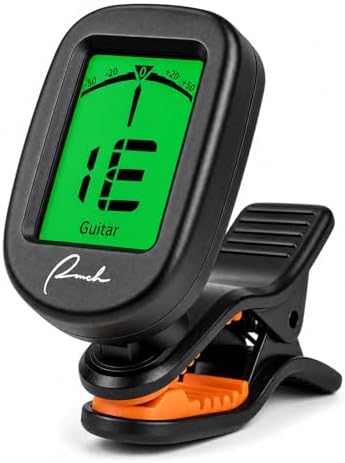
- Piezo sensor for string instruments
- Vibration-based tuning ignores background noise
- 360° rotating green backlit LCD
- Spring-loaded clip with silicone padding
1. Korg – AW-LT100V Violin Clip-on Tuner – Black
Best for: Violinists who prioritize battery longevity and dedicated modes.
This tuner stands out for its power efficiency, offering 100 hours of operation from a single AAA battery. Its dedicated mode for violin and viola ensures the sensitivity is tuned to the specific needs of these instruments, while the bright LCD makes it easy to read in various practice settings. You can switch between two meter speeds, which is helpful if you prefer a faster or slower visual response while adjusting your pegs.
The design is compact and lightweight despite the use of a AAA battery, ensuring it doesn’t feel heavy on your scroll. The Korg AW-LT100V provides 100 hours of operation. It’s a straightforward, reliable tool that removes the guesswork from tuning.
Pros
- Long battery life that lasts for weeks of regular use
- Dedicated mode for violin and viola
- Switchable meter speed
- Bright color LCD screen
Cons
- Requires a AAA battery rather than being rechargeable
- Heavier than units using coin-cell batteries
2. D’Addario Nexxus 360 Rechargeable Violin Tuner
Best for: Players who want a rechargeable solution without buying batteries.
The Nexxus 360 is a convenient choice for anyone tired of swapping out small batteries. It provides 24 hours of tuning time per charge, and the inclusion of a USB-C cable makes it easy to power up. The high-performance piezo pickup is optimized to ignore room noise, which is great for tuning in busy rehearsal halls or noisy practice rooms.
Its 360-degree adjustability allows you to position the screen perfectly, ensuring you always have a clear view. While the Korg AW-LT100V offers more total run time, the convenience of the Nexxus 360’s rechargeable system is a major plus for daily use. The auto-power-off feature also helps preserve the charge when you forget to turn it off.
Pros
- Rechargeable via USB-C
- 360-degree screen rotation
- Optimized piezo pickup for noisy rooms
- Auto-power-off function
Cons
- 24 hours of runtime is significantly shorter than the extensive battery life offered by the Korg AW-LT100V
- Must be kept charged to remain functional
3. Korg TM-70T Tuner & Metronome w/Sound Out
Best for: Advanced students needing extreme precision and ear training tools.
If accuracy is your primary goal, this Korg model provides high-level precision. It’s more than just a tuner, as it includes a metronome and a Sound Out mode for ear training. The transpose function allows you to switch between different keys, making it a versatile tool for orchestral musicians who need to match specific concert pitches.
The display is improved for better visibility, and the compact size makes it simple to stow away. Compared to the Fender FCT-2, which is designed for general clip-on use, this unit offers much higher tuning precision for those who need to be exact. It’s an excellent choice for serious practice sessions where intonation is the focus.
Pros
- Includes metronome and tone generator
- Adjustable calibration for different concert pitches
- Transpose function for various keys
Cons
- Larger and more complex than a simple clip-on tuner
- Requires more menu navigation to access all features
4. Ulumac Aroma 3-in-1 Digital Metronome Tuner
Best for: Musicians who need a single device for practice and timing.
This 3-in-1 tool combines a digital metronome, chromatic tuner, and tone generator. It covers a wide tempo range of 30–260 BPM and offers 10 beat patterns, which is helpful for developing your rhythm. The large LCD screen with a 45-degree angle ensures you can see your status clearly while you play.
It supports a wide tuning range from A0 to C8, making it useful for many instruments beyond the violin. While the Korg TM-70T is more precise, the Ulumac Aroma provides a broader set of practice features like rhythm styles and beat patterns.
Pros
- Combines metronome, tuner, and tone generator
- Wide tempo range from 30–260 BPM
- Supports A4 calibration (430–450Hz)
- Large, readable backlit display
Cons
- Not suitable for piano tuning
5. Fender FCT-2 Professional Multi-Instrument Clip-On Tuner
Best for: Players who switch between multiple string instruments.
The Fender FCT-2 is designed for versatility, with dedicated modes for violin, guitar, bass, and ukulele. It uses a dual-hinge clip that adjusts smoothly, allowing you to place it on different parts of the headstock for a comfortable viewing angle. The color LCD needle display is intuitive, moving toward the center as you reach the correct pitch.
Because it senses vibrations directly, it performs well in loud environments where microphones might struggle. Compared to the ENO MUSIC Violin Tuner, which is strictly for bowed instruments, this Fender model offers broader compatibility for musicians who play several types of stringed gear. It comes with a CR2032 battery so you can use it immediately.
Pros
- Dedicated modes for five instrument types
- Dual-hinge clip for flexible positioning
- Clear color LCD needle display
- Reliable vibration sensing for noisy rooms
Cons
- Standard A440 calibration only
6. ENO MUSIC Professional Violin Viola Tuner
Best for: Beginners looking for a simple, no-fuss tuning experience.
This tuner is built specifically for violin family instruments, including the viola, cello, and bass. It uses a clear, colorful LCD screen that displays the string number and note name, making it very easy for students to understand. The two-button control scheme is simple to master, allowing you to focus on playing rather than navigating complex menus.
The 360-degree rotating clip ensures you can find the right spot on your pegbox for the best sensitivity. While the Fender FCT-2 offers more instrument modes, the ENO MUSIC tuner’s focus on violin-family specific notes makes it very approachable for younger or new players. The ENO MUSIC Violin Tuner includes two CR2032 batteries.
Pros
- Displays string number and note name clearly
- Simple two-button operation
- Designed for violin, viola, cello, and bass
- Full rotation for easy viewing
Cons
- Limited to violin-family instruments and chromatic mode
- Less versatile than the multi-instrument Fender FCT-2
7. Snark SN5XT Clip-On Tuner
Best for: Violinists who need specific reference pitches for their orchestra.
The SN5XT features updated software for faster tuning and supports pitch calibration for 432Hz and 442Hz. This is particularly useful for players who need to match specific orchestral standards that differ from the common 440Hz. The high-resolution screen is extra bright, and the anechoic sound shield helps block out ambient noise during use.
It includes a USB recharging cable, which is a significant convenience over models requiring disposable batteries. Compared to the AARVI Clip On, which offers complete rotational freedom, the Snark’s focus on software precision and calibration makes it a better pick for orchestral settings. It’s a sturdy, reliable option for daily rehearsals.
Pros
- Supports 432Hz and 442Hz calibration
- Extra bright, high-resolution screen
- Includes USB recharging cable
- Anechoic sound shield for noisy rooms
Cons
- Calibration options are specific compared to the wider 410-460Hz range of the Sondery Tuner
- The clip design is less adjustable than the omnidirectional swivel of the Sondery
8. Sondery Rechargeable Clip On Tuner TFT
Best for: Players who want the clearest possible screen in bright light.
This tuner features a high-definition TFT screen that stays clear even under direct sunlight or bright stage lights. It uses a piezo transducer to detect vibrations, providing accurate results without interference. The 360-degree swivel mechanism on the clamp gives you excellent positioning flexibility, which is helpful for instruments with smaller or crowded headstocks.
It offers a wide calibration range of 410-460Hz, allowing for great precision in various musical contexts. While the Snark SN5XT is great for specific orchestral pitches, the Sondery’s broader calibration range and superior TFT screen make it a better choice for varied performance environments. It also includes an auto-off function to save battery life.
Pros
- High-definition TFT screen for great visibility
- Wide 410-460Hz calibration range
- Omnidirectional swivel for flexible positioning
- Rechargeable battery
Cons
- Lasts for 4 hours per charge, which is much less than the 24 hours of the D’Addario Nexxus 360
- Requires frequent charging compared to battery-powered units
9. AARVI Guitar Tuner Clip On
Best for: Musicians who want one tuner for all their string instruments.
The AARVI Clip On provides six dedicated tuning modes plus a chromatic setting, making it useful for violin, guitar, bass, ukulele, and banjo. Its advanced processor is designed to lock onto pitches quickly, even when you’re in a noisy room. The fully rotating display ensures that you can always see the screen, regardless of how you clip it on.
It automatically powers off after three minutes to save the CR2032 battery life. Compared to the ENO MUSIC Violin Tuner, which is limited to bowed instruments, the AARVI offers a much wider range of compatibility. It’s a practical, all-around tool for someone who owns several different types of stringed gear.
Pros
- Six dedicated modes plus chromatic
- Fully rotating display
- Auto-power-off after 3 minutes
- Fits all instrument headstocks
Cons
- Uses CR2032 batteries instead of being rechargeable
- Calibration range isn’t specified, unlike the Sondery Tuner
10. Ranch Clip-On Tuner
Best for: Players who need a reliable vibration tuner.
This tuner uses a sensitive piezo sensor that picks up vibrations directly from the headstock, ignoring background noise in crowded rooms. It’s compact and features a bright green backlit LCD that clearly shows when you’re in tune. The silicone padding on the clip protects your instrument’s finish while ensuring a secure grip.
It’s designed to be very fast, locking onto a pitch in under a second. Compared to the Korg AW-LT100V, which has a longer battery life, this model focuses more on immediate, noise-free feedback.
Pros
- Reliable vibration-based tuning for noisy rooms
- Fast pitch detection under one second
- Protective silicone padding on the clip
- Easy-to-read green backlit display
Cons
- No rechargeable battery option
- Basic feature set compared to the Korg TM-70T
Also Worth Considering
The KORG CA-50 Chromatic Tuner is a dedicated orchestral tuner that includes a memory backup feature to save your settings. It’s a more traditional, non-clip-on unit compared to the Korg AW-LT100V, making it better for players who prefer to set their tuner on a music stand.
The Donner Metronome Tuner is a 3-in-1 device that handles tuning, metronome functions, and tone generation. It offers similar multi-functionality to the Ulumac Aroma but serves a slightly different set of instruments. It’s a good backup for those who find the Ulumac’s interface doesn’t fit their needs.
The LEKATO Guitar Tuner is a rechargeable clip-on option that features a very bright screen. It competes directly with the D’Addario Nexxus 360 for users who want a rechargeable, rotatable display, though the D’Addario offers a more specialized focus on violin-specific ergonomics.
How to Choose the Right Violin Tuner
Vibration vs. Microphone Tuning
Vibration-based tuners, like the Ranch Clip-On or Korg AW-LT100V, clip directly onto your instrument. They sense the physical movement of the wood, which means they work well in noisy rooms. Microphone tuners require silence to be accurate, which is rarely possible in a group rehearsal or classroom.
Battery Life and Power
Choosing between rechargeable units like the D’Addario Nexxus 360 and battery-operated ones like the Korg AW-LT100V depends on your habits. Rechargeable models save you from buying batteries, but they require frequent plugging in. Battery-powered units, especially those using AAA batteries, often run for much longer on a single power source.
Accuracy and Calibration
For most students, a standard tuner is enough. However, orchestral players often need to match specific pitches like 442Hz. The Snark SN5XT and Korg TM-70T allow for this kind of fine-tuning. ISO 16 provides international standards for tuning references, which professional musicians use to ensure consistency across instruments.
Display and Readability
A bright, high-contrast screen is essential if you play on stage or in low-light conditions. The Sondery Rechargeable Tuner offers a high-definition screen that remains clear under bright lights. If you have trouble reading small text, look for models like the ENO MUSIC Violin Tuner that show the note name and string number in large, simple characters.
Related guides
- What Happened to Two Set Violin
- Do Piano Tuners Have Perfect Pitch
- Can You Use a Violin Tuner on a Ukulele
Frequently Asked Questions
Can I use a guitar tuner for my violin?

Many multi-instrument tuners, such as the Fender FCT-2, include a specific violin mode. Using a general chromatic mode is also possible, but a dedicated violin mode is better because it recognizes the specific notes of the violin strings (G, D, A, E). This makes the process much faster for beginners.
Do I need a metronome built into my tuner?
It isn’t required, but it’s very helpful for practice. Devices like the Ulumac Aroma combine both tools, which saves space in your case. If you already have a separate metronome app on your phone, a simple clip-on tuner like the Korg AW-LT100V is likely all you need.
Final Thoughts
The Korg AW-LT100V remains the most reliable choice for most players due to its long battery life and dedicated violin mode. If you prefer a rechargeable option that’s just as easy to use, the D’Addario Nexxus 360 is a fantastic alternative. Pick one and start practicing with more confidence today.
As an Amazon Associate, Instrument Insight earns from qualifying purchases at no additional cost to you.