
The Yamaha HS8 is the best studio monitor for music production here because its 120W bi-amp system and 38Hz low end reach deeper than anything else on this list. These picks help anyone setting up a room to mix, record, or master audio. The one thing that separates them is how much power they push and how low their woofers can play.
You don’t need a giant room to make good music, but you do need speakers that tell the truth about your sound. Comparing the specs and features of these options shows exactly which ones fit a small desk and which ones fill a treated studio.
- Best Overall: Yamaha HS8 — 120W amplification and 38Hz bass response lead every other pick.
- Most Portable: IK Multimedia iLoud Micro — Bluetooth streaming and ultra-small footprint travel anywhere.
- Lowest Noise Floor: Kali Audio LP-6 V2 — 12dB noise reduction keeps quiet passages clean.
- Best Compact Professional: JBL 305P MkII — Patented boundary EQ corrects placement issues in tight spaces.
- Simplest Setup: Yamaha HS3 — Room control knobs and a paired box mean instant stereo sound.
- Best Entry-Level Pair: PreSonus Eris 3.5 — Front headphone jack and acoustic tuning controls simplify daily use.
- Best Desktop Step-Up: Mackie CR4.5 — Isolation pads and all cables included inside the box.
- Best Wired Latency-Free: M-Audio BX3 — Zero-latency wired connection suits live tracking sessions.
- Best Wooden Enclosure: Edifier R1700BT — 10-degree tilt angle directs sound straight at your ears.
- Best Nearfield Accuracy: Yamaha HS5 Pair — Sonic purity emphasis leaves the original signal uncolored.

- 38Hz – 30kHz frequency response
- 75W LF plus 45W HF bi-amp, 120W total
- 8-inch cone woofer, 1-inch dome tweeter
- Large magnets in Advanced Magnetic Circuit design

- Smallest active studio reference monitoring system
- Internal DSP for linear frequency response
- Class D amplifiers deliver 50W RMS down to 55Hz (-3dB)
- Portable and lightweight with optional travel bag

- 2nd gen LP-6 with robust DSP for flat response
- 12dB noise reduction and low distortion upgrades
- Updated boundary EQ for any placement
- Bi-amped 80 watts, 1" tweeter, 6.5" driver

- JBL 305P MkII undergoes 100-hour full-power test
- Updated high and low frequency transducers
- New boundary EQ and Slip Stream low-frequency port
- Balanced XLR and 1/4" TRS inputs, adjustable volume
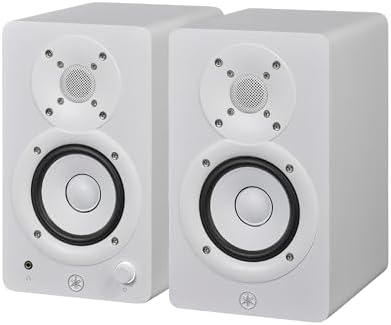
- Packaging: Pair
- 2-way bass-reflex, 3.5" cone woofer, 0.75" dome tweeter
- 70 Hz – 22 kHz frequency response (-10 dB)
- 26 W + 26 W output power
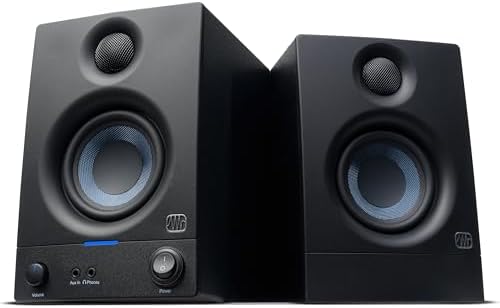
- Sold as a complete stereo pair
- 50 watts of built-in amplification
- 3.5” woven-composite woofers, 1” silk-dome tweeters
- High- and low-frequency acoustic tuning controls

- Sold as a pair, step-up size for desks
- Fuller low end than 3.5-inch monitors
- Tone Knob: front-panel voicing control
- Location Switch: wall or free-standing bass correction

- Latency free wired connection for audio monitoring
- Bi-amplified power for desktop use
- 3.5-inch Kevlar woofers for low-frequency drivers
- Natural silk dome tweeters for precise stereo imaging

- Built-in amplifier, 33 watts x 2 speakers
- Frequency response: 55 Hz to 20 kHz
- Bluetooth pairing capability for streaming audio
- 10° tilt angle directs sound toward ears

- Includes (2) Yamaha HS5 studio monitors
- 2 Way bass reflex, 5 inch Cone woofer, 1 inch dome tweeter
- Emphasize sonic purity without coloring
- 54 hertz to 30 kilohertz, 45W LF plus 25W HF, 70 watts
1. Yamaha HS8 8-Inch Powered Studio Monitor Pair
Best for: producers mixing bass-heavy tracks in treated rooms.
This pair arrives ready for serious work right out of the box. A 75W low-frequency amplifier drives the 8-inch cone woofer while a separate 45W amp handles the 1-inch dome tweeter.
The frequency response drops down to 38Hz and reaches up to 30kHz. That bottom number matters because most electronic music and hip-hop lives below 50Hz, and hearing those notes clearly changes how you balance a track. Large magnets in an Advanced Magnetic Circuit design keep the drivers moving precisely.
Pros
- 120W total bi-amped power system
- 8-inch cone woofer and 1-inch dome tweeter
- 38Hz to 30kHz frequency response
- Bundle includes a pair of two monitors
- Advanced Magnetic Circuit design with large magnets
Cons
- 8-inch cone woofer requires significant desk or stand space to avoid wall reflections
2. IK Multimedia iLoud Micro Monitor 50 watt Portable Wireless Bluetooth
Best for: traveling musicians needing reference sound on the go.
Size defines everything about these speakers. The listing calls them the smallest active studio reference monitoring system in the world, built around a 3-inch high-rigidity custom composite woofer and a 3/4-inch silk dome tweeter. Internal DSP offers various EQ settings, letting you switch between free field and desktop setups effortlessly. That means you can put them on a hotel desk and adjust the bass response instantly.
Class D amplifiers push 50W RMS total. The front-firing bass reflex port helps them reach down to 55Hz at -3dB, which is impressive for a 3-inch driver. You can also stream wirelessly via Bluetooth or plug in through Stereo RCA and 1/8-inch aux inputs.
Pros
- Internal DSP with position compensation EQ
- 50W RMS class D amplification
- Bluetooth wireless pairing capability
- Stereo RCA and 1/8-inch aux inputs
- 3/4-inch silk dome tweeter and 3-inch woofer
Cons
- The travel bag is optional, so anyone needing it on the road makes a second purchase.
3. KALI AUDIO LP-6 V2 6.5″ Project Lone Pine Powered Studio
Best for: engineers who hate hiss during quiet passages.
Noise ruins a mix session faster than bad acoustics. This monitor features a 12dB noise reduction upgrade specifically targeting the hiss and chuffing that plague nearfield listening. The front port lets air exit at uniform velocity to minimize turbulence, keeping the background dead silent.
A robust DSP system delivers a flat frequency response from 47Hz to 21kHz. The updated boundary EQ lets you place it on a stand, against a wall, or directly on your desk without losing accuracy. Bi-amped design splits 80 watts of power between the 1-inch tweeter and the 6.5-inch driver, reaching a max SPL of 115dB.
The JBL 305P MkII lists 82 watts of power against 80 watts on the Kali Audio LP-6 V2, giving the JBL slightly more amplification per unit.
Pros
- 12dB noise reduction and low distortion upgrades
- Updated boundary EQ for flexible placement
- 80 watts of bi-amped power
- 47Hz to 21kHz frequency range
- Max SPL of 115dB
Cons
- Sold individually, so a stereo setup requires purchasing two separate units
4. JBL Professional 305PMkII 5-Inch 2-Way Powered
Best for: professionals needing patented tech in tight spaces.
JBL built this monitor using technologies derived from their Master Reference Monitors. New design improvements optimize damping for superior transient response, resulting in impressive deep bass and crystal-clear highs with lower harmonic distortion. It undergoes a rigorous 100-hour full-power test to ensure dependable performance over years of daily use.
Dual Class-D amplifiers provide 82 watts. The new boundary EQ restores neutral low frequency response when speakers sit on a work surface or adjacent to walls. A patented Slip Stream low-frequency port ensures superior bass performance at all playback levels. Connectivity is flexible, offering balanced XLR and 1/4-inch TRS inputs plus a +4dBu / -10dBV input-sensitivity switch.
The purchase includes only one 305P MKII studio monitor. The PreSonus Eris 3.5 arrives as a complete stereo pair, whereas the JBL 305P MkII is sold individually.
Pros
- Patented Slip Stream low-frequency port
- Boundary EQ for surface and wall placement
- 82 watts of dual Class-D amplification
- Balanced XLR and 1/4-inch TRS inputs
- +4dBu / -10dBV input-sensitivity switch
Cons
- Purchase includes only one monitor, requiring a second purchase for stereo mixing
5. Yamaha HS3 Powered Studio Monitor in White
Best for: beginners wanting instant stereo without confusion.
Sometimes you just need to plug things in and start working. This packaging includes a pair of monitors, eliminating the guesswork of buying singles. It’s a 2-way bass-reflex powered speaker featuring a 3.5-inch cone woofer and a 0.75-inch dome tweeter. Output power sits at 26W + 26W.
The frequency response spans 70 Hz to 22 kHz at -10 dB. While it doesn’t dig deep into the sub-bass, room control and high trim response controls let you tailor the output to your specific space. These physical switches on the back panel mean you don’t need software or external equalizers to fix basic room problems.
A floor of 70 Hz means kick drums and bass guitars will sound thin without a dedicated subwoofer added later. The PreSonus Eris 3.5 reaches down to 80 Hz against 70 Hz on the Yamaha HS3, though both require careful placement to maximize their limited bass.
Pros
- Packaging includes a matched pair
- Room control and high trim response controls
- 26W + 26W output power
- 3.5-inch cone woofer and 0.75-inch dome tweeter
- 2-way bass-reflex powered design
Cons
- Frequency response starts at 70 Hz (-10 dB), leaving sub-bass instruments largely unheard
- Total power limits maximum volume in larger untreated rooms
6. PreSonus Eris 3.5 Powered Studio Monitors
Best for: first-time buyers needing versatile desktop connections.
This set arrives as a complete stereo pair driven by 50 watts of built-in amplification. The 3.5-inch woven-composite woofers deliver tighter bass, while 1-inch silk-dome tweeters smooth out harshness across the full 80 Hz to 20 kHz range.
Built-in high- and low-frequency acoustic tuning controls let you tailor the sound to your space without extra gear. Connection options cover everything on your desk: balanced TRS, RCA, and a front-panel aux input handle computers, interfaces, mixers, game consoles, phones, and turntables. There’s even a front headphone jack for private listening when you can’t play speakers out loud.
Pros
- Sold as a complete stereo pair
- 50 watts of built-in amplification
- 3.5-inch woven-composite woofers and 1-inch silk-dome tweeters
- High- and low-frequency acoustic tuning controls
- Front-panel aux input and headphone jack
Cons
- 80 Hz low-end limit means deep bass notes won’t register accurately
- 3.5-inch woofers restrict maximum acoustic output compared to larger drivers
7. Mackie CR4.5 Studio Monitors (Pair)
Best for: desk users upgrading from standard computer speakers.
Stepping up in size changes what you can hear. Sold as a pair, these monitors use 4.5-inch woofers to produce a fuller low end than the more compact models without needing a sub. That extra inch of cone area moves significantly more air, making bass lines easier to track during production. A front-panel Tone Knob gives you immediate voicing control over the overall sound signature.
Placement flexibility comes from a Location Switch that applies wall or free-standing bass correction automatically. The box also includes both monitors, isolation pads, and all cables.
Relying solely on a single Tone Knob limits precise surgical adjustments compared to dedicated high and low trim switches. The PreSonus Eris offers separate high- and low-frequency acoustic tuning controls against the single Tone Knob on the Mackie CR4.5.
Pros
- Sold as a pair with 4.5-inch woofers
- Front-panel Tone Knob for voicing control
- Location Switch for wall or free-standing bass correction
- Box includes isolation pads and all cables
- Fuller low end without needing a subwoofer
Cons
- Single Tone Knob replaces dedicated frequency band controls, limiting precise room correction
- 4.5-inch woofers still fall short of the bass extension provided by 5-inch or larger drivers
8. M-AUDIO BX3 3.5″ Wired Studio Monitors Pair
Best for: podcasters and gamers needing zero audio delay.
Wireless convenience introduces latency, and latency ruins live recording. These wired desktop speakers are engineered for zero-latency audio monitoring, providing a pure, uninterrupted signal.
The 3.5-inch Black Kevlar low-frequency drivers provide a smooth, punchy bass response tailored for music production. Natural silk dome tweeters handle the top end, ensuring precise stereo imaging and pristine highs. An acoustically-inert MDF cabinet paired with an advanced bass reflex design stops unwanted vibration. Rear inputs offer complete hook-up flexibility with 1/4-inch, 1/8-inch, and RCA connections for DJ gear and instruments.
A strict wired-only architecture means you can’t stream audio from your phone while sitting across the room. The IK Multimedia iLoud Micro supports Bluetooth pairing against the wired-only connection on the M-Audio BX3.
Pros
- Engineered for zero-latency wired audio monitoring
- 3.5-inch Black Kevlar low-frequency drivers
- Natural silk dome tweeters for precise stereo imaging
- Acoustically-inert MDF cabinet with bass reflex design
- 1/4-inch, 1/8-inch, and RCA rear inputs
Cons
- Wired-only connection prevents wireless streaming from mobile devices
- 3.5-inch Kevlar woofers limit absolute low-frequency extension compared to larger models
9. Edifier R1700BT Bluetooth Bookshelf Speaker
Best for: listeners wanting Bluetooth and classic wood aesthetics.
Wooden enclosures reduce cabinet resonance better than hollow plastic. This active 2.0 setup features a wooden enclosure housing a built-in amplifier delivering 33 watts per speaker, totaling 66w RMS. The frequency response covers 55 Hz to 20 kHz, reaching surprisingly deep for a bookshelf design.
Bluetooth pairing capability lets you stream audio playback from compatible devices without running cables across the room. Dual RCA inputs allow you to connect two sources simultaneously, avoiding tedious plugging and unplugging when switching between a computer and a turntable. A built-in 10° tilt angle directs sound toward your ears to create a better listening experience on flat desks.
Standard RCA inputs lack the balanced XLR or TRS connections required to reject interference in professional studio wiring runs. The JBL 305P MkII provides balanced XLR and 1/4-inch TRS inputs against the dual RCA inputs on the Edifier R1700BT.
Pros
- Built-in 66w RMS amplifier (33 watts x 2)
- Wooden enclosure construction
- Bluetooth pairing capability
- Dual RCA inputs for multiple sources
- 10° tilt angle for direct ear-level sound
Cons
- Dual RCA inputs only, lacking balanced XLR or TRS connections for professional interfaces
- 55 Hz low-end limit means heavy synth bass might still require a subwoofer
10. YAMAHA HS5 Powered Studio Monitor
Best for: engineers prioritizing uncolored sonic truth above all.
Yamaha’s HS series emphasizes sonic purity without any coloring or alteration of the original sound. This package includes two HS5 studio monitors, forming a complete 2-way bass reflex bi-amplified near field setup. Each unit houses a 5-inch cone woofer and a 1-inch dome tweeter. The bi-amp system dedicates 45W to the low frequencies and 25W to the highs, totaling 70 watts of power amplification.
The frequency response stretches from 54 hertz to 30 kilohertz. That upper limit captures extreme harmonic content and cymbal shimmer that many speakers roll off early. XLR and TRS phone jack inputs accept balanced or unbalanced signals, ensuring compatibility with virtually any audio interface or mixer on the market.
Pros
- Includes two Yamaha HS5 studio monitors
- 54 hertz to 30 kilohertz frequency response
- 45W LF plus 25W HF bi-amp system (70 watts total)
- 5-inch cone woofer and 1-inch dome tweeter
- XLR and TRS phone jack inputs for balanced or unbalanced signals
Cons
- 5-inch cone woofer limits maximum acoustic output in larger rooms
- 70 watts total power amplification is less than higher-wattage alternatives
Also Worth Considering
JBL Professional 306P MkII 6-Inch: This listing describes a 6-inch 2-way powered active monitor speaker sold individually. The JBL 305P MkII on our main list shares the same patented boundary EQ and Slip Stream port technology but uses a 5-inch driver.
PreSonus Powered Desktop Studio Monitors: The title identifies this as the Eris 4.5 Bluetooth Powered Desktop Studio Monitors Pair with 50W output. The PreSonus Eris 3.5 we recommend matches that 50W rating and includes acoustic tuning controls, but lacks the Bluetooth connectivity and larger 4.5-inch woofers stated here.
M-AUDIO BX3BT Bluetooth Studio Monitors: This product is listed as a 3.5-inch Bluetooth Studio Monitors Pair. The M-Audio BX3 on our main list focuses entirely on zero-latency wired connections using identical 3.5-inch Kevlar woofers.
How We Chose
To earn a place, a listing had to state clear driver dimensions and power ratings. Products missing basic specifications like frequency range or amplifier wattage were removed immediately. The final ten represent distinct use cases, separating portable Bluetooth designs from heavy bi-amped nearfield systems. Every chosen monitor states its exact inputs, ensuring buyers know if their existing interface connects directly. Groupings reflect physical driver size and intended room application rather than brand loyalty alone. Listings selling individual units versus pairs were noted to clarify what arrives in the box. Active loudspeaker design principles dictate how amplifier power matches driver capacity, a relationship reflected directly in the bi-amped specifications printed across these selected product pages.
How to Choose the Best Studio Monitors for Music Production
Driver size and bass extension
Decide how low your music needs to go before picking a speaker. A 3.5-inch woofer on the PreSonus Eris 3.5 hits 80 Hz, while the 8-inch driver on the Yamaha HS8 reaches 38Hz. Electronic producers need that lower number. Acoustic guitarists might survive perfectly well with the 54 Hz floor of the Yamaha HS5 Pair. Match the woofer diameter to your genre.
What comes in the box
Check if you’re getting one speaker or two. The Kali Audio LP-6 V2 and JBL 305P MkII are sold individually, meaning you must buy twice for stereo. The Yamaha HS8, PreSonus Eris, and Mackie CR4.5 arrive as pairs. The Mackie CR4.5 even includes isolation pads and all cables, saving a second shopping trip.
Inputs and connectivity
Look at the back of your audio interface before buying monitors. If it outputs balanced XLR or TRS, the JBL 305P MkII and Yamaha HS5 Pair accept those signals directly. If you rely on older gear or phones, the M-Audio BX3 offers 1/4-inch, 1/8-inch, and RCA inputs. For wireless streaming, the IK Multimedia iLoud Micro and Edifier R1700BT include Bluetooth.
Room correction features
Untreated bedrooms color sound heavily, so built-in EQ matters. The Kali Audio LP-6 V2 and JBL 305P MkII both feature boundary EQ switches to fix bass buildup near walls. The Yamaha HS3 provides room control and high trim switches. Without these physical toggles, you’ll rely entirely on third-party software to tame acoustic reflections.
Related guides
Frequently Asked Questions
Do I need an external amplifier for these?
No, every monitor on this list is active, meaning amplification is built inside the cabinet. The Edifier R1700BT explicitly states there’s no need for an outside amplifier or receiver. The Yamaha HS8 uses a 120W internal bi-amp system. You simply connect your audio source directly to the speaker’s inputs and plug the power cord into the wall.
Can I connect these directly to my laptop?
Yes, but the connection type depends on the model. The PreSonus Eris 3.5 features a front-panel aux input and RCA connections. The M-Audio BX3 provides 1/8-inch inputs. However, using an audio interface with balanced TRS outputs into monitors like the Yamaha HS5 Pair yields cleaner results.
Why are some monitors sold individually?
Professional studios often replace single damaged units or build custom surround arrays, so brands like Kali Audio and JBL sell the LP-6 V2 and 305P MkII one by one. This gives facilities flexibility. Home producers usually need stereo immediately, making bundled pairs like the Yamaha HS8 or Mackie CR4.5 simpler starting points since you won’t forget to order a second speaker.
Does Bluetooth add latency for recording?
Yes, wireless transmission introduces a slight delay. The M-Audio BX3 is engineered specifically for zero-latency audio monitoring via wired connections to prevent this issue during live tracking. The IK Multimedia iLoud Micro includes Bluetooth for convenient playback, but you should use its 1/8-inch aux or RCA inputs when actively recording instruments or vocals to maintain perfect synchronization.
Are isolation pads really necessary?

They stop vibrations from transferring into your desk, which muddies the bass. The Mackie CR4.5 includes isolation pads directly in the box, solving this problem instantly. Other monitors, like the Yamaha HS3, don’t list them as included accessories. Placing any speaker directly on a hollow wooden desk without decoupling causes the furniture itself to resonate and color the sound.
Will a 3-inch woofer produce enough bass?
It depends entirely on your definition of “enough.” The IK Multimedia iLoud Micro uses a 3-inch driver but employs DSP and a front-firing bass reflex port to reach 55Hz at -3dB. That’s remarkable engineering for its size. Still, comparing that 55Hz floor to the 38Hz reach of the Yamaha HS8’s 8-inch cone shows why larger rooms demand bigger drivers.
Conclusion
The Yamaha HS8 remains the strongest choice for most producers because its 120W bi-amped system and 38Hz extension handle any genre you throw at it. If you just need simple stereo sound on a small desk without fuss, the Yamaha HS3 gets you working instantly. Pick the driver size that matches your room, connect your interface, and start mixing.
As an Amazon Associate, Instrument Insight earns from qualifying purchases at no additional cost to you.