
The PreSonus Eris 3.5 monitors are among the cheapest studio monitors that provide accurate, balanced sound without a complicated setup. They deliver a clear reference for music production and everyday listening in a compact package. The crowded market of desktop audio comes down to features that actually matter for your workflow. The most important difference between these picks is how they handle connectivity and sound tuning in your specific workspace.
Quick Picks
- Best Overall: PreSonus Eris 3.5 — Reliable, balanced sound with versatile input options for any workspace.
- Best Single Monitor: KRK Classic 7 — Powerful, bi-amped performance with a front-firing port for flexible placement.
- Best Wired Desktop: M-AUDIO BX3 — Zero-latency performance with durable Kevlar woofers for precise audio monitoring.
- Best Bluetooth Connectivity: Edifier MR3 — Hi-Res certified audio with multi-point Bluetooth and app-based EQ control.
- Best Tone Control: Mackie CR3.5 — Intuitive tone knob and location switch for quick adjustments on the fly.
- Best Reference Accuracy: Yamaha HS4 — Professional-grade frequency response with room control for precise, uncolored sound.
- Most Powerful Output: Rockville APM8D — Massive power delivery with a built-in USB interface for direct computer connection.
- Best Midrange Clarity: KRK Kreate 3 — Woven glass fiber woofers provide clear, detailed midrange and tight bass.
- Best Built-In DAC: Ortizan C7 — High-fidelity 24-bit DAC captures digital audio directly to minimize signal loss.
- Best Nearfield Pair: Yamaha HS5 Powered — Bi-amplified nearfield performance designed for absolute sonic purity.
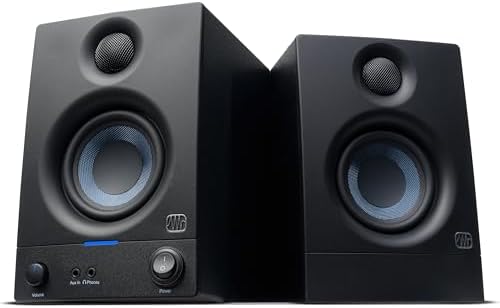
- Sold as a complete stereo pair
- 50 watts of built-in amplification
- 3.5” woofers and 1” silk-dome tweeters
- Built-in high- and low-frequency tuning controls

- 73 watt active studio monitor
- Bi-amped class A/B amplifiers
- Heavy-duty enclosure
- Front-firing port for flexible placement

- Latency-free wired connection
- Bi-amplified power
- 3.5-inch Kevlar woofers
- Natural silk dome tweeters
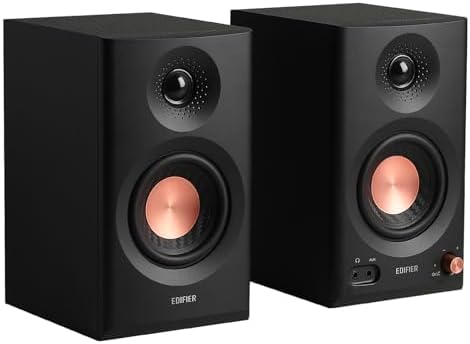
- Hi-Res Audio certified 52Hz to 40kHz response
- TRS, RCA, AUX, and Bluetooth inputs
- 18W*2 RMS output with 3.5" drivers
- Customizable sound modes via EDIFIER ConneX app

- Sold as a pair
- Tone knob for voicing adjustments
- Location switch for bass correction
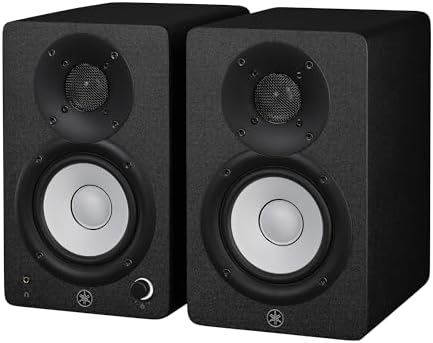
- Packaging: Pair
- 4.5" cone woofer and 1" dome tweeter
- 60 Hz – 22 kHz frequency response
- 26 W and above output power

- 500W peak power with bi-amped Class-D
- MDF wood cabinet construction
- XLR, TRS, RCA, and USB inputs
- ADAU1701 DSP and TPA3116 amplifier circuitry

- Textile dome tweeter
- Woven glass fiber composite woofer
- 3.5” glass aramid woofer
- Bluetooth input for wireless streaming

- RCA and Bluetooth 5.3 inputs
- Built-in 24-bit DAC
- 3.5 inch carbon fiber woofer and tweeter
- Flat frequency response curve

- Includes (2) Yamaha HS5 studio monitors
- 5 inch cone woofer and 1 inch tweeter
- 54 hertz to 30 kilohertz frequency response
- 70 watts bi-amp system
1. PreSonus Eris 3.5 Powered Studio Monitors
Best for: Creators needing a simple, all-in-one monitoring solution for small desks.
These monitors offer a straightforward approach to desktop audio. The inclusion of high and low-frequency tuning controls allows you to adjust the output to fit your specific room acoustics without needing extra gear. They provide a balanced sound profile that works well for music production, streaming, and general media consumption.
Connectivity is a major strength here. You get balanced TRS, RCA, and a front-panel aux input, which means you can switch between your computer, phone, and other gear without constantly unplugging cables. Comparing these to the M-AUDIO BX3, the Eris 3.5 offers similar 3.5-inch woofer sizing but includes more integrated acoustic tuning controls for your space.
Anyone who requires high-volume output for large rooms might find the 50-watt amplification limit restrictive compared to larger monitors like the Rockville APM8D.
Pros
- Built-in high/low acoustic tuning controls
- Balanced TRS and RCA inputs
- Front-panel aux and headphone jack
- Compact stereo pair design
Cons
- 50 watts of amplification limits maximum output in large spaces
2. KRK Classic 7 Powered Two-Way Professional Studio Monitor
Best for: Producers who need high headroom and flexible placement near walls.
The KRK Classic 7 stands out for its 73-watt bi-amped design, which provides extra headroom for clear audio at higher volumes. The front-firing port is a thoughtful inclusion, as it allows you to place these monitors closer to walls without the bass buildup often associated with rear-ported designs.
This monitor is built for durability with a heavy-duty enclosure. It includes dedicated high and low-frequency level adjustments, letting you match the response to your room. When you compare the 7-inch woofer here to the 3.5-inch woofer on the PreSonus Eris 3.5, the Classic 7 provides significantly more low-end presence for bass-heavy projects.
Pros
- 73-watt bi-amped power
- Front-firing bass port for placement flexibility
- High and low-frequency level adjustments
- Durable heavy-duty enclosure
Cons
- Large 7-inch driver size requires significant desk space
3. M-AUDIO BX3 3.5″ Wired Studio Monitors Pair
Best for: Live streamers and podcasters who require a zero-latency wired connection.
These monitors are engineered to provide a pure, uninterrupted signal path. The use of Kevlar woofers is a highlight, as this material is known for its ability to handle punchy, fast-transient bass response, which is useful for beat-making. The MDF cabinet is designed to be acoustically inert, which helps reduce unwanted vibrations during playback.
You get a variety of rear inputs, including 1/4-inch and RCA, which makes them highly compatible with standard studio equipment. The front-panel aux input is convenient for quick headphone access. Compared to the Edifier MR3, this model focuses entirely on a wired connection rather than wireless or app-based features.
This monitor isn’t meant for those who want wireless freedom, as it lacks the Bluetooth capabilities found on the Edifier MR3 or Ortizan C7.
Pros
- Zero-latency wired monitoring
- 3.5-inch Kevlar woofers
- Acoustically-inert MDF cabinet
- Front-panel headphone access
Cons
- The box lists 1/4-inch, 1/8-inch, and RCA inputs and not XLR, so that is a second purchase.
4. Edifier MR3 Powered Studio Monitor
Best for: Users who want high-resolution audio and wireless convenience.
The Edifier MR3 is certified for Hi-Res audio, covering a wide frequency range from 52Hz to 40kHz. This makes them a strong choice for precise monitoring or high-quality listening. The inclusion of multi-point Bluetooth is a major advantage for those who switch between multiple devices.
The companion app allows you to switch between music and monitor modes, which is a rare feature at this level.
Anyone who strictly prefers analog-only setups may find the app-based EQ requirements unnecessary for their workflow.
Pros
- Hi-Res Audio certified
- Multi-point Bluetooth connectivity
- Dedicated app for EQ control
- Balanced TRS and RCA inputs
Cons
- A flat response across 52Hz to 40kHz, so deeper bass needs a separate subwoofer.
5. Mackie CR3.5 Studio Monitors (Pair)
Best for: Beginners who want to adjust their sound without navigating software menus.
The Mackie CR3.5 is designed for simplicity. The physical tone knob on the front allows you to change the voicing of the speakers instantly, which is ideal if you want to quickly switch between a flat monitor sound and a more colored listening profile. The included location switch helps correct bass response based on whether the monitors are against a wall or in open space.
The package is complete, including isolation pads and cables to get you started immediately. Comparing the tone knob feature to the app-based control of the Edifier MR3, this physical approach is much faster for on-the-fly mixing.
Pros
- Dedicated front-panel tone knob
- Location switch for bass correction
- Includes isolation pads and all cables
- Compact, desk-friendly footprint
Cons
- Sized for desks and small studios, which anyone with a larger room has to plan around.
6. Yamaha HS4 Powered Studio Monitor in Black
Best for: Professionals who prioritize an accurate, uncolored reference sound.
The Yamaha HS4 is built for those who need to hear exactly what is in their mix without any flattering or enhancement. The 4.5-inch woofer offers a balanced frequency response from 60Hz to 22kHz. The room control and high trim switches on the back give you the tools to flatten the response in your specific environment.
The combo inputs, which accept XLR and TRS cables, offer professional-level connectivity. When compared to the Rockville APM8D, the HS4 is much more focused on transparency than raw power, providing a more clinical, accurate sound for editing.
Pros
- Professional-grade reference accuracy
- Room control and high trim switches
- Versatile XLR/TRS combo inputs
- Compact 4.5-inch woofer design
Cons
- 26-watt output is lower than the 250W-per-pair Rockville APM8D
7. Rockville APM8D 8″ 500W Active Powered Studio Monitor Speakers (Pair)
Best for: Producers who need maximum power and a built-in USB interface.
The Rockville APM8D is a powerhouse, delivering 500 watts of peak power. The use of an 8-inch polypropylene woofer allows for significant low-end extension, reaching down to 30Hz. The built-in USB audio interface is a standout feature, as it allows you to plug the monitor directly into your computer for stereo playback without needing a separate sound card.
The MDF wood construction feels substantial and helps minimize cabinet resonance. Comparing the 8-inch driver here to the 4.5-inch driver on the Yamaha HS4, the Rockville is significantly larger and better suited for tracking and mixing bass-heavy music.
Pros
- 500W peak power output
- Built-in USB audio interface
- 8-inch woofers for deep bass
- MDF construction minimizes vibration
Cons
- Large-format speakers are difficult to fit on small desks.
8. KRK Kreate 3 Powered Studio Monitors Pair
Best for: Users who want detailed midrange and wireless input options.
The KRK Kreate 3 uses woven glass fiber woofers, which are lightweight and responsive, helping to keep the midrange clear and the bass tight. The textile dome tweeter is designed to provide smooth high-frequency reproduction without harshness. The addition of Bluetooth input makes this a versatile option for casual listening alongside studio work.
The monitors support multiple inputs, making them easy to integrate into different setups. When you compare the glass fiber woofer material to the Kevlar used in the M-AUDIO BX3, the Kreate 3 offers a distinct sonic signature that emphasizes midrange clarity.
9. Ortizan C7 Powered Studio Monitors Pair with Bluetooth 5.3
Best for: Creators who need a high-fidelity DAC for digital audio production.
The Ortizan C7 features a built-in 24-bit DAC, which is a major benefit for those who want to minimize signal loss when connecting to a computer via USB. The compact carbon fiber speaker and 0.75-inch silk dome tweeter provide a clean, layered sound. The balanced TRS input is excellent for connecting professional mixing consoles or electric instruments.
The tuning is designed to be flat, which is exactly what you want for accurate monitoring. Compared to the Mackie CR3.5, the C7 provides a more advanced digital-to-analog conversion process for digital sources.
This monitor isn’t meant for users who only need analog connectivity, as the advanced DAC features are the primary focus of this specific design.
Pros
- Built-in 24-bit USB DAC
- Balanced TRS input for pro gear
- Carbon fiber woofer construction
- Bluetooth 5.3 connectivity
Cons
- Advanced digital features may be overkill for analog-only users
10. YAMAHA HS5 Powered Studio Monitor
Best for: Nearfield monitoring where sonic purity is the top requirement.
The Yamaha HS5 is a classic choice for nearfield monitoring. The 5-inch cone woofer and 1-inch dome tweeter are bi-amplified with 70 watts of total power, providing a balanced, clear sound that doesn’t color the original audio signal. The frequency response is quite wide, reaching up to 30kHz.
The build quality is professional, with XLR and TRS inputs that accommodate both balanced and unbalanced signals. Comparing the 5-inch woofer of this model to the ultra-compact woofer of the PreSonus Eris series, the HS5 delivers a more substantial and accurate low-end for professional mixing tasks.
Anyone who has a very small, restricted desk space will find the HS5 monitors to be larger and more demanding of space than the most compact options available.
Pros
- Professional nearfield accuracy
- 70W bi-amplified system
- Wide frequency response up to 30kHz
- XLR and TRS balanced inputs
Cons
- 54 hertz to 30 kilohertz frequency response, so deeper bass requires a separate subwoofer.
Also Worth Considering
The PreSonus E4.5 is a 4.5-inch nearfield monitor that sits between the Eris 3.5 and larger professional models. It offers more low-end presence than the Eris 3.5 but is smaller than the Yamaha HS5, making it a good choice for those who need a balance of power and desk space.
The Mackie CR5BT includes a 5.25-inch woofer and Bluetooth connectivity. It’s beat by the Yamaha HS5 in terms of reference accuracy, but it’s a strong option for users who want a larger driver for more bass without sacrificing the convenience of wireless streaming.
The M-AUDIO BX5BT features a 5-inch desktop design. It’s compared to the Yamaha HS5 for its similar driver size, but it offers different input flexibility for those who prefer the M-AUDIO ecosystem for their studio setup.
How We Chose
To qualify, a monitor had to state its frequency response and power rating clearly. Models that lacked balanced inputs or professional-grade acoustic tuning controls were deprioritized in favor of those that provide more control over the listening environment. Differences in woofer material, such as Kevlar or carbon fiber, were evaluated for their impact on transient response and clarity. Finally, products were selected based on their specific utility for different types of users, ranging from casual content creators to professional home studio engineers.
How to Choose the Right Studio Monitor
Size and where it has to fit
Your desk size is the biggest factor. Monitors like the PreSonus Eris series take up very little space, while the Rockville APM8D requires a large, sturdy surface. Always measure your available desk area before choosing, as larger drivers like the 8-inch woofer on the APM8D will overwhelm small workstations.
What comes in the box
Check if the listing includes cables and isolation pads. The Mackie CR3.5 comes as a complete package, which saves you from buying extra parts. Other monitors, like the Yamaha HS4, provide specific cables, while some pro-level models expect you to supply your own high-quality XLR or TRS balanced cables.
Connectivity and inputs
Think about what you’re connecting. If you use a computer, a built-in USB interface like the one on the Ortizan C7 can simplify your signal chain. For studio gear, look for balanced TRS or XLR inputs, which are standard on the Yamaha HS5 to reduce interference and noise in your audio signal International Electrotechnical Commission.
Related guides
- How to Turn Up Volume on Beats Studio Wireless Headphones
- Can I Use Computer Speakers As Studio Monitors
- How to Connect Bluetooth Headphones to FL Studio
Frequently Asked Questions
Are these monitors safe to use with electric guitars?
Yes, many of these monitors, such as the Ortizan C7 and Yamaha HS5, feature TRS inputs that can connect to professional equipment like mixers or electric pianos. Always ensure you’re using the correct cables to avoid signal distortion, and keep the volume low when first connecting your instruments to prevent sudden spikes.
Do I need an external audio interface?
While you can connect directly to your computer using the aux or RCA inputs on models like the PreSonus Eris 3.5, an audio interface is recommended for professional work. The Rockville APM8D actually includes a built-in USB interface, which allows you to bypass the need for an external sound card entirely for stereo playback.
Can I place these monitors directly against a wall?
Placement depends on the port design. Models like the KRK Classic 7 feature a front-firing port, which is specifically designed to allow for placement near walls without causing bass interference. Rear-ported monitors generally require a few inches of space from the wall to prevent the bass from becoming muddy or boomy.
Is Bluetooth connectivity as good as a wired connection?

Wired connections, like the zero-latency setup on the M-AUDIO BX3, are preferred for professional music production because they provide a pure, uninterrupted signal. Bluetooth, featured on the Edifier MR3 and KRK Kreate 3, is excellent for convenience and casual streaming but may introduce minor latency that can affect real-time mixing or gaming.
How do I tune the monitors to my room?
Many monitors, such as the PreSonus Eris 3.5 and Yamaha HS4, include rear-mounted room control or high/low-frequency switches. These allow you to adjust the output to compensate for room reflections. Start with the “flat” setting and make small, incremental adjustments to the bass or treble until the sound feels balanced at your listening position.
Conclusion
The PreSonus Eris 3.5 is the most versatile choice for most people, offering a reliable, balanced sound in a compact footprint. If you need more power and professional-grade accuracy, the Yamaha HS5 is a simpler, more robust alternative that focuses on pure, uncolored audio for your home studio. Choose the one that fits your desk and start creating today.
As an Amazon Associate, Instrument Insight earns from qualifying purchases at no additional cost to you.