
The Kennedy Violins Bunnel Pupil earns the top spot as the best violins choice for most players because it arrives with a professional-grade setup performed in the USA. Whether you’re searching for your first instrument or looking to upgrade, the core difference between these models is the level of attention paid to the initial assembly and the quality of the included accessories.
- Best Overall: Kennedy Violins Bunnel Pupil — Features a professional USA-based setup and a lifetime warranty.
- Most Premium Materials: Cecilio 4/4 Violin — Uses flamed maple back and sides for enhanced resonance.
- Best for Beginners: Eastar 3/4 Violin — Includes an inlaid finger guide to help students find notes.
- Best Starter Kit: Kmise 4/4 Violin — Provides the most comprehensive set of learning charts and accessories.

- Slight cosmetic defect
- Includes bow, rosin, strings, and case
- Assembled and checked in the USA
- Handcrafted maple and spruce with ebony fittings

- Solid spruce top and flamed maple back
- Includes hard case, 2 Brazilwood bows, and rosin
- Premium strings with satin antique finish
- Adjustable shoulder rest with padded base

- Inlaid Muscovite finger guide
- Spruce panel with maple back and sides
- Handmade with embedded black line
- Wood tuning knobs with four fine tuners
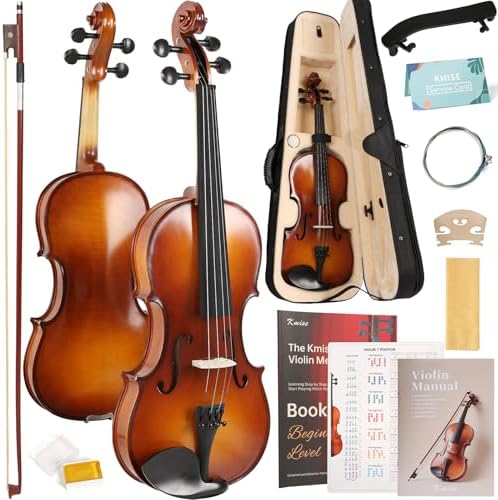
- 4/4 full size acoustic violin
- Smooth ebony fingerboard
- Ebony pegs and 4 fine tuners
- Suitable for teens and adults
1. Bunnel Pupil Violin Outfit 4/4 Full Size Clearance By Kennedy
Best for: Players who want a professional setup straight from the box.
This violin stands out because it’s hand-assembled and checked in the USA.
The Bunnel Pupil features solid maple and spruce tonewoods.
Anyone who needs a smaller fractional size should look elsewhere, as this specific model is built as a full-size instrument.
Pros
- Handcrafted with solid maple and spruce.
- Includes high-quality Giuliani Brazilwood bow.
- USA-based final assembly and inspection.
- Lifetime warranty coverage included.
Cons
- This instrument is too large for younger students needing fractional sizes.
- Marked as a clearance item due to slight cosmetic defects.
2. Cecilio Full Size 4/4 Violin with Hard Case & Shoulder
Best for: Players who prioritize aesthetic beauty and resonant wood grain.
The Cecilio 4/4 Violin features a spruce top with flamed maple back and sides. Its satin antique finish mimics a mature instrument.
The outfit includes two Brazilwood bows, which gives you a spare if one hair starts to fray during practice.
Pros
- Features flamed maple back and sides.
- Includes two Brazilwood bows with Mongolian hair.
- Inlaid purfling for improved structural resonance.
- Adjustable shoulder rest included for ergonomic comfort.
Cons
- This model is only available in a full-size build, limiting it to adult or teen players.
3. Eastar 3/4 Violin
Best for: Students who need visual help to learn finger placement.
The most helpful feature of the Eastar 3/4 Violin is the inlaid Muscovite fingerboard points. These act as a visual map for students, allowing them to quickly find the correct handle position without guessing. This removes a major barrier to progress and helps build muscle memory faster.
The kit includes two bridges and an extra set of strings. Compared to the Kennedy Violins Bunnel Pupil, which uses ebony for its fittings, this model uses date wood for the chin rest and tailpiece, which is a different material choice that you should consider if you have specific wood preferences.
Pros
- Inlaid finger guides assist with note placement.
- Includes two violin bridges for backup.
- Smooth antique varnish finish.
- Four integrated fine-tuning pegs.
Cons
- Fingerboard inlay is permanent, which may be distracting for experienced players.
- Uses date wood fittings rather than the more common ebony.
4. Kmise Violin 4/4 Full Size Starter Kit
Best for: Beginners who want a complete guide to learning the instrument.
The Kmise 4/4 Violin focuses on providing the most educational value in its accessory kit. Including a fingering chart and guide makes starting much easier.
The tuning system uses four fine tuners, which are essential for beginners who are still learning how to turn the larger pegs with precision.
Pros
- Includes a helpful fingering chart for students.
- Features an ebony fingerboard for longevity.
- Four fine tuners simplify the tuning process.
- Solid spruce top for balanced sound.
Cons
- Designed primarily for beginners, which limits its appeal to advanced performers.
- Listing indicates it’s a 4/4 size only, ruling out younger children.
How to Choose the Right Violin
Size and how it must fit
The most critical factor in choosing a violin is the size. A 4/4 full-size instrument is intended for adults and older teens. Younger students must use fractional sizes to prevent strain.
What comes in the box
A complete outfit should include everything needed to start playing. Look for a case, a bow, rosin, and a shoulder rest.
The importance of the setup
Proper setup is what separates a playable instrument from a frustrating one. USA-based setup, like the Kennedy Violins Bunnel Pupil, ensures the bridge is positioned correctly. Maintaining the proper humidity levels for wooden instruments is also essential to prevent warping, according to the National Music Museum guidelines for stringed instrument care.
Frequently Asked Questions
What are the benefits of an ebony fingerboard?
The ebony fingerboard provides a smooth surface for playing. The Kmise 4/4 and Kennedy Bunnel Pupil use ebony for durability.
Do I need to buy a separate bow?
Most of these kits, such as the Cecilio 4/4 Violin, include a bow in the box. Included bows are sufficient for beginners.
How often should I apply rosin to the bow?
You should apply rosin to the bow hair every time you play. Without rosin, the hair won’t grip the strings to produce sound.
Can I tune the violin myself?
You can tune the violin yourself using the fine tuners for small, precise adjustments. If strings are significantly out of tune, you may need to use the larger pegs instead.
What is the purpose of the inlaid purfling?
Inlaid purfling is a decorative strip of wood placed near the edge of the violin’s top and back plates.
Why do some violins include extra bridges?
A bridge is a delicate piece of maple that holds the strings at the correct height above the fingerboard. Because it’s held in place only by the tension of the strings, it can be knocked out of alignment or even snap during tuning.
Are carbon fiber shoulder rests better than foam?
Carbon fiber shoulder rests are generally more rigid and adjustable than basic contour foam rests. They allow the player to change the height and angle of the rest to better fit their body, which promotes better posture.
How do I know if the violin is the right size for me?
Measure the distance from the base of your neck to the center of your left palm to determine your size. This measurement indicates the correct fractional violin size for your reach. If you cannot comfortably reach the scroll, you must choose a smaller instrument.
What is the benefit of a satin oil finish?
A satin oil finish is designed to let the wood breathe more freely than a thick, high-gloss lacquer. Many players prefer this finish because it often results in a more natural, resonant sound and a pleasant tactile feel.
Why do some violins have fine tuners on all four strings?
Fine tuners allow for very small adjustments to the pitch, which is much easier than turning the large, main tuning pegs. Beginners often find that the main pegs are difficult to control, as they can slip or jump too far when turned.
How does the wood type affect the violin’s sound?
Spruce is the standard material for the top of a violin because it’s lightweight and provides excellent vibration, which creates a bright, clear sound. Maple, used for the back and sides, is denser and helps project that sound.
Can I change the strings on my violin?
Yes, you can change your violin strings when they become dull or worn. Most players replace their strings once or twice a year depending on practice frequency. Keeping a spare set on hand ensures you have a replacement ready if a string breaks during a lesson.
What should I look for in a violin case?
A good case must protect the instrument from temperature changes and physical impact. A lightweight hard case with a plush interior, like the one included with the Cecilio 4/4 Violin, is ideal because it holds the violin securely in place. Look for cases that include backpack straps and accessory compartments, as these features make it much easier to carry your violin and rosin to lessons or school.
How do I maintain the fingerboard?
Wipe the fingerboard and strings with a soft, dry cloth after every practice session to remove rosin dust. Avoid using harsh chemicals or wood polishes, as these can leave a residue that affects string feel.
What is the function of the tailpiece?
The tailpiece anchors the strings at the bottom of the instrument and must withstand significant tension. It is typically crafted from durable woods like ebony or date wood. A high-quality, stable tailpiece is essential for maintaining consistent string tension while you play.
Why is the nut height important?
The nut is the small piece at the top of the fingerboard that guides the strings. If its height is incorrect, you may experience finger pain or buzzing during play.
Should I use a shoulder rest?
A shoulder rest is recommended to keep the violin stable and reduce neck and shoulder tension. Models like the Cecilio and Kmise include adjustable rests to fit your specific height. Using a rest is essential for maintaining good form during long practice sessions.
How do I know if the bridge is positioned correctly?
The bridge must be centered between the f-holes and stand perpendicular to the top plate. If it leans, it may warp or collapse under string tension.
What is the role of the chin rest?
The chin rest provides a comfortable, ergonomic place for your jaw while you hold the violin. If you find your rest uncomfortable, you can replace it with a shape that better suits your needs.
How does the varnish affect the sound?
Varnish protects the wood from humidity while allowing it to vibrate for better sound. A thin, high-quality finish like the one on the Kennedy Bunnel Pupil promotes resonance. Avoid thick finishes, as they can dampen the instrument’s natural tone and projection.
Can I play this violin in an orchestra?
Yes, a well-set-up violin like the Kennedy Violins Bunnel Pupil is suitable for student orchestras and school performances. As you progress, you may choose to upgrade to more specialized strings or a different bow, but the core instrument is designed to support your musical growth through many years of practice.
Why is the bow weight important?
A properly weighted bow is essential for producing a clear tone without causing wrist fatigue. Brazilwood bows, included with the Cecilio 4/4, are popular for their balance and consistent weight. This makes them a reliable choice for beginners learning to manage bow pressure.
What is the advantage of a solid spruce top?
A solid spruce top is preferred over laminate or plywood because it vibrates more effectively, leading to a richer and more balanced sound. Spruce is the industry standard for violin tops due to its strength-to-weight ratio.
How do I keep the bow hair in good condition?
Loosen the bow hair after every practice session to prevent the stick from warping. Avoid touching the hair with your fingers, as skin oils prevent rosin from gripping the strings. If the hair becomes damaged or stretched, it should be replaced by a professional.
What is the difference between a student violin and a professional one?
Student violins feature durable, standardized setups designed to help beginners learn without frustration. Professional instruments are handcrafted from aged tonewoods to provide a wider range of tonal colors.
Can I use a humidifier for my violin?
Using a humidifier in your violin case is a great way to protect the wood from cracking in dry environments. Wooden instruments are sensitive to changes in humidity, and keeping the environment stable is key to longevity. Many students find that a simple case humidifier helps keep their instrument in tune and prevents the wood from shrinking during the winter months. This is a small investment that can significantly extend the life of your instrument.
Why are there fine tuners on the tailpiece?
Fine tuners are small metal screws that tighten or loosen the string by a very small amount. They’re particularly useful when you’re getting close to the correct pitch and need to make minor adjustments. The Eastar 3/4 Violin and the Kmise 4/4 Violin incorporate these into the tailpiece, which is a standard feature for student models. It makes the tuning process much faster and more accurate for those who are still developing their ear for pitch.
Does the wood grain affect the quality?
The wood grain is often an indicator of how the tree grew and how it will vibrate. A tight, even grain on the spruce top is often considered ideal for sound production. While the grain is important, the overall construction and setup are the most vital factors for a beginner.
How do I know when the strings need replacing?
Strings need replacing when they no longer hold their pitch, sound dull or “dead,” or show signs of fraying or rust. If you find that you’re constantly tuning the violin, the strings may be reaching the end of their life. Having an extra set on hand, like the ones included with the Eastar 3/4 Violin, allows you to change them immediately so your practice isn’t interrupted.
Is the case included with these violins waterproof?
Most student violin cases are water-resistant, meaning they can protect the instrument from a light rain or damp conditions. However, they aren’t fully waterproof and shouldn’t be submerged or exposed to heavy downpours. The cases included with the Kennedy Violins Bunnel Pupil and the Cecilio 4/4 Violin are designed for safe transport to and from lessons, providing a layer of protection that’s sufficient for daily use in most environments.
What makes a bow “high quality”?
A high-quality bow is one that’s straight, well-balanced, and has hair that holds rosin evenly. It should feel like a natural extension of your arm. The Giuliani Brazilwood bow included with the Kennedy Violins Bunnel Pupil is often cited by teachers as a solid choice for students because it offers the right balance of weight and flexibility, allowing for a wide range of bowing techniques as you learn.
Why is the fingerboard inlay on the Eastar 3/4 Violin helpful?
The inlaid points on the Eastar 3/4 Violin act as a visual guide for where to place your fingers to play specific notes. This is helpful for beginners who haven’t yet developed the muscle memory to know exactly where each note is on the fingerboard. It provides immediate feedback, which can speed up the learning process and give you more confidence when you’re just starting to play scales and simple melodies.
How do I clean my violin?
You should clean your violin by gently wiping the body and fingerboard with a soft, clean cloth after every use. This removes rosin dust and sweat, which can damage the finish over time. Don’t use furniture polish or other cleaners, as these can leave a residue that’s difficult to remove and may affect the sound of the instrument. Keeping the violin in its case when not in use is also the best way to keep it clean and protected from dust.
What should I do if my pegs keep slipping?
If your pegs are slipping and the violin won’t stay in tune, it’s often because the wood has dried out or the peg isn’t seated correctly in the pegbox. You can try pushing the peg in more firmly while turning it, but be careful not to apply too much force. If the problem persists, a professional repair shop can apply a small amount of peg compound to help the peg grip the wood properly.
Why is the nut made of ebony?
On many high-quality violins, the nut is made of ebony because it’s a very hard wood that can withstand the constant pressure of the strings over many years. This prevents the strings from wearing deep grooves into the nut, which could eventually cause them to sit too low and buzz against the fingerboard.
Can I use the same rosin for all types of strings?
Yes, most general-purpose violin rosin works well for the standard strings found on beginner and student violins. The rosin cake included with the Kmise 4/4 Violin and the Cecilio 4/4 Violin is designed to provide the right amount of friction for the strings included in those kits. As you progress and start using more specialized strings, you might experiment with different types of rosin to see how they affect your tone and bowing response.
Why does the Kennedy Violins Bunnel Pupil come with a lifetime guarantee?
The lifetime guarantee on the Kennedy Violins Bunnel Pupil reflects the manufacturer’s confidence in the quality of the materials and the care taken during the USA-based setup process. It covers the structural integrity of the instrument, giving students and parents peace of mind that their investment is protected. This is a rare feature for a student-level violin and demonstrates a commitment to long-term customer satisfaction and instrument support.
How do I transport my violin safely?
Always transport your violin in its hard case, ensuring that all latches are securely fastened. Avoid leaving the case in a hot car or in direct sunlight, as extreme heat can cause the glue to weaken or the wood to warp. When carrying the case, use the handle or the provided backpack straps to ensure it stays level.
Why is the bridge height critical?
The height of the bridge determines the action, or the distance between the strings and the fingerboard. If the bridge is too high, it requires excessive pressure to press the strings down, which is exhausting for the player. If the bridge is too low, the strings may hit the fingerboard and create a buzzing sound. Because the Kennedy Violins Bunnel Pupil is set up in the USA, the bridge height is already adjusted to the ideal level, making it much easier to learn proper technique.
What is the advantage of a lightweight hard case?
A lightweight hard case provides the necessary structural protection to keep the violin safe while remaining easy for students to carry to school or lessons. The case included with the Cecilio 4/4 Violin features backpack straps, which are particularly helpful for younger students who need to keep their hands free. A well-designed case also has interior compartments for accessories like rosin, a shoulder rest, and a tuner, keeping everything organized and easy to find.
Why is the fingerboard made of ebony?
Ebony is a very dense, dark hardwood that’s naturally resistant to the wear caused by the friction of strings being pressed down repeatedly. It remains smooth for many years, allowing the player’s fingers to slide easily along the fingerboard. The Kmise 4/4 Violin and the Kennedy Violins Bunnel Pupil use ebony, which is a major benefit for students who intend to play the violin daily for several years, as it ensures the fingerboard won’t need premature repair or replacement.
How do I adjust the shoulder rest?
Most shoulder rests, such as those included with the Cecilio 4/4 Violin and the Kmise 4/4 Violin, have adjustable feet that can be moved to fit the width of your violin. They also have height adjustments that allow you to change the angle at which the violin sits on your shoulder. You should experiment with these settings until you find a position that feels natural and allows you to hold the violin without using your chin to grip it too tightly.
What is the benefit of a “full size” 4/4 violin?
A 4/4 full-size violin is the standard size for adults and teens. It provides the full range and resonance that the instrument is designed for, which is why it’s the goal for students to eventually move to this size.
How does the bow hair affect the sound?
The bow hair is usually made of horsehair, which has tiny barbs that grip the string and pull it to create vibration. When you apply rosin, you’re filling the gaps between these barbs to increase the friction. If the hair is old or dirty, it won’t grip the string effectively, resulting in a thin or scratchy sound. Keeping your bow hair clean and properly rosined is essential for producing a clear, full tone, which is why the kits like the one from Eastar include a fresh cake of rosin.
Why is the neck made of maple?
Maple is a strong, stable wood that’s resistant to warping, which is essential for the neck of a violin. The neck must support the constant tension of the strings while remaining straight so that the fingerboard stays in the correct alignment.
What is the purpose of the four integrated fine tuners?
The four fine tuners are small screws on the tailpiece that allow for very precise adjustments to the pitch of each string. They’re invaluable for beginners who are still learning to turn the larger pegs, as they make it much easier to fine-tune the instrument without fear of the peg slipping. The Eastar 3/4 Violin and the Kmise 4/4 Violin include this feature, which is why they’re so highly recommended for students who want a stress-free tuning experience.
Why does the Kennedy Violins Bunnel Pupil have a clearance status?
The Bunnel Pupil is sometimes marked as a clearance item due to minor cosmetic defects, such as a slight blemish in the finish or a small scratch in the wood. These defects are purely aesthetic and don’t affect the sound or playability of the instrument in any way. This allows the manufacturer to offer the violin at a different stage in their inventory while still providing the same high-quality USA setup and lifetime guarantee that comes with all their instruments.
Is the fingerboard inlay on the Eastar 3/4 Violin durable?
Yes, the Muscovite fingerboard points are inlaid directly into the wood, meaning they’re a permanent part of the fingerboard and won’t wear off over time. They’re designed to withstand the friction of the strings and the pressure of your fingers during daily practice. For a student who needs a clear visual guide, this is a very reliable and long-lasting feature that will remain helpful throughout their entire time learning on this specific instrument.
What should I do if the bridge falls over?
If the bridge falls over, you should immediately loosen the strings to prevent the bridge or the violin from being damaged by the sudden change in tension. You’ll then need to carefully place the bridge back in its upright position, ensuring the feet are centered on the top of the instrument and the strings are seated in their notches. If you’re unsure how to do this, it’s best to take the violin to a local music shop for assistance, as an incorrectly positioned bridge can cause serious damage to the violin’s top.
Why is the tailpiece often made of ebony?
Ebony is a very durable wood that can withstand the high tension of the strings over many years without cracking or deforming. A high-quality tailpiece is essential for keeping the strings stable and ensuring that the instrument stays in tune.
Can I practice with a mute?
Yes, you can use a practice mute to significantly reduce the volume of your violin, which is a great way to practice in an apartment or late at night without disturbing others. While a mute isn’t included with these kits, they’re an inexpensive addition that fits easily over the bridge. It’s a very common tool for students who need to balance their practice needs with the environment in which they live.
Why is the spruce top important?
Spruce is the preferred material for the top of a violin because it’s lightweight and has excellent acoustic properties. It vibrates efficiently when the strings are played, which is the key to producing a clear, resonant sound. The Kmise 4/4 Violin and the Kennedy Violins Bunnel Pupil both feature solid spruce tops, which is why they’re known for their balanced and warm tone, making them ideal for students who want an instrument that sounds as good as it plays.
How do I know if my violin is in tune?
You can use a digital tuner or a smartphone app to check the pitch of each string. The violin strings are tuned to G, D, A, and E, from lowest to highest. As you play, you’ll learn to hear whether the strings are in tune with each other. Using a tuner is the most accurate way for a beginner to ensure their instrument is set to the correct pitch before they start their practice session.
What is the advantage of a Brazilwood bow?
Brazilwood is a traditional material for violin bows because it offers the right balance of flexibility and strength. It allows the player to perform a wide range of bowing techniques, from smooth, legato strokes to crisp, staccato articulations. The Cecilio 4/4 Violin and the Kennedy Violins Bunnel Pupil include Brazilwood bows, which are highly regarded by teachers for their performance and durability, making them an excellent choice for any student.
Why is the setup process so important?
The setup process involves adjusting the bridge, the nut, the pegs, and the soundpost to ensure the violin is playable and produces the best possible sound. If these components aren’t correctly positioned, the violin may be very difficult to play, leading to frustration and poor technique. The Kennedy Violins Bunnel Pupil is set up in the USA by professionals, which means you can be confident that your instrument is ready to play the moment you take it out of the box.
Can I play the violin if I have small hands?
Yes, you can absolutely play the violin if you have small hands, provided you choose the correct fractional size. The Eastar 3/4 Violin is a great option for students who aren’t yet ready for a full-size instrument. As you grow and your reach increases, you can transition to a 4/4 violin, like the ones from Kennedy Violins or Kmise, which will provide you with the full range and resonance of a standard-sized instrument.
Why is a shoulder rest recommended?
A shoulder rest is recommended because it helps keep the violin in a comfortable, stable position on your shoulder, which prevents you from having to use your chin to grip the instrument tightly. This allows you to relax your neck and shoulder muscles, which is essential for developing good playing technique and preventing discomfort during long practice sessions. The adjustable shoulder rests included with these kits are a simple but effective way to improve your overall experience.
What is the benefit of an antique finish?
An antique finish is designed to give the violin a mature, professional appearance, often with a slightly darker, warmer color. It isn’t just for looks, as the application of this finish is typically thin enough to allow the wood to vibrate freely. The Cecilio 4/4 Violin features a satin antique finish, which gives it a sophisticated look that many students enjoy, as it makes the instrument feel more like a professional performance violin.
Why are there two bridges included with the Eastar 3/4 Violin?
The inclusion of two bridges is a practical choice for a beginner kit, as the bridge is a delicate component that can easily break if the string tension is adjusted too quickly or if the instrument is bumped. Having a spare bridge means that a minor accident doesn’t have to end your practice session, as you can simply swap it out and continue playing. It’s a thoughtful addition that shows the manufacturer understands the needs of students.
How do I store my violin?
You should store your violin in its hard case in a cool, dry place away from direct sunlight, radiators, or air conditioning vents. Extreme changes in temperature and humidity can cause the wood to expand or contract, which can lead to cracks or warping. Keeping your violin in its case also protects it from dust and accidental damage, ensuring it remains in great condition for many years of practice.
What is the role of the f-holes?
The f-holes are the two openings on the top of the violin that allow the sound to project out of the body. They’re also essential for the overall resonance of the instrument, as they define how the top plate vibrates. The placement and shape of the f-holes are carefully calculated to ensure the best possible sound, which is why they’re a signature feature of the violin’s design and are present on all the models in this guide.
Why is the tailpiece important for tuning?
The tailpiece serves as the anchor for the strings and, when equipped with fine tuners, is the primary point of adjustment for the pitch. A sturdy tailpiece ensures that the strings are held at the correct tension, which is vital for keeping the instrument in tune. The Kennedy Violins Bunnel Pupil and the other models here feature reliable tailpieces that are designed to handle the daily demands of a student’s practice routine, ensuring consistent performance.
How does the shoulder rest improve posture?
A shoulder rest elevates the violin, allowing you to keep your head and neck in a more natural, relaxed position. Without a shoulder rest, many students find themselves hunching their shoulder up to hold the instrument, which can lead to muscle tension and discomfort. By using an adjustable shoulder rest, you can set the height and angle that works best for your body, which helps you maintain proper posture and focus on your playing technique.
Why is the fingerboard smooth?
The fingerboard must be perfectly smooth so that your fingers can slide easily from note to note without catching or snagging. This is essential for playing quick passages and for developing the fluid technique required for advanced pieces. The ebony fingerboards on the Kennedy Violins Bunnel Pupil and the Kmise 4/4 Violin are polished to a high level of smoothness, providing a tactile experience that makes it easier for students to develop their skills.
What is the purpose of the rosin?
Rosin is made from pine resin and is applied to the bow hair to increase the friction between the hair and the strings. Without rosin, the bow would slide over the strings without making a sound, or it would produce a very faint, airy tone. By applying rosin, you allow the bow hair to “grab” the string, which causes it to vibrate and produce a clear, full sound. Every violin kit here includes a cake of rosin, which is essential for your very first lesson.
Why is the neck of the violin shaped the way it is?
The neck is shaped to be comfortable to hold and to allow your hand to move easily up and down the fingerboard. It’s carved to fit the hand, which is crucial for developing good playing technique. The maple neck on the Eastar 3/4 Violin is crafted to provide a solid, comfortable feel, ensuring that students can focus on their finger placement and bowing without being distracted by the instrument’s design.
How do I know if my bow hair is too loose?
You can tell if your bow hair is too loose if it sags significantly when you hold the bow horizontally. You should tighten the adjustment screw at the end of the bow until there’s a small gap between the hair and the bow stick. Be careful not to over-tighten, as this can warp the stick and make it difficult to play. A properly tensioned bow will have the right balance of flexibility and grip, which is essential for producing a good sound.
Why is a hard case better than a soft bag?
A hard case provides a rigid, protective shell that shields the violin from physical impact, pressure, and temperature fluctuations. A soft bag, while lighter, offers almost no protection against drops or heavy objects, which could easily damage the delicate wooden body of the violin. For students who transport their violin to school or lessons, a hard case like those included with the Cecilio 4/4 Violin and the Kennedy Violins Bunnel Pupil is the safest and most practical choice.
What is the benefit of an adjustable shoulder rest?
An adjustable shoulder rest allows you to customize the height and angle of the rest to fit your body, which is essential for maintaining a comfortable and healthy playing posture. Since everyone’s neck and shoulder anatomy is different, being able to fine-tune the fit ensures that you can hold the violin securely without straining. The models in this guide include adjustable rests that are easy to set up, making them a great feature for beginners and students of all ages.
Why is the bridge notched?
The bridge is notched to keep the strings in their correct positions and to maintain the proper spacing between them. If the strings weren’t held in place by the notches, they would slide across the bridge and become difficult to play. The notches are carefully cut to ensure the strings are at the right height and are correctly aligned with the fingerboard, which is why it’s so important that the bridge is set up by a professional, as it’s with the Kennedy Violins Bunnel Pupil.
How do I clean the strings?
You should wipe your strings with a soft, clean cloth after every practice session to remove rosin dust and sweat. This helps maintain the life of the strings and ensures they continue to produce a clear, bright sound. Avoid using any cleaners or solvents, as these can damage the strings and the surrounding wood. Keeping the strings clean is a simple but important part of your daily maintenance routine that will help your violin sound its best for years to come.
Why is the tailpiece often made of wood?
A wooden tailpiece, such as one made of ebony or date wood, is preferred for its durability and its ability to withstand the tension of the strings without warping. It also contributes to the overall aesthetic of the violin, complementing the fingerboard and other fittings. The quality of the tailpiece is a good indicator of the overall construction of the instrument, which is why the models in this guide use high-quality wood for their fittings to ensure long-term performance.
Can I use my violin for classical music?
Yes, all the violins in this guide are designed to be versatile and are suitable for playing classical music, as well as other styles like folk or pop. The solid spruce tops and maple bodies provide the warm, resonant sound characteristic of the violin, making them perfect for students who are learning the classical repertoire. As you develop your skills, these instruments will continue to provide the quality and reliability you need to explore and enjoy a wide range of musical styles.
What does it mean if my violin sounds “wolfy”?
A wolf tone is a strange, warbling vibration that occurs when the natural resonance of the violin body matches the frequency of a note you’re playing. It’s most common on higher-quality instruments but can occasionally happen on any violin. If you notice a specific note sounds unstable or “chokes,” try adjusting the pressure of your bow or changing the angle at which you play that note.
Can I paint my violin to make it look unique?
You should never paint or apply any non-standard finish to your violin. The wood of a violin is meant to vibrate, and applying a thick layer of paint will dampen these vibrations and ruin the sound quality. The satin oil and antique finishes found on the models in this guide are specially formulated to protect the wood while allowing it to resonate freely; keeping the instrument in its original finish is essential for maintaining its sound.
Why do the strings feel sticky after I apply rosin?
If your strings feel sticky, you have likely applied too much rosin to your bow. When you play, excess dust from the bow hair transfers to the strings and the body of the violin. You should wipe your strings and the area of the violin under the bow with a soft cloth after every session. If the sticky buildup is significant, a professional can safely clean the instrument without damaging the varnish.
Should I loosen the bow hair every time I finish playing?
Yes, you must always loosen the tension on your bow hair after you’re done practicing. If you leave the bow under tension, the wood stick will eventually lose its natural curve and warp, which makes it much harder to play. A warped bow can’t be easily fixed and will often require a total replacement. Simply turn the tension screw until the hair is loose but not dangling, and store the bow in its case.
Does the humidity in my house affect the tuning?

Wooden instruments are very sensitive to changes in humidity, and your violin will likely go out of tune if the environment changes quickly. If your home is very dry, the wood may shrink, which can cause the pegs to slip. If it’s very humid, the wood may swell, making the pegs difficult to turn. Keeping your violin in a case with a small humidifier is the best way to stabilize the instrument and keep it in tune for longer periods.
What should I do if a string breaks?
If a string breaks, you should remove the remaining pieces from the peg and the tailpiece before installing a new one. It’s helpful to keep a spare set of strings, like the extra set included with the Eastar 3/4 Violin, so you can replace a broken string immediately. When installing a new string, make sure it’s seated properly in the nut and the bridge notch, and tune it slowly to reach the correct pitch to avoid snapping the new string as well.
Final Thoughts
Choosing an instrument is a personal journey, but you shouldn’t feel overwhelmed by the options. Once you’ve picked the model that feels right in your hands, take it to a local teacher for a quick check-up. They’ll help you get comfortable, and you’ll be ready to start playing your favorite songs soon.
As an Amazon Associate, Instrument Insight earns from qualifying purchases at no additional cost to you.